Qin Dynasty
Original
Chinese History
Dec 03 • 1797 read
Qin dynasty (221 - 207 BC) ruled only for fifteen years which was one of the shortest ruling periods in all of the dynasties in Chinese history. But unified China was formed for the first time.
/fit-in/0x0/img/201912/Qin_Dynasty-article-1575337931.jpg)
Emerging from the disorder of the Warring States period in 221 BCE, the Qin Dynasty defeated the other states and unified the country. The Qin dynasty ruled only for fifteen years which was one of the shortest ruling periods in all of the dynasties in Chinese history. But it was one of the most significant dynasties among all dynasties, because it united China for the first time in centuries, and unified China as a single state-in many ways, for the first time.
Foundations of the Unification
The forces that permitted the Qin to grow from a small state to a power that conquered other states in China had developed earlier the first Qin emperor was born. The state started as a fief in the west bestowed by King Ping, one of the first of the Eastern Zhou rulers, from the lands around the old Zhou capital in the west direction. As one of the influential states of the time, Qin fought with its competitor's states at the time of the Eastern Zhou period. But for centuries there were not single enough powerful states among all that could conquer the others. Qin was home to perhaps the strictest traditions of Legalism, however, which supported the importance of the state at the expense of the individual. Qin relied on Legalist doctrine, brutal techniques to consolidate and expand his power. Also, the Qin were known for being cruel and ignoring gentlemanly custom and proper battlefield protocol to win at all costs.
One of the most significant figures in building the Qin state into a force capable of dominating China was the Legalist statesman Shang Yang. Shang Yang was an administrator from the state of Wey who was appointed as an advisor. Shang Yang was a vigorous reformer, he systematically reworked on the social order of Qin society, and eventually established a complicated, massive bureaucratic state, launched several advancements, and supported for the unification of Chinese states. As a Legalist, Shang Yang believed that all people should be loyal foremost to the state, and passed laws to force subjects of the kingdom to act in ways that facilitated the state: he forced people to marry early, to give birth too many children, and produce an enormous surplus of food. He depressed commerce in favor of agriculture. Most importantly, the nobility was stripped of control and authority so that the independent and disloyal nobility that had plagued the Zhou would not pose a problem.
Shang Yang’s improvements was a successful system to increase the army beyond the nobility, giving land as a reward to peasants who enlisted. This helped to create a force of infantry that was less expensive to maintain as compared to the traditional chariot forces. After the death of Duke Xiao’s, Shang Yang was charged with disloyalty to the state. He opposed the crime and attempted to fight back and tried to establish his territory but was executed in 338 BC with five chariots pulling him apart for viewers in a market. But Shang Yang’s ideas had already shaped the foundation for the Qin Empire. His improvements were kept in place, and they meant that the Qin state was the most efficient and centralized among all of the previous Chinese states.
After Ying Zheng rose to power in 246 BC, the state of Qin was the most influential and powerful in China and had already started to expand into regions surrounding it and defeat the neighbor’s states. In 316 BC, the states of Ba and Shu went to war, both requested for Qin’s help. Qin replied by conquering each of them and, over the next forty-years, relocating thousands of families there, and continuing their expansionist efforts into other areas. Ying Zheng, the son of King Zhuangxiang of Qin, is believed to be the first emperor of China. He was supported by his cunning advisor, Li Si, the remaining states of China would be quickly absorbed and integrated into the expanding Qin Empire. After his father died in 247 BC, Ying Zheng took the throne at the age of 13.
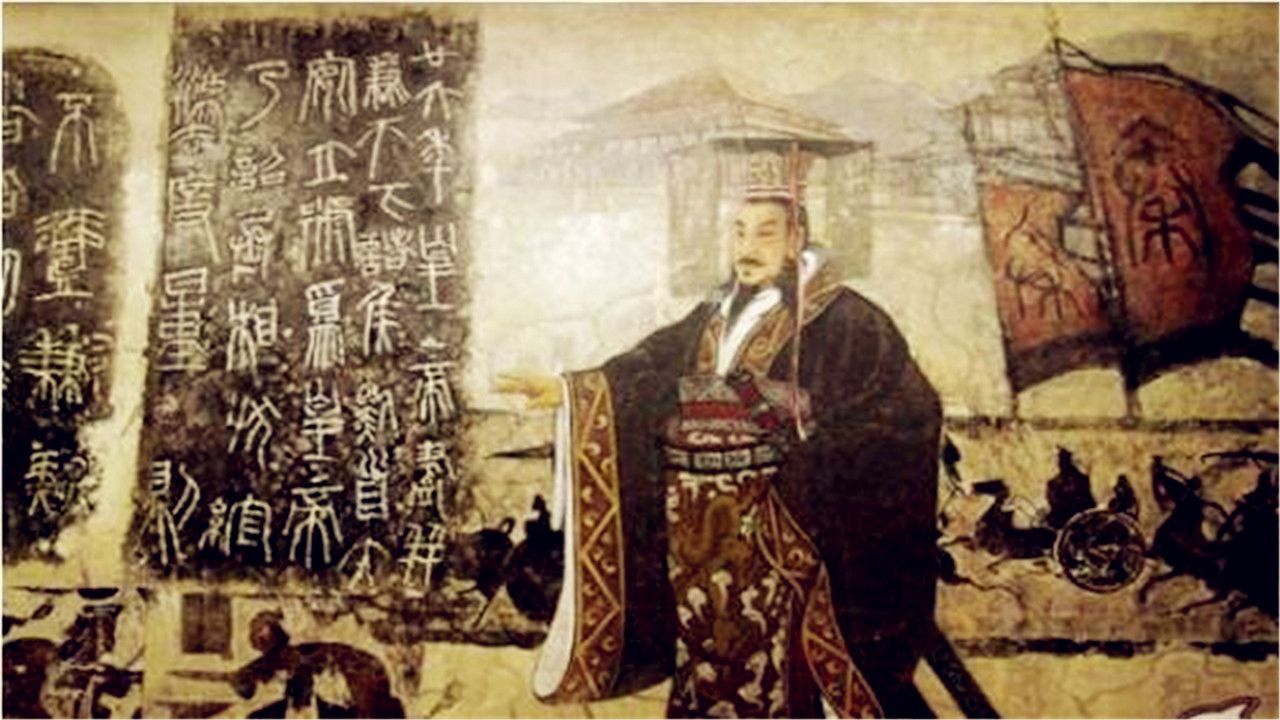
The First Emperor of China
Ying Zheng had finished his conquest of China by 221 BC. With the whole country under his rule and the Zhou kings gone, he claimed the ‘Mandate of Heaven and’ governed all over China. Instead of choosing the traditional title of king (Wang), however, Ying Zheng named himself as ‘Shi Huangdi’ which is usually translated as ‘First Emperor of Qin,’ and a far grander title than King. Huangdi was previously a title kept for the ancient, semi-divine rulers of China from the legendary past, and the title had meanings of divinity, literally meaning ‘Holy Emperor.’ and he is hereafter known by his new name-Qin Shi Huang or First Qin Emperor.
With the stable Legalist roots of the Qin Dynasty, Qin Shi Huang presented himself as the unopposed leader of China and governed as a totalitarian autocrat. All schools of philosophy except Legalism were suppressed. Directed by the sorcerer Lu Sheng, Qin Shi Huang traveled in secrecy through a system of tunnels and lived in secret location to facilitate communing with immortals. People were discouraged from using the emperor’s personal name in documents, and anyone who revealed his place would face execution.
Qin Shi Huang’s adviser, Li Si, suggested the ruler burn all the books that did not help in maintaining Qin power. Philosophical and historical texts were destroyed, especially Confucian texts, as well as historical works that covered any history that was not helpful for the state of Qin. Later, Qin Shi Huang ordered intellectuals of non-Legalist philosophical schools to be buried alive, supposedly in revenge for being deceived by a pair of alchemists, but perhaps also to unite China under Legalist thought. Qin Shi Huang’s after burning of books and philosophical literature marks the end of the Hundred Schools of Thought. The philosophy of Mohism was utterly wiped out.
Qin Shi Huang introduced several impressive building projects. After indecisive warfare with the pastoralist nomad tribes that lived to the north of China, Qin Shi Huang had a large defensive wall built in the north. This wall helped as the foundation from which, the Great Wall of China would eventually be built in later centuries. During the government of Qin Shi Huang, the Lingqu canal was also constructed, which was a massive human-made waterway that connected the Li Rivers and Xiang and allowed the emperor to transport supplies and soldiers more easily. Thousands of workers died in order to create such building projects quickly, but this was in line with Legalist philosophy, which held that the state was more important than the lives of its subjects.
With the direction of Li Si, Qin Shi Huang set about standardizing weights and measures, creating a single currency, and expanding roads and other methods of travel and communication. A standardized system of writing was formed for all of China, and the burning of books helped eliminate the old-fashioned scripts. Qin Shi Huang and Li Si also struggled to decline the nobility, to keep them from becoming too strong, as had happened under the Zhou. In place of the nobility, they established an organized bureaucracy under the power of the ruler. The bureaucrats carried out the ruler’s will, and they were rewarded with influence, but not land.
Great Wall of China
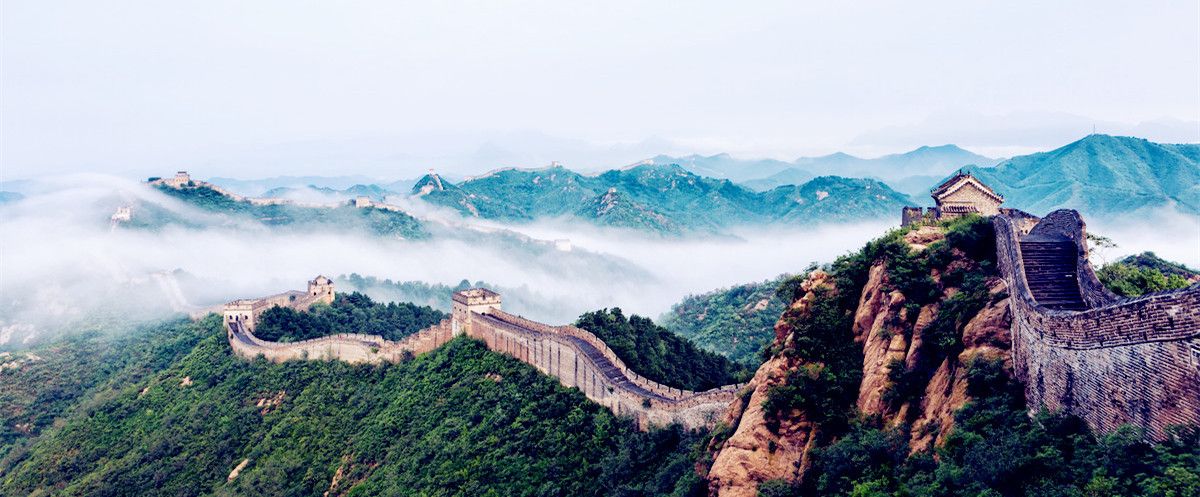
The Qin Empire is known for its marvels engineering, including a complex system of over four thousand miles of road and one superhighway, the Straight Road, which ran for about 500 miles along with the Ziwu Mountain range and is the path on which materials for the Great Wall of China were transported. The territory’s borders were marked on the north by border walls that were connected, and these were expanded into the beginning of the Great Wall. Supervised by the Qin road builder Meng Tian, thirty thousand workers were brought to work on the construction of the Great Wall, and on the service roads required to transport supplies.
Qin Shi Huang was famous for audacious marvels of architecture and art meant to celebrate the glory of his new dynasty. Each time Qin made a new defeat, a replica of that state’s ruling palace was built across from Qin Shi Huang’s Palace along the Wei River, then linked by covered walkways and populated by singing girls brought in from the occupied states. Weapons from Qin defeats were collected and melted down to be used for the casting of giant status in the capital city Xianyang.
Tomb and Terracotta Army
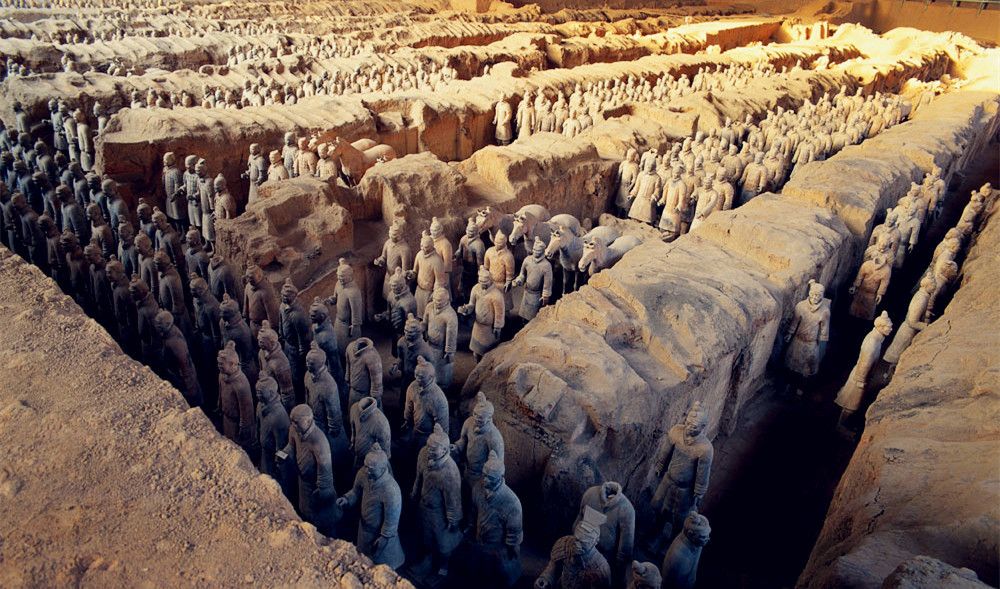
Perhaps the greatest building project and most brash creation of Qin Shi Huang was the one constructed for his death. Before he died, he had constructed a massive tomb for himself on Li Mount, near to the modern-day Xi’an, and after his death, he was buried there. Shi Huang sent seventy-thousands workers to build an underground complex at the foot of the Lishan Mountains to serve his tomb. It is designed as an underground city from which Qin Shi Huang would rule in the afterlife, and the complex includes vast chambers and halls, temples, administrative buildings, bronze sculptures, animal burial grounds, a replica of the imperial armory, terracotta statues of acrobats and government officials, a fish pond and a river.
A mile away from the underground city, at the eastern gate, Qin Shi Huang developed an army of life-size statues, almost eight thousand terracotta warriors and six hundred terracotta horses, plus stables, chariots, and other artifacts. This massive complex of terracotta statuary, weapons and other treasures including the tomb of Qin Huang himself is known as the Terracotta Army. The Qin Shi Huang excavation of the tomb has been delayed because of high levels of toxic mercury at the archaeological site, and it is believed that the emperor had liquid mercury installed in the tomb to mimic rivers and lakes.
The Decline of the Qin Dynasty
The most glaring weakness of the Qin Empire, centered on Qin Shi Huang, was that it was his authority and personality that kept China unified. He survived numerous killing attempts, but his death and the breakdown of his empire was a significant threat. Perhaps he concerned about this, and he became obsessed with finding ways to prolong his life, and avoid his death, and achieve immortality. He employed sorcerers and alchemists and went on journeys with his court in search of a life-giving medicine. In the end, it was his desire to live forever that killed him. He died because of the poisonous concoction in hopes that it would give him immortality.
In 210 BC Qin Shi Huang died; initially, his death was kept secret by Zhao Gao and Li Si, the emperor’s chief eunuch. They knew that the empire would fragment on news of Qin Shi Huang’s death. Qin Shi Huang's eldest son, Fusu, had been sent off to fight a campaign in the north because he had argued with his father about executing scholars. Zhao Gao and Li Si knew that it is challenging to control Fusu, so in the absence of Fusu, they quickly choose Huhai, the younger son of Qin Huang as an emperor. Fusu died there, and Huhai became the new emperor who is known by Qin Er Huang, he was the Second Qin Emperor.
Zhao Gao and Li Si started fighting overpower, however, and Zhao Gao defeated Li Si and executed his entire family. He forced the new king Qin Er Huang to do as he said, but his orders were cruel and inefficient. People were angry at Emperor Qin Er Huang’s mishandling, and claiming that Fusu should have been emperor, several revolts broke out. The states of Han and Chu, which had been occupied by Qin Shi Huang, declared themselves independent once more and sought to take over the Qin Dynasty. Initially, Qin Er Huang was in denial of the fact that the empire is slipping from his hand. He blamed Zhao Gao and tried to remove him from his position, but Zhao Gao had the loyalty of the army, which forced the emperor to kill himself. The Ziying, the new emperor, finally executed Zhao Gao, but by then the rebellions had grown too strong. Ziying tried to exchange with the protestors by declaring himself one king among many, but the rebels people had no reason to agree to this. The military of Chu attacked and beaten Ziying, and he was killed. Within a year, the Qin capital in Xianyang and the Qin dynasty was destroyed.
Despite Qin Shi Huang’s claim that the Qin dynasty would last for thousands of generations, it survived only fifteen years. But that fifteen-year period has of immense importance in Chinese history. In those fifteen years, they saw the unification of Chinese society which allowed the Chinese people to think of themselves as members of a single state. It also showed that one dynasty could efficiently rule all of China. Though the fall of the Qin Dynasty rushed the state into civil war and battle, it was not long before others learned from these lessons, and unified China under a more enduring dynasty. The Han Dynasty, which soon replaced the Qin, would rule for over four hundred years, and usher in the golden age of ancient China.
Responses • 0
0/2000
ID: 322
Matthias
Offline
1 day
Visited
From
Orlando, United States
Send Message