美哉我大明朝
(more)Ming Dynasty
Original
Chinese History
Dec 06 • 2573 read
Ming dynasty (1368 – 1644 AD), despotism was strengthened, and the multi-ethnic state was further unified and consolidated. The handicraft industry and commodity economy flourished.

The Ming dynasty ruled China from 1368 to 1644 and was the last ethnic Chinese dynasty. It was between two foreign dynasties; the Mongol Yuan dynasty and the Manchurian Qing dynasty. It ruled China for 276 years and was the fourth-longest Chinese dynasty. The Jesuit scholars introduced Western science during this period, and Chinese science and technology inventiveness declined. The merchant class improved in status and power, and painting and ceramic production thrived.
According to ‘The History of East Asia Civilization,’ the Ming dynasty period was one of the most significant periods of social stability and orderly government in human history. Ming policy establishes a standing army of one million troops and a vast navy. The Grand Canal was restored, Great Wall and Forbidden City were established in Beijing during the 15th century. There were 160 to 200 million population during the late Ming era. The name ‘Ming’ means brightness, and the first Ming Emperor chose it in contrast to the dark period in which the Ming dynasty came to power. During the Ming dynasty, there was cultural and economic growth, which produced the first commercial contacts with the West. There is rare contemporary literature on the Ming dynasty; however, there were several million documents that were kept in government archives, all but around ten thousand were destroyed during a fight at the end of the dynasty. By contrast, 14 million original documents remain from the Qing dynasty.
Ming Rise to Power
Competition among the Mongol imperial rulers, natural disaster, and peasant uprisings caused the decline of the Yuan dynasty. The Han Chinese and former Buddhist monks were the founders of the Ming dynasty, who turn rebel army leaders. Zhu Yuanzhang was the one who launched a rebellion against the Mongols. He was a self-made man of great talents and the son of a farmer who lost his family members in an epidemic when he was seventeen years old. Zhu spends several years in a Buddhist monastery and, after that, launched a rebellion, which lasted for thirteen years against Mongols, while Zhu became the head of a Chinese peasant insurgency, called Red Turbans, made up of Taoists, Confucianists, Buddhists, and Manichaeists. The rebels surrounded Beijing in 1368, and the Yuan dynasty came to an end. Toghon Temur Khan, the last emperor, did not even attempt to defend his Khanate. He first fled to Sandhu with his empress and concubines, then to the Karakoram, where he was killed when Zhu became the leader of the Ming dynasty.
Ming Power
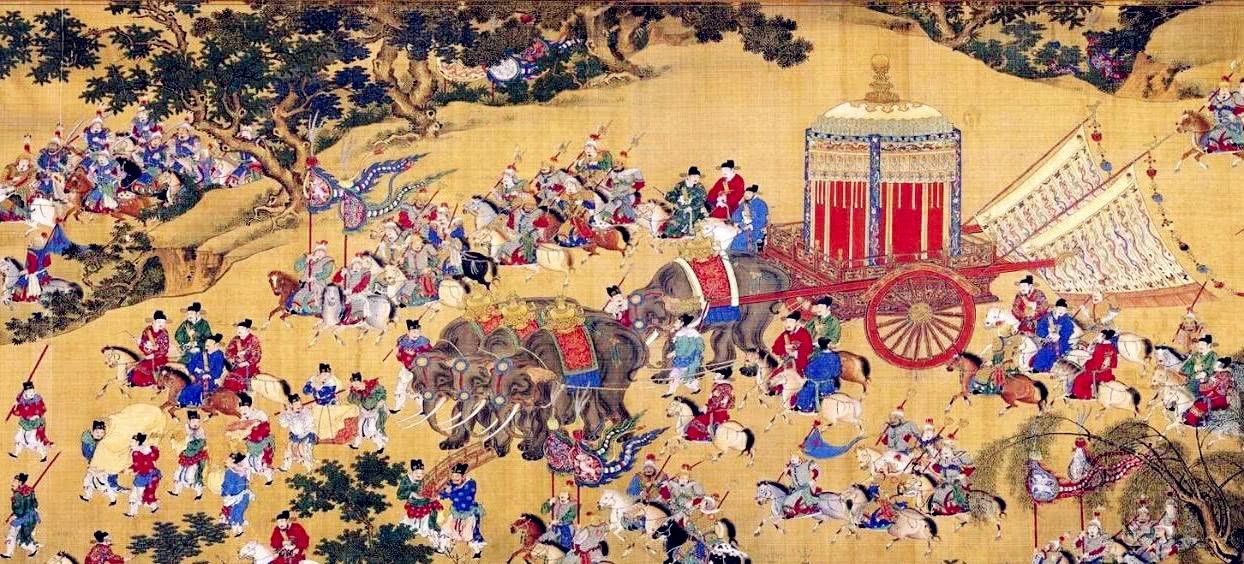
The first capital of Ming was at Nanjing, and later in Beijing, while the Ming reached the peak of its power during the first quarter of the 15th century. The Ming increased their authority by granting themselves the power to dismiss any prime minster who opposed them. John Keegan, wrote in his book ‘History of Warfare’ that the Ming militarized China and created a hereditary military class; it was during the Ming era that China embarked on it only sustained effort of overseas expansion, and its most significant effort to control the land by direct offensive action; five great expeditions were riding north of the Great Wall, which was also then reconstructed in the form we see it today. The Ming was not very good at dealing with the Central Asian tribes that challenged them. They shunned both diplomacy and war but were too weak to drive them out. The Ming constructed walls and mocked the Central Asia horsemen, demanding that they are referred to as Yi (barbarians) and demanding that Yi always be written in the smallest possible letters.
Great Wall of China during the Ming Dynasty
During the Ming Dynasty, the most famous sections of the Great Wall were built from stone, brick, and mud. The Ming rulers devoted a large amount of workforce and resources to the project. Stones weighing over a ton were moved, shaped, and heaved on top of each other. Over 60 million tons of stone and bricks slabs were used. The Ming constructed their walls as lines of defense with as many as four rows of fortifications in a strategic area. They used durable construction materials, intending to make something that lasted. The mud bricks were made of straw, soil, egg yolk, and tamarisk, and rice paste. It took 100 years to complete the project. Nearly one in every three males members of China was recruited to help construct it. Municipalities along the wall became industrial areas for blasting rocks to make fill and sharpening stones. Military units were put to work on a rotating basis, so no one unit would be overworked and rebel.
The walls and towers were often made distinctly, with the towers being completed first from brick that was carried in. Wall sections were constructed between the towers, first with local stone, and then with materials that were carried in. They were usually constructing during the spring when the weather was good. During the construction of the Great Wall, hundreds of thousands of people died from starvation and severe weather. The people who live around the Great Wall in the present time, especially in the hills northeast of Beijing, claim to be offspring of soldiers that were stationed on the wall. Many of these people trace their roots back to a policy in the 1550s that aimed to prevent soldiers' firm deserting by allowing their wives and families to move into the watchtowers with them. Ming General Qi Jiguang in the 1500s permitted soldiers to bring their families to the frontlines. Local commanders were allocated to different towers, which their families treated with proprietary pride.
Arts during the Ming Dynasty
During the Ming era, there was cultural restoration and expansion. Painters were instructed during the Ming dynasty to return to didactic and realistic representation, in imitation of the style of Southern Song Imperial Painting Academy. Large scale landscapes and figural narratives were particularly favored as images that would glorify the new dynasty and convey its majesty and virtue. The traditions of both Yuan and Southern Song painting academy scholar artists were developed further in Ming paintings.
In Ming scholar-painting, each form is made up of a recognized set of brushstrokes, yet the performance of these forms is, each time, a sole personal performance. The Ming painter scholar valued the presence of personality in work rather than technical skill, and they aimed for mastery of performance over laborious craftsmanship. During the Ming dynasty continued to prevail, and ink wash painting of the Imperial Painting Academy and Southern Song was briefly famous. Two approaches were developed to scholarly painting During the late Ming and early Qing dynasties, in the first approach, artists studied and copied ancient themes subjects and themes, and in the second approach, artists abandoned models and expressed their creativity through inventive means. In the late Qing period, research on ancient inscriptions influenced painting.
Ming Porcelain
Ming dynasty ceramics were famous for the boldness of their form and decoration and the varieties of design. Artisans made both large and highly decorated vessels and small, delicate, white ones. Many of the beautiful decorations and glazes; moonlight blue, cracked ice, peach bloom, and oxblood glazes; and rice grain, rose pink, and black decorations- were inspired by nature. Emperor Jianwen, in 1402, ordered the establishment of an imperial porcelain factory in Jingdezhen. Its primary function was to produce porcelain for court use in state and religious ceremonies and tableware and gifts. Jiangdezhen was producing nearly all of the world’s porcelain between 1350 and 1750. The Jiangdezhen had access to China’s coast, which was used for transporting finished products to places in China and around the world.
Exploration and Expansion during the Ming dynasty
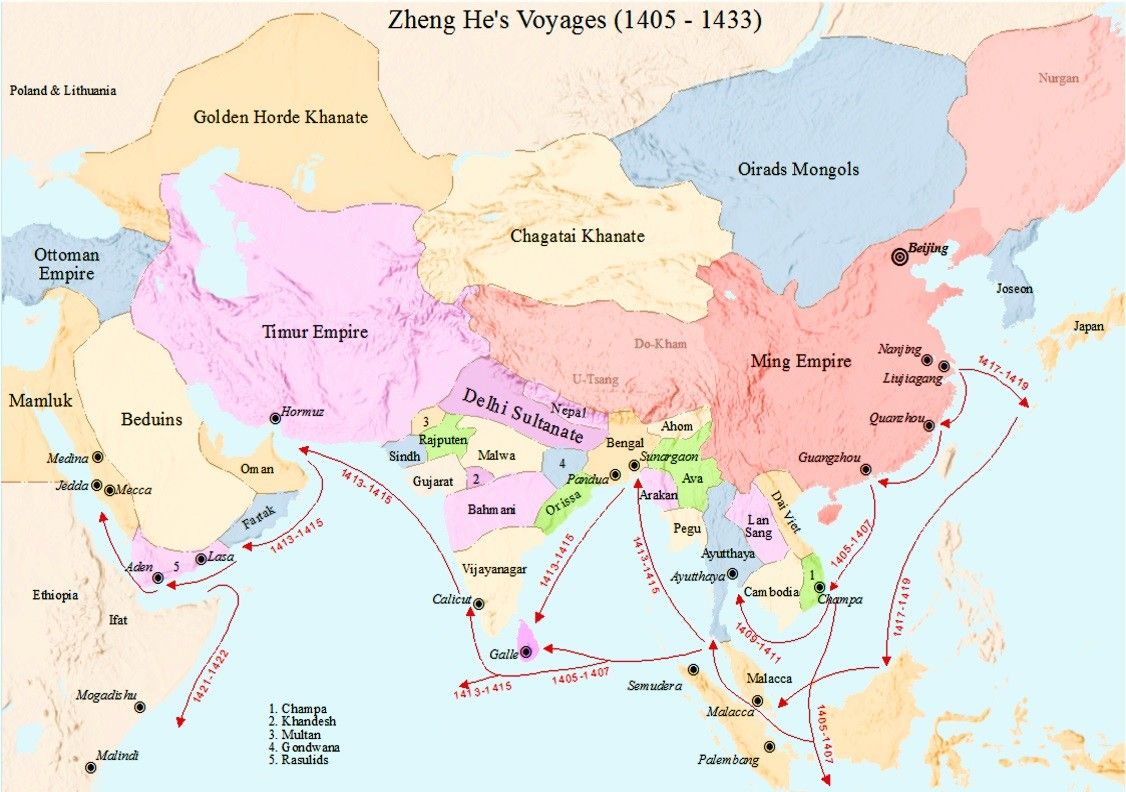
The Chinese military reconquered Annam (present-day northern Vietnam), while the Chinese navy sailed the China Seas and the Indian Ocean. The Asian maritime nations sent envoys with tribute for the Chinese ruler. The Grand Canal was extended to its farthest limits and proved to be a stimulus to domestic trade. After 1433, the Ming maritime expeditions stopped. Historians have given as one of the causes that the high spending of large-scale expeditions at the time of preoccupation with northern defenses against the Mongols. Opposition at administration also may have been a causal factor, as traditional officials found the concept of expansion and commercial ventures unfamiliar to Chinese ideas of government. The Ming dynasty stability, which was without major disruptions of the population, arts, economy, politics, or society, indorsed a belief among the Chinese that they had accomplished the most satisfactory civilization on earth.
Eunuchs during Ming dynasty
It is said that during the Ming dynasty there were 20,000 eunuchs were employed in the Forbidden City. They contributed to Chinese culture and civilization. In the Ming dynasty, court eunuchs were the first Chinese to play Western classical music. The eunuch Zheng was China’s greatest explorer. During the ruling of Emperor Wanhi, the court eunuchs reached the peak of their political power. Emperor Wanhi hired 10,000 eunuchs in the imperial court and many of them in official positions throughout the country. The Forbidden City maintained a special eunuch clinic during the Ming dynasty, where people had their genitals removed while sitting on a unique chair with a hole in it. People that did not survive were carried away with their penis and testicles in a pouch for reunification in the afterlife.
Ming dynasty official; Hui Rui behind the Cultural Revolution
Hai Rui (1514 to 1587) was a renowned official in the Ming dynasty. In Chinese history, he is regarded as a model of honesty and truthfulness in office, and he reemerged as a vital historical character during the Cultural Revolution. Hai Rui was born in Qiongshan, Hainan, and was raised by a Muslim mother from a Hui family. He failed the official examination, and in 1553, started his official career as clerk of education in Fujian province. Then he was promoted as the magistrate of Chun’an County in Zhejiang and Xingguo County in Jiangxi, where he equalized the tax, reversed many unjust cases, cracked down corrupt officials, and enjoyed the ardent support of the people.
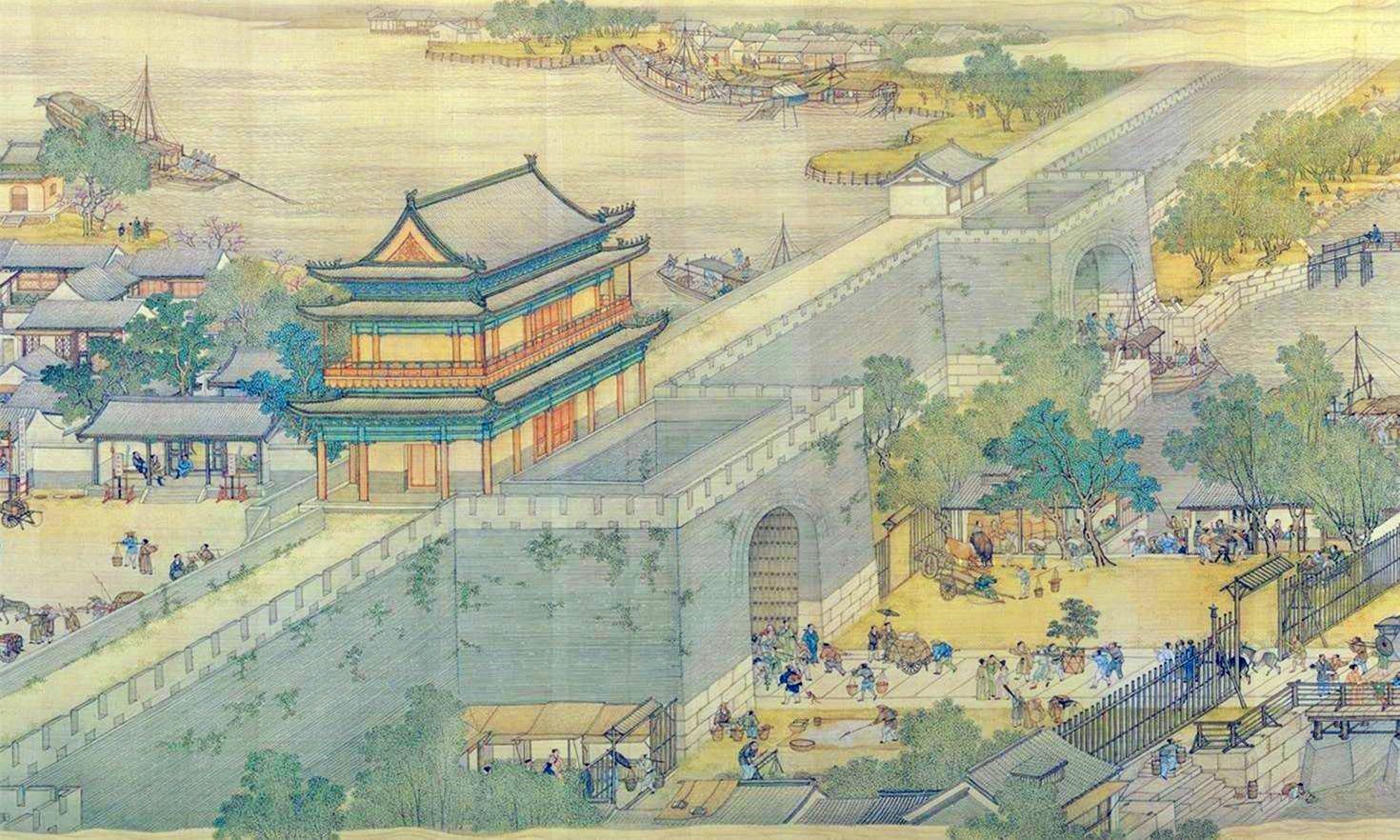
In the 15th year of the Jiajing emperor, he was promoted as president of the Yunnan Department of the Board of Revenue. He criticized the Shixong ruler for practicing witchcraft, living in luxury, and ignoring his responsibilities. For this criticism, he was thrown into prison, but he was released after Shizong died. In 1569, during the rule of Longqing, he was promoted as vice Qiandu Yushi. Like before, he punished corrupt officials, constructed river channels and irrigation works, and forced corrupt officials to work in the fields, and thus he became known as ‘Hai the Clear Sky.’ After that, he was removed from his position and stayed at home for sixteen years. Again in 1585, during Wanli rule, he was appointed as the vice president of the Board of Civil office in Nanjing and again strictly punished corrupt officials and crackdown on the trend of accepting bribes. Two years later, Hai Rui died in office.
Hai Rui was famous for not compromising on upright morality, scrupulous honesty, poverty, and fairness. Because of this, he widely became famous and won the support of the people but made him many enemies in the bureaucracy. When he criticized Jiajing in 1565, Hai Rui was initially sentenced to death but escaped that fate because of popularity. He was known as honest and incorrupt official and was deeply respected by the people throughout his life. It is said that, when the local people heard the news of his death, they were filled with deep sorrow. Hai Rui's reputation lived on in modern times. An article title ‘Hai Rui Dismissed from office’ was written by Wu Han (Communist Party official) in 1959 and after made into a Peking Opera play, was interpreted by Gang of Four member Yao Wenyuan as an symbolic work with the honest moral official Hai Rui representing discredited official Peng Dehuai, who was eliminated by Mao Zedong. The November 10, 1965 article published by a prominent Shanghai newspaper, and written by Yao, with the title “A Criticism of the Historical Drama ‘Hai Rui Dismissed From Office,’” is widely seen as the spark that kindled the Cultural Revolution. The grave of Hai Rui was destroyed during the Cultural Revolution, but it was rebuilt.
Decline and fall of the Ming dynasty
Wars with the Mongols, invasions by the Japanese into Korea, and harassment of Chinese seaside towns by the Japanese in the 16th century damaged the Ming Empire, which became ripe for an alien takeover. In 1644, the Manchus took Beijing and established the last imperial dynasty (1644-1911). The court of Ming was corrupt; some civil servants and court eunuchs collected a small amount of money by setting fires and getting kickbacks from the contractors who restored the damage. Others stole money that was supposed to buy food for the court elephants. The Ming dynasty was weakened by corruption and political trouble on its border. The decline was faster after a costly was against Japan over Korea. The 16th-century historian Zhang Dai wrote that after Manchu invasions from the north, Beijing was overrun with unemployed clerks and soldiers, laid off couriers, landless laborers, refugees from the Manchu dominated areas, Muslim and traders who had lost their money as the Silk Road trade faltered.
Peasant Rebellions and Manchu Invasion
The devastating famine and an invasion of Manchus from the north caused peasant rebellion in the Shaanxi province, which finally collapsed the Ming dynasty. In the early 17th century, drought and famine fasten the collapse of the Ming dynasty. Zhang Xianzhong and Li Zicheng, who belonged to the areas in Shaanxi that were hit by famine, led the peasant rebellion.
At the same time, the Ming military was busy in defense of the northerner border against the Manchu ruler Huangtaiji, whose father, named Nurhaci, had united the Manchu tribes into a unified force. In 1636, Huangtaiji declared himself emperor of the Qing dynasty. The peasant rebellion spread from Shaanxi to Huguang and Henan in the 1630s. In 1641, Luoyang fell to Li Zicheng and Xiangyang to Xianzhong. In 1642s, Li Zicheng occupied Kaifeng, and the next year, Zhang Xianzhong captured Wuchang and established himself as the ruler of his Xi kingdom. In 1643, Li Zicheng captured Xi’an, renamed it Chang’an. He declared himself of the Shun dynasty in 1644 and prepared to capture Beijing.
For the Chongzhen Emperor, the situation became critical by this point, who rejected the proposal to recruit new militias from the Beijing area and to recall General Wu Sangui, the protector of Shanhai Pass on the Great Wall. The Chongzhen Emperor posted a new field commander, Yu Yinggui, who failed to stop the army forces of Li Zicheng’s as they crossed the Yellow River in December 1643. In Beijing, the capital defense forces were starving because of the corrupt eunuchs who were responsible for their supplies; also, the troops had not been paid for nearly a year. Meanwhile, Li Zicheng forces occupied Taiyuan, which gave his additional campaign momentum; garrisons began to surrender to him without a fight. In early 1644, the Chongzhen Emperor rejected proposals to move the court south to Nanjing, and in early April, he declined the suggestion to transfer the crown prince to the south.
Fall of the Ming Dynasty and it’s Displacement by the Manchus
The last Ming ruler killed himself rather than being captured. The Manchus defeated the rebel group that overthrew the Ming dynasty in 1644. In 1644, the Ming dynasty was overthrown by the Manchus. In April 1644, when the rebels were at its peak in Beijing, Li Zicheng, the rebellion leader, offered the emperor an opportunity to surrender, but the negotiations produced no results. Rather than to capture by the rebels, the Chongzhen ruler gathered all members of the imperial household except his sons. By his sword, he killed Princess Kunyi and Consort Yuan and severed the arm of Princess Changping. The empress hanged herself, and the Chongzhen hanged himself or strangled himself with a sash. He was buried in the Ming Tombs. The Manchus were fast to exploit the death of the Chongzhen by claiming to ‘avenge the emperor.’ They united support from the loyalist civilians and Ming forces.
The Shun dynasty lasted for a year with Li Zicheng’s overthrow at the Battle of Shanhai Pass. The victorious Manchus created the Shunzhi Emperor of the Qing dynasty as ruler of all China. Because the Chongzhen Emperor had rejected to move the court south to Nanjing, the new Qing government took over a vast intact Beijing bureaucracy, aiding their efforts to displace the Ming. After the death of Chongzhen Emperor, loyalist forces announced a Southern Ming dynasty in Nanjing, naming Zhu Yousong as the Hongguang Ruler. However, in 1645, the Qing military started to move against the Ming remnants. The Southern Ming was unable to hold back the Qing attack, and Nanjing surrendered in June 1645. Zhu Yousong was caught and brought to Beijing, where he died the following year. The Southern Ming were frequently pushed farther south, and the last ruler of the Southern Ming, Zhu Youlang, was finally captured in Burma, transported to Yunnan, and executed in 1662 by Wu Sangui.
Ming Tombs
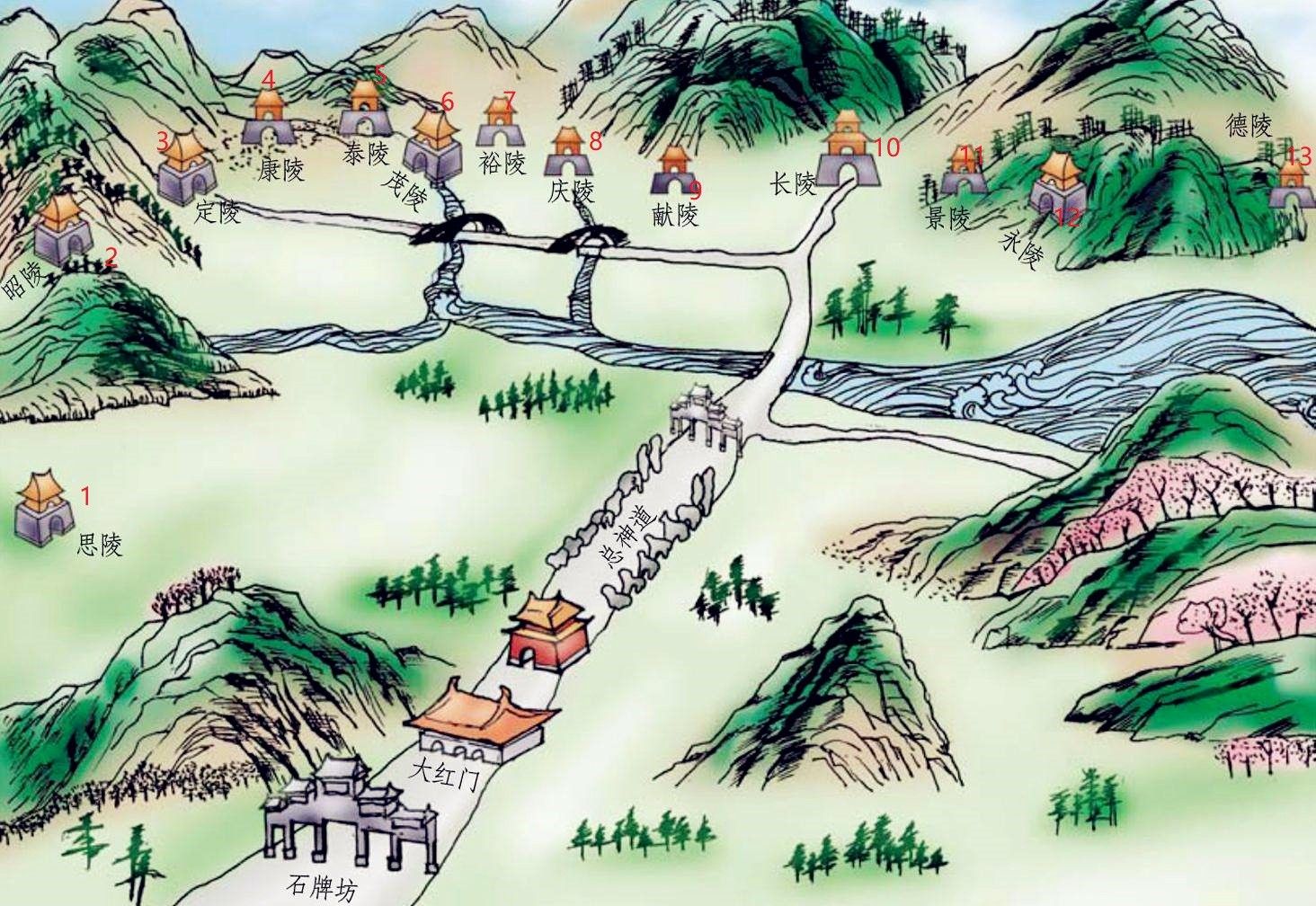
The Ming Tombs are located in the northwest of Beijing, 45 kilometers away from the Great Wall of China. The 13 tombs can be reached by following the four-mile Sacred Way, which starts at a white marble gate and ends in a lovely quiet gorge enclosed by trees. Many people find the tombs to be disappointing but like the walk and the lovely countryside. The Sacred Way passes via Great Red Gate, a group of three grand archways, each 120 feet high and 35 feet wide. Further along is the 30 foot high stele Pavilion, decorated with statues of dragons and tortoises, and the renowned Avenue of the Animals, featuring 12 pairs of stone animals include horses, elephants, lions, camels, and two mythical creatures - a qilin (a dragon-like beast with deer antlers and a cow’s tail) and a Xiechi (a horned cat). The human figures look like generals. Continuing further visitors pass some rows of mandarin statues, a Dragon and Phoenix Gate, and seven-arch bridge to arrive at the tombs finally.
Emperor Shen Zong (A.D. 1573-1620) tomb is the only open one. It is surrounded by several buildings, terraces, courtyards, and two museums. There are three rooms inside the tomb; the first one does not have much; the second one holds funerary lamps, altars, and a throne. The Emperor's body and his two empresses were kept in the third room, along with various treasures. The tomb of ruler Cheng Zu (A.D. 1403-1424) is unexcavated and surrounded by lovely terraces, gardens, pavilions, courtyards, and gates.
ID: 322
Matthias
Offline
1 day
Visited
From
Orlando, United States
Send Message