Li Qingzhao
Original
Chinese Literature
Jul 17 • 1412 read
Li Qingzhao (李清照) (1084 - 1155) was a female poet in the Song Dynasty. She was a representative of the Euphemistic Ci style and was known as "the first talented woman through the ages".
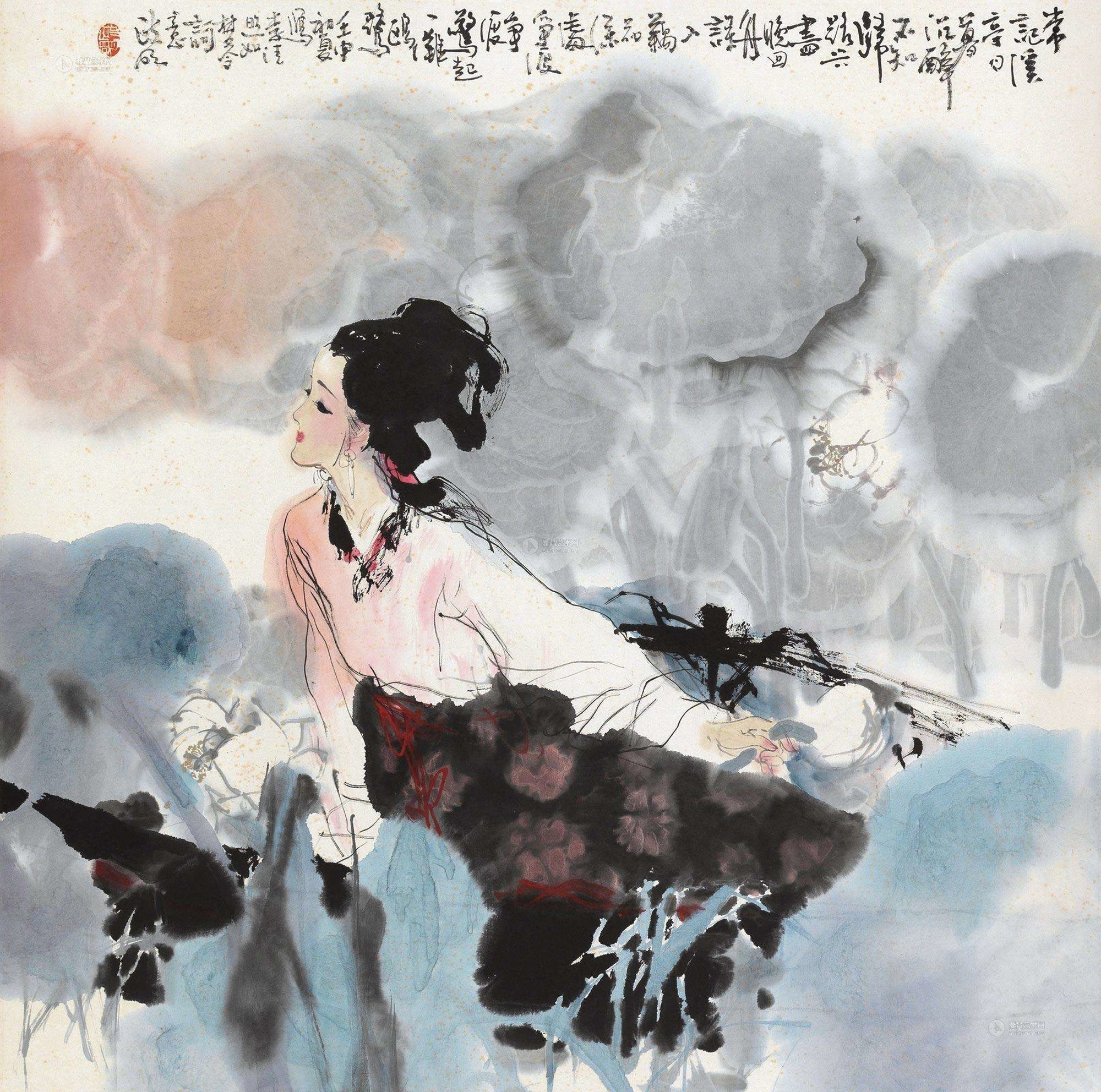
Li Qingzhao (李清照) (pseudonym: Householder of Yi’an), who is a rare talented woman and poet in ancient China. from Mingshui, Zhangqiu, Shandong, was born in 1084.
Life introduction
According to modern research, she died sometime after 1155, having lived to her 70s. She was born into an affluent family of scholars. Her father, Li Gefei, wrote the famous piece Famous Gardens of Luoyang (洛阳名园记), and his work even caught the attention of the famous Su Dongpo. Her mother, surnamed Wang, was also educated, a rarity for women of the time. Such a family gave Li Qingzhao a strong literary foundation, allowing her to gain fame for her poetry at an early age.
When she was 18, she married Zhao Mingcheng, a graduate of the Imperial College who later became prefect of Laizhou and Zichuan. The two shared a love of poetry, frequently writing and enjoying poetry together, had a passion for collecting ancient inscriptions on bronze and stone tablets, dressed and ate frugally, and accumulated a massive collection of literary artifacts from the past. Zhao wrote Records of Bronze and Stone Inscriptions (金石录), and Li contributed to it as well. To escape the chaos of the 1127 Jingkang Incident, the couple crossed the Huai River and headed south, leaving many of their bronze and stone relics behind to be destroyed.
Two years later, Zhao died of illness in Jiankang (present-day Nanjing), after which Li began a period of drifting among the regions of Hangzhou, Yuezhou, Taizhou, and Jinhua, living alone and helpless for the latter half of her life. There is little documentation of her life, but she wrote an Afterword to Records of Bronze and Stone Inscriptions (金石录后序) in 1134 (at the age of 51), in which she gives an account of her life, including her many misfortunes, from the time of her marriage. In 1143, she revised and organized the writings of her husband’s book into a final draft, which was commended by the imperial court. In about 1156 or thereafter, full of despair about the loss of her beloved husband and the inability to return to her hometown, as well as being plagued with extreme loneliness and sorrow, she passed away. Though the exact date is unknown, it could not have been earlier than 1155 (at which time she was 73).
Li is one of the few talented female writers of pre-modern China. She was good at calligraphy and painting, highly knowledgeable on ancient bronze and stone inscriptions, and especially excelled at poetry and Ci lyric poetry. Her Ci (词) lyric poetry was unparalleled in its time and has received wide praise ever since, hence her being hailed as a master of this art form. Her Ci lyric poetry may be divided into early and late work. Her early work focused mainly on her life of leisure, including love and natural scenery. The rhyme in this work is elegant, as exemplified by “Sprig of Plum Blossoms (一剪梅·红藕香残玉簟秋)” Her later work, such as “Slow Tune (声声慢·寻寻觅觅)” is characterized by a lament for her plight and a longing for her hometown and the past. Her unique style was straightforward, and she employed elegant and beautiful language. In her work Lunci (“on Ci lyric poetry”), she emphasizes harmony, refinement, and the idea that Ci lyric poetry is different than other forms of poetry, thus advocating that the former should not be written in the same way as the latter. She produced work in other forms of poetry too, though not much remains to the present. Some of it expressed her feelings on current affairs and history. Her style in these poems is impassioned and liberal but different from her Ci lyric poetry. It was precisely her unique style that established her important place in the history of Chinese literature.
Records of Bronze and Stone Inscriptions《金石录》
Records of Bronze and Stone Inscriptions consists of 13 scrolls. Most of it was written by Zhao Mingcheng by 1129, but he soon died of illness. After two years of a difficult life in Lin’an, Li decided to polish and organize her husband’s work, producing its final form.
The book documents inscriptions on bronze vessels and stone tablets and gravestones from a period spanning the Xia dynasty (ca.2070 – 1600 BCE) to the Tang dynasty (618 – 907 CE), making it the earliest catalog and textual study on the subject and serving to promote historical verification via these objects. It has played an important role in the continued research of these objects. In terms of his toriography, textology, literature review, and calligraphy of the bronze and stone inscriptions, the book represents Li’s major contribution to historical research, and it is still a valuable reference to this day.
Female poet Li Qingzhao possessed a character as admirable as her work. She was hailed as the “queen of the ci lyric poetry realm,” and her work has been known as some of the best in all of China. Since the Ming dynasty (1368 –1644), four memorial halls and numerous shrines have been built in honor of her.
Memorial Hall in Zhangqiu, Shandong
The Qingzhao Garden, located near the Baimai Springs in Mingshui District, Zhangqiu, covers an area of 18,000 square meters. The memorial hall covers 1,270 square meters, water covers 1,500 square meters, and greenery covers 10,000 square meters. It officially opened on May 1, 1997.
Memorial Hall in Qingzhou, Shandong
The Li Qingzhao Memorial Hall in Qingzhou sits beside Yangxi Lake, outside of the western gate of the ancient walled city. It occupies an area of 630 square meters and faces south. Inside the gate is a path that heads north. To the east of the path is the Shunhe Building and to the west is the Sisong Pavilion, both having been built during the Qing dynasty. At the end of the path is a quadrangle built-in 1993. Above the gate to the quadrangle is a horizontal board that reads “Li Qingzhao Memorial Hall” in characters written by the famous cilyric poet Xiao Lao.
Memorial Hall in Jinan, Shandong
The Li Qingzhao Memorial Hall in Jinan, located in a courtyard to the north of the Liuxu Spring in the Baotu Spring Park, covers 360 square meters. The courtyard belonged to the rich and powerful Zhang clan of the Northern Song dynasty (960 – 1120). During the Jurchen Jin dynasty (1115 –1234), it was made into the Lingquan Convent. Then during the late Qing dynasty(1644 – 1911), it was turned into a shrine to Ding Baozhen, who had passed the Palace Examination during the Xianfeng Emperor’s reign and had served as governor of Shandong. Because of a poem entitled “Visits the Home of Li Yi’an by the Liuxu Spring” (“Yi’an” was Li Qingzhao’s pseudonym) by the early Qing-dynasty poet Tian Wen, people mistakenly believed Li had lived in a house beside the spring. This misconception that Li had lived in Jinan spread among writers and calligraphers.
Memorial Hall in Jinhua, Zhejiang
The Li Qingzhao Memorial Hall in Jinhua is in the Bayon Building on Bayong Road, in the southern part of the city. The edifice, named the Xuanchang Building and Yuanchang Building in the past, was built in494 by the Dongyang prefect Shen Yue. In 1994, the Bayong Building CulturalRelic Preservation Office turned the main hall into a memorial hall for Li.
Li was named the Lotus Goddess by the people of Jinan during the Qing dynasty. They worshiped her and built a shrine to her on the banks of Lake Daming in Jinan.
Welcome to Shandong
Dear friends, Shandong boasts modern civilization, magnificent mountains and rivers, time-honored history, and a galaxy of talents. It is located on the eastern coast of China, at the lower reaches of the Yellow River, across the sea from South Korea and Japan, and at the juncture of the eastern section of “Belt and Road”. It’s the birthplace of a group of thinkers and contributors to Chinese culture, such as Confucius, Mencius, Zengzi, Zisi, Mozi, and Sunzi. Shandong has the third-highest GDP in China, with a population of over 100 million.
Shandong is to recruit 20,000 “Confucius Culture and Tourism Envoy” from all around the world. Join us to know about “Friendly Shandong, the home of Confucius”.
We look forward to meeting you in Shandong.
Responses • 0
0/2000
ID: 322
Matthias
Offline
2 day
Visited
From
Orlando, United States
Send Message