
HSK 1
Correct
的 de
/ de /
Strokes
/fit-in/684x0/img/202210/的-de-Chinese-grammar-Cchatty-902fb3d7-34f8-4460-a368-98c7956b2e99-1665629489.jpg)
Formula
1
AB + 的 + Noun
2
AA/AABB + 的 + Noun
3
Noun/Pronoun + 的 + 这/那 + Quantifier + Adjective + Noun + Headword
4
(代词/形容词/动词)+ 的 = (代词/形容词)+ 的 + 名词
5
的 + Noun
6
Adjective + 地 + Verb
7
Verb + 得 + complement
Definition
Attributes (定语) + 的 (结构助词) + Headword (中心语)
1, 的 as a Structural Particle (结构助词),
1), 的 is used between "A (a noun)" and "B (a noun)";
2.1), 的 is used between "A (an adjective)" and "B (a noun)";
2.2), 的 is usually omitted when "A" is a monosyllabic adjective;
3), 的 is used between "A (a verb)" and "B (a noun)";
4), 的 is used between "A (a subject-predicate phrase)" and B (a noun)";
5), 的 is used between "A (a preposition)" and "B (a noun)";
6), the order of the Attributes: [ …… 的 + 这/那 + Quantifier + Adjective + Noun + Headword]
2, The following structures are often used to express the quantity/quality/feature of something/somebody:
[words/phrases indicating quantity/quality/feature + 的 + N...]
The noun in this structure is the so-called "headword". In some cases, 的 can be omitted.
3, 的, 地, and 得, their pronunciation all are [de], all are Structural Particle (结构助词), the difference is:
的 + N
V + 得 + complement
adj + 地 + V
Example
的 is used between "A (a noun )"and "B ( a noun )"
1. To express "B belongs to A"
2. "的" can be omitted in the following cases to indicate "B belongs to A": ①B是A的家庭成员; ②B是A的亲戚; ③B是A工作的地方
3. When A is used to describe the feature(s) of B, "的" is usually omitted
2. "的" can be omitted in the following cases to indicate "B belongs to A": ①B是A的家庭成员; ②B是A的亲戚; ③B是A工作的地方
3. When A is used to describe the feature(s) of B, "的" is usually omitted
1
Bàba
爸爸
de
的
chē
车
/
tā
他
de
的
tóufa
头发
dad's car / his hair
2
Wǒ
我
bàba
爸爸
/
nǐmen
你们
xuéxiào
学校
my father / your school
3
Zhōngguó
中国
rén
人
/
hànyǔ
汉语
kèběn
课本
Chinese people / Chinese book
的 is placed between "A (an adjective)" and "B (a noun)"
1. To express "A is the feature of B".
2. To indicate "A is the feature of B". If A is a monosyllabic word, "的" is usually omitted.
3. The duplication of an adjective act as an Attribute.
Attention: 的 is optional between a few two-character adjectives and nouns because of their close relationships, eg, 新鲜(的)空气,幸福(的)生活
2. To indicate "A is the feature of B". If A is a monosyllabic word, "的" is usually omitted.
3. The duplication of an adjective act as an Attribute.
Attention: 的 is optional between a few two-character adjectives and nouns because of their close relationships, eg, 新鲜(的)空气,幸福(的)生活
AB + 的 + Noun
AA/AABB + 的 + Noun
4
Piàoliang
漂亮
de
的
nǚháir
女孩儿
/
cōngming
聪明
de
的
xiǎogǒu
小狗
beautiful girl / smart dog
5
Nǚ
女
xuésheng
学生
/
dà
大
fángzi
房子
girl student / big house
6
Hónghóng
红红
de
的
tàiyang
太阳
/
gāogāodàdà
高高大大
de
的
nánháir
男孩儿
red sun / high boy
的 is placed between "A ( a verb phrase)" and "B ( a noun )" to indicate A is used to modify B.
7
Lǚxíng
旅行
de
的
fèiyòng
费用
the cost of the trip
8
Cānjiā
参加
bǐsài
比赛
de
的
xuésheng
学生
students who participate in the contest
的 is placed between "A (a subject-predicate phrase)" and "B (a noun)" to indicate A is used to narrow down the range of B.
9
Wǒ
我
mǎi
买
de
的
dàngāo
蛋糕
。
the cake that I bought
10
Péngyou
朋友
sòng
送
de
的
yī
一
běn
本
shū
书
a book that friend gave
的 is placed between " A (a preposition-object phrase)" and "B (a noun)".
11
Duì
对
lǎoshī
老师
de
的
yìjiàn
意见
。
suggestions for teacher
12
Guānyú
关于
nǐ
你
de
的
wèntí
问题
problems about you
The order of Attributes
Noun/Pronoun + 的 + 这/那 + Quantifier + Adjective + Noun + Headword
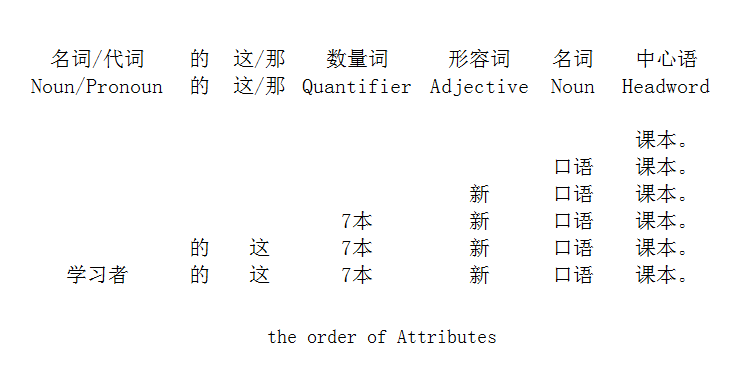
13
Xuéxízhě
学习者
de
的
zhè
这
qī
七
běn
本
xīn
新
kǒuyǔ
口语
kèběn
课本
。
Learners's these seven new oral books
Nominal phrases containing 的
A phrase that a pronoun, adjective or verb collocates with 的 is equivalent to the noun phrase that the headword is omitted.
(代词/形容词/动词)+ 的 = (代词/形容词)+ 的 + 名词
14
A
A
:
nǐ
你
yào
要
mǎi
买
shénmeyàng
什么样
de
的
yīfu
衣服
?
B
B
:
biànyí
便宜
de
的
。
(
=
biànyí
便宜
de
的
yīfu
衣服
)
A: What clothes do you want to buy ? B: Cheap (clothes).
15
A
A
:
zhè
这
shì
是
shuí
谁
de
的
shū
书
?
B
B
:
wǒ
我
de
的
。
(
=
wǒ
我
de
的
shū
书
)
A: Whose book is this ? B: It's mine.
的 is not used in the following situations.
1. Set phrases.
2. A single-character adjective is used as an attributive.
3. Interpersonal relationships or materials of things are involved.
Attention: Sometimes 的 can also be used for emphasis, contrast and classification.
2. A single-character adjective is used as an attributive.
3. Interpersonal relationships or materials of things are involved.
Attention: Sometimes 的 can also be used for emphasis, contrast and classification.
16
Liúxíng
流行
yīnyuè
音乐
popular music
17
Hànyǔ
汉语
shuǐpíng
水平
kǎoshì
考试
Chinese Proficiency Test
18
Chángtóufa
长头发
long hair
19
Hǎo
好
péngyou
朋友
good friends
20
Wǒ
我
māma
妈妈
my mother
21
Sīchóu
丝绸
chènshān
衬衫
silk shirt
Distinctions between 的, 地 and 得
1. 的 is followed by a headword, which is usually a noun or noun phrase.
2. 地 is followed by a verb or verb phrase and preceded by an adverbial, which is often an adjective or adjective phrase indicating the status of the action.
3. 得 is preceded by a verb and followed by a compliment, which indicates the status, degree or evaluation of an action.
2. 地 is followed by a verb or verb phrase and preceded by an adverbial, which is often an adjective or adjective phrase indicating the status of the action.
3. 得 is preceded by a verb and followed by a compliment, which indicates the status, degree or evaluation of an action.
的 + Noun
Adjective + 地 + Verb
Verb + 得 + complement
22
Wǒ
我
de
的
hànyǔ
汉语
shū
书
my Chinese book
23
Gāoxìng
高兴
dì
地
shuō
说
speak happily
24
Kǎo
考
de
得
hěn
很
hǎo
好
did well in the exam
Teaching Skill
的(HSK1)
表示领属关系的宾语 The attributive qenitive
“的”字结构语法点1:代词、名词作宾语表示领属关系时,后面要加结构助词“的”
例如:他的书
张老师的学生
王兰的哥哥
逐字稿
教学建议:
第一步:情景法导入,教师可利用自己和学生的汉语书进行导入,引导学生进行操练。
师说:(教师边展示汉语书边说)这是什么?
生说:这是汉语书。
师说:这是谁的汉语书?
生说:这是老师的汉语书。
师说:那是老师的汉语书吗?
生说:不是,这是我的/(学生名字)的汉语书
第二步:语言点操练:教师可利用实际物品,如:手机、笔、词典和与本课相关图片引导学生进行操练。
目标句:这是……的汉语书。
那是……的手机。
这是……的笔。
他是……的学生。
她是……的老师。
他/她是……的同学/朋友/同事。
第三步:扩展练习,教师可让学生介绍一下儿自己,或根据照片介绍自己的朋友、家人。
目标句:他/她是我的 ,他/她叫
他/她是 。
板书:
(1) 书 (2) 学生
汉语书 张老师的~
谁的汉语书? 他是张老师的~
我的汉语书
老师的汉语书 (3) 哥哥
这是我的汉语书 王兰的~
那是老师的汉语书 他是王兰的~
例句:(1)A:这是谁的汉语书?
B:这是我的汉语书。
(2)A:那是谁的汉语书?
B:那是老师的汉语书。
(3)A:他是谁的学生?
B:那是张老师的学生。
(4)A:他是谁的哥哥?
B:他是王兰的哥哥。
的:(structural particle)表示领属关系的定语。The attributive genitive
“的”字结构语法点2:人称代词作定语,而中心语是亲属称谓或表示集体、单位等的名词时,定语可以不用“的”。(英文详见《301句》P402)
释义:(1)人称代词(我/你/他/她)在表示亲属(爸爸/爷爷/妈妈/哥哥……)或表示人的名词(朋友/同学/同事……)之前,“的”字可以省略。
格式:我/你/他/她+(的)+亲友
例句:我 的 爸爸=我爸爸(√)
你 的 哥哥=你哥哥(√)
他 的 朋友=他朋友(√)
她 的 同事=她同事(√)
(2)人称代词(我们/你们/他们)在表示集体名词(学习/班/公司/宿舍/国家/大学/医院/队……)前,“的”字可以省略。
格式:我们/你们/他们+(的)+集体名词
例句:我们 的 班=我们班 (√)
他们 的 公司=他们公司(√)
你们 的 学校=你们学校(√)
注:我班(×) 我的班(√) 我/你/他/她在表示集体名词前,“的”不能省略。
我们爸爸(×) 我们的爸爸(√) 我们/你们/他们在表示亲属或表示人的名词前“的”不能省略。
的:
词性:结构助词
板书:
第一部分 第二部分
我/你/他/她+(的)+家人/朋友 我们/你们/他们+(的)+集体名词(公司/学校/班……)
我 爸爸(√) 我们 公司 (√)
你 妈妈(√) 你们 学校 (√)
他 朋友(√)
她 同学(√) 他们 班 (√)
注意:特殊:我公司(√)
我国 (√) 我们国(×)
我校 (√)
当“我”代表公司、国家、学校发言时,可以这么说,如:新闻播音员、国家领导人、公司领导、学校领导等等。
但是 我班(×) 我的班(√)
我们爸爸(×) 我们的爸爸(√)
逐字稿内容如下:
教学建议:
第一步:展示第一部分板书,带领学生认读并正音。
师说:(教师指“家人”、“朋友”)跟我读“家人”、“家人”、“朋友”、“朋友”(2遍)
生说:家人、朋友。
师说:我们的家人有谁?
生说:爸爸、妈妈、爷爷、奶奶、哥哥、姐姐……
师说:对,他们都是我们的家人。好,跟我读,“我的爸爸”(2遍)
生说:我的爸爸。
生说:我爸爸(2遍)
生说:我爸爸
师说:我的爸爸、我爸爸都对
好,××同学你读。
生说:我的爸爸、我爸爸(你的妈妈/你妈妈方法同上)
师说:很好,那朋友有谁?
生说:男朋友、女朋友(答案不一)
师说:对,男朋友、女朋友、同学、同事都是我们的朋友,都可以
(边说边写板书“朋友”、“ 同学”并指读)
跟我读,他的朋友、他朋友(2遍)
生说:他的朋友、他朋友
师说:好,他的朋友、他朋友都对(她的同学/他同学方法同上)
你们看,我、你、他、她后边的这个词是家人、朋友的时候,关系很近的时候,有“的”也对,没有“的”也对。
好,跟我读。
我爸爸
你妈妈 (2遍)
他朋友
她同学
(跟读2遍,教师即时纠音)
第二步:展示第二部分板书:带领学生认读并纠音。
师说:你们看集体是什么意思?
生说:很对人。
师说:对,很多人,比如:学校、公司、班这样的词叫“集体名词”,我们、你们、他们后边有学校、公司、班、大学等等这样的词有“的”也对,没有“的”也对。
我们的公司 我们公司(2遍)
生说:我们的公司,我们公司。
师说:好,××同学,你读。
生说:我们的公司
我们公司
(你们学校 他们班方法同上)
师说:你们听,我说“我班”对吗?
生说:不对。
师说:很好,因为“班”是集体名词,和我/你/他/她一起说的时候一定有“的”。
跟我读 我的班
你的班 (2遍)
他的班
(学生跟读,教师即时纠音)
师说:你们听,我说“我们爸爸”对吗?
生说:不对。
师说:对,爸爸是表示家人的名词,和我们/你们/他们一起说的时候,一定有“的”。
怎么说?
生说:我们的爸爸
师说:非常好。跟我读 我们的爸爸
他们的爸爸 (2遍)
你们的爸爸
(学生跟读,教师即时纠音)
的:
(1)(代词/名词/动词/形容词)+ 的 + 名词
老师 的 书 老师书(×)
我 的 书 我书(×)
漂亮 的 裙子 漂亮裙子(×)
买 的 裙子 买裙子(×)
(2)我/你/他/她+(的)+家人/亲友
我 的 爸爸=我爸爸(√)
你 的 妈妈=你妈妈(√)
她 的 哥哥=她哥哥(√)
他 的 女朋友=他女朋友(√)
我们/你们/他们+(的)+集体
我们 的 班=我们班(√)
你们 的 大学=你们大学(√)
他们 的 公司=他们公司(√)