Synced Transcripts, Seamless Fluency
AI Learn Chinese
6 hr • 0 read
Timesynced transcript app enables immersive Chinese video learning by eliminating contextswitching.
Introduction: The Friction of Flow in Authentic Media
For the dedicated language learner, authentic video content—be it a gripping drama, a nuanced documentary, or a casual vlog—represents the holy grail of input. It provides the unfiltered cadence, emotional texture, and contextual richness that no textbook can replicate. The ultimate goal is immersion: to absorb language as it is naturally used, to let patterns sink in subconsciously through sheer exposure. Yet, for decades, this process has been shackled by a persistent, maddening barrier: the context switch.
The traditional learning workflow is a study in fractured attention. A viewer hears an unfamiliar word or phrase. The scene is paused.
The learner navigates away from the video—to a browser tab, a separate dictionary app, or a physical phrasebook. They transcribe or copy-paste characters, initiate a search, parse the results, and then must consciously reconstruct the narrative and emotional thread of the video they just left. This cycle repeats, sometimes dozens of times per hour.
The cognitive load is immense. The precious state of flow—that effortless, absorbed focus where learning feels organic—is constantly ruptured.
This friction is not a minor inconvenience; it is a fundamental design flaw in how we interact with authentic media for learning. It treats language as a series of isolated lexical puzzles to be solved, rather than a continuous stream of meaning to be experienced. The cost of each lookup, measured in seconds of interrupted immersion and mental reorientation, accumulates into hours of lost exposure per week. It actively discourages learners from tackling challenging, native-level content, trapping them in a cycle of artificially simplified "learner material."
The dream, therefore, has always been a tool of radical simplicity: what if the dictionary lived inside the video player? What if the transcript itself was the interface, allowing a single tap to reveal meaning, pronunciation, and grammar without ever pausing the playback? What if the barrier between the visual narrative and textual understanding could be made virtually transparent?
A detailed user report from a major language learning forum describes an application that attempts to realize this vision. It marks a critical shift from viewing supplementary tools as external aids to embedding them directly within the content consumption environment. The core promise is one of zero-friction inquiry: load any Chinese video—from a major streaming platform or a local file—and have every single word in its synchronized transcript become an instantly tappable gateway to its definition, pronunciation, and usage.
This article will deconstruct the conceptual design, the intricate technical implementation, the profound challenges (especially surrounding Chinese segmentation), and the broader pedagogical implications of such a system. We will explore why its development for the Mac and iPad signals a maturation toward serious, desk-based study and how its open, community-driven model addresses the inherent impossibility of perfect automation for a living language.
The Engine of Seamlessness: From Video Source to Interactive Transcript
The application's entire value proposition is architecturally predicated on a single, unifying engineering principle: the absolute elimination of context switches. The user journey begins with a video source, supplied via several flexible methods. The most common is pasting a URL from a supported platform like Bilibili, YouTube, Youku, or Tencent Video directly into the app.
Alternatively, an integrated browser may allow for in-app searching and selection. For offline study, users can import local video files (MP4, MOV, etc.). This versatility is crucial, liberating the tool from any single content ecosystem and allowing it to work with educational lectures, feature films, news broadcasts, and personal recordings alike.
Once a source is selected, the backend initiates its critical sequence. The first objective is to obtain a time-coded transcript. The ideal, low-friction scenario occurs when the video's creator has already provided official, accurate subtitles or a transcript file (SRT, VTT).
The application can fetch and parse this existing data directly. Creator-provided text is the gold standard, as it is meticulously aligned with specific dialogue, intentional slang, and even pronunciation quirks.
But, a vast corpus of Chinese video content, especially user-generated material, lacks reliable, machine-readable subtitles. For these cases, the application employs a sophisticated on-device automatic speech recognition (ASR) engine. This component analyzes the video's audio track and generates a synchronized text transcript locally on the user's Mac or iPad.
Running this process on-device, rather than in the cloud, is a major technical and philosophical achievement. It eliminates network latency, avoids recurring API costs, and, most critically, safeguards user privacy—the video audio never leaves the device. The quality of this locally generated transcript varies with audio clarity, accents, and background noise, but it provides a functional, if imperfect, baseline for interaction.
With a raw transcript in hand—whether fetched or generated—the system performs the linchpin operation for Chinese: word segmentation (分词, fēncí). This is the process of parsing the continuous string of Chinese characters into individual lexical units. Unlike alphabetic scripts, Chinese text contains no spaces between words.
A sequence like "我爱学习中文" must be correctly segmented as "我 (I) | 爱 (love) | 学习 (study) | 中文 (Chinese)". An error here—parsing "学习" as two separate words or misidentifying "中文" as "中" and "国"—cascades into a completely broken user experience where taps yield nonsensical definitions.
The segmentation engine uses a hybrid approach, combining massive, curated dictionaries with statistical language models and, increasingly, neural networks. It calculates the most probable word boundaries based on character co-occurrence frequencies and contextual probability. For standard modern Mandarin, accuracy is remarkably high, often exceeding 95% on clean text—a testament to decades of NLP research. Yet, as we will explore, the remaining errors occur in precisely the contexts learners most often encounter.
The final setup step is synchronization. Each segmented word is tagged with precise start and end timestamps derived from the original subtitle timing or the ASR's time-alignments. This creates a dynamic, interactive layer perfectly overlaid on the video's timeline.
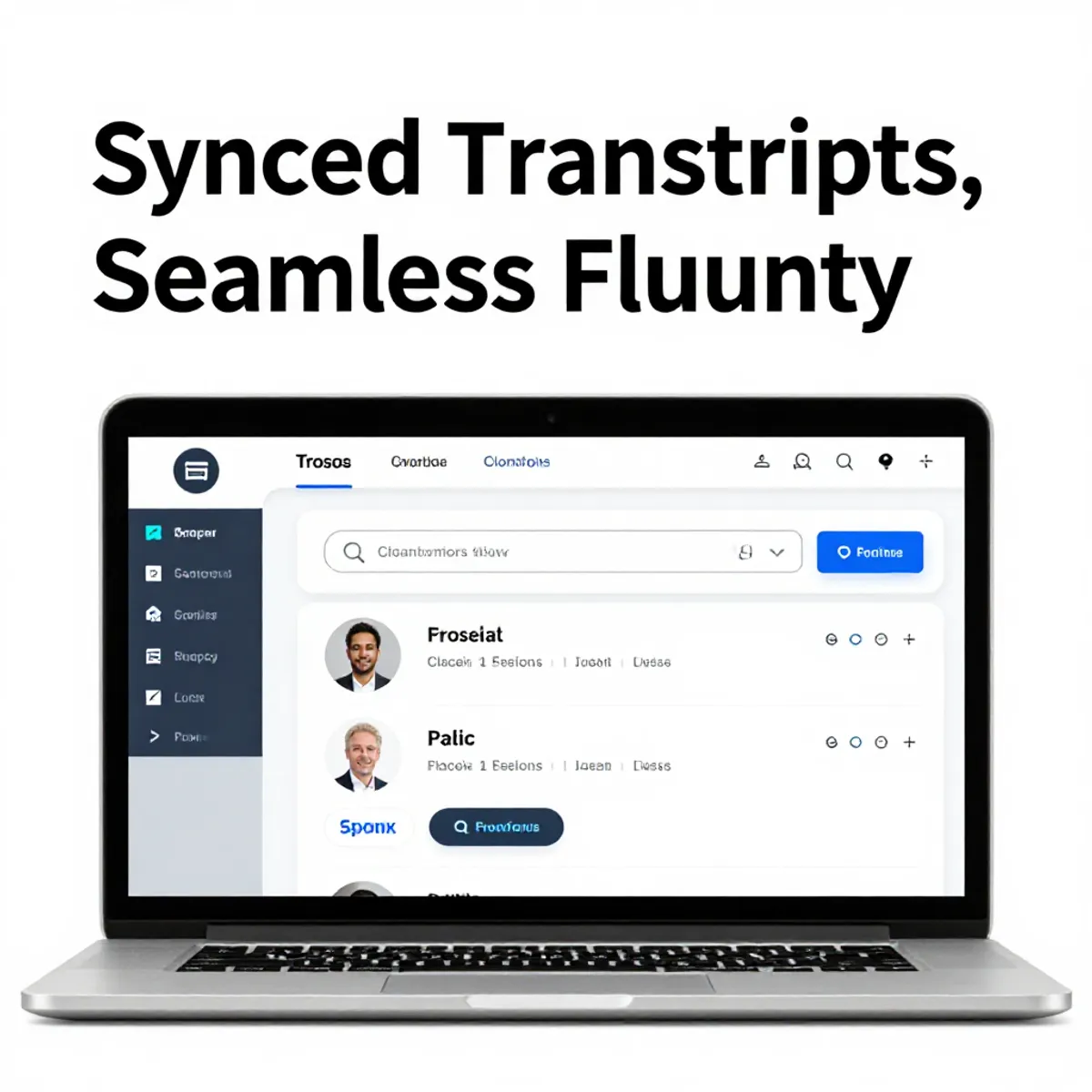
The user interface typically presents this transcript in a scrollable pane adjacent to or below the video player. As playback proceeds, the current word is highlighted in real-time, establishing a tight audio-visual-textual triad. The learner is no longer a passive watcher; they are an active reader following a moving pointer.
The Tap: Instant Lexical Access Without Interruption
The elegance of the system is consummated in the tap interaction. When a user clicks (Mac) or taps (iPad) any word in the synchronized transcript pane, a rich information panel slides or pops up instantly, without pausing the video. This panel is the learner's all-in-one dictionary, pronunciation guide, and micro-grammar reference, pulling data from a comprehensive, built-in lexical database curated for learners.
The primary output is the word's definition in the user's native language. For single-character words, this is direct. For multi-character compounds, the app correctly provides the holistic, often idiomatic meaning—not a mere sum of parts.
Tapping "发动机" (fādòngjī) yields "engine," not separate entries for "发" (issue), "动" (move), and "机" (machine). This correct holistic treatment is a direct consequence of the prior segmentation step and is fundamental to usability.
Beyond meaning, the panel delivers pronunciation data: the pinyin with accurate tone marks (e.g., "mā", "má", "mǎ", "mà"). Seeing the correct tonal notation for a just-heard word is invaluable for reinforcing the sound-meaning connection. Most implementations include an audio button to playback the word's standard pronunciation in isolation for auditory reinforcement.
A third, more advanced layer is grammatical information. The system identifies a word's primary part of speech (noun, verb, adjective, measure word) and may provide brief usage notes. Tapping the verb "给" (gěi, to give) might indicate its common prepositional use meaning "to/for." Tapping the particle "了" (le) might explain its role as a completed-action or change-of-state marker. This moves beyond a bilingual list toward a lightweight, context-aware grammar assistant.
Crucially, the video continues playing. The learner can glance at the definition, confirm a pronunciation, note a grammatical role, and return to the scene in under a second. This maintains the precious flow state of media consumption.
The tool serves curiosity without hijacking attention. The cost of a lookup approaches zero.
The Segmentation Crucible: Why Chinese Word Parsing is the Linchpin and Perpetual Battlefield
The entire seamless experience is architecturally dependent on one foundational and notoriously difficult process: Chinese word segmentation. In English, spaces pre-solve the problem. In Chinese, "I love learning Chinese" is a continuous character stream: "我爱学习中文".
The parser must decide where words begin and end. This is not a trivial task; it is a core problem in computational linguistics that has driven research for decades. The app's parsing engine is its unsung hero and its perpetual Achilles' heel.
The engine employs a maximum matching algorithm coupled with statistical or neural models. It uses a massive dictionary of known words. Starting from the first character, it finds the longest word beginning at that position that exists in its dictionary (forward maximum matching), then repeats. Modern systems use conditional random fields (CRFs) or neural network taggers that consider the entire sentence's context to assign a "word boundary" label to each character.
For standard, modern Mandarin prose, this works impressively well. But, the moment content deviates from the "standard" training corpus, problems emerge with startling frequency. The challenges are manifold and deeply tied to the nature of Chinese.
1. Neologisms and Internet Slang: Chinese internet slang evolves at breakneck pace. A tech review might use "种草" (zhòngcǎo, lit.
"plant grass," meaning "to recommend/rave about"). A gaming stream might feature "下饭" (xiàfàn, lit. "down with rice," meaning "so entertaining you can eat more rice").
These may not exist in the parser's static dictionary, leading to character-by-character parsing ("种" as "plant" and "草" as "grass"), yielding a misleading definition.
2. Proper Nouns: Names of people, places, brands, and fictional characters are a consistent nightmare. "特斯拉" (Tèsīlā, Tesla) might be parsed as "特" (special), "斯" (this), "拉" (pull).
"《流浪地球》" (the film The Wandering Earth) could be split into "流浪" (wander) and "地球" (Earth), losing the title as a single unit. This is particularly damaging in dramas or documentaries where names are central.
3. Homographs and Polysemy: The character "行" can be xíng (to walk) or háng (row, line). The parser must choose the correct reading based on the word it forms (e.g., "银行" yínháng, bank, uses the háng reading).
In ambiguous contexts, it will sometimes choose wrong. Similarly, "东西" (dōngxi) means "thing(s)" colloquially but "east-west" literally. A parser defaulting to the literal meaning fails the learner.
4. Classical and Literary References: Historical dramas, literary adaptations, or philosophical discussions use classical Chinese grammar and vocabulary, where segmentation rules from modern Mandarin do not apply. A phrase like "之乎者也" is a set phrase for classical particles and should not be segmented into individual words with modern meanings.
5. Ambiguous Boundaries: Some phrases exist in a gray zone between a fixed compound and a free combination. "打電話" (dǎ diànhuà, to make a phone call) is almost always a single verbal unit.
But "打篮球" (dǎ lánqiú, to play basketball) could be argued as "打" (play) + "篮球" (basketball). Different parsers may make different calls, with no always-correct answer.
The honest admission—"improving the character parsing is a never-ending effort"—is not a bug; it is a profound feature statement about the nature of Chinese and the limits of technology. The language is a living, dynamic system. New words are coined, old words are repurposed, and regional usages diverge.
No static dictionary or model can ever be perfect. The app's viability, therefore, depends on a continuous learning loop. The community of users becomes a distributed sensor network, reporting segmentation errors from the vast, uncharted territories of real-world video content.
Each correction is a data point to retrain and refine the models. The tool's intelligence grows not just from its initial programming, but from the aggregated experience of its users. This transforms the app from a static product into a living, adaptive platform.
Platform Strategy: Why Mac and iPad Define the Serious Learner's Workspace
The explicit focus on Mac and iPad versions—"If you try it on a Mac or iPad I'd genuinely love to hear what breaks or what's missing"—is a critical strategic signal. It represents a pivot from the mobile phone as the primary device to the larger, more powerful, productivity-oriented ecosystems of macOS and iPadOS. This is not a simple port; it is a re-imagining of the interaction paradigm for a different user context and a different set of study behaviors.
The smartphone is a device of micro-moments and interrupted attention. Study sessions are often brief, during commutes or idle pockets. The small screen makes a persistent transcript pane a significant spatial commitment.
The phone is also a powerful distraction engine. While the app works brilliantly on iPhone for quick lookups, the user experience described suggests a desire for something more substantial.
The iPad, with its larger canvas and robust multitasking (Split View, Slide Over), enables a fundamentally different study mode. A user can dedicate the entire screen to the video app on one side and a note-taking app (Notability, GoodNotes) on the other. They can tap a word in the transcript, see its definition, and then use the Apple Pencil to write the character, jot a sample sentence, or draw a mnemonic—all without leaving their personalized study layout.
The iPad becomes a digital notebook integrated with an interactive video library. The tactile element of handwriting reinforces motor memory for character formation. The iPad is the ideal device for sustained, focused sessions—watching a full 45-minute drama episode with the transcript permanently visible.
The Mac introduces an entirely new dimension: the productivity hub. Here, the physical keyboard and trackpad enable rapid navigation, powerful shortcuts, and seamless integration with a desktop ecosystem. A student might use the app on their Mac while simultaneously having a browser open for supplementary research, a word processor for essay writing, and a flashcard app like Anki.
The ability to quickly copy a parsed word (with its pinyin and definition) and paste it into a spreadsheet or flashcard software is a killer feature for systematic vocabulary building. The Mac is where curation and creation happen. Users might export parsed word lists from a documentary to create themed decks, or source authentic example sentences for a research paper.
This platform shift reveals the target user profile: the serious, self-directed learner. This is not someone seeking a five-minute gamified lesson. This is the university student majoring in Chinese, the professional preparing for an assignment in Shanghai, the researcher analyzing film dialogue, or the dedicated hobbyist consuming hundreds of hours of drama.
These users engage in long-form content consumption and demand tools that support deep work. They value window management, keyboard efficiency, and interoperability with other professional tools. The developer's solicitation for feedback on these platforms is a recognition that the needs of this cohort—export functionality, customizable transcript fonts, system dictionary integration, robust performance with long local files—differ from those of the casual mobile user.
The "what's missing" question is particularly acute on these platforms. Does the Mac version support multiple windows so the transcript can be floated over other applications? Can the iPad version handle Apple Pencil pressure sensitivity for annotating a screenshot?

Is the on-device ASR optimized for different Mac models? These are platform-specific, high-value features that define a premium, desktop-class experience. The move to Mac and iPad is the application's graduation from a clever mobile utility to a central component of a serious learner's digital workspace.
Community-Driven Evolution: The Crowdsourced Path to Accuracy
The origin story—a user's post on a public forum, not a corporate press release—is perhaps its most defining characteristic. It is a grassroots, learner-built tool whose evolution is inextricably linked to an open, public feedback cycle. This model fundamentally alters the traditional developer-user dynamic.
The user, "/u/toku_reader," performs several vital roles. First, they are a discoverer and evangelist, sharing a transformative resource. Second, they are a realistic advocate, framing capabilities ("every word in it is tappable") alongside acknowledged limitations ("improving the character parsing is a never-ending effort"). This transparency builds trust and sets appropriate expectations.
Most importantly, they issue a direct call to action: "I'd genuinely love to hear what breaks or what's missing." This transforms the comments section into an active collaborative testing and development ground.
Other users respond with precise, actionable intelligence: "I tested it on a video about traditional Chinese medicine, and it completely mangled all the herbal names like '何首乌' (hé shǒu wū, fleeceflower root)." "The pinyin for the particle '了' is often missing when it's used at the end of a sentence to indicate a change of state." "On my M1 MacBook Air, parsing a 2-hour movie took over 10 minutes and used a lot of battery." "I wish I could adjust the transcript font size independently of the system font."
These are specific, reproducible bug reports and feature requests rooted in real use cases. The developer can mine this data, identify patterns (e.g., "many errors in traditional medicine terminology"), and prioritize fixes. The reporting user, in turn, feels heard and becomes a stakeholder in the tool's evolution.
This contrasts sharply with the closed cycle of commercial software. Here, the *community is the quality assurance team, the product management board, and the marketing department*. The app's value is amplified not just by its codebase, but by the vibrant, knowledgeable ecosystem around it. The developer's humble sign-off, "I hope this helps your study!", reinforces a posture of service and collaboration.
This model directly attacks the "never-ending effort" of segmentation. No centralized team can possibly possess a perfect parser for the entire, evolving Chinese language. But a distributed community of thousands of active learners, consuming millions of words across countless videos, can collectively identify edge cases, rare usages, and regional variants at a scale impossible for any single entity.
The app, therefore, evolves into a platform for collective intelligence. Its lexical database becomes a crowdsourced artifact, refined daily by the very people who rely on it. Dedicated users might earn recognition for contributions, creating a virtuous cycle of engagement.
The Path to 2026: Invisible Assistance and a New Medium
Projecting the trajectory from its current state to 2026 involves extrapolating trends in AI, hardware, and edtech. The most certain evolution is the core parsing and ASR engine.
By 2026, on-device neural networks, particularly those leveraging Apple's Neural Engine in Silicon Macs and iPads, will be significantly more powerful and efficient. We can anticipate near-perfect segmentation for standard Mandarin, with residual errors confined to the most niche slang, obscure proper nouns, and classical Chinese. The engine may also graduate from simple segmentation to word sense disambiguation. For a polysemous word like "打" (dǎ), which can mean "hit," "fight," "make," "play," etc., the system could present a short list of the most likely meanings based on immediate context.
Integration with the broader learning ecosystem will deepen. Imagine a one-click "Send to Anki" button creating a new flashcard containing the tapped word, its pinyin, definition, and a screenshot from the video capturing the speaker's expression. This bridges passive comprehension and active recall.
Integration with handwriting practice apps could allow users to practice writing characters just encountered. The app could evolve from a comprehension tool into the central nervous system of a holistic study workflow, connecting input (video) to output (writing, speaking, flashcards).
Hardware advancements will be synergistic. The continued performance leaps of Apple Silicon will make on-device processing of long, high-resolution videos virtually instantaneous and power-efficient. The iPad, with the Apple Pencil, could introduce a hybrid annotation mode. If the app performs OCR on hard-coded subtitles (image-based text within the video), users could literally circle words on the screen with the Pencil to trigger the lookup, blending digital interaction with a physical gesture.
The content ecosystem may expand beyond parsing existing videos. The app could partner with creators to produce "learning-enabled" versions of popular content, with pre-validated, 100% accurate transcripts and embedded, context-specific pop-up quizzes. Alternatively, it might develop a library of its own graded, comprehensible input videos, where language is controlled and parsing is guaranteed perfect from a known script.
Finally, the social and gamified layers could become formalized within the app. The informal forum thread might evolve into an official, in-app community with a reputation system. Users could earn points or badges for submitting valid parsing corrections.
A "crowdsourced definition" system could allow users to suggest better example sentences for ambiguous words, with community voting. This would turn the lexical database into a living, wiki-like resource, curated by its most expert users.
The ultimate vision for 2026 is a state of "invisible assistance." The learner opens the app, selects a video, and forgets the tool exists. They simply watch, read, and tap when curiosity strikes. The technology has receded completely into the background.
Parsing errors are so rare they are a novelty, not a frustration. The Mac and iPad versions feel as native and essential as the operating system's own media player. The app ceases to be categorized as a "Chinese learning tool." It becomes simply "how you watch Chinese video." It has successfully dissolved the barrier between consumption and comprehension, making the entire universe of Chinese-language audiovisual content a direct, frictionless learning environment.
Conclusion: The End of Context-Switching and the Dawn of Immersive Fluency
The application described represents more than an incremental improvement over digital dictionaries or browser extensions. It signifies a paradigm shift in how we conceptualize the relationship between learning tools and authentic content. It is not a reference book to be consulted; it is an augmenting layer permanently bonded to the video itself.
By collapsing the cost of a lexical lookup from "several seconds and a fractured attention span" to "an instantaneous tap and a glance," it fundamentally alters the economics of learning from video. The barrier to engaging with compelling, native-level content drops dramatically. Learners are no longer forced to descend to artificially simplified material to maintain comprehension. They can remain in the ocean of real language, with a life raft always beneath their feet.
Its revolutionary power lies in its profound respect for the learner's attention and cognitive resources. It acknowledges that the scarcest commodity in language study is not money or even time, but uninterrupted, focused engagement with the target language. Every second spent alt-tabbing to a dictionary, every moment spent reorienting to a scene after a pause, is a second stolen from the immersive experience.
By reclaiming thousands of such seconds over weeks and months, the app returns hours of pure, contextual exposure. It transforms passive watching into a form of active, self-directed reading practice, where the text is provided in perfect, time-synced alignment with the audio—a feature previously only available in professionally subtitled materials.
The explicit development focus on Mac and iPad is a telling acknowledgment that serious language study is often a desk-bound or lounge-chair activity, not a mobile one. It caters to the user who wants to spend an hour with a film, transcript pane open, taking notes, building vocabulary lists, and truly dissecting the language. These are the users for whom friction is not a minor annoyance but a critical usability flaw. The platform-specific feature requests are the demands of professionals optimizing a workflow.
The open, community-driven development model, born from a forum post, is the engine that will determine the tool's long-term success. It accepts the inherent truth that language is too vast and fast-moving for any single entity to map perfectly. The only viable path to accuracy is a symbiotic relationship between a smart, adaptable core engine and a large, engaged community providing constant, real-world feedback. This turns users into co-developers and makes the tool's intelligence a collective achievement.
Ultimately, this app points toward a future where the artificial divide between "learning" and "entertainment" evaporates. The most effective, sustainable way to master a language is to use it for things you genuinely care about—to laugh at a comedy, to be awed by a nature documentary, to be engrossed in a political debate. By making the comprehension of that content virtually frictionless, the app helps dissolve that divide.
It doesn't teach Chinese; it removes obstacles to experiencing Chinese. And in doing so, it transforms the daunting, monolithic corpus of Chinese video from a textbook exercise into a vibrant, navigable universe—a universe where every word is a door, and you can now open any door without ever stopping your journey. The medium of video becomes the textbook, the classroom, and the playground, all at once.
This is not just a new app; it is a new medium for language acquisition. The era of context-switching is over. The era of immersive fluency has begun.
Responses • 0
0/2000
ID: 1326
Chris
Offline
2 hr
Visited
From
Bakersfield, United States
Send Message