Hangzhou Unscripted: Real Life Questions Answered
China Travel
7 hr • 0 read
A Hangzhou local shares personal, unfiltered insights on daily life in China. Ask about culture, food, travel, and the realities beyond the headlines.
Let’s be clear from the start: I am not a spokesperson, a tour guide, or a cultural ambassador in any official capacity. I’m just a person who lives here. I pay rent, I complain about the traffic sometimes, I queue for the newest milk tea shop, and I watch the sunset over West Lake when I need to breathe. The invitation to “ask me anything” comes from that ordinary, everyday space. It’s an offer to trade stereotypes for specificities, to move from the abstract idea of “China” to the concrete reality of a Tuesday afternoon in Hangzhou, Zhejiang. This article isn’t a comprehensive guidebook or a political analysis. It’s a collection of perspectives, built around the questions people most often have, rooted in the simple act of living one’s life in a specific place at a specific time. The goal is texture over truth, experience over theory.
The Rhythm of Daily Life in Hangzhou: It’s Not All Ancient Canals
When people picture Hangzhou, they see the water-laced alleys of West Lake, misty and poetic. That image is real, but it’s a curated part of the city’s personality. The daily rhythm is a layered mix of the serene and the hyper-efficient. My day starts not with a tea ceremony, but with the frantic efficiency of the city’s public transit. The metro is impeccably clean, shockingly punctual, and packed with commuters scrolling on phones or listening to podcasts. By 2026, Line 3’s extension will have swallowed even more of the city’s sprawl, connecting tech campuses in the west to older districts in the east. This is the first truth: modern Hangzhou is a engine of logistics and digital commerce, powered by the same companies that run your favorite apps.
The “ordinary” is defined by small, repeated rituals. It’s the “dabao” (lunch box) culture—a steaming square of rice, a protein, and two vegetables, packed neatly and carried back to an office. It’s the evening “square dance” (guangchangwu) in any available public space, where retirees move in synchronized unison to a blaring mix of Mandopop and folk tunes, a spectacular assertion of public space and community. It’s the shared-bike queues outside subway stations, a sea of yellow, blue, and orange wheels waiting for the next rider. Life here is communal in its infrastructure but intensely private in its domestic spaces. The high-rising apartment compounds are vertical villages, where you might know your neighbor’s face but not their name. The sense of community is often found in the shared friction—complaining together about the humidity in June, or the sudden downpour that strands everyone under the same awning.
The cost of this rhythm is a palpable pace. There’s a term here, “neijuan” or “involution,” that describes the feeling of running faster and faster just to stay in the same place. It’s most acutely felt in the professional sphere, particularly in the tech and e-commerce sectors that define the city’s economy. The “996” schedule (9 a.m. to 9 p.m., six days a week) is a notorious, if officially frowned upon, reality in many private companies. The pursuit of a stable, middle-class life—an apartment, a car, education for a future child—is a relentless project. The serenity of West Lake is a necessary counterpoint, a sanctioned space for decompression. You go there to be, not to do. That dichotomy—the frantic doing of the city and the contemplative being of the lake—is the central tension of Hangzhou life.
Food as a Cultural Compass: More Than Just Sweet and Sour
If you want to understand a place, follow the food. Hangzhou’s cuisine, Zhejiangcai, is one of China’s eight great culinary traditions, and it’s defined by a philosophy, not a flavor profile. The mantra is “fresh, tender, smooth, fragrant.” It’s about preserving the innate quality of the ingredient, often through gentle braising, quick stir-frying, or steaming. The city’s signature dish, Dongpo pork, is a masterpiece of this—fatty belly meat slow-cooked in Shaoxing wine and soy until it’s translucent and melts on the tongue. It’s rich, but it’s not cloying; the sweetness is layered with umami and aroma.
This is not the “sweet and sour” Chinese food found abroad. That’s a different dialect. Here, sweetness often comes from the natural sugar of ingredients like winter melon or the careful addition of rock sugar to balance saltiness. Vinegar is used sparingly, for brightness. The palate is subtle. A dish of “xihu cuyu” (West Lake fish in vinegar gravy) is about the delicate, lily-pad-like texture of the fish and the sharp, clean cut of the vinegar sauce. You learn to appreciate the absence of overpowering spices. Chili is present, especially in neighboring Jiangxi, but it’s a supporting actor, not the star.
Eating is a social algorithm. The “hot pot” (huoguo) is less a meal and more a multi-hour interactive event, with a simmering broth at the center and plates of raw vegetables, thinly sliced meats, and tofu arranged around it. It’s democratic—everyone cooks their own food in the shared pot—and it forces conversation. For a quick bite, the “nan Song” (Southern Song) dynasty-style noodle shops are temples of speed and flavor. You point at the ingredients—a slab of braised pork, a handful of greens—and they’re tossed into your bowl of freshly pulled noodles in seconds. The street food is a universe of its own: “cong you bao” (scallion oil buns) that are flaky and explosively savory, “jian dui” (sesame balls) with a molten red bean core, and “roujiamo” (Chinese hamburgers) where the “bread” is a crispy, pan-fried flatbread stuffed with spicy minced pork.
But food is also a marker of season and region. In spring, it’s all about fresh bamboo shoots and wild greens. In autumn, the crabs from nearby Yangcheng Lake are a national obsession, steamed simply with ginger and eaten with a specific set of tools. To eat in Hangzhou is to participate in a cycle of nature and locality that feels increasingly rare in a globalized world. It’s a daily, delicious reminder that you are in a specific ecosystem.
Navigating Cultural Nuances: The Unspoken Rules
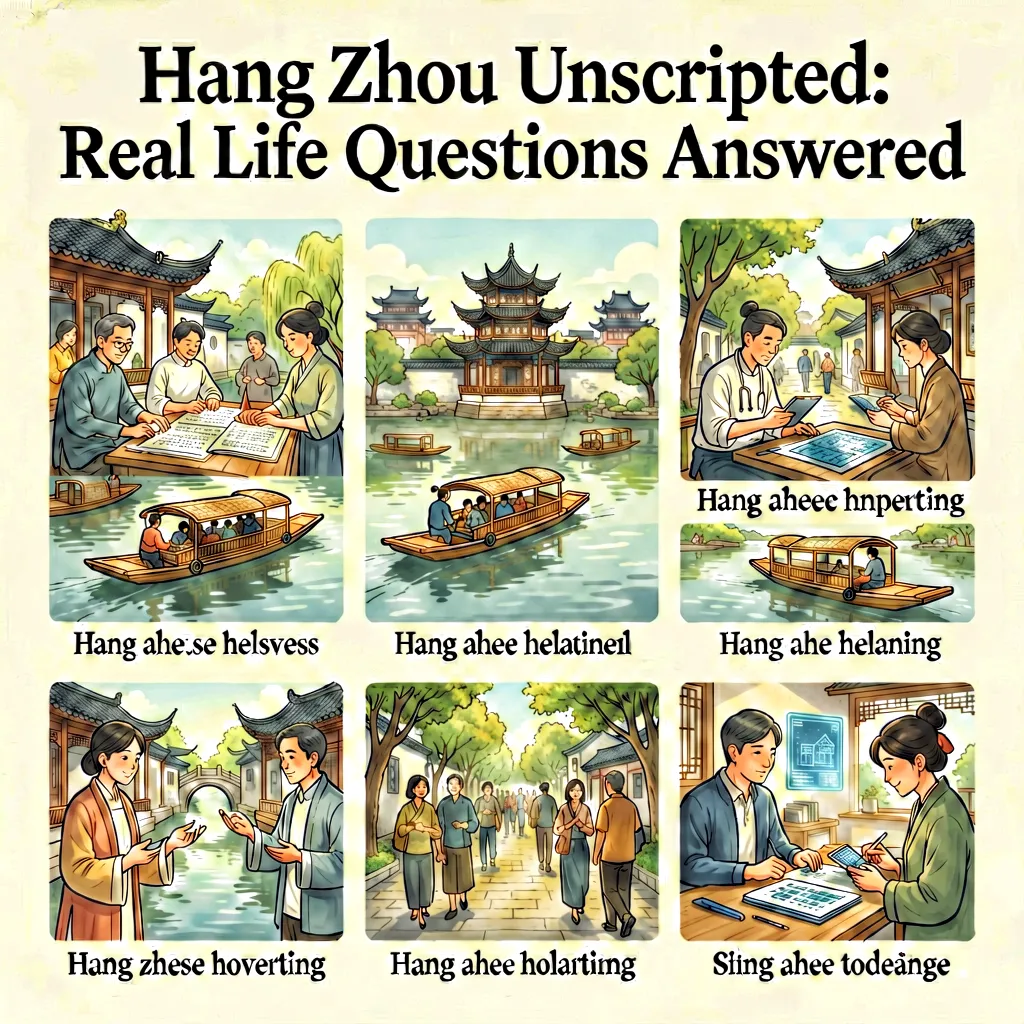
The biggest questions usually revolve around social norms. What’s polite? What’s rude? The answer is often: it depends on the context, and the rules are fluid. The most foundational concept is “mianzi,” or “face.” It’s not about embarrassment; it’s about social standing, dignity, and harmony. You give “face” by showing respect, acknowledging someone’s status or achievements, and avoiding public criticism. You save “face” by accepting compliments graciously (with a humble “na li, na li” – “where, where”) and by handling disagreements privately, indirectly. A direct “no” is often considered a face-losing act. Instead, you’ll hear “kan kan” (we’ll see), “you kong shuo” (let’s talk when there’s time), or a long, convoluted explanation that circles around the refusal. Learning to hear the “no” in the “maybe” is a key skill.
Hierarchy is another subtle current. It’s less about rigid class and more about acknowledging roles—age, job title, length of service. When meeting a group, you greet the most senior person first. When drinking at a formal meal, you toast the highest-status individual first, holding your glass lower than theirs as a sign of respect. The practice of “hejiu” (drinking together) is a social contract. To refuse a toast can be a major slight. The ritual of pouring tea for others before yourself, and tapping the table with two fingers when someone pours tea for you (a gesture supposedly originating from a Qing emperor incognito), are small, potent signals of belonging.
The concept of “guanxi” (relationships/connections) is the social operating system. It’s not “corruption” in a simplistic sense; it’s the deep, reciprocal network of obligation and trust that governs everything from getting a table at a packed restaurant to securing a business deal. It’s built through shared meals, favors, and time. You don’t ask a new acquaintance for a “guanxi” favor. You build it slowly, through consistent, genuine interaction. The Western idea of transactional networking can feel cold here. The relationship is the transaction.
Finally, there’s the “gaokao” (national college entrance exam) mentality that permeates everything. The pressure to excel, to get into the right school, to secure a prestigious job, is a collective anxiety that shapes family dynamics, educational choices, and even city planning. It creates a society that is fiercely competitive but also deeply invested in collective success—the success of the family, the company, the nation. Individual dreams are often framed within this collective project. This isn’t to say people don’t have personal passions; they do. But the path to pursuing them is often negotiated with, and sometimes in service of, these larger expectations.
Travel Beyond the Postcard: Seeing the Real Hangzhou
West Lake is the crown jewel, and you must see it. But understanding its role is key. It’s not a “natural” site; it’s a masterpiece of landscape design, a UNESCO World Heritage site precisely because it’s a cultural artifact shaped by poets, emperors, and philosophers for over a millennium. The “Ten Views of West Lake” are not just pretty spots; they are painted poems, each with a story. Visiting it on a weekday morning, you’ll see retirees practicing calligraphy with water brushes on the stone paths, groups doing Tai Chi, and fishermen using cormorants—a living museum of traditional leisure.
But to see the city’s soul, you must venture beyond. The “ Xiaohe Zhijie” (Small River Hezhuang) historic street is a beautifully restored water town, but it’s also a commercialized stage set. For something more lived-in, head to the “Qiantang River” tidal bore viewing area in spring. The sight of the river water being pushed backward by the incoming tide is a raw, powerful display of nature that dwarfs any human-made garden. Or take bus 7 to the “Longjing” (Dragon Well) tea village. Hike through the terraced tea fields, smell the drying leaves, and visit a family-run plantation. The experience of sipping fresh-picked green tea in a farmers’ home, with the scent of the fields in the air, connects you to the region’s economic and cultural heart.
The city’s modern face is the “Qianjiang New City” CBD, with its skyline of glass towers, including the spectacular “Hangzhou Grand Theatre” shaped like a moon. It feels like a different city—clean, wide avenues, international cafes, and the headquarters of Alibaba and Ant Group. This is the “future” Hangzhou, a city built on data and logistics. The contrast between the ancient, human-scale West Lake and the futuristic, data-driven Qianjiang district is the city’s central narrative. The true magic is in the seam between them: the tea house with free Wi-Fi, the elderly man in traditional dress checking his smartphone, the temple bell that rings near a server farm.
For a day trip, the water towns of “Wuzhen” or “Xitang” are stunning but heavily touristed. For a more authentic feel, try “Nanxun,” a less-visited古镇 (ancient town) where you can see how wealthy merchant families from the late Qing dynasty lived, with a blend of Chinese and European architectural influences. It’s a quieter, more contemplative experience. Travel within Zhejiang province is easy via the high-speed rail; you can be in Shanghai in under an hour, or in the mountain retreat of “Moganshan” in two. But sometimes, the most profound travel is vertical: taking the elevator to the 45th floor of a hotel in the city center just to watch the thunderstorm roll over the Qianjiang River, a spectacle of nature meeting megacity.
Addressing Common Misconceptions: The Weight of “The Narrative”
The most frequent questions are about the things people have heard. “Is the internet really censored?” “Do people have freedom of speech?” “What about Tibet/Xinjiang/Taiwan?” These are heavy, complex geopolitical questions that a personal perspective can only touch on peripherally, because my experience is, by definition, limited to my bubble. I can tell you that for the vast majority of people in Hangzhou, daily life is not spent thinking about these issues. They are thinking about their next work project, their parents’ health, their child’s “buxiban” (cram school) schedule. The political discourse that happens in Western media is not the primary discourse in the coffee shops or on the subway here. It exists in a different register, in official channels, in academic papers, in controlled public discussions.
That doesn’t mean there’s no awareness or no personal opinion. People have incredibly nuanced, often cynical, views about local governance, environmental policies, or economic trends. The critique is usually directed at implementation, efficiency, or corruption—the “how,” not necessarily the “what” of the system. The space for public dissent on core political tenets is, as documented by numerous international bodies, severely restricted. The social contract here is different: the state provides stability, infrastructure, and a path to prosperity, and in return, public challenge to its authority is not a tolerated form of participation. This is the stark, non-negotiable reality. My personal, neutral observation is that most people I know navigate this by focusing their energy and ambition on the spaces that are open—their careers, their families, their hobbies. The political dimension is a background hum, not the foreground melody.
On the “censorship” question: yes, there is a system, often called the “Great Firewall.” It blocks access to a defined list of foreign websites and platforms (Google, YouTube, Twitter, Facebook, major Western news sites). For an ordinary person, this means using domestic alternatives: Baidu for search, WeChat for everything (messaging, payments, social media, mini-apps), Douyin for short video, Weibo for public discussion. It’s a parallel ecosystem. The firewall is not a perfect, total barrier; technically-minded people use VPNs. But for the mainstream, the domestic internet is a fully functional, vibrant, and commercially sophisticated world. The experience is not one of “lack” but of “difference.” You don’t feel you’re missing Facebook; you’re deeply engaged in WeChat’s “Moments” feed. The feeling is one of encapsulation, not necessarily deprivation. The question isn’t “Do you have access to X?” but “What is the nature of the ecosystem you do have access to?” That ecosystem is all-encompassing for daily life.
Practical Advice for Visitors and New Residents: The Little Things
If you’re coming to Hangzhou, forget the idea of “getting by” with English. While younger people in universities or tech companies may have a working knowledge, outside those bubbles, English is a foreign language. Learn three phrases: “Ni hao” (Hello), “xiexie” (Thank you), and “duo shao qian?” (How much money?). Use a translation app with offline capability and a camera function for menus and signs. Pointing is a universally understood language. Carry cash. While Alipay and WeChat Pay are ubiquitous, some small street vendors, older taxis, or ticket booths for minor attractions still operate on cash only.
Get a local SIM card immediately. Data is cheap and essential for navigation (Amap is the Google Maps equivalent, more detailed for China) and translation. Register your passport at a local police station within 24 hours of arrival if staying in a private residence (a requirement often missed by Airbnb guests). Download the “Hangzhou Citizen Card” app or the national “Health Code” app (though COVID restrictions are largely gone, the infrastructure remains and may be repurposed for other public services).
Understand the queue. Queues are sacred and strictly observed. Cutting in line is one of the most visible social sins. When boarding a bus or train, wait for passengers to alight fully before boarding. The flow is orderly, not pushy. In subway stations, follow the colored lines on the floor for transfers—they are your lifeline.
On safety: Hangzhou is exceptionally safe by global standards. Violent crime is very rare. Petty theft (phone snatching, pickpocketing) exists in crowded areas, as it does anywhere. The common sense rules apply: don’t flash expensive items, be aware in packed subway cars, secure your phone in your front pocket. The real daily danger is the traffic. Scooters and electric bikes move with terrifying, silent speed on sidewalks and bike lanes. Look both ways, and then look again, before stepping off any curb.
Finally, adjust your expectation of “service.” The concept of “the customer is always right” is not deeply ingrained. Service can be brusque, indifferent, or hurried. A clerk might be on their phone while serving you. A waiter might pour tea without a smile. This isn’t personal hostility; it’s a different cultural performance of the service role. The transaction is efficient, not experiential. Don’t expect constant pleasantries. Your polite “xiexie” will be met with a grunted “bu keqi” (don’t be polite) or a simple nod. The relationship is functional. Let it be.
The Personal Perspective: Why Share This?
Why does a person in Hangzhou spend time answering these questions? Partly, it’s the simple joy of connection. After the initial “Wow, China is so big/so different” conversation, you can get to the human stuff: the frustration with the housing market, the love for a particular park, the debate over the best brand of frozen dumplings. These are universal conversations. Sharing them bridges the gap between the monolithic “China” and the specific, lived reality.
There’s also a quiet desire to complicate the narrative. The international discourse on China is often polarized, swinging between awe-inspiring growth and dystopian control. Both are true, but neither is the whole story of a Tuesday. The whole story is in the detail: the smell of rain on hot pavement after a summer storm, the specific melody of the garbage collection truck’s tune, the way the light hits the West Lake at 5:30 p.m. in late October. My perspective is one grain of sand on a vast beach. It is not representative, but it is authentic. It’s a view from the ground, not from the stratosphere of geopolitics.
So, ask about the smell of the air after it rains (it’s clean and petrichor, thanks to the city’s massive greening efforts). Ask about the sound of the city at 3 a.m. (mostly silence, broken by the occasional drunk argument or the hum of the 24-hour pharmacy). Ask about the feeling of seeing your parents use WeChat Pay without understanding the technology behind it. Ask about the collective sigh when a new, pointless form appears on the company’s internal chat. These are the textures of life. They don’t explain the system, but they explain what it feels like to be inside it. That’s the only perspective I can truly offer: the felt experience of a life being lived, here, now, in Hangzhou. The questions are the door. The answers are just the room on the other side, as I see it.
Responses • 0
0/2000
ID: 1326
Chris
Online
From
Bakersfield, United States
Send Message