Sui Dynasty
Original
Chinese History
Dec 04 • 1511 read
Sui dynasty (581-618 AD) is a unified dynasty that inherited the Northern and Southern Dynasties and started the Tang Dynasty in Chinese history, the Grand Canal constructed in this period.
/fit-in/0x0/img/201912/Sui_Dynasty-article-1575442445.jpg)
Sui dynasty ruled for a short period, but this dynasty set the foundation for advanced politics and economical for the following dynasties in the next millennium in Chinese history.
Farmers were pleased and repulsed by the action of the Sui emperors who ruled in this dynasty. Some of the projects built by the Sui rulers live on today, which continuously reminding Chinese citizens and tourists about the Sui dynasty. In 581 AD, the Yang Jian who is also known by Emperor Wendi of Sui found the Sui dynasty. Before the establishment of the Sui dynasty, China was going through a period known as the Southern and Northern dynasties, during that period, the Chinese state was divided between several states. Emperor Wendi of the Sui was working as a high ranking official in the Northern Zhou dynasty court, which governed much of the northern part of China from their capital of Chang’an. Yang Jian was a talented general, and he gained his power through the marriage of his daughter to the heir of the Northern Zhou dynasty, Yuwen Yun, who later became the Emperor Xuan of the Northern Zhou. During the Sui dynasty, science, arts, and commerce all flourished. After 300 years of division and disintegration following the collapse of the Han dynasty in 220 AD, China was once again unified under the Sui dynasty. The governmental and political institutions were established during this short period and lay the foundation for the development and prosperity of the succeeding Tang dynasty.
Rulers of the Sui Dynasty - Yang Jian/Wendi (581-604)
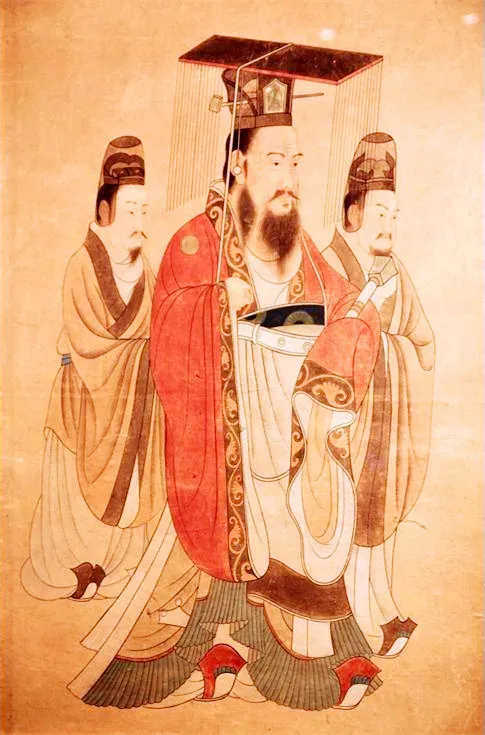
Yang Jian was the regent for the child-emperor of the Northern Zhou dynasty. Yang Jian took control of the throne after the child emperor's father died in 578 CE. He was able to gain support from citizens and government officials, who helped him to keep the throne. He was a Buddhist, who had scholarly education and military training, and was employed by the age of 14. After ruling the Sui dynasty for eight years, In 589 CE, Wendi combined over 500000 troops along the Yangzi River. He planned to take over southern China, and Wendi was successful by 590 CE. He was the first one in three hundred years to govern a united China. Under his ruling Sui dynasty achieved many things. Inventions such as outdoor rooms that could adjust several hundred guests and which were rotated by mechanisms located underneath the rooms enhanced life at the palace. His wife believed in monogamy and had one concubine killed when Emperor Wendi fell in love with the women. To unify north and south further, he holds his power on the army to stop emerging rebellions, he dispersed private army and gave land and rights as peasant farmers to its soldiers.
Emperor Wendi reconstructs some parts of the Great Wall and extended towns to the border of his empire. He also extended the canal system between south and north China, which helped in easier trade between the two areas. Grand Canal system was established through waterways, which helped in the transport of rice and other food items to the north. He was hardworking, who would meet with officials at dawn to reviewed paperwork, laws and other judicial decisions without having a secretary. He redistributed land and doubled the income tax for government treasuries. He was successful in invading northern Vietnam and reestablishing Chinese authority. He also sent forces to Korea to take back the control of Chinese territory but was unsuccessful. He used Buddhism for the appeal to unify China and built more than 400 Buddhist temples. Over 100,000 new images of Buddha were erected around China, and over 1,500,000 images were restored.
Yang Guang (569-618)
Yang Guang ruled the Sui dynasty from 604 to 618 as a second emperor. He spent his teenage years in southern China. He was Buddhist and also believed in Daoism and Confucianism. Yang commissioned literary writings and increased library holdings. He strengthened the centralized administrative framework, designated Luoyang as a vital city following the capital city of Chang’an and constructed the Grand Canal. He also faced rebellion throughout the country as he failed in a series of army campaigns in Korea. He was famously outraged at the letter he received from the official diplomatic delegations sent by the leader of Japan named Shotoku. The people's dissatisfaction also grew as Yang Guang continued large-scale, labor-intensive construction projects, making more than 2 million people work on the construction of the Grand Canal. In 616, when rebellions broke out all around China, Emperor Yang Guang killed all those officials who advised him to return to Chang’an to deal with the issues and shifted his base to Yangzhou, which was a significant location along the Grand Canal.
Yang Guang centralized government system introduced legal codes. Before his ruling, it was difficult to get government jobs without having an official’s connections. Emperor Yang set-up a civil service examination system in China to select potential candidates for bureaucracy. This examination helped to shape China’s political, cultural, and intellectual life for centuries and influenced several other countries to adopt such an examination system. Though there were exams for officials as early as the Han dynasty, an extensive modern examination was first developed in 605, at the time of the Sui dynasty. There were tests for recruitment to the imperial civil service bureaucracy, which became the major path to government offices by the mid of Tang dynasty.
Emperor Yang rebuilt Luoyang capital by using 2,000,000 men's power, extended its size and built lakes and parks that covered 60 squares miles. One of the influential architects in Chinese history named Yuwen Kai was active during the period of the Sui dynasty. He designed the Sui capital of Changa’an present-day Xian and also projected to build the city of Luoyang. Though Luoyang capital was smaller than the Changa’am, so it became well known for its innovative planning and extravagant palace structure. During the Yang empire, envoys and Buddhist monks from Japan began to arrive in China. Their relationship helped to share political and religious ideas for some time. The Yang empire work on the capital at Luoyang, Grand Canal, and failed attempts of their empire to take their territory from Korea began to take a toll on the Chinese people. The people started a rebellion, government officials who criticized the emperor were killed, and challengers to the emperor began to mobilize.
Yang Guang was spoiled by drinking and dining, spending more time in his palaces and less time involved in government affairs, and was unable to recover his power. He was killed after two years, which led to the decline of the Sui dynasty. According to professor Li Wencai of Yangzhou University, the history of China is always revised by the succeeding dynasty in which the previous dynasty is always demonized. That is why the Tang dynasty, which succeeded Sui used the name Yang Guang is ‘to arrogantly maintain distance from the common people.’ In reality, many institutions of the Sui dynasty were continued in the Tang dynasty. Yang Guang was a great ruler of considerable achievements, while Tang desperately tried to stain his reputation. In March 2013, the tomb of Emperor Yang was found in Yangzhou. However, since there already exists a mausoleum in Yangzhou, the discovery created a controversy as to which tomb is the real one.
Emperor Gongdi
After the death of Emperor Yang Guang in 618 CE, his grandson “Gongdi” which means a respectful emperor, succeeded him as the third emperor of the Sui dynasty. Emperor Gongdi was born in 611 CE, and his birth name was Yang Yu. During his reign, a regent governed the Sui dynasty. The regent, Li Yuan, took control of the capital at Luoyang in 618 CE. Emperor Yangdi had spared this same Li Yuan during the rebellions before Yang Guang death. Li Yuan overthrew Emperor Gongdi and declared himself to the first emperor of the Tang dynasty.
Yang Guang and the Grand Canal
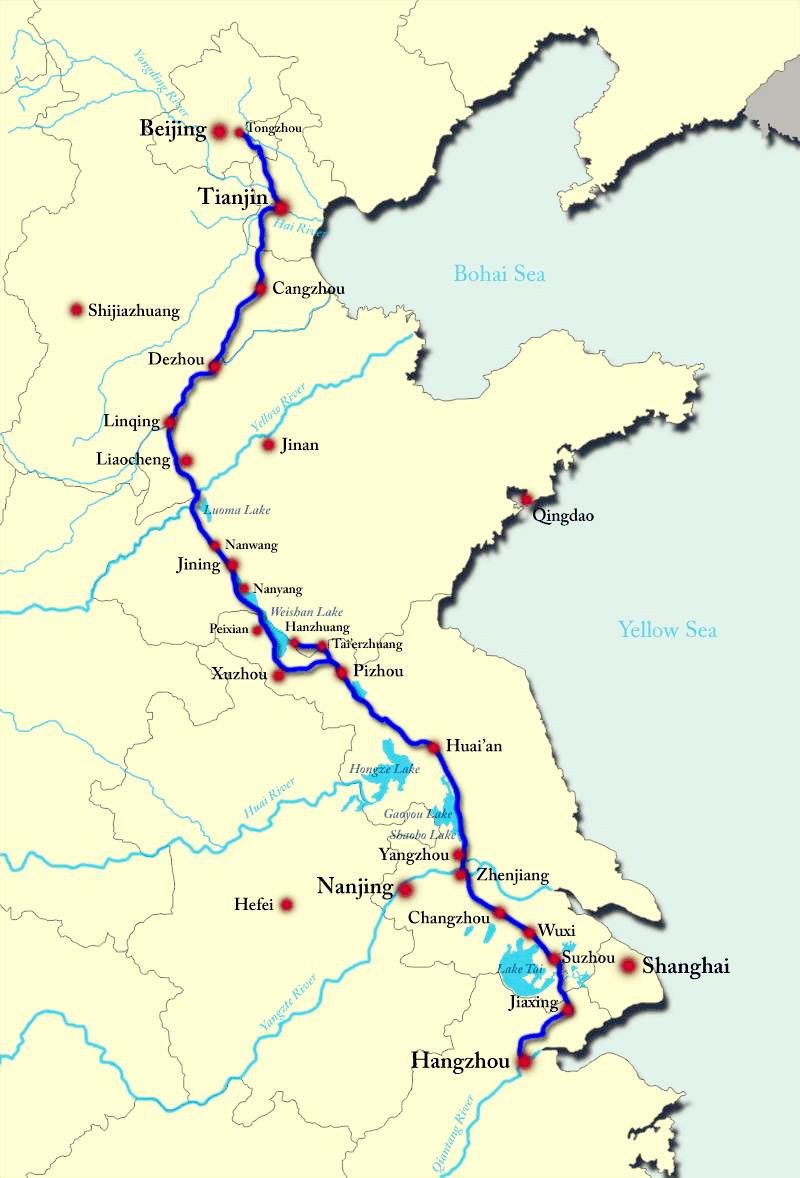
Yangzhou in Jiangsu Province, which is located on the Yangtze River has flourished as a city of water transportation. The Canal that runs through the center of the city is iconic. Initially constructed in the 5th century B.C., it was developed and expanded into the Great Canal by Yang Guang. Green willows grow along both sides of the canal and are known among residents as ‘Yangliu.’ They were planted along the banks when Emperor Yang had his people build the canal. Yang Guang spent ten years in Yangzhou as a provincial governor before becoming emperor in the capital Changan, and he loved the Yangzhou city and its scenic beauty. In 605, after finishing the construction of a part of the Grand Canal, Yang Guang visited Yangzhou in a ‘dragon boat’ a boat that used for pleasure trips.
The construction of the great Grand Canal was necessary for the transport of products from the developed lower reaches of the Yangtze River to the Northern area. Though it is said that the emperor planted willows on the banks to suit his taste for austere elegance, it is believed that they were planted to reinforce the banks. Yang Guang had tremendous foresight since the Grand Canal has proved priceless even after the decline of the Sui dynasty. Though part of the canal is now detached, it is still in use after all these years as a route for transporting cargo.
Grand Canal, it’s History and Construction
The Grand Canal is the largest ancient artificial waterway in the world and an engineering marvel on the scale of the Great Wall of China, which was launched in the Sui dynasty period. Its construction was started in 540 A.D and completed in 1327 A.D, it is 1107 miles long and has mostly been dug by hand force. Today, the Great Canal has been extended from Tianjin in the north of China to Hangzhou. It attaches Beijing and Xian in the north with Shanghai in the south and links four great rivers, the Yangtze, the Yellow, Qiantang, and Huai. Water levels were maintained by using a system of stone gates that divert water in and out of the canals. In the situation of flood gates were opened so that water can be diverted into lakes. In June 2014, the Grand Canal was named a UNESCO World Heritage Site. On paper, the Grand Canal runs, 1760 kilometers, between Beijing and Hangzhou, which is about 200 kilometers from Shanghai. However, since the 1970s the northern part of its course, from Beijing to Jining, has been too dry and shallow to accommodate shipping. The waterway's main commercial artery encompasses 580 kilometers from Jining to the Yangtze.
The original canal system, constructed by king Yang of the Sui dynasty, was seen by historians scholars as a brilliant act. Rivers in ancient China mainly ran from west to east, and Emperor Yang wanted to break this hold of geography. He required a way to move rice from the productive region around the Yangtze northwest to feed his court, and his armies, which were continuously fighting nomadic tribes. The emperor’s officials forced an estimated million workers, mostly peasants, into the construction of the first section of the canal. Supervised by thousands of soldiers, the men and women were driven around the clock. Yang ‘inflicted intolerable sufferings’ a ninth-century poet wrote, yet these projects provided endless benefits to the people. On paper, it is stated that the work was finished in 171 days in the years 605, but in reality, it took six years to complete and claimed an untold number of lives, many of the worker were villagers who starved because there were not enough hands left to harvest the crops.
The canal did more than move grain, as the country uniting feature, it was a powerful political symbol and a strategic target for attackers. In the early 1840s, during the First Opium War, the British wanted to put a stranglehold on China, they occupied Zhenjiang, at the intersection of the Great Canal and the Yangtze, controlling the flow of tax revenues and grain to Beijing. Within weeks China surrendered. The Grand Canal was also a cultural channel. Rulers on visits to examine the canal’s locks and coopted local ways. That’s why it is said to be how Beijing developed two trademarks; Peking opera, from Anhui and Hubei Provinces and Peking duck, from Shandong Province. Theater troupes, who depended on the canal to get around, said prayers to its wharves, while its very presence moved poets.
The Grand Canal was constructed by connecting a series of smaller canals built-in separate areas. It was constructed mainly to move troops from the north to south and transport food from the fertile agricultural lands in the south to overpopulated areas in the north. It was also helped merchants to circumvent transporting their shipments on the high seas where they were helpless to typhoons and pirates. Construction of the Great Canal has been done in a fragmentary fashion over the centuries, new sections were added, and others were reconstructed. The majority of the work was done during the Sui dynasty under the leadership of the brutal emperor Yang DI, who put 5.5 million workers to work for six years. It is unknown how many workers died while digging the canals but it was probably in the tens of thousands. During the peak of the Tang dynasty, which followed the Sui dynasty, long strings of barges carried 100000 tons of grain a year from the rice fields in the south to the north. Kublai Khan, the great Mongol leader, put three million people to work in 1279 to extend the Grand Canal 135 miles so that rice could be transported from the fertile Yangtze Delta, near Shanghai, to his new capital, present-day Beijing.
The population at the time of Sui dynasty
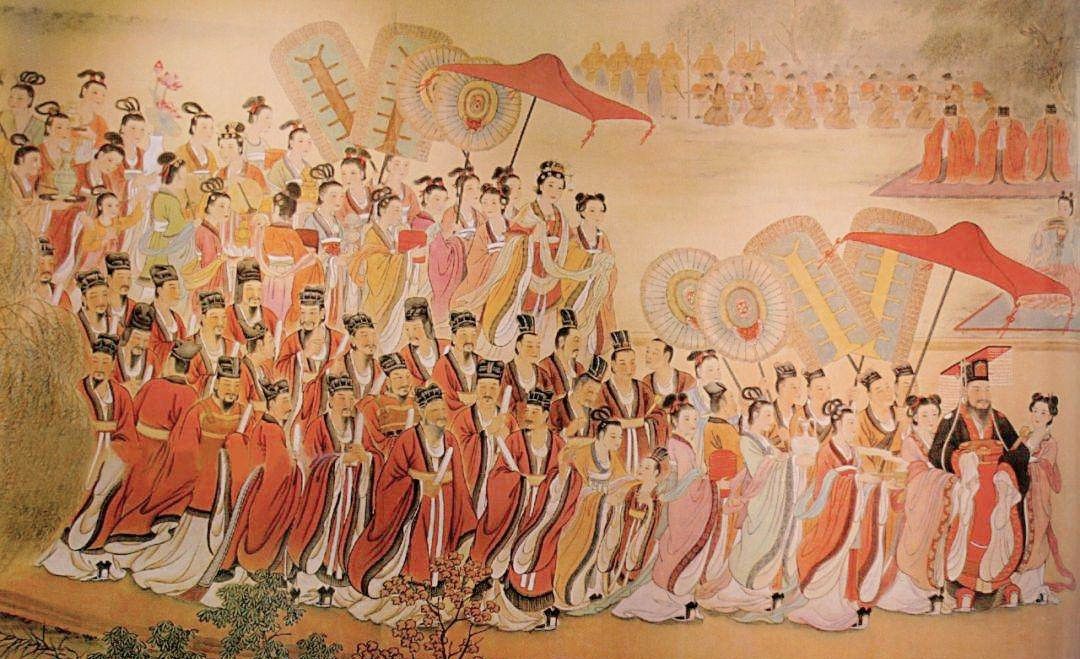
In 606, the census was conducted under the Sui dynasty, which showed the empire population was about 46 million people, and that was lower than the Han dynasty, which was about 60 million people. This change in population shows that the past few centuries were damaging to the people of China. There had been significant changes in the distribution of the population in the past few centuries. The majority of the people during the Han period were living in the North, while the south part was thinly populated. The chaotic conditions which caused the fall of the Han dynasty also moved a large number of peasants migration to the south, and eventually, by the end of the 6th century CE, a third of the population was living in the South of China.
Religion at the time of Sui dynasty
Buddhism was firmly established in China by the end of the middle of the 6th century. The Buddhism popularity was because of Emperor Wendi, who was presenting himself as an ideal Buddhist monarch, and he constructed Buddhist temples, monasteries, and promoted Buddhism as the religion of the ordinary people. However, Confucianism reserved its status as the medium of education and as an ideology of the government. Government officers were expected to have a good grip on the Confucian philosophy and remained broadly Confucian, though practicing Buddhism in their private life. To keep the loyalty of his administration, Wendi therefore also ensured that he presented himself as an ideal Confucian ruler. That’s why he made sure that the knowledge of Confucian writings was tested in his new civil services examinations system.
Fall of the Sui dynasty
There was much dissatisfaction with the losses of forced labor and heavy taxes. Compulsory labor duties and heavy taxation led to widespread revolt and short civil war. Ruler Yang was killed in 618 by his advisor, Yuwen. Li Yuan (566-635) in the northern part of the empire and his clan emerged as powerful rulers. After capturing Daxing (present-day Xian) capital, Li Yuan declared himself as Emperor Gaozu of the Tang dynasty in the year 618. It is said that Li Yuan was the cousin of Yang’s, their mother were sisters.
The Sui dynasty cemented the way for a long and prosperous dynasty, as the Qin dynasty did. The Sui dynasty ruled for the shortest duration and ruled much the same region 800 years beforehand, although their vast empire only lasted for 15 years. Just as the Qin dynasty did, the Sui dynasty unified China after a period of wars, then used the people and constructed massive projects and fought wars on large scales. Qins Great Wall and Sui dynasty Great Canal ranked among the world’s most magnificent feats of engineering at the time. Tyranny and an unknown number of workers' lives led to the fall of both the Sui and Qin dynasty in civil rebellions. Both Sui and Qin dynasties cleared the way and built the foundation for prosperous and long-lasting dynasties that followed. The Qin dynasty was replaced by the Han dynasty (206 BC-220AD), and the Sui dynasty paved the way for the golden age of the Tang dynasty (618-907).
Responses • 0
0/2000
ID: 322
Matthias
Offline
1 day
Visited
From
Orlando, United States
Send Message