Phrase order in the Mandarin
Original
Learn Chinese
Nov 21 • 1191 read
different phrase order different meaning, the phrase order is the basic structure of Mandarin grammar.
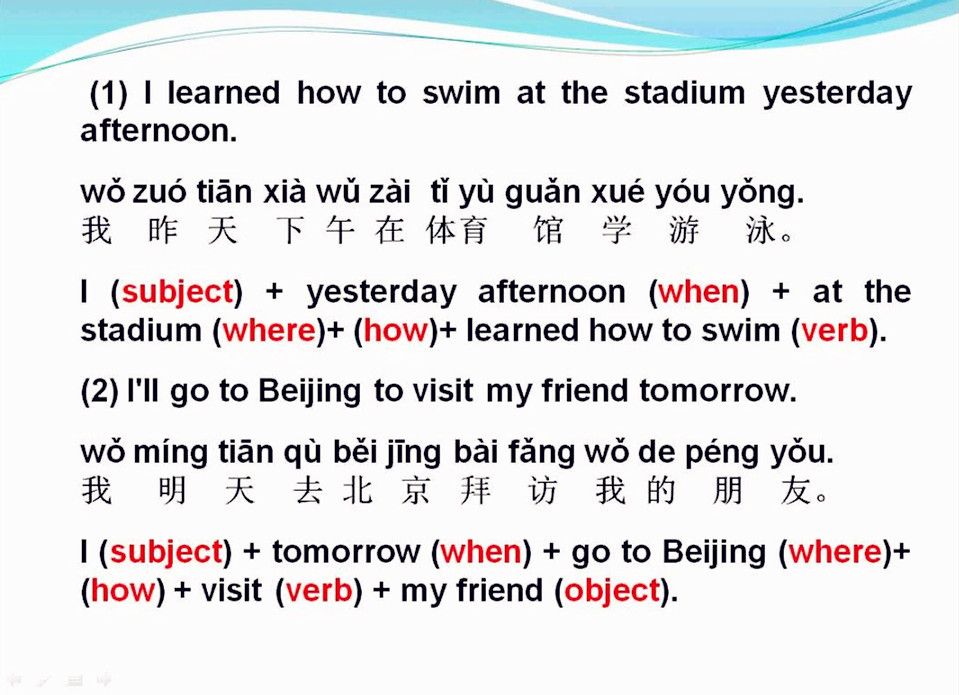
From: "Modern Mandarin Chinese Grammar"
1. Basic phrase order
The basic order of Mandarin sentences is
Topic + Subject + Predicate
A sentence need not have an overt topic. In addition, if the subject is understood based on the context of the sentence, it is often omitted from the sentence.
The predicate covers everything in a sentence except for the topic and subject, including the verb, objects, negation, adverbial modifiers, and prepositional phrases. The rest of the article will illustrate the order of these sentence elements in a sentence.
2. The position of direct and indirect objects
In the neutral sentences in which nothing is emphasized, the direct and indirect objects of the verb are often placed right behind the verb. We refer to the verb and its objects as a verb phrase. In such a phrase, the indirect object usually precedes the direct object.
For example:
Subject + verb + indirect object + direct object
他给我 一本书。
He gave me one book.
Most verbs are followed by only one direct object.
Subject + verb + direct object
我看了那些书。
I read those books.
The object may also be placed before the subject to emphasize it. In this way, the object is topicalized.
3. The position of prepositional phrases
Prepositional phrases are always placed before the verb and its objects.
Subject + prepositional phrase + verb + direct object
他跟他的女朋友吃饭。
He eats dinner with his girlfriend.
4. The position of location phrases
The location phrase is a type of preposition phrase, which is often placed before the verb phrase.
Subject + location phrase + verb phrase
我在家吃饭。
I eat at home.
In a location phrase, the names of different components of a location are written down from the largest to the smallest. The addresses on letters also follow this principle.
北京市朝阳区建国门外大街一号
Number 1, Jianguo Gate Outer Road, Chaoyang District, Beijing, China
5. The position of "time when" phrases
The phrase that indicates the time when a situation takes place is often found before the predicate.
Subject + time when + predicate
我每天喝咖啡。
I drink coffee every day.
他每天跟他的女朋友吃晚饭。
He eats dinner every day with his girlfriend.
If "time when" is emphasized or contrasted with another time, it may occur before the subject:
昨天我不太舒服。今天已经没问题了。
Yesterday I was a bit uncomfortable. Today it is no longer a problem.
Within the “time when” phrase, the different parts of the time are written down from the "年" (year) to the "日" (day):
For example:
2018年2月15日
2018 Year February 15 → February 15, 2018
昨天晚上8点钟。
Yesterday evening 8 o'clock → 8 o'clock last night
6, The relative order of the "time when" phrase and the location phrase
When a sentence includes both a “time when” phrase and a location phrase, the “time when” phrase is often placed before the location phrase.
Subject + time when + location + verb phrase
我每天在家吃饭。
I eat at home every day.
7. The position of adverbs
Adverbs are often placed before predicates, verbs, and any prepositional phrases. Adverbs are usually found after the "time when" phrase.
我上月只看了一个电影。
Last month I only saw one movie.
8. The position of negation
The negation phrase usually occurs before verbs and prepositional phrases. It is often found after adverbs, though certain adverbs can be placed either before or after the negation phrase.
9. The position of duration phrases
Duration phrases are time phrases that indicate the length of time that action takes. Duration phrases are placed right after the verb. Unlike English, there is no preposition associated with the expression of duration in Mandarin.
For example:
我在中国住了3年。
I in China lived for three years. → I lived in China for three years.
我昨天晚上睡了8个钟头。
I yesterday evening slept for eight hours. → I slept for eight hours yesterday.
10. Order within the noun phrase
The main part of a noun phrase is the noun, which is always the last character in the phrase. All other characters that describe or modify the noun are often found before the noun.
For example:
这本很有意思的书。
that very interesting book.
11. Phrase order in questions
In Mandarin, the order of phrases in questions is identical to the order of phrases in declarative sentences. Unlike English and many European languages, Mandarin questions do not have a specific word order.
Declarative sentence:
我喜欢他。
I like him.
Content question:
你喜欢谁?
Who do you like?
Yes–no question
你喜欢他吗?
Do you like him?
Responses • 0
0/2000
ID: 322
Matthias
Offline
2 day
Visited
From
Orlando, United States
Send Message