Chinese grammar introduction
Original
Chinese Grammar
Apr 09 • 1339 read
To help students grasp modem Chinese grammar, some of the fundamental concepts concerned are introduced below.
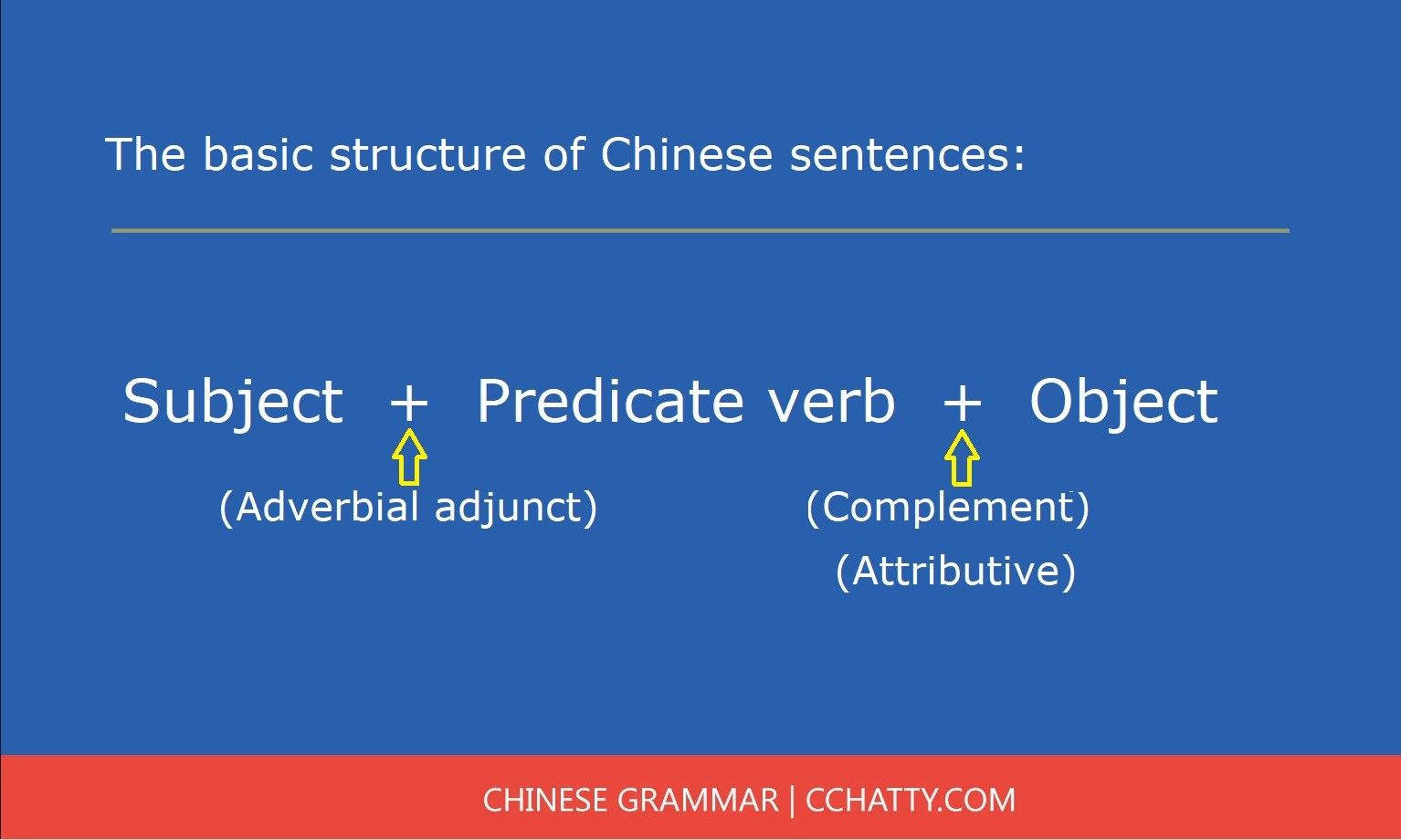
The Chinese language is the language of the Chinese Han nationality, which comprises over 90% of the total population of China, as well as being the common social language of all nationalities of China. It is also, with its long history, one of the most developed and wide-spread languages of the world.
Chinese is a language with a great variety of dialects. The modem Chinese described in this here is the so-called Putonghua (the common language) that takes Beijing speech sounds as its standard pronunciation, the Northern dialects as its basic dialect and standard modem vernacular literature as its grammatical model.
Grammar is one of the elements of a language. Foreigners learning modem Chinese must have a good understanding of the characteristics of its grammar, in addition to the command of pronunciation, Chinese characters (the written symbols of Chinese) and vocabulary, before they can acquire a mastery of the rules of sentence making and work usage.
To help students grasp modem Chinese grammar, some of the fundamental concepts concerned are introduced below.
1, Sentence
A sentence is a language unit that makes complete and independent sense in social communication. In the Chinese language, there are two kinds of sentences, the simple and the complex.
Structurally, simple sentences can be classified into two different groups: the one-member sentence consisting of either the subject or the predicate, and the two-member sentence consisting of both the subject and the predicate, which is also called the subject-predicate ( S-P) sentence, e.g.
in the sentence, 我们学习汉语,我们 is the subject and 学习汉语 the predicate.
In the sentence 来!, there is only the predicate,
while in the sentence 妹妹呢?, there is only the subject.
Therefore the last two examples are called one-member sentences or non-subject-predicate sentences. One point which should be mentioned here is that in the Chinese language, not only verbs,but also other notional words, can function as the predicate.
2, Sentence element
A sentence is composed of various words or phrases arranged according to certain grammatical relationships. These words and phrases in a sentence with certain grammatical functions are called sentence elements.
Generally speaking, there are six sentence elements in Chinese: subject, predicate, object, attributive, adverbial adjunct and complement.
For instance, there are three elements in the sentence 我们学习语法. 我们 is the subject,学习 the predicate and 语法 the object.
In the sentence 我妹妹努力学习语法, there are five elements; subject, predicate, object, attributive and adverbial adjunct.
The sentence elements are shown in the following:
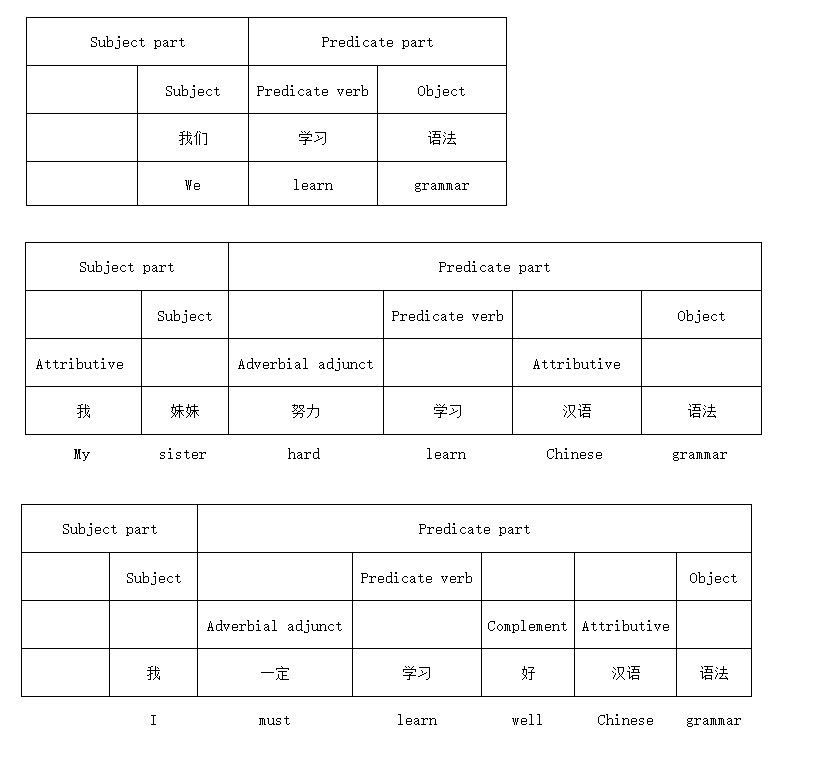
the meanings of the above 3 sentences,
1) We learn grammar.
2) My sister learns hard at Chinese grammar.
3) I must learn Chinese grammar well.
3, Word
A word is the most basic language unit in making up a sentence.
For example:
1) 我们学习语法 is made up of 3 words: 我们, 学习, 语法.
2) 我妹妹努力学习汉语语法 is made up of 6 words 我, 妹妹, 努力, 学习, 汉语, 语法.
3) 我一定学好汉语语法 is made up of another 6 words: 我, 一定, 学, 好, 汉语, 语法.
Chinese words can be divided into two categories according to their meaning and grammatical function - notional words and auxiliary words.
Notional words have actual meaning and can act as sentence elements independently. Nouns, verbs, auxiliary verbs, adjectives, numerals, measure words, and pronouns belong to this category. All the 10 words in the above 3 sentences are notional words.
While function words do not have actual meaning and can not be used alone as sentence elements. Prepositions and auxiliary words are in this category.
4, Phrase
A phrase is a combination of words arranged according to certain grammatical rules.
There are the subject-predicate (S-P) phrase, the verb-object (V-O) phrase, the endocentric phrase, etc.
For example:
in the sentence 我妹妹努力学习汉语语法. 我妹妹 and 汉语语 法 are both nominal endocentric phrase.
我 and 汉语 both serve as the attributive;
努力学习 is a verbal endocentric phrase modified by the adverbial adjunct 努力.
学习语法 is a Verb-Object phrase.
The types of Chinese sentences and the relationship between them are illustrated briefly in the following ;
Sentence: Simple sentence and Complex sentence
Simple sentence: Two-member sentence (S-P sentence) and One-member sentence (Non-S-P sentence)
Complex sentence: Clause (Simple sentence)
The main characteristics of Chinese grammar:
1, Word order plays a major role in the Chinese language.
The basic sentence pattern of the Chinese language is: the subject comes first, verbs follow. The modifier, be it attributive or adverbial, must be placed before the modified word, while the complement is always placed after the verbs. Pay attention to the following:
妹妹的朋友, sister's friend
妹妹的 is the modifier as the attributive, the modified word is 朋友;
朋友的妹妹, friend's sister
朋友的 is the modifier as the attributive, the modified word is 妹妹.
Different word order brings different meanings. Same words, but two different persons.
积极进取, up and coming
积极 is the modifier as the adverbial adjunct, the modified word is 进取
万分感激, very thankful
万分 is the modifier as the adverbial adjunct, the modified word is 感激
看清楚, see clearly
看 is the main word, 清楚 as the complement
快二分钟, two minutes fast
快 is the main word, 二分钟 as the complement
Look at the following two sentences. Because the order of the adverbial 不 and 都 changes, the meaning changes completely:
我们都不去。None of us are going.
我们不都去。We don't all go.
Unlike the verbs in an Indo-European language, there is no strict morphological change in the Chinese language. The form of a verb remains unchanged under all circumstances. Differences in person, gender, number or time do not require changes in the form of a verb, which makes the word order even more important:
Take the verb 是 as the example: look at the following four sentences
1) 我是学生。I am a student.
2)他是大夫。He is a doctor.
3)他们是演员。They are actors.
4)现在她是学生。Now she is a student.
Though the subjects vary in their gender and number, the verb 是 stays the same.
This can be illustrated by one further example. The form of the verb 学习 also remains unchanged with any time reference. For example :
我去年学习法语。 I learned French last year. (Referring to the past)
我现在学习汉语。 I'm learning Chinese now. (Referring to the present)
我明年学习日语。 I will learn Japanese next year. (Referring to the future)
2, The use of “function word” also plays an important role in the Chinese language.
The term “function word” refers to adverbs, prepositions, conjunctions and particles, interjections and onomatopoes.
They do not carry concrete lexical meaning, but grammatically, they play a very important role. Take the “function word” 的 and 了 for example:
我书。 This is incorrect, it is meaningless in Chinese.
我的书。(My book.) This means I own this book.
我写信。(I write a letter.) This means I am planning on writing a letter. or I am writing a letter.
我写了一封信。(I wrote a letter.) I have written a letter.
3, The use of measure words
Another feature of modem Chinese is the wide array of measure words, which indicate the specific unit or measure of things or actions.
The use of measure words is obligatory, extensive and complicated. It is not easy for foreigners to learn all those measure words. He has to learn them one by one.
Take the following measure words for examples
个: 一个苹果 (an apple)
张: 一张桌子 (a desk)
把: 一把椅子 (a chair)
本: 一本书 (a book)
次: 看一次 (take a look at)
遍: 写二遍 (write twice)
To sum up, it is not easy for foreign learners to remember all those measure words, to master a method of word formation and sentence construction which relies mainly on word order and function words,but it must be done.
It is hoped foreign learners will strive hard to grasp the characteristics of Chinese grammar.
Responses • 0
0/2000
ID: 322
Matthias
Offline
2 day
Visited
From
Orlando, United States
Send Message