Thanks for sharing! i will share them with my students.
(more)Chinese Characters Handwriting
Original
Chinese Characters
Apr 14 • 2349 read
The necessity of learning to Chinese characters handwriting, and how to improve the skills of Chinese characters handwriting, also share some learning resources.
For people who are not learning Mandarin, the question of how to advance handwriting does not come up very often. Some people are interested in calligraphy, but that is beyond writing merely to communicate, more art than language. For individuals who are learning Mandarin, there are many things to say about handwriting.
In this article, I will cover many of them, although briefly in some cases. In this article, some of the questions that will be answered include: Do I need to learn to write by hand? What skills does handwriting in Chinese need? How do I advance my handwriting? What resources can help me learn Chinese writing?
Is it essential to write Chinese by hand?
Do you have to learn to write Chinese by hand? Since the most famous input systems on computers and phones depend on how the characters are pronounced, cannot you just skip handwriting?
This relies on your goals. If your objective is to learn only spoken language, then skipping handwriting is fine. However, many learners want to learn to read and write, too, though to a more limited degree. It means that you would understand how to say more things than you could write, for insistence, which seems to be the most natural way to me.
Also, it seems natural to be able to write by hand fewer characters than you can type, but this does not mean that you can skip handwriting altogether. I think all learners who want to learn to read and write Mandarin characters must also write by hand, not because it is useful but because it helps you understand Chinese characters.
What you require to write a Chinese character by hand
Let’s begin by looking at what writing a Mandarin character means. Success relies on being able to: recall which character to write out of several possible options. It could be said that this one is the more challenging aspects of learning Mandarin characters. Recall the elements of the character is made up of. Recall the relative placement of the components. Recall what strokes each element is composed of, for example, recalling the difference between 千 and 干.
Naturally, most incorrect strokes do not turn the character into another character; they are just wrong. Evoke the properties of the strokes, including their length, placement, order, and direction. Form a mental image of the character uniting all these things and bind it to paper by using a pen. This is the actual writing, the penmanship. With some practice, all learners can do this well to be able to communicate in writing, but whether you do it gracefully or beautifully is another question and not something I intend to discuss in this article.
This is more complicated to write by hand in Chinese than in other languages, where handwriting is slower and, at least for some, more annoying way of typing. If you can type a word in English, you understand how to write it by hand. This is not true in the case of Chinese, where typing just needs you to recognize a character, whereas handwriting requires much more.
Intent then execution
When it comes to advance your Chinese handwriting, it helps to separate intent and execution. The intent refers to what you want to write; it is your mental image of the character. The execution refers to the actual character you write on paper. These will seldom be the same. The intent is more important than execution.
The former requires learning things about Mandarin characters, the second just requires more practice, i.e., more writing practice by hand. Unlike for speaking, where it can be tough to know if an incorrect initial is a just a slip of the tongue or signifies a systematic error, this is usually clearer for writing.
If you plan to write the wrong character, it will turn out wrong no matter how many times you try to write it. If you aim to write the right character, but execute it incorrectly, only practicing will solve your issue. This article does not aim to be about memorizing characters, so let’s leave that for now.
Target models for Chinese characters
When you start learning Mandarin, you must have models to mimic that are correct, or at least models that follow to the standard in whatever region you are focusing on. Your textbook and teacher probably do an okay job of this, although there will always be minor inconsistencies.
However, most people nowadays study Mandarin using their computers and phones. When you do that, keep in mind you must have proper fonts installed. This will avoid a lot of misunderstanding later and is well worth spending some time on as you start. Some learners did not do this, and soon they realized that they had learned other standards such as Japanese for many characters because that is what their computer used by default.
Practice of execution
Assuming that you understand what the correct character looks like, how can you advance your execution or your skill to transfer your mental image to paper using a pencil? The answer, of course, relies on your current level, but here are some general suggestions.
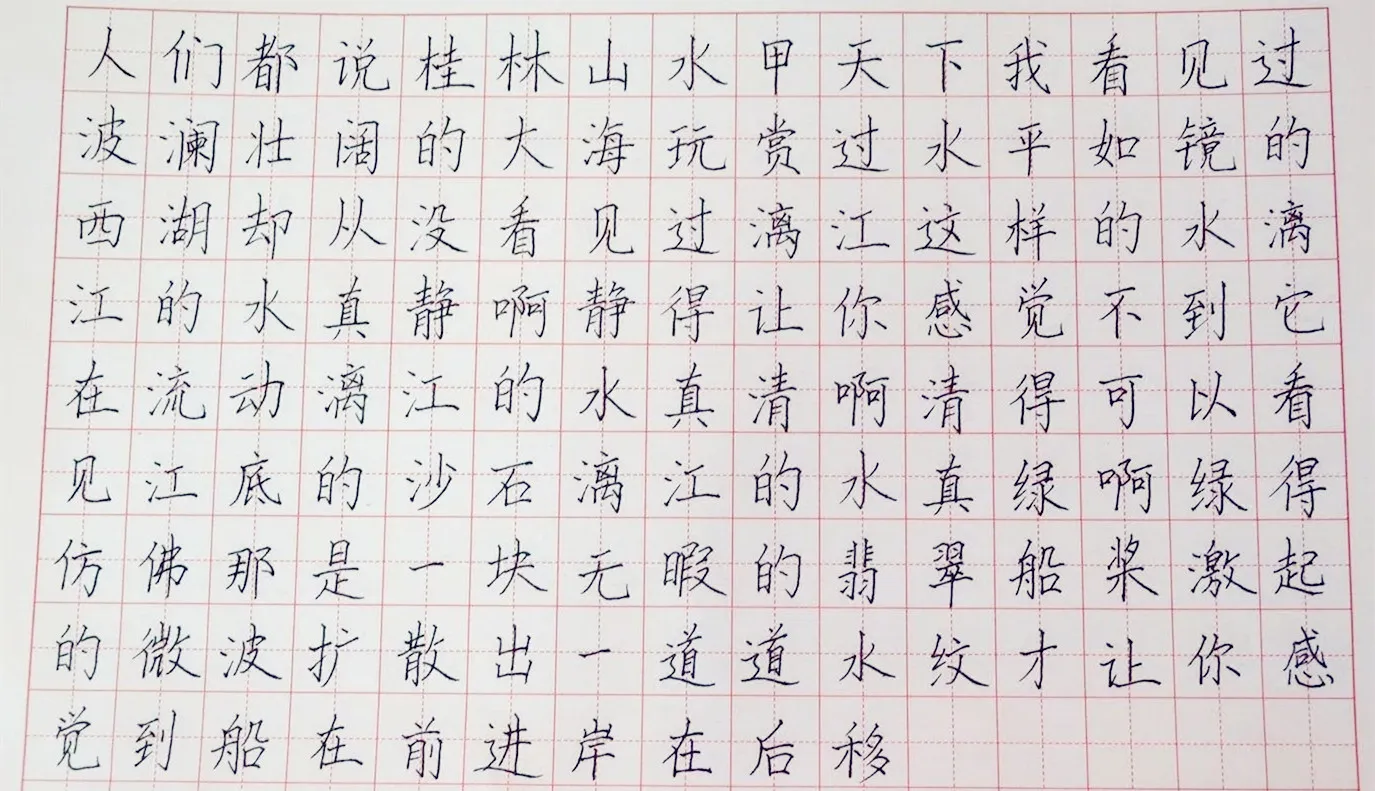
Use grid paper: This is mainly useful for beginners since it gives you clear strategies for how big the character is, and it is much easy as compared to the proportions of dissimilar components. There are many tools to create grid paper for Chinese characters.
Get feedback: As is usually the case when learning languages, getting feedback is essential. While you will be smart enough to spot some mistakes by yourself, but there will be things you are doing wrong that you are not even aware of.
Mimic a target model: This is only good advice if you want to advance the way you write, not whether you recall the characters or not. Find a person who writes neatly (preferably approved by a native speaker, so you do not pick anything too far out) and imitator the way they write.
Practice again and again: If you want to improve your Mandarin handwriting, you need to practice. You require to care about the way it looks; you expect to spend the time writing the characters, not just with the goal of getting them down on paper as fast as possible, but to do so more gracefully than last time.
Spread it out: As is the case with most forms of learning, including motor skills such as penmanship, it is more beneficial to space your practice than to mass it. This means that practicing a little every day is better than doing one long session every month.
Resources to Improve your Chinese Handwriting
Writing things down helps us to remember it better. A quick web search will give you a plethora of websites, apps, and software that all promise to advance your Chinese handwriting skills significantly. With all the choices out there, it can be confusing to find those that are the most effective – that is where this section comes in.
Websites
Skritter is the most popular website to improve your Chinese handwriting. The site itself, as well as its companion and Android apps, is a beneficial and enjoyable way of learning. Skritter is engaging and fun. Its repetition-based system is very well scheduled. If you have failed to write a particular character more often than another, it will be shown again at an increased rate.
Likewise, a character that has been written multiple times without mistakes will be shown less frequency. Skritter’s handwriting recognition system checks your stroke order is correct or not, in case you are wrong, a quick tap on the screen will show you a hint as to the next step.
Another tool that helps you to boost your writing skills is Arch Chinese Handwriting practice. It uses handwriting recognition technology to deliver instant feedback about the stroke order and form of numerous components of Chinese characters. Unfortunately, one should pay to get the most of both resources. In case you do not have money, consider the free Chinese Time School’s writing tool. Chinese Time School’s tool does not provide any feedback. Furthermore, Skritter’s vocabulary lists include thousands of items, while this website has only five hundred primary Chinese characters. However, it is better than nothing, especially for beginners.
In the last one, we definitely recommend our website cchatty, you can find the Chinese HSK words list. It includes the definition, HSK level, Pinyin, Strokes, dedicated collocations and formulas for foreign learners, and the example sentences of the same level as this word.
Apps
On the Google Play and iOS App Store, many free alternatives may be found. The Hello Chinese mobile app, for instance, contains a long list of characters to practice handwriting and learn Mandarin quickly. It is hand-picked vocabulary massive, but unfortunately not customizable.
Additionally, advanced Chinese learners may find hints about the correct stroke order a little bit annoying. However, the app is entirely free. If you require more flexibility, try out the Pleco app. It is primarily a dictionary, but it comes with a built-in handwriting recognition technology. Pleco helps you write characters by yourself, which is beneficial for learning new characters, but is tolerant of stroke order mistakes, so you would not get any feedback about your accuracy. Train Chinese writer is styled more similar to a game.
Chinese characters drop from the top of the screen, and you have to draw them correctly to do not let them reach the bottom. All the websites and apps mentioned above are reliable alternatives to writing on paper. They are mainly helpful when you need to get used to the rules of writing Chinese characters.
And, to understand the importance of the correct stroke order and to learn how to differentiate commonly confused characters. The only restraint is that most handwriting recognition systems used in these resources are not perfect yet. Despite their general correctness, sometimes they pick up incorrect strokes, for instance, a vertical line may be recognized as a hook.
On the opposite, components correctly are written, but slightly in the wrong direction or location are sometimes not ‘accepted’ as correct.
Worksheets
If you think using an app would somehow impede your learning, you are probably more interested in practicing your writing skills on paper.
Of course, there are many worksheets and workbooks available in bookstores, but what if you wish to exercise characters from a customized list?
Fortunately, many online tools help you to make your own grids: from the pretty simple to rather sophisticated. Some services, like Hanzi Grids, offer customizable fonts, grid colors, background guides, and other customizable features.
Responses • 10
0/2000
rosalinejia
0
•
Reply •
Sep 15
wow thats really incredible handwriting!! Im so impressed. motivated to work harder
0
•
Reply •
Sep 04
Thank you for sharing.
谢谢分享
谢谢分享
0
•
Reply •
Sep 03
Thanks for sharing
0
•
Reply •
Sep 03
Thank you! It's great
0
•
Reply •
Aug 30
I don't know about anyone else, but I find it difficult to learn to READ a langauge if I do not also learn to WRITE it by hand. Typing does not work for me to learn to read a language unless it uses the same writing system that I use natively (the Latin alphabet, which is used in many languages).
Thank you for introducing some additional apps that focus on teaching proper stroke order. I have books for that as well as Pleco and eStroke, but they only show the stroke order, not correct you when doing it.
Thank you for introducing some additional apps that focus on teaching proper stroke order. I have books for that as well as Pleco and eStroke, but they only show the stroke order, not correct you when doing it.
0
•
Reply •
Aug 30
Thank you for sharing.
0
•
Reply •
Aug 29
Thank you for sharing.
0
•
Reply •
Aug 14
Thanks for all the information!
0
•
Reply •
Aug 09
Thanks for the excellent post. You are welcome to join our Reddit community /r/Chinese_handwriting too
0
•
Reply •
Aug 09
ID: 322
Matthias
Offline
1 day
Visited
From
Orlando, United States
Send Message