Xinjiang's Dual Reality
AI Learn Chinese
3 hr • 0 read
A traveler discovers Xinjiang's stunning landscapes and Uyghur culture, alongside whispered fears and restricted religious life in Kashgar.
Introduction: The Sparkling Facade
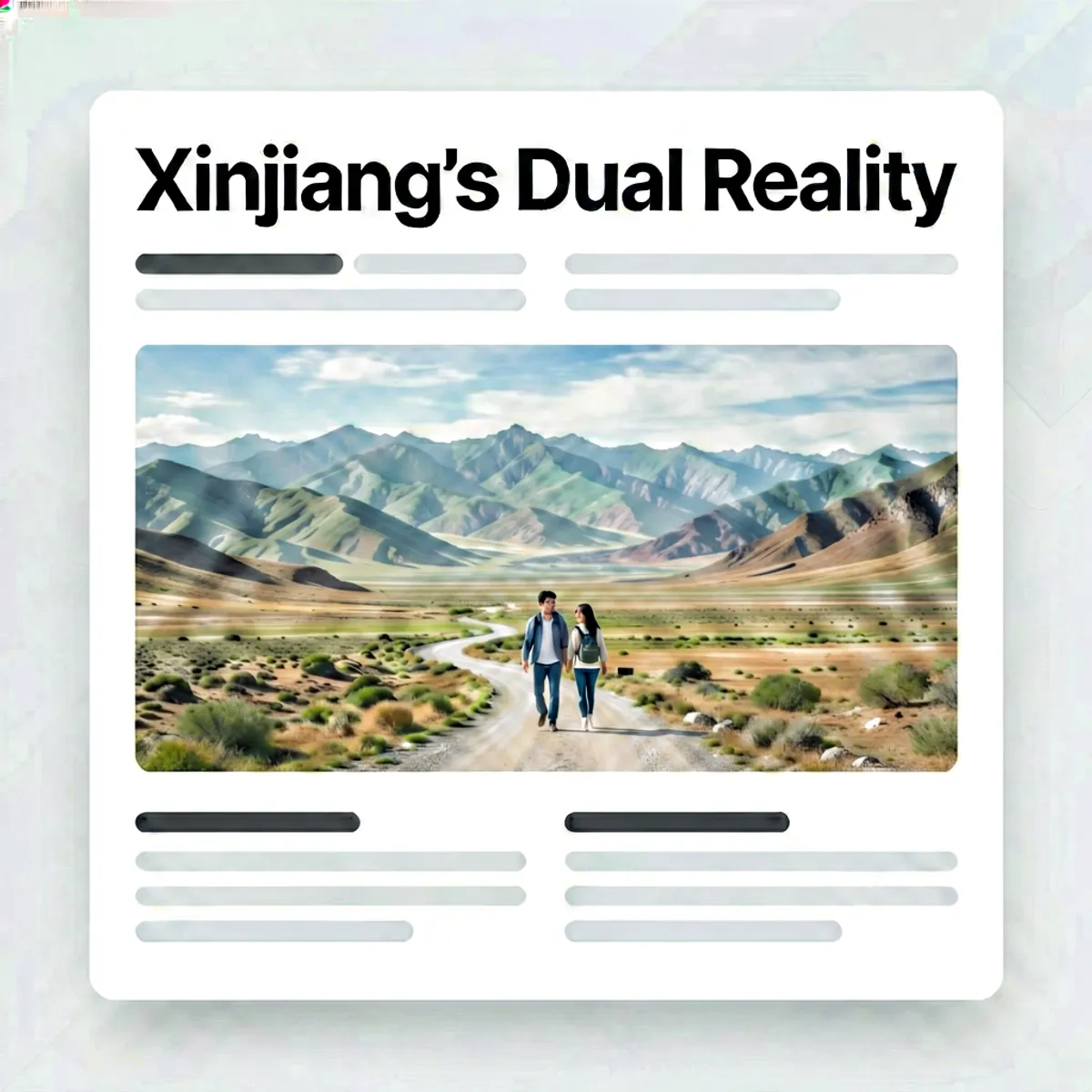
My plane descended over the vast, arid expanse of Xinjiang, the sunlight catching the rust-colored canyons and distant, snow-dusted peaks of the Tian Shan. The initial impression was one of monumental, almost mythical beauty. Stepping into the warm, dry air of Ürümqi, the scent of cumin, grilled lamb skewers (yangrouchuan), and freshly baked naan immediately enveloped me.
For a first-time visitor, the region presented a compelling, vibrant picture. The markets overflowed with bright melons, piles of apricots, and intricate Uyghur embroidery. The music, a blend of Central Asian strings and percussion, spilled from teahouses.
This was the Xinjiang of travel brochures, a place where cultural expression seemed exuberantly on display. Over a couple of weeks, I would taste some of the best food I’ve ever eaten and witness landscapes that defied the imagination. Yet, beneath this polished surface, a far more complex and tense narrative began to emerge, piece by uneasy piece.
The Vibrant Cultural Presentation
The public face of Uyghur culture in Xinjiang is a carefully curated celebration. In the old towns of Kashgar and Hotan, the narrow alleyways buzz with activity. Artisans hammer copper into intricate trays, and women in vibrant, floral headscarves sit cross-legged, stitching patterns that have been passed down for generations.
The air is thick with the aroma of spices from the Grand Bazaar in Kashgar, a labyrinth of commerce where everything from handwoven carpets to dried goji berries is for sale. Every evening, public squares host performances of the Sanam dance, where couples spin in colorful dresses, their movements fast and joyful, accompanied by the rhythmic dap drum. This cultural vitality is not performative in a cheap sense; it is deeply authentic and a source of immense pride.
Tourists are actively encouraged to watch, participate, and photograph these scenes. It is a narrative of harmonious, multi-ethnic life that the authorities prominently promote. For many visitors, this performance becomes the defining memory—a testament to a preserved and cherished heritage.
Conversations in the Backstreets
The true texture of life reveals itself not in the main squares but in the quieter moments, often in the backstreets away from the tourist gaze. I hired a local Uyghur guide, a man in his thirties named Ibrahim, whose family had lived in Kashgar for generations. His Mandarin was fluent, a necessity he noted with a slight, weary smile.
As we navigated the winding lanes towards the Id Kah Mosque, he pointed out architectural details and explained the significance of the mihrab niches. Our conversation, initially about history and architecture, slowly shifted. He spoke of the changes he’d witnessed over some years.
The vibrancy of the bazaar, he said, was real, but it existed within a tightly managed frame. "For tourists, everything is beautiful," he told me, his voice dropping as we passed a uniformed police officer. "For us, every day is a calculation." This subtle pivot from tour guide to confidant was the first crack in the gleaming facade.
The language itself—Mandarin—was a constant reminder of the central state’s presence, a tool of administration and integration that permeated all aspects of life.
The Guide's Confession
Seeking a permit to visit a more remote historical site, Ibrahim and I sat in his car, filling out forms under the glare of the midday sun. The bureaucratic process was slow, laden with photocopies and stamps. As we waited, his guard lowered further.
He spoke carefully, choosing his words as if weighing them. He confirmed what international reports had long alleged: that "vocational education and training centers," widely described as re-education camps, were indeed a significant reality in previous years. He did not shout or gesture; his testimony was quiet, matter-of-fact, and therefore more chilling.
He revealed that a distant relative, a man known for quietly holding traditional Islamic views, had been sent to one such facility for nearly a year. The stated reason was vague—"extremist thought." Ibrahim himself, he admitted, had been questioned multiple times by officials about his travel patterns, his friendships, and his attendance at the mosque. The fear, he explained, was not of dramatic violence but of the quiet erasure of autonomy: the sudden police visit, the lost job, the child’s university application mysteriously denied.
It was a system of pervasive, low-grade pressure designed to shape behavior without constant, visible force.
A Moment at the Mosque
Our next destination was the historic Id Kah Mosque, the largest in China and a spiritual heart for many Uyghur Muslims. As we approached, the call to prayer echoed from its minarets, a sound that simultaneously felt ancient and oddly tense. At the entrance, a security checkpoint was standard, but this time was different.
Ibrahim went ahead to handle the permit for my visit. When he returned, his expression was uncharacteristically stiff. "They are not allowing prayer today," he stated.
"For visitors, it is closed for prayer." I was taken aback. I had visited mosques across the Muslim world, from Istanbul to Jakarta, and had never been denied the simple, private act of prayer inside the courtyard. Here, in this symbolic center, the spiritual space was being bureaucratically segregated.
The prayer hall, I was told, was for worshippers only, and my foreign passport apparently disqualified me from even standing in the courtyard during the adhan. It was a first for me, a stark, personal demonstration of the restrictions on religious life. The beautiful, serene courtyard, usually a place of universal welcome, now felt like a restricted zone, its spiritual function secondary to its role as a monitored cultural exhibit.
The Symbolism of a Denied Prayer
That denied prayer at Kashgar’s grand mosque crystallized the trip’s central paradox. The architecture, the call to prayer, the flowing robes—all the symbols of faith were publicly visible, preserved as cultural heritage. Yet, the lived experience of that faith, the personal, intimate act of worship, was being cordoned off, policed, and made contingent on identity and permission.
For the local Uyghur Muslims, the act of praying in their own historic mosque could itself be an act of potential scrutiny. The separation was not just between tourist and worshipper, but between a sanitized, state-approved "culture" and a lived, potentially suspect "religion." My exclusion was a minor inconvenience, but for Ibrahim and others like him, it was a daily reality. It demonstrated how religious practice had been transformed from a right into a managed privilege, a key component of the broader social control apparatus.
The mosque, therefore, stood not just as a house of worship but as a physical monument to this separation of form and substance.
Layers of Control
The restrictions I glimpsed are part of a multi-layered system of control that has intensified over the past decade. It extends far beyond mosque access. There are regulations on beards and veils, bans on religious names for children, and mandatory "ethnic unity" education.
Surveillance is omnipresent: facial recognition cameras dot every intersection, police checkpoints are common, and residents are often required to install apps that monitor their phone usage. The Mandarin language is the primary medium of instruction in schools, dramatically reducing the use of Uyghur in public life and education. Ibrahim mentioned that parents now hesitate to teach their children traditional religious songs or stories at home, fearing it could be reported.
The fear is not of a single draconian law but of the unpredictable application of countless rules, creating an atmosphere where self-censorship becomes the default mode. This is a system designed to preempt dissent by making the cost of any deviation unpredictable and potentially severe, thereby engineering compliance through pervasive uncertainty.
The Silence Between Notes
Returning to those evening performances in Kashgar’s square, I watched the dancers with new eyes. The joy in their steps was authentic, the music beautiful. But the silence of the audience was telling.
There was no spontaneous chanting along, no extra verses added from collective memory. The performance was precise, timed, and concluded promptly. The vibrant cultural presentation, so praised by tourists, can feel like a performance precisely because the space for unscripted, organic community expression has shrunk.
The vibrancy is real, but it exists within a heavily guarded perimeter. The Uyghur people I met were unfailingly polite, even warm, but their conversations were studded with pauses and careful phrasing. They would speak of the delicious polu (pilaf) or the beauty of the Kara-Koram mountains with genuine enthusiasm, but when the topic turned to family, history, or belief, a cautious filter would descend.
This is the profound impact of the control apparatus: it doesn't just restrict actions; it shapes thought and speech, creating a society where trust is a liability and authenticity is a risk.
The Generation of Calculated Silence
The most profound impact of this layered control is perhaps most visible in the younger generation. Teenagers and young adults in Kashgar and Ürümqi navigate a world where their ethnic identity is both their birthright and a potential liability. In schools, Mandarin dominates; Uyghur language classes, where they exist, are often limited to basic literature or song, stripped of content that might be deemed "separatist." The historical narratives taught are those of the central state, emphasizing a multi-ethnic Chinese identity over a distinct Uyghur past.
I spoke with a university student, Alim, in a crowded teahouse. He was eager to practice his excellent English, but our conversation was a careful dance. He described his coursework in engineering with pride, his ambitions to work in the new "Silk Road" economic zones.
When I gently asked about his grandparents' stories or traditional music, his demeanor shifted. "We listen to some songs," he said, staring into his tea. "But the new songs on the radio, they are...
different." He meant the Mandarin pop from the east, but the subtext was clear: the cultural soundtrack of his youth was being replaced, and to cherish the old one was to risk being labeled backward or, worse, disloyal. His generation is fluent in the language of the state for survival, but often fluent in little else of their own heritage, creating a quiet, internal exile.
The Erosion of Intergenerational Transmission
This linguistic and cultural truncation severs the vital chain of oral history and familial teaching. Grandparents who once recounted epic tales like the Ede Zaman (The Story of Creation) or taught children intricate muqam melodies now often speak only Mandarin at home, fearing that Uyghur lullabies or proverbs might be misconstrued. The intimate space of the family, traditionally a sanctuary for cultural continuity, has been penetrated by the atmosphere of suspicion.
A retired teacher, her eyes sharp behind a simple veil, shared this quietly. "My grandson knows more about the Yangtze River than the Tarim," she murmured, fanning herself in the dim room. "I used to tell him stories of our ancestors on the steppes.
Now... I tell him to study hard, to get a good danwei (work unit). What else can I tell him?
The stories might get him into trouble." Her resignation was a quiet tragedy. The state’s promotion of "intangible cultural heritage" in public performances thus rings hollow when the private, familial transmission of that heritage is stifled by fear. The culture is being museum-ified—preserved as an exhibit, but denied the breath of everyday life.
The Economics of Compliance
Control is not merely enforced through police and checkpoints; it is woven into the economic fabric. The booming infrastructure projects, the new rail lines and highways slicing through the desert, are symbols of development, but they also serve as conduits for demographic and economic integration. The job market increasingly favors Mandarin proficiency.
State-owned enterprises and large private companies often have internal party committees and ideological requirements. Employment can be contingent on political reliability, a vague standard that can be weaponized.
Small business owners like the copper-smiths in the old town operate under a constant gaze. Their licenses, their ability to travel for supplies, even their children's schooling, can be influenced by their perceived adherence to "social stability" guidelines. The vibrant bazaar economy, while real, operates within a framework where non-compliance can mean sudden closure or worse.
This creates a powerful incentive for self-censorship in economic life. The Uyghur entrepreneur doesn't just calculate profit and loss; he calculates political risk with every transaction, every hiring decision, every conversation with a supplier from a different region.
The Han Settler Narrative
Parallel to this is the state-sponsored migration of Han Chinese into Xinjiang, presented as a "pairing assistance" (duikou) program for development. New towns, built with modern apartment blocks and wide boulevards, often house Han professionals and their families, brought in with lucrative contracts. In these spaces, the cultural landscape shifts: Mandarin is the sole language of administration and commerce, the festivals are those of the lunar calendar, and the cuisine is Sichuanese or Shandong.
This is not presented as a replacement, but as a complement—a "melting pot" of progress. Yet, for Uyghurs, it can feel like a quiet colonization of their own urban spaces. The economic opportunities are real, but they often come with an implicit cultural price.
Integration becomes a one-way street: Uyghurs are expected to adapt to Han cultural norms in the workplace and public services, while the reverse is rarely encouraged. The "multi-ethnic unity" campaigns frequently depict Han and Uyghur colleagues smiling together, but these images rarely show the deep cultural negotiation, or the Uyghur professional who must downplay his faith and traditions to advance. The economic dimension thus reinforces the cultural and political pressure, making assimilation a practical strategy for security and prosperity.
The Architecture of Surveillance as Social Engineering
The surveillance state in Xinjiang is not just a policing tool; it is a system of social engineering designed to produce a specific, predictable citizen. The omnipresent cameras, the mandatory face scans at gas stations and hotels, the "People's Convenience" apps that report on neighbors—these create a total informational environment. The state seeks to collect data not just on crimes, but on patterns, relationships, and deviations.
What is being engineered is a form of "safe" ethnicity: Uyghur identity that is expressed through dance and food, but stripped of religious devotion, historical consciousness, and trans-regional solidarity. The architecture of control seeks to decouple ethnicity from religion and politics. You can be Uyghur, the message implies, as long as your Uyghurness is a folkloric costume you wear on weekends, not a worldview that informs your daily life or your children's future.

This is why the denial of prayer at the Id Kah Mosque was so symbolically potent. It wasn't just about security; it was about defining the acceptable parameters of religious identity. Worship is permitted, but only under strict, monitored conditions.
The adhan can be heard, but the act of responding to it as a community in a historic space is restricted. The state wants the aesthetic of faith without the communitarian, potentially mobilizing, substance. It is the ultimate separation of signifier from signified.
Whispers and the Cartography of Forbidden Spaces
For all the high-tech surveillance, information still travels in whispers. The forbidden spaces are not just physical—like certain mosques or neighborhoods—but conversational. Averted eyes in a market.
A sudden change of subject when a police patrol passes. The use of vague, coded language: "the situation" (awaz), "those times" (shu waqt), "he went away for study" (oqughigha ketti), a euphemism for detention.
This creates a parallel cartography of the region, mapped not by streets and landmarks, but by zones of permissible speech and zones of deadly silence. A family living room might be a safe zone for discussing the weather, but a minefield for discussing the past. A car on a rural road might be a place for cautious truths, but bugged with listening devices.
The traveler, like myself, is often a temporary repository for these whispers, a neutral ear that can be trusted for a few moments before the caution returns. These fragments—a story of a relative, a comment on lost language, a sigh at a checkpoint—are the true data points of life under this system, more revealing than any official statistic.
The Performance of Harmony and Its Cracks
The state’s preferred narrative is one of "ethnic unity" and "common prosperity." The vibrant public performances, the inter-ethnic photo ops, the glossy magazine spreads of smiling Han and Uyghur colleagues—this is the official text. But the subtext is written in the careful language of Ibrahim, the averted gaze of Alim, the closed prayer hall.
The performance requires constant reinforcement because the reality is fragile. The harmony is staged, not organic. It depends on a pervasive sense of threat to justify the controls.
Thus, the very apparatus of control—the checkpoints, the cameras, the ideological campaigns—is presented as necessary for protecting the very "vibrant culture" it simultaneously stifles. It is a circular logic: we must restrict your freedom to preserve your culture. The cracks appear when the Uyghur participants in the staged dance, or the Han officials posing with local farmers, exchange a glance that holds no warmth, only the weary understanding of a script they are all forced to follow.
The Psychology of Pervasive Uncertainty
What makes this system particularly insidious is its reliance on pervasive uncertainty. There is no single, clear law that says "do not teach your child religious songs." Instead, there are vague provisions on "spreading religious extremism" or "undermining ethnic unity." The boundaries are fluid and decided by local officials, whose interpretations can vary wildly. This means the cost of any action—a beard worn long, a child named Muhammad, a visit to a relative in a remote village—is unknown and potentially catastrophic.
The result is a population that engages in pre-emptive self-censorship. The fear is not just of punishment, but of the unpredictable process of punishment: the sudden midnight knock, the months of detention without trial, the black mark on one's hukou (household registration) that shadows a child's future. This manufactured uncertainty is a powerful psychological tool.
It induces a state of chronic anxiety, a constant background calculation of risk. It exhausts mental energy and stifles initiative, creating a society that is outwardly calm but internally strained. The vibrant bazaar still buzzes, but the laughter is a little more measured, the business deals concluded with a glance at the security camera.
The Traveler's Complicity and the Gaze
As a foreign visitor, my position is one of privileged observation, but also of subtle complicity. My presence validates the performance. My camera, focused on the colorful dresses and smiling dancers, captures the curated surface that the state wants projected.
My questions about "culture" are answered with rehearsed enthusiasm. To ask about the denied prayer, as I did, is to momentarily disrupt the script, but my foreign passport ultimately insulates me from consequence. I leave with stories and photos; Ibrahim lives with the consequences of our conversation.
The tourist gaze, therefore, can become part of the system. We come seeking "authentic" culture and are given a spectacular, sanitized version. We leave praising the beautiful dances and the friendly people, often unaware of the silent spaces our presence helps to maintain.
The travel brochure image of Xinjiang—the majestic landscapes, the bustling bazaars, the joyful festivals—is not false, but it is profoundly incomplete. It is the sparkling facade, meticulously maintained for the external eye. The traveler who only sees this is witnessing a masterpiece of political theater, taking the set design for the entire play.
Lingering in the Contradiction
To be in Xinjiang is to live in a sustained state of contradiction. You see the most breathtaking natural beauty on Earth—the rainbow mountains of the Kunlun, the endless poplar forests along the Irtysh—side by side with the most intrusive systems of social control. You taste unparalleled hospitality, a deep-rooted Uyghur value of welcoming guests, while knowing that such hospitality is now often performed with an eye on the listening devices. You hear the hauntingly beautiful muqam melodies, a UNESCO-listed treasure, and wonder if the young people singing them in the square fully understand the history and poetry embedded in the notes, or if they are simply learning the approved repertoire.
This contradiction is not a bug in the system; it is the system. The state allows, even promotes, the safe forms of culture—the dances, the foods, the crafts—because they are lucrative and harmless. It suppresses the dangerous forms—the collective memory, the transnational faith, the independent thought—because they are seen as threats to political control.
The Uyghur people are thus placed in an impossible position: to be truly themselves is to risk everything; to conform is to surrender a piece of their soul. The vibrant public life is therefore a testament not just to resilience, but to a terrifying form of adaptation, a culture learning to express itself only within the lines drawn by its censors.
My journey did not end with a neat conclusion. It ended with the image of the Id Kah Mosque at dusk, its minarets stark against a violet sky, the call to prayer echoing but restricted, the courtyard empty of worshippers for my visit. I had seen the stunning landscapes and tasted the incredible food.
I had also heard the whispers in the backstreets and seen the fear in a guide's eyes when a police car passed. Xinjiang presents two realities, not as separate places, but as two layers of the same place, one visible to the camera, the other visible only to the heart attuned to silence. The challenge for anyone seeking to understand it is to hold both truths at once, without reducing one to an illusion or the other to the whole story.
The sparkling facade is real. The whispered fears behind it are just as real. And they are, in the end, two sides of the same coin.
Conclusion: Carrying the Contradiction
Leaving Xinjiang, my mind was not emptied of the breathtaking vistas of the Taklamakan Desert or the unforgettable taste of a warm samsa pastry. Those sensory memories are indelible. Yet, they are forever paired with the memory of Ibrahim’s quiet confession and the strange, unsettling exclusion from the mosque courtyard.
Xinjiang presented a profound dual reality: one of stunning physical beauty and resilient cultural expression, and another of systemic social control and palpable, subdued fear. The two are not separate; the former exists in the shadow of the latter. The state’s project seems to be to preserve Uyghur culture as a static, apolitical museum piece—the music, the dance, the food—while systematically dismantling the religious and intellectual frameworks that give that culture its dynamic, lived meaning.
My experience was that of an outsider granted a glimpse behind the curtain, a view that revealed the immense pressure under which a remarkable people continue to live, to perform, and to endure. The region’s beauty is undeniable, but its true story is written in the hesitant pauses between the notes of its celebrated songs.
Responses • 0
0/2000
ID: 1326
Chris
Offline
3 hr
Visited
From
Bakersfield, United States
Send Message