White in China, No Chinese?
AI Learn Chinese
4 hr • 0 read
Exploring the plausibility of a white individual born and raised in China lacking Chinese language skills, examining expat bubbles, family choices, and historical patterns.

A story posted on Reddit in 2010 presented a curious paradox: a white man, not of mixed heritage, who was born and raised in China yet claimed he spoke no Chinese. He communicated in perfect American English. The original poster and their friends, likely university students at the time, were immediately skeptical. The claim felt like a convenient fiction, a tall tale told by a foreigner trying to seem more intriguing. Yet, the man was described as nice, and as they spent more time with him during their second year of study, the initial disbelief softened. The scenario began to seem plausible. This anecdote touches on deep questions about expatriate life, language acquisition, identity, and the social structures that can develop within a foreign land. It challenges the intuitive assumption that mere physical presence in a country guarantees linguistic assimilation. To understand how such a situation could occur, we must look beyond the surface and examine the intricate ecosystem of foreign communities in China, the decisions families make, and the historical precedents that shaped them.
The Initial Disbelief and the Allure of the Story
The gut reaction to the Reddit post is one of dismissal. China, with its massive population and overwhelming linguistic dominance, seems an environment where not speaking the language would be a severe handicap. For a child born there, the expectation is almost biological: surrounded by Chinese sounds from infancy, a person should absorb the language naturally, effortlessly. The idea of a "white" person—visibly, unmistakably foreign—living a full life in China without a single word of Chinese feels like a contradiction. It suggests either a profound isolation or a deliberate, almost willful, rejection of the surrounding culture. The original poster’s friends thought it was "BS," a common response because it violates our mental model of how language and environment interact.
This skepticism is rooted in a universal principle: language immersion typically leads to acquisition. Unless a child is actively shielded, they will learn the dominant tongue. The story’s power lies in its defiance of this principle. It introduces a variable that seems impossible to reconcile: a person physically present but linguistically absent. The fact that the man was "a nice guy" adds a layer of cognitive dissonance. Nice people, we潜意识里 think, are more integrated, more open, more likely to engage with their surroundings. His niceness makes the claim harder to dismiss as mere antisocial behavior. It forces us to consider structural, rather than personal, explanations. Could there be a social architecture so complete, so self-sufficient, that it renders the local language unnecessary? The journey from skepticism to plausibility, as described by the Redditor, mirrors an intellectual shift from individual judgment to systemic analysis.
Inside the Expat Bubble: Social and Geographic Insulation
The most straightforward explanation is the existence of a highly insulated expatriate community. This is not merely a group of foreigners who socialize together; it is a fully realized parallel society with its own economic, educational, and recreational infrastructure. In major Chinese cities like Beijing and Shanghai, certain neighborhoods function as de facto foreign enclaves. Think of the area around Sanlitun in Beijing or the French Concession in Shanghai. Here, grocery stocks import goods from home, restaurants serve Western cuisine, and social life revolves around clubs, bars, and events conducted entirely in English.
Within this bubble, daily life requires no Chinese. You can work for an international corporation where the office language is English. You can shop at a western-style supermarket where staff speak broken English or are fellow expats. You can socialize exclusively with other foreigners, attend church services in English, and even have your children educated in systems that use English as the medium of instruction. The bubble provides a complete linguistic and cultural shield. For a child growing up within it, the world outside the bubble might as well be a different country. Their parents’ friends, their playmates, their teachers—all operate in English. Chinese becomes the language of the "other," the background noise heard through car windows or in markets their family rarely visits. This is not a conscious decision to avoid Chinese; it is a simple matter of social geography. The bubble defines the boundaries of one’s functional world.
The plausibility of the Reddit story hinges on the density and completeness of such a bubble. Not all expat communities are equally insulated. Some families make a concerted effort to integrate, to hire local helpers, to venture into neighborhoods where English is scarce. But others, particularly those on short-term corporate assignments or with young children, prioritize comfort and continuity. They seek out the familiar, creating a little piece of home abroad. In the most extreme cases, this bubble can be so encompassing that a child’s entire lived experience—the conversations that matter, the instructions they follow, the emotions they express—happens in English. Chinese is relegated to the status of a foreign language, something perhaps studied as a subject in school but never needed for survival or social connection.
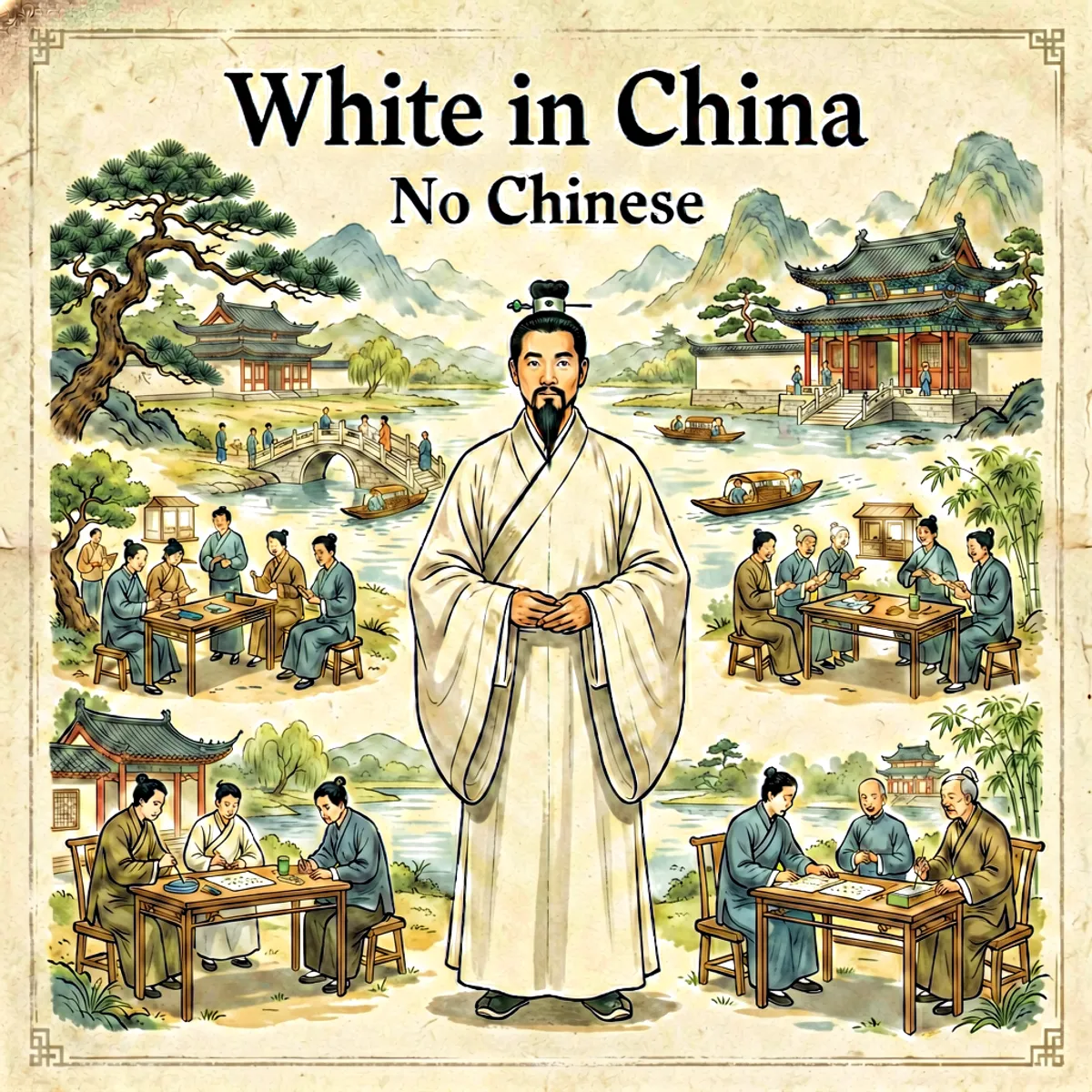
Family Dynamics and Parental Choices in Language Exposure
The family unit is the primary engine of language transmission. If the parents, particularly the primary caregivers, do not speak Chinese, the child’s exposure is immediately limited. For a white foreigner born in China, this likely means both parents are also foreigners, probably from an English-speaking country like the United States, as evidenced by the man’s "perfect American English." If the parents are posted to China for work—for a multinational, a embassy, or a non-governmental organization—their own social and professional lives may be conducted predominantly in English. They may have limited Chinese themselves, or their Chinese may be transactional, not the language of intimate family life.
Crucially, parents make active choices about their children’s linguistic environment. Some believe that focusing on English first provides a stronger foundation and that Chinese can be learned later. Others worry that introducing a second language too early might confuse the child or dilute their "native" English. There is also a protective, isolating instinct: in a foreign land, the home is a fortress of the familiar. Speaking only English inside the home is a way to maintain cultural identity and parental authority. If the parents hire a nanny or helper, they might specifically seek one who speaks English, or at least give instructions that the nanny should speak English to the child. The child’s world, therefore, is intentionally engineered to be English-only.
This engineering extends to education. While the input mentions no "school," the educational choice is paramount. In China, families with means often opt for international schools that follow British, American, or International Baccalaureate curricula. These institutions are legally required to serve expatriate children and operate entirely in English. The student body is a microcosm of the global elite, with children from South Korea, Japan, Europe, and the Americas, all using English as their lingua franca. In such a setting, Chinese is, at best, a subject on the timetable, akin to French or Spanish. It is studied for a grade, not for life. A child in this environment can complete their primary and secondary education with minimal functional Chinese. The social hierarchy within the school may even subtly devalue Chinese language skills, associating them with the local population rather than the international community.
The parents’ social circle reinforces this. If their friends are other expats, playdates occur in English-speaking homes. Birthday parties, weekend outings, holiday celebrations—all are conducted in the parental native tongue. The child never needs Chinese to make a friend, to ask for a toy, to express a feeling. The need, the fundamental driver of language acquisition, simply does not exist. The Reddit user’s observation that "the more time we spent with him the more plausible it seemed" suggests that this man’s entire behavioral repertoire, his humor, his stories, his mannerisms, were all comfortably expressed in English. There was no code-switching, no moments of faltering for a Chinese word, because his social and emotional universe required no such tool.
A Historical Pattern: Foreign Enclaves and Social Separation
This phenomenon is not unique to contemporary China. History is replete with examples of foreign communities living for generations in a host country without adopting the local language. The most famous examples are the European concessions in treaty port cities like Shanghai, Tianjin, and Guangzhou during the late Qing and Republican eras. These were not just diplomatic zones; they were self-governing municipalities with their own police, courts, hospitals, and clubs. The British, French, American, and Japanese settlements were physically separated from the Chinese sections by walls, gates, and a profound social chasm.
Within these enclaves, foreigners lived a life almost entirely detached from the Chinese majority. Their children attended separate schools (the forbearers of today’s international schools) where the curriculum was British or American. Their social life was confined to the country clubs, the racecourses, and the churches of their own nationality. While many did learn some Chinese—often for business with servants or tradesmen—it was frequently a pidgin or a rudimentary form. Full fluency in the local language, especially literary Chinese, was rare and sometimes even viewed with suspicion as a sign of over-assimilation. Generations of foreigners were born and died in Shanghai’s International Settlement without becoming fluent in Shanghainese or Mandarin. Their identity was explicitly foreign, their allegiance to their home nation, and their daily existence was conducted in their native tongue.

The modern expat bubble in China is a direct, albeit less formally segregated, descendant of this historical model. The legal equality is different—there are no treaty ports—but the social and economic dynamics create a similar outcome. The scale is smaller, the technology (English-language apps, global media) provides a constant link to the home culture, and the bubble is more voluntary than imposed. Yet the result can be the same: a complete, multi-generational community where the host country’s language is irrelevant to daily life. This historical precedent lends significant credibility to the Reddit anecdote. It demonstrates that the scenario is not a biological impossibility but a sociological reality that has played out before, under even more rigid conditions of separation.
The Psychology of Language Learning: Motivation and Identity
From a psycholinguistic perspective, the story challenges the simplistic "immersion equals acquisition" model. Language learning is not a passive soaking-up; it is an active, motivated process driven by need, desire, and social integration. The critical period hypothesis suggests young children learn languages more easily, but this ease is contingent on interaction. A child must be compelled to communicate in the target language. If every need is met in their first language, the motivation to learn a second evaporates.
For the man in the story, the motivation likely never existed. His parents provided everything in English. His peers spoke English. His educational instruction was in English. There was no practical necessity to learn Chinese. Contrast this with the child of immigrants who must act as a bridge between their family and the outside world, or the child in a local school who needs Chinese to make friends and understand lessons. The absence of instrumental need—the need to achieve a practical goal—stifles acquisition. Integrative motivation, the desire to become part of the local community, was presumably also absent. If his social world was exclusively expat, there was no psychological drive to "become Chinese" through language. In fact, for some, not speaking Chinese might be a badge of foreign identity, a conscious or subconscious marker of difference.
In addition, language is deeply tied to identity. For a visibly white person in China, the default social categorization is "foreigner." No amount of Chinese fluency can erase that physical marker. Some individuals may lean into this identity, consciously or not, by maintaining linguistic distance. Learning Chinese might feel like an act of assimilation that conflicts with a self-concept as an outsider. Conversely, for those who seek deeper integration, language becomes a gateway. The man’s apparent lack of Chinese suggests he either never sought that integration or was never positioned to need it. His identity was formed and affirmed within the English-speaking expat community. Chinese was the language of the "them" outside, not the "us" inside his world.
Modern China, Persistent Divides: Why the Story Resonates in 2026
As we consider this anecdote in the context of 2026, the landscape of expatriate life in China has evolved but retains core features. While China has opened up dramatically since the early 2000s, the infrastructure for a sealed expat experience remains robust. International schools are more numerous, western supermarkets are ubiquitous in major cities, and digital connectivity allows for constant engagement with home culture. The "bubble" is now often augmented by virtual bubbles—social media groups, streaming services, and online communities that reinforce a sense of being abroad but not of being there.
The story resonates because it confronts a common assumption: that globalization and physical proximity erase difference. We might think that in a hyper-connected world, someone living in China for their entire childhood would inevitably absorb the culture and language. This anecdote is a corrective to that view. It highlights that social and psychological barriers can be more powerful than geographical ones. It suggests that integration is not an automatic product of location but a complex outcome of family strategy, community formation, and personal identity.
It also raises questions about privilege and access. The ability to live in China without speaking Chinese is predicated on economic and social privilege. It requires a family structure and income that can purchase insulation—international school tuition, western goods, housing in expat-favored compounds. For the vast majority of people in China, and for many foreigners who live there on more modest means, such insulation is impossible. They must engage, negotiate, and learn. The man in the story represents a specific, privileged stratum of foreign life, one that can sustain a linguistic and cultural parallel universe.
Finally, the anecdote is a reminder of the diversity of human experience. We often categorize people by appearance. A white person in China is automatically assumed to be a temporary outsider, a tourist or a short-term worker. The idea that such a person could be, in their own mind and in their social reality, completely at home while linguistically alien, subverts that categorization. It forces us to separate appearance from lived experience, to acknowledge that "China" as a lived environment can mean vastly different things to different people. The Redditor’s journey from skepticism to acceptance mirrors a broader lesson: the world is more complicated, and social ecosystems more varied, than our first impressions allow. The nice guy who didn’t speak Chinese wasn’t necessarily lying or broken; he may have simply been a product of a world within a world, a testament to the enduring power of community to shape, and sometimes shrink, the boundaries of our lives.
Responses • 0
0/2000
ID: 1326
Chris
Offline
2 hr
Visited
From
Bakersfield, United States
Send Message