WeChat's 30Minute Privacy Intrusion
AI Learn Chinese
5 hr • 0 read
WeChat's 30minute ad exposes privacy, algorithms, and cultural negotiation in China's superapp ecosystem.
The Incident: When a Private Chat Became an Ad
It begins with a relatable moment: a Reddit user, /u/Due_Bathroom5296, describes a mundane conversation with his girlfriend on WeChat about a wisdom tooth. They covered the dentist, the procedure, and—critically—the pricing. The exchange felt securely private, confined to two accounts.
Yet within roughly 30 minutes, while he was at work, a targeted advertisement for dental services appeared. A separate, unrelated call to an AI answering machine only heightened his awareness of how AI permeates daily life. His central question cut to the core of digital privacy: how could a platform like WeChat transform a personal message into a targeted ad so swiftly?
The experience suggested a surveillance capability that felt both invasive and instantaneous, challenging the common user assumption that 1-on-1 chats are sacrosanct. This isn’t merely one person’s suspicion—it taps into a widespread, often unspoken anxiety among users of Chinese digital platforms.
The belief that “private” messages remain private is a cornerstone of user trust. When that belief fractures due to a coincidental ad, it forces a confrontation with the business models underpinning “free” services. WeChat, owned by Tencent, is not just a messaging app.
It is a super-app, an operating system for daily life in China and for millions abroad. Its ecosystem includes payments, mini-programs, official accounts, and a vast advertising network. The Reddit user’s experience implies that the walls between these compartments are more porous than advertised, and that the content of your social conversations might be a key input for the algorithms deciding what you see next.
The speed—30 minutes—is the most unsettling detail. In programmatic advertising, data processing and ad placement can occur in milliseconds. But the pipeline from a specific, nuanced human conversation to a relevant ad category involves multiple steps: transcription or keyword extraction, categorization, matching to advertiser demand, and auction.
The perceived immediacy suggests either a remarkably efficient system or, more likely, that the relevant data points were already being collected and categorized in near real-time, waiting for a triggering keyword like “dentist” or “wisdom tooth” to activate a pre-defined audience segment. This turns a spontaneous chat into a predictable data event.
The Psychology of the “Creepiness Factor”
The psychological impact of such an experience is significant. It induces what scholars call the “creepiness factor”—a visceral sense of being monitored that erodes trust. The user doesn’t just think, “Oh, relevant ad.” They think, “They are listening.” This feeling, whether technically accurate in the way a human listens or not, is damaging to brand perception. For WeChat, which relies on a social contract of utility in exchange for data, this breach of perceived privacy can have long-term consequences for user engagement and loyalty, even if it doesn’t immediately reduce user numbers due to lack of alternatives.
This incident also highlights a gap in digital literacy. a number of users understand that their browsing history is tracked for ads. They are less aware that their private messages might be.
The mental model of “private” versus “public” online is outdated in the context of integrated platforms. The Reddit user’s post is a form of collective sense-making, trying to reconcile his experience with his mental model. The discourse itself is part of a growing public awareness.
The sentiment is neutral-to-negative, not because the user necessarily hates ads, but because the ad felt derived from a source deemed off-limits. The violation is of a contextual integrity norm. We expect certain conversations to be insulated from commercial exploitation.
When that norm is broken, even for a beneficial ad (a good dentist!), the feeling is one of intrusion. This norm violation is a powerful driver of user backlash and regulatory scrutiny. It’s not about the ad’s content; it’s about the source of the data.
Understanding WeChat’s Hybrid Ecosystem
To grasp how this might happen, one must first understand WeChat’s unique architecture. Unlike Western apps that often specialize—WhatsApp for chat, Facebook for social, PayPal for payments—WeChat integrates all these functions into a single, seamless interface. A user can send a text, pay a bill, book a doctor’s appointment, and read news without ever leaving the app.
This platform approach creates an unparalleled breadth of user data. Every action—every tap, every payment, every minute spent in a mini-program—is a data point that can be connected to a user’s core identity, which is often verified via phone number and linked to other services. The “private chat” exists within this vast, interconnected landscape.
While end-to-end encryption is not standard for all WeChat messages (group chats and certain official account interactions are not encrypted), the primary concern here is not necessarily a human reading the chat. It is about automated systems. WeChat’s privacy policy, like those of most platforms, states that data may be used to “provide, maintain, and improve our services” and for “personalized advertising.” The legal and technical mechanisms that allow an ad about dental pricing to appear after a chat about dental pricing do not require a person to spy; they require systems to analyze, categorize, and act on the information.
This ecosystem is a two-sided market. On one side are over a billion users. On the other are millions of businesses—from local dentists to national e-commerce giants—who buy ads to reach potential customers.
Tencent’s revenue is heavily reliant on this advertising segment. The economic incentive to make advertising more precise and timely is immense. The more accurately a platform can connect a user’s expressed intent (in a chat) to a commercial offering, the higher the value of that ad impression to the advertiser, and the more Tencent can charge.
This creates a constant pressure to mine every available data stream for signals of user intent, blurring the line between “service improvement” and “ad targeting.”
The Walled Garden Advantage
The tight 30-minute loop points to what is often called a “walled garden” advantage. Because Tencent controls the entire user journey—communication, commerce, content—it can shortcut the typical data-sharing delays that occur between separate companies. Consider the alternative explanations.
Could it be a coincidence? Possibly, but the specificity of the topic (dental pricing) makes pure chance less likely. Could the ad have been triggered by something else?
Maybe the user had previously searched for dental topics on a different platform, and that data was licensed to Tencent. But, the user’s strong sense of causality—the ad came right after the chat—and the niche nature of the topic point toward the chat as the primary trigger. The speed implies the signal source was internal and immediate.
This tight integration has profound implications. It demonstrates that within China’s major digital ecosystems, the concept of “private” communication is functionally separate from “commercially analyzed” communication. The user experience creates an expectation of privacy in 1-on-1 chats, but the backend business logic may treat all text-based interactions as a potential goldmine for ad targeting.
The 30 minutes is less a technical benchmark and more a psychological one. It collapses the temporal distance between the private thought and the commercial solicitation, making the surveillance feel personal, aggressive, and omnipresent. It turns a casual conversation into a data event with immediate commercial consequences.
The Data Pipeline: From Chat to Category
So, how does a message about a wisdom tooth become an ad? The process begins with data ingestion. WeChat’s systems automatically scan message content for keywords, entities, and sentiment.
This is not speculative; it is standard industry practice for platforms that offer free services. The scan is performed by algorithms, not humans, looking for terms that match advertiser categories: “dentist,” “pain,” “cost,” “insurance,” “appointment.” The mention of “pricing” is a strong indicator of commercial intent. This keyword extraction happens on the server side as messages pass through Tencent’s infrastructure.
Next comes profiling and categorization. The extracted keywords are attached to the user’s broader profile. This profile is a composite of their declared information (name, location from phone number), behavioral data (what they buy with WeChat Pay, what mini-programs they use, what official accounts they follow), and social graph (who they chat with frequently).
A chat about a dental issue might increase the user’s score in “health & wellness” or “local services” interest categories. If the user has recently used a mini-program for booking appointments or searched for clinics within the app, the signal becomes stronger. The 30-minute window suggests the chat itself provided a fresh, high-confidence signal that was quickly integrated into the live ad-targeting system.
Finally, ad delivery and auction. When the user opens WeChat or another Tencent app (like QQ or a news aggregator within the ecosystem), an ad slot is available. An automated auction occurs in real-time.
Advertisers who have bid for users in the “dental services” or “health insurance” categories enter the auction. The platform’s algorithm selects the winning ad based on bid price, predicted user relevance (using the freshly updated profile), and other factors. The ad is served.
To the user, it looks like magic or spying. To the system, it is a logical output of a complex but routine data processing pipeline. The girlfriend’s chat was not “spied on” by a person; it was ingested by an algorithm that treats language as a commodity to be mined.
Technical Deep Dive: The Real-Time Signal Flow
Let’s speculate on the potential technical architecture enabling the 30-minute ad. First, natural language processing (NLP) models run on incoming message streams. These models, likely transformer-based like BERT or its successors fine-tuned on Chinese text, perform named-entity recognition (NER) to spot “dentist,” “wisdom tooth,” “pricing.” They also perform intent classification to gauge commercial intent. This happens in near real-time as messages are routed through Tencent’s servers.
Second, the signal is written to a real-time data stream (like Apache Kafka) that feeds multiple consumers. One consumer updates the user’s profile in a low-latency feature store. Another might trigger an immediate “lookalike” expansion, finding users with similar chat histories.
The profile update must be reflected in the ad-serving engine’s feature cache within minutes. This requires a highly optimized, low-latency data pipeline between the messaging backend and the advertising backend—a technical challenge that explains why not all platforms can do this quickly, but Tencent, with its unified tech stack, can.
Third, the ad exchange within Tencent’s ecosystem (similar to a private marketplace) receives the updated user features. When the user next loads a feed (in WeChat Moments, or a Tencent-owned news app), an ad request is sent. The exchange runs a real-time auction.
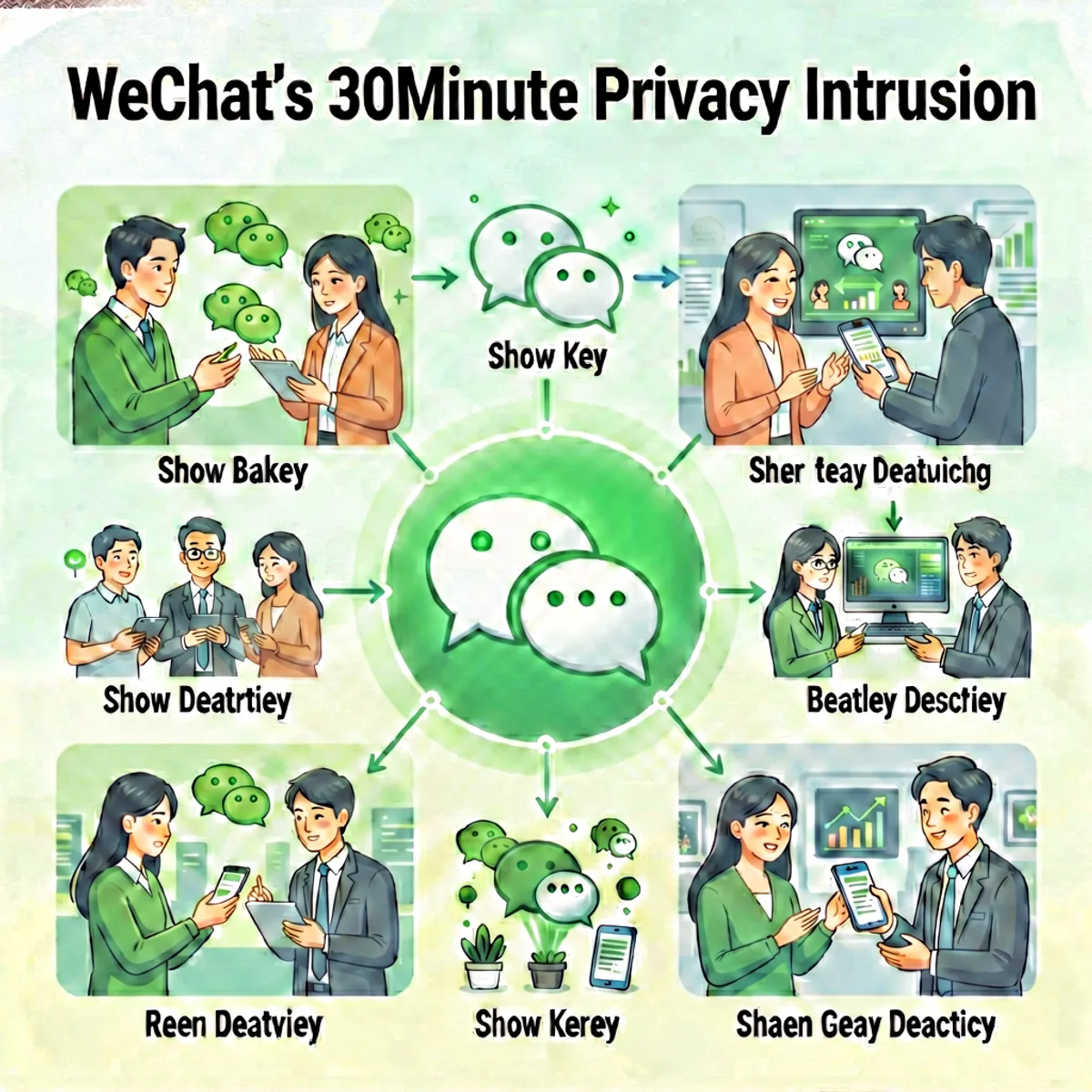
Advertisers targeting “dental services” in the user’s city, who have bid on this audience segment, compete. The winner’s ad is rendered and sent to the client. The entire loop, from keyword extraction to ad render, can theoretically be completed in seconds if the infrastructure is built for it.
The 30-minute gap may include user inactivity (he was working) and caching delays, not system latency.
This pipeline relies on first-party data—data collected directly from the user on Tencent’s own platforms. It avoids the delays and inaccuracies of third-party data onboarding. This is the “walled garden” advantage: complete, immediate, and granular control over the data.
The user’s chat is not sold to a data broker; it is used internally, instantly, to adjust the ad they see next. This internal use is harder to detect and regulate than external data sharing, as it leaves no third-party trail. It is the black box within the black box.
Legal and Regulatory Frameworks in China
The user’s shock is partly rooted in a Western-influenced expectation of privacy, often associated with regulations like the EU’s GDPR, which strictly limits the use of “special category data” like health information without explicit consent. China’s data protection regime, while evolving rapidly, operates on a different philosophical foundation. The Personal Information Protection Law (PIPL), effective since November 2021, is China’s comprehensive data privacy law. It requires clear notice and separate consent for processing “sensitive personal information,” which includes health data.
But, the enforcement and interpretation of the PIPL present gray areas. Consent is often obtained through broad, bundled privacy policies that users must accept to use the service. The definition of “necessary” for providing a service is broad.
An argument could be made that analyzing chat content to show relevant ads is part of “improving user experience” and thus falls under the service’s core function, a contention many privacy advocates would dispute. The PIPL also emphasizes national security and social stability, which can be invoked to justify broader data collection and sharing with authorities, though this specific case concerns commercial advertising.
For the dental chat scenario, the key legal question is whether information about a dental issue constitutes “health” information under the PIPL. It likely does. The platform would then need separate, explicit consent for using that specific data for advertising.
Did WeChat obtain that? Almost certainly not in a granular, informed way. Users clicking “I agree” to a lengthy policy are not giving specific consent for each topic.
This creates a regulatory gap: the law on paper is strong on sensitive data, but in practice, bundled consent and the technical difficulty of auditing algorithmic decisions make meaningful enforcement challenging. The 2026 updates to the PIPL’s implementing guidelines are expected to clarify the boundaries of “personalized advertising,” but the core tension between commercial interests and individual privacy remains.
Regulatory Divergence: China vs. The West
Is this uniquely Chinese? The experience of an ad following a private chat is a global phenomenon, though the specifics differ. In the West, Facebook and Google have faced immense criticism for using data from WhatsApp (now end-to-end encrypted) and Gmail to target ads.
The CIA triad (Confidentiality, Integrity, Availability) of information security is compromised differently across regions. Western platforms often rely on data sharing between their own suite of apps (e.g., Facebook, Instagram, WhatsApp under Meta) and third-party data brokers. The “walled garden” is also a feature of Apple’s ecosystem, though Apple has staked its brand on privacy, limiting ad targeting to its own first-party data with differential privacy techniques.
China’s model is distinct in its integration and scale. WeChat is more central to daily life than any single Western app. Its payment system, social graph, and mini-program ecosystem create a more complete picture of a user’s life.
The regulatory environment also differs. While the PIPL is robust on paper, enforcement prioritizes national security and social stability alongside individual rights. The government itself is a major user of data for social governance, which normalizes a broader conception of data utility.
This does not mean Western users have more privacy; their data is similarly exploited, but often through a more fragmented, broker-driven system that feels less like a single entity “listening” to your chat. The global lesson is that the super-app model, wherever it emerges, inherently pressures the boundary between private communication and commercial exploitation. The more functions an app absorbs, the more opportunities to correlate data streams.
The 30-minute speed in the anecdote may be a function of Tencent’s integrated stack, but the underlying business logic is universal. What changes is the user’s perception and the legal recourse. In the EU, such a use of health-related chat data without explicit consent would likely violate the GDPR and result in hefty fines.
In China, the outcome would depend on whether regulators classify the use as “necessary” for the service and whether the consent mechanism is deemed sufficiently transparent—a judgment call that often favors platform innovation in the early stages of a law.
The Illusion of Privacy in Super-App Environments
The Reddit user’s experience shatters a common illusion: that the “private chat” is a sanctuary within a super-app. This illusion is carefully cultivated. WeChat labels 1-on-1 chats with a lock icon (though this is often misunderstood as end-to-end encryption, which it is not for most chats).
The interface design fosters a sense of intimacy and confidentiality. Users know they are sharing with one other person. What they often do not know or fully appreciate is the third party in the room: the platform’s algorithms, silently parsing every word for commercial value.
This is the paradox of the Chinese digital experience. Users are highly aware of commercial advertising—they see it everywhere. They are also increasingly aware of data privacy issues, with surveys in 2025 showing a majority of Chinese netizens express concern about personal data leaks.
Yet, the convenience of the super-app is so total that withdrawal is nearly impossible for daily life. To not use WeChat is to be socially and economically disconnected. This creates a state of resigned acceptance or “privacy pragmatism.” Users may employ workarounds—discussing sensitive topics in voice messages (though voice data can also be transcribed), using code words, or switching to other apps for truly private talks—but the default assumption for most mundane chats is a vague, unarticulated risk.
The super-app model inherently eliminates privacy by design. Every feature is interconnected. Data from your payment history (what you buy, where you buy it) can inform the ads you see in your chat feed.
Data from the official accounts you follow can inform the products suggested in your mini-programs. The dental chat does not exist in a vacuum; it is cross-referenced with your location (are you near a dental clinic?), your past appointments (have you visited a dentist before?), and even your social network (do your friends also discuss dental issues?). The “private” conversation becomes a node in a vast, invisible network of correlations.
The user feels spied on because, in a functional sense, they are—not by a person, but by a system designed to connect every dot.
The Role of Guanxi in Data Sharing
The concept of guanxi (关系), or relational networks, extends into the digital realm. Data shared within a super-app is not merely personal; it is a node in a vast relational graph. When a user chats about a dental issue, that information becomes, in a metaphorical sense, part of their digital guanxi profile—accessible to the platform that mediates so many of their other relationships (payments, official services, social networks).
The platform, in this view, is not an external spy but a central, trusted (if commercial) hub within one’s social and functional universe. The shock comes when the hub’s commercial imperatives override the user’s internal model of relational boundaries, turning a guanxi-based conversation into a cold data point. This cultural lens explains why the outrage, while real, often coexists with continued app usage; the trade-off is understood, but the specific crossing of a line—from social utility to overt commercial exploitation of intimate conversation—feels like a breach of digital guanxi etiquette.
Corporate Incentives and Algorithmic Imperatives
Behind the user’s feeling of violation lies the unassailable logic of platform capitalism. Tencent, like Meta or Google, is a data-driven advertising company. Its primary product, from an investor’s perspective, is not messaging; it is attention and intent.
The more precisely it can package that attention and intent for advertisers, the more valuable its ad inventory becomes. The algorithm’s “goal” is to maximize engagement and conversion, which is measured in revenue. A user who just discussed dental pricing is a high-intent, warm lead.
Serving a relevant ad at that moment has a much higher probability of click-through and conversion than serving a generic ad.
This creates an algorithmic imperative to harvest all available signals, including conversational content. The engineers building these systems are not necessarily thinking about privacy; they are thinking about feature performance. “Can we improve ad relevance by 0.5% by incorporating semantic analysis of 1-on-1 chats?” is a plausible A/B test question.
The moral and privacy dimensions are often siloed in legal or compliance teams, while the product and AI teams are incentivized to push the boundaries of what data can be used. The 30-minute turnaround suggests this feature, if not fully public, is at least in an advanced testing phase or a standard part of the ad-targeting stack for high-value verticals like local services and healthcare.
In addition, the competitive pressure within China’s tech landscape is fierce. ByteDance’s Douyin (TikTok) and its massive ad business are built on supremely effective recommendation algorithms that mine every interaction. To compete, Tencent must similarly leverage its unique data assets.
The social graph and private communication data are Tencent’s crown jewels, unavailable to rivals in the same depth. It is commercially irrational for them not to use this data to improve ad targeting. The user’s expectation of privacy is in direct conflict with the platform’s economic imperative to monetize every facet of the user experience.
The system is not “broken”; it is working exactly as designed from a corporate standpoint.
Cultural Underpinnings of the Privacy Trade-off
The user's visceral reaction to the dental ad reveals a deeper cultural negotiation. Traditional Chinese philosophy, particularly Confucian collectivism, emphasizes social harmony and relational networks over individual autonomy. This historical backdrop subtly informs the modern “privacy pragmatism” observed in the super-app era.
The expectation of absolute privacy in personal communications is a relatively Western, liberal construct. By comparison, the Chinese digital experience often operates on a utilitarian model: convenience and social connectivity are prioritized, with data sharing accepted as an implicit cost of participation in the digital ecosystem. The feeling of violation stems not just from the act of data use, but from the unexpected exposure of a private moment within a relationship (the chat with a girlfriend) to the commercial sphere, disrupting a nuanced social boundary.
Linguistic Adaptation: Coding Conversations in the Digital Age
Chinese netizens have long developed sophisticated linguistic strategies to navigate sensitive topics within monitored spaces. The dental chat incident highlights a growing awareness that even 1-on-1 messages may be algorithmically parsed. This spurs a creative, grassroots evolution in digital communication.
Users employ homophones, numeric codes, and obscure internet slang (e.g., using “河蟹” he xie—harmony—as euphemism for censorship) to discuss health, finance, or politics. A conversation about “tooth pain” might shift to coded references about “mouth hygiene maintenance costs.” This is not paranoia but a practical adaptation, a form of linguistic opsec born from lived experience with platform scrutiny. The language itself becomes a shield, with meaning derived from context and shared understanding rather than explicit keywords.
This phenomenon is a direct cultural response to the perceived porosity of the “private” chat, demonstrating how communication norms evolve under systemic pressure.
The Algorithm as a Censor and a Catalyst
Interestingly, this cat-and-mouse game with algorithms influences language evolution in two directions. First, it incentivizes obfuscation, as described. Second, it can inadvertently standardize certain euphemisms.
When a critical mass of users adopts a specific code for “dentist” or “price,” that code itself becomes a high-confidence signal for advertisers. The system learns the new lexicon. This creates a feedback loop where evasive language is eventually harvested and monetized, forcing users to constantly innovate.
For the language learner, this dynamic is a crucial window into contemporary Chinese digital culture. The vocabulary of evasion—of discussing the unspeakable within constrained spaces—is a living, pragmatic layer of the language not found in textbooks. It reflects a cultural fluency in navigating power structures, whether governmental or commercial.
User Strategies and Limitations
Faced with this reality, what can a user do? The most effective strategy is platform reduction: minimize the use of super-apps for sensitive conversations. Use Signal or Telegram (with awareness of their own limitations) for truly private discussions about health, finances, or politics. This is the digital equivalent of “don’t discuss illegal activities on a corporate phone.” It’s a pragmatic separation of communication purposes.
Within WeChat, users can employ operational security (opsec) tactics. Use voice messages instead of text for sensitive details, though this is not foolproof as voice can be transcribed. Discuss topics in vague, coded language if they must be discussed on the platform.
Be aware that mini-programs are not private; they are web apps running within Tencent’s container and can collect data separately. Avoid using WeChat Pay for transactions you wouldn’t want linked to your ad profile, though this is increasingly difficult.
But, these are individual burden-shifting solutions. The onus should not be on the user to engineer privacy out of a system designed to be pervasive. The real power lies in collective action and regulatory pressure.
Sustained public criticism, like the Reddit post, raises awareness. Supporting strong data protection advocacy groups in China, though challenging, is a long-term path. The most potent tool is regulatory enforcement.
If the PIPL is applied rigorously to cases like this, with significant fines and mandated changes to consent mechanisms, platforms will be forced to build more meaningful privacy safeguards, such as true opt-outs for conversational ad targeting or clear, granular consent prompts for sensitive topics.
Ultimately, the user’s power is in withdrawal of attention. If a critical mass of users begins to associate WeChat with intrusive ad targeting and shifts sensitive communication elsewhere, the platform’s data quality for those high-intent signals degrades. This is a slow, diffuse form of protest.
For now, in 2026, the pragmatic answer for most is a cynical but functional awareness: assume nothing you type in a major Chinese platform is private from the algorithm, and plan your digital life accordingly. The girlfriend chat is a useful reminder of that new normal.
Future Trajectories: Privacy, Profit, and Platform Power
Where is this heading? Three trajectories seem likely. First, regulatory tightening.
Expect the PIPL and related regulations like the Data Security Law to see more specific rules around “profiling” and “automated decision-making.” The 2026 amendments may explicitly require a clear opt-in for using communication content for advertising, not just a buried policy clause. Fines will increase, and high-profile cases against Tencent or Alibaba could set precedents. But, regulation will always lag technology, and national security clauses will remain a wild card.
Second, technological countermeasures. Privacy-enhancing technologies (PETs) like federated learning allow models to be trained on user data without the raw data leaving the device. Differential privacy adds noise to datasets to protect individuals.
WeChat could, in theory, implement on-device analysis that never sends raw message text to its servers for ad targeting, only sends anonymized, aggregated signals. But this would reduce ad targeting precision and revenue, creating a strong disincentive. Do not expect voluntary adoption of strong PETs by profit-driven platforms.
Third, user behavior evolution. As awareness grows, we may see a bifurcation of communication: “low-stakes” chat on super-apps for utility and social coordination, and “high-stakes” chat on dedicated, security-focused apps. This is already happening among tech-savvy and privacy-conscious demographics. The super-apps may respond by trying to make their privacy controls more visible and granular, a form of “privacy theater” that gives the illusion of control without substantially changing data flows.
The most probable future is a continued, grinding tension. Platforms will push the envelope of data use, testing user tolerance and regulatory boundaries. Users will develop sophisticated, often subconscious, strategies to game the system.
Regulators will issue fines and new rules after harms occur. The 30-minute ad will become faster, perhaps instantaneous, as algorithms improve. The line between helpful personalization and creepy surveillance will remain blurry and contested.
Implications for Learners and Cultural Observers
For students of Chinese language and culture, the dental ad anecdote is more than a tech privacy story; it is a case study in modern social operating systems. Understanding this ecosystem is now part of cultural literacy. A learner who uses WeChat to chat with friends, pay for meals, and follow official accounts is participating in the same integrated environment that generates those unsettling ad experiences.
Recognizing the data flows—how a message in a chat might inform an ad in a feed—is essential for developing a realistic mental model of the platform. This awareness changes behavior. Learners might consciously separate “practice chat” from “sensitive chat,” use voice notes for nuanced topics, or develop their own coded references when discussing anything from healthcare to travel plans. This is not just about privacy; it is about learning the unspoken rules of a digital society where the platform's logic is inescapable.
The Pedagogy of the Platform
This reality presents a challenge and an opportunity for language education. Traditional pedagogy focuses on textbook dialogues and formal grammar. The new imperative is to teach “platform pragmatics”: how language is actually used within the constraints and opportunities of apps like WeChat.
This includes understanding the implied audience of a message (is it just the recipient, or the algorithm?), the cultural weight of sharing certain data (e.g., health status), and the etiquette of using mini-programs versus direct chat. Instructors can use anonymized cases like the 30-minute ad to spark discussion. What assumptions did the user have?
What cultural and technical knowledge would have predicted this outcome? Such exercises bridge linguistic competence with cultural competence, preparing learners not just to speak Chinese, but to navigate the complex, data-saturated social landscape where the language lives today. The super-app is the new public square, and its rules are written in code and commercial incentive as much as in characters.
Conclusion: Reclaiming Contextual Integrity
The Reddit user’s story ends with a question: “Do platforms use private conversations?” The evidence, both anecdotal and technical, suggests a qualified yes. They do not use them in the way a spy novel depicts—with a person reading your messages. They use them through automated systems that reduce language to data points, profiles to segments, and conversations to commercial opportunities. The 30 minutes is the tell, the temporal signature of a tightly integrated ad-tech stack hungry for intent signals.
This violates a sense of contextual integrity. The context of a 1-on-1 chat implies a bounded audience. The context of ad targeting implies a commercial, third-party audience.
The platform’s architecture has merged these contexts without a meaningful, informed user consent. The result is a feeling of betrayal that is rational, even if the technical mechanism is mundane.
Solving this requires more than individual caution. It demands transparency from platforms about exactly how message content influences ads. It demands regulatory frameworks that treat conversational data as sensitive by default and require explicit, granular opt-in for its commercial use.
It demands a societal conversation about what we are willing to trade for convenience. The wisdom tooth chat is trivial in isolation. Its power lies in what it represents: the quiet, constant conversion of human connection into corporate asset.
Recognizing that conversion is the first step toward demanding a different equation. The super-app’s convenience is undeniable, but its cost is the erosion of a fundamental boundary: the space where we speak freely, believing only our intended listener hears us. Reclaiming that space—or defining a new, digitally appropriate boundary—is the next frontier in the relationship between technology, culture, and the self.
The 30-minute ad is not an anomaly; it is the logical endpoint of a system designed to know you better than you know yourself, and to profit from that knowledge without asking. The dance between user, algorithm, and regulator continues, each step revealing deeper layers of how we live, communicate, and compromise in the age of the super-app.
Responses • 0
0/2000
ID: 1326
Chris
Offline
1 hr
Visited
From
Bakersfield, United States
Send Message