Weaponizing Beijing's Forbidden City
AI Learn Chinese
4 hr • 0 read
In 1967, a 1950s Forbidden City plan was framed as Liu Shaoqi's plot in Cultural Revolution propaganda.
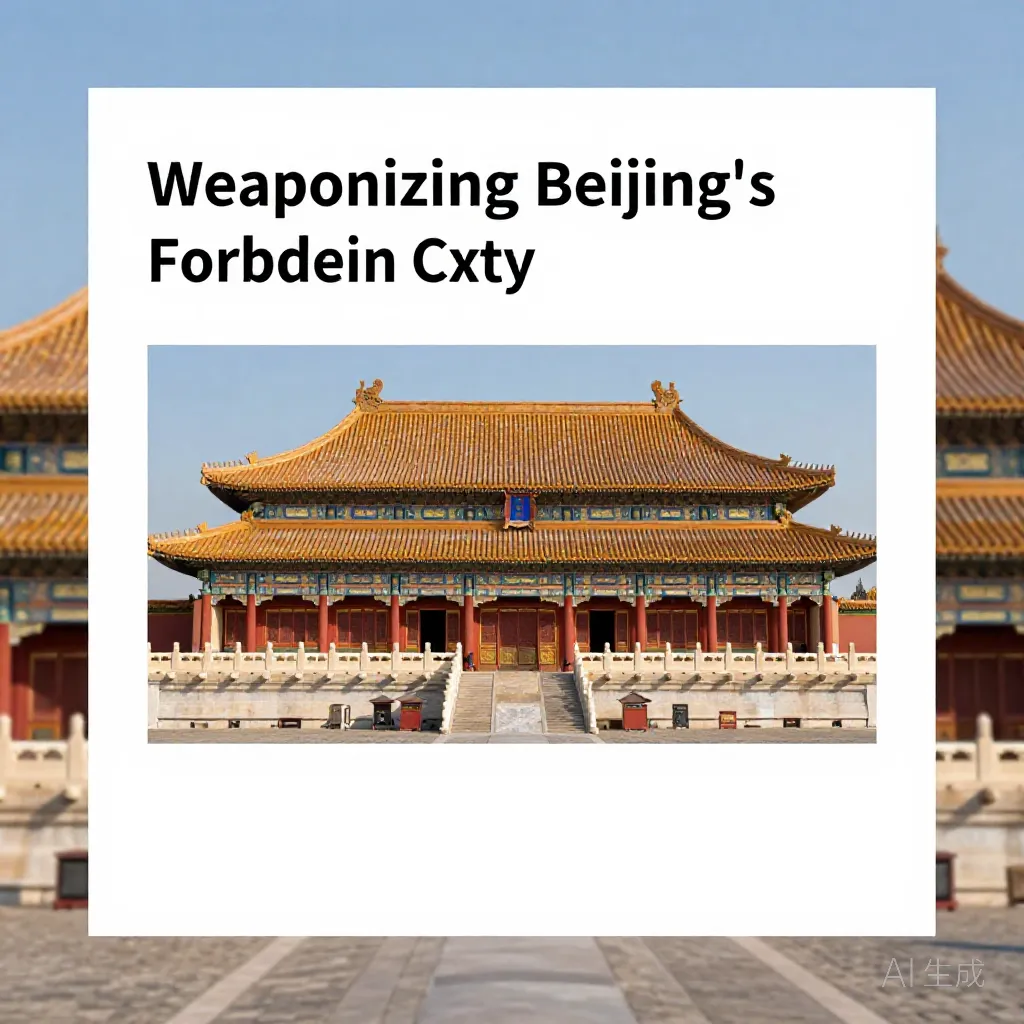
Introduction: A Blueprint as a Political Weapon
In the chaotic spring of 1967, as the Cultural Revolution spiraled into a nationwide purge, a startling document appeared from an unlikely source. It was not a Red Guard pamphlet or a Party Central Committee edict, but a technical journal issued by the Beijing city planning bureau. Titled The Revolutionary City Plan (Chengshi Guihua Geming), the magazine featured detailed architectural drawings of Beijing’s historic core.
The most provocative illustration depicted a radical transformation of the Forbidden City and Tiananmen Square, most notably with the iconic Tiananmen Gate conspicuously absent. The accompanying article launched a fiery polemic, declaring the plan a smoking gun. It was presented as the long-hidden, treasonous scheme of Liu Shaoqi, the fallen head of state, to physically move the central government into the ancient imperial palace, thereby consolidating a personal power base to supplant Mao Zedong.
This incident stands as a stark case study in the weaponization of history and space. It reveals how a speculative, decades-old urban proposal—likely born from pragmatic, if ideologically fraught, debates in the early 1950s—was exhumed, stripped of its original context, and forged into the central exhibit in a show trial. The “Forbidden City plot” was less about architecture than about the terrifying power of narrative in a revolutionary system where intent could be retroactively read into brick and mortar.
This analysis will trace the plan’s origins, deconstruct its 1967 resurrection, and examine its role in the final, fatal stage of Liu Shaoqi’s political destruction. We will explore the symbolic geography of Beijing, the bureaucratic context of post-1949 capital planning, the mechanics of Cultural Revolution propaganda, and the enduring legacy of a ghostly, unbuilt vision that haunted a nation’s capital.
The Sacred Geography of Power: The Forbidden City and Tiananmen Square
The Imperial Legacy as Revolutionary Taboo
To comprehend the virulence of the 1967 accusation, one must first grasp the profound semiotic weight of the Forbidden City (Zijincheng, or Purple Forbidden City). For over 490 years, from the Ming through the Qing dynasties, it was the absolute, sacrosanct center of the Chinese cosmos, the exclusive residence of the Son of Heaven. Its very layout—a strict north-south axis, layered enclosures, and hierarchical court sequences—was a physical manifestation of cosmic order and imperial absolutism.
The 1912 Xinhai Revolution ended its function as a seat of power, but not its symbolic potency. The question of its future was a national obsession: museum, relic, or something else?
When the Chinese Communist Party (CCP) victory in 1949 gave them control of this space, they inherited not just a complex of buildings but the ultimate symbol of the “old society” they had vowed to destroy. The revolutionary leadership, particularly Mao Zedong, was acutely aware of the dangers of symbolic regression. Occupying the Forbidden City risked visually conflating the new people’s republic with the imperial past, undermining the narrative of a clean historical break.
Consequently, a powerful, though often unstated, consensus emerged: the palace would be preserved as a museum, the Gugong Bowuyuan (Palace Museum), its imperial function permanently sealed. To suggest moving the organs of state into its walls was to flirt with the ultimate ideological taboo—a charge that could be framed as “restoring capitalism” or yearning for a new dynasty.
Tiananmen Gate: The Inverted Threshold
The Tiananmen Gate (Gate of Heavenly Peace) forms the monumental northern barrier of the Forbidden City. Historically, it was the imperial threshold, separating the divine emperor from the profane world. After 1949, its meaning was powerfully inverted.
It became the stage for the new regime’s founding ceremonies and mass rallies. The vast plaza to its south, Tiananmen Square, was dramatically expanded in the 1950s, cleared of traditional buildings to create a space for the masses.
The construction of the Great Hall of the People (1959) on the square’s west side and the National Museum of China (1959) on its east flank created a new ceremonial axis. This axis deliberately pointed toward the Forbidden City, creating a visual dialogue that acknowledged the past while asserting a new, revolutionary present. The Forbidden City was now the “old” museum object; the square and its new buildings were the “new” stage of the people.
This carefully curated spatial relationship—the revolutionary square facing the imperial museum—was a foundational myth of the PRC. Any proposal to alter this geography, to dissolve the boundary between the two, was not merely a planning issue; it was an act of symbolic sacrilege.
The Unspoken Consensus: Preservation as Ideology
Within the CCP leadership in the early 1950s, moving the government into the Forbidden City was considered ideologically dangerous and practically unnecessary. The pragmatic arguments for utilizing the vast, vacant palace courtyards—centralizing administration, using existing high-quality infrastructure—were consistently overridden by symbolic and political concerns. The palace was a relic, a teaching tool for the “old society,” not a home for the new government.
This consensus was so strong it rarely needed to be debated; it was a background condition of all capital planning. This made the very existence of a formal proposal for such a move a political time bomb. If such a plan could be found, and attributed to a rival, it could be portrayed as evidence of a deep, reactionary ambition—a desire to literally inhabit the trappings of the overthrown emperor.
Liu Shaoqi and the Ghost of a 1950s Planning Debate
Liu Shaoqi: The Pragmatic Successor
Liu Shaoqi was a towering figure in the early PRC. A long-time comrade of Mao, he served as Chairman of the Standing Committee of the National People’s Congress and was widely regarded as the likely successor, handling much of the day-to-day governance and economic management. His official responsibilities included oversight of state construction projects and capital works, placing him at the nexus of the monumental task of building Beijing as the socialist capital.
The city planning bureau, which would later publish the damning magazine, operated within the administrative sphere he supervised. Liu was known for his pragmatic, institutional approach—a stark contrast to Mao’s revolutionary romanticism. This very pragmatism, in the paranoid atmosphere of the later Cultural Revolution, would be recast as calculation and ambition.
The “Reconstruct the Forbidden City” Discussion
Historical evidence, primarily from memoirs of architects and planners like Liang Sicheng and later scholarly research, indicates that the idea of utilizing the Forbidden City for government offices was not a fringe fantasy but a topic of serious, if controversial, discussion in the immediate post-1949 years. The driving force was pragmatic: the palace complex contained thousands of rooms of superb traditional architecture, sitting largely vacant in the 1950s. Proponents argued that central government ministries could be efficiently housed there, avoiding the need for new construction and creating a dense administrative core. This proposal existed within a broader, heated debate about Beijing’s future: should it be a preserved historical museum city, or a modern industrial capital?
The specific plan attacked in 1967 was likely one iteration of these discussions. It was referred to in polemics as the “Reconstruct the Forbidden City” plan. Its core concept was to repurpose the vast spaces of the inner and outer courts for ministries and offices. Crucially, it involved a radical reconfiguration of the Tiananmen Square area, envisioning a new, massive governmental complex that would integrate directly with the palace’s Meridian Gate (Wumen), fundamentally altering the symbolic relationship between the square, the gate, and the palace.
The Architectural Vision: Dissolving the Threshold
The 《城市规划革命》 magazine’s drawing revealed the plan’s full, startling scope. It did not merely suggest filling empty courtyards. The illustration showed the existing Great Hall of the People and National Museum reimagined as merely the western and eastern “wings” of a colossal, symmetrical megastructure.
This new complex was designed to wrap around and connect seamlessly to the Meridian Gate, the main southern entrance of the Forbidden City. Most damningly, the drawing omitted the Tiananmen Gate itself. Its absence was interpreted as implying removal or subordination, a deliberate erasure of the revolutionary threshold.
The plan sought to physically dissolve the boundary between the revolutionary square and the imperial palace, merging them into one continuous, palace-like administrative zone. This was not renovation; it was a revolutionary re-conception of the nation’s symbolic heart, proposing a spatial merger of the PRC’s ceremonial center with the Qing dynasty’s physical center.
1967: The Magazine as a Weapon of Mass Political Destruction
The Bureaucracy in the Cultural Revolution Storm
The year 1967 was the zenith of radicalism in the Cultural Revolution. Following the “January Revolution” in Shanghai, radical factions seized power in institutions nationwide. The Beijing city planning bureau, like all state organs, was torn apart by factional struggle.
The publication of The Revolutionary City Plan was a product of this environment. Its title explicitly linked urban design to the revolution itself, framing planning as a class struggle. The listed organization, 《城市规划革命》, presented itself as a revolutionary body, almost certainly a radical faction that had gained control of the bureau’s printing press or a splinter group.
The technical agency was now a political prosecutor.
The Exposé Format: “Discovering” a Crime
The article employed the classic format of a revolutionary “exposé.” It presented the 1950s-era architectural drawing as a “discovered” document, a long-hidden smoking gun. The text charged that this was Liu Shaoqi’s personal, secret scheme. It argued the plan demonstrated his deep-seated desire to “restore capitalism” by reviving Imperial forms and creating a new “feudal court” centered on himself.
By seeking to house the government within the Forbidden City, Liu was allegedly attempting to physically and symbolically replace Mao’s revolutionary authority with his own imperial-style rule. The omission of the Tiananmen Gate in the drawing was interpreted as a symbolic desire to erase the memory of the 1949 founding ceremony, which Mao had presided over from that very gate—an act of historical negationism.
Technical Analysis as Ideological Indictment
The article meticulously dissected the plan’s technical aspects to bolster its political charge. It noted the proposed complex dwarfed the existing Great Hall of the People in scale, framing the Hall not as a revolutionary triumph but as a mere “phase one” of Liu’s monstrous vision. It pointed to the integration with the Forbidden City as a direct violation of the established museum policy and a betrayal of the revolution’s break with the past.
Every architectural choice—the traditional roof lines, the adherence to the ancient north-south axis, the sheer monumental grandeur—was filtered through a crude class analysis. They were decried as “feudal,” “bourgeois,” and “revisionist,” proof of Liu’s reactionary soul. The city planning bureau, once a neutral technical agency, had become a courtroom, using blueprints as primary evidence.
The Political Logic: From Architectural Plan to Treason
Constructing the Charge: “Scheming to Overthrow”
The central accusation derived from the plan was not merely bad taste or ideological error. It was a concrete capital crime: Liu Shaoqi had schemed to overthrow Mao Zedong. The propagandistic logic, as presented, was as follows: by moving the government into the Forbidden City, Liu would control the physical and symbolic heart of the Chinese state.
He would surround himself with the trappings of Imperial power, creating a personal fiefdom and a new dynastic center. This spatial act was the first step in a counter-revolutionary restoration. The plan, therefore, was depicted as a master blueprint for a coup, a revolutionary act in reverse.
The charge transformed an urban design into a literal map of treason.
Weaving into the Larger Narrative of Treason
The “Forbidden City plot” did not exist in isolation. It was meticulously woven into the larger tapestry of crimes attributed to Liu during the Cultural Revolution: being a “capitalist roader,” a “traitor,” a “hidden emperor,” and the “ biggest capitalist roader in the Party.” The urban plan charge provided a tangible, visual manifestation of these abstract ideological accusations. It gave the public a “smoking gun”—a drawing they could see and understand.
It made the idea of Liu’s ambition concrete and spatially comprehensible. This specific charge was particularly potent because it involved the most sacred space of Chinese governance, directly implicating Liu in a sacrilege against the revolution’s sacred sites. It personalized the political struggle onto the very map of the capital.
The Primacy of the Visual Argument
The decision to publish the layout was masterful in its propagandistic simplicity. Complex political theories about “revisionism” could be debated, but a picture was irrefutable to the masses. The average reader could immediately see that the Tiananmen Gate was missing and that the Great Hall of the People was subsumed into a larger, palace-integrating complex.
The visual implied an erasure of the revolutionary present and a return to the imperial past. It made the abstract charge of “scheming to overthrow Mao” graphically clear. The Forbidden City, a place every Chinese person knew from textbooks, posters, and (for many) tourism, was now depicted as the target of a counter-revolutionary plot, making the threat feel immediate, personal, and spatial.
The Great Hall: Re-Framing a Revolutionary Symbol
From Triumph to “Phase One” of Treason
The Great Hall of the People and the National Museum of China, completed in 1959 for the 10th anniversary of the Peoples Republic, were celebrated as triumphs of socialist architecture and symbols of the new China’s confidence. In the 1967 magazine, they were retroactively stripped of this revolutionary meaning. They were no longer proud buildings standing beside the old palace; they were now revealed as the incomplete, initial “wings” of Liu Shaoqi’s monstrous, never-completed plan.
This re-framing was crucial. It drained these iconic structures of their positive symbolism and recast them as architectural evidence of a crime. The very symbols of the PRC’s achievement became exhibits A and B in the case against its former president.
The “Bigger Plan” That rarely Was
The magazine’s drawing revealed the full, intended scale of the project—a scale that was never realized. The proposed complex would have radically altered the Beijing cityscape, creating a continuous, massive governmental zone stretching from the southern end of the Forbidden City deep into Tiananmen Square. The open, vast plaza of the square as we know it—a space for mass rallies and ceremonies—would likely have been absorbed into a dense, palace-like administrative quarter.
The visual and ceremonial prominence of the Tiananmen Gate would have been diminished, subordinated to the new governmental mass. The clear symbolic break between the socialist square and the Imperial palace, carefully maintained since 1949, would have been erased.
The fact that this larger complex was never built was spun not as a failure of the plan, but as evidence of Liu’s frustrated ambition. The partial construction of the Great Hall was the “tip of the iceberg” of his plot, halted only by the vigilance of the revolutionary masses and the CCP leadership around Mao. The unbuilt state of the majority of the plan was converted from evidence of its impracticality into proof of its sinister, suppressed nature.
The Crucible of 1967: Cultural Revolution Politics
The Peak of Radical Factionalism
The publication occurred at a peak moment of Cultural Revolution radicalism. The “January Revolution” in Shanghai had inspired similar power seizures nationwide. The CCP hierarchy was in disarray.
Liu Shaoqi, once the head of state, had been stripped of all positions, placed under house arrest, and subjected to daily struggle sessions. The campaign against him needed new, visceral ammunition to mobilize the masses and justify his elimination to the Party rank-and-file. An old urban plan, unearthed and given a sinister reinterpretation, was perfect.
It allowed the radicals to attack Liu not just as a political opponent (“capitalist roader”), but as a physical, spatial threat to the nation’s sacred heart—a threat that could be visualized.
The “Mass Line” Applied to Urban Space
The magazine exemplified the Cultural Revolution tactic of applying the “mass line” to local, tangible issues. Abstract ideological debates about “revisionism” were grounded in the bricks and mortar of the capital. Every citizen of Beijing, and every Chinese person who had seen images of Tiananmen Square, could instantly grasp the charge.
The city planning bureau was instructing the public on how to see their own capital through a new, revolutionary lens. The fight against Liu Shaoqi was no longer confined to party meetings; it was a fight to control the meaning of the city itself. The spatial layout of the capital became a key battleground in the ideological war.
Erasure and Revolutionary Spatial Politics
The Cultural Revolution was obsessed with eradicating the “Four Olds” (old ideas, culture, customs, habits). The 1967 magazine argued that Liu’s plan was the ultimate “old” idea: trying to physically resurrect the Imperial order. Conversely, the imagined destruction of the Tiananmen Gate in the plan was framed as a necessary revolutionary act.
To complete the revolution, the symbolic threshold of the Forbidden City had to be removed. This created a perverse inversion: while radicals were physically attacking “old” things in the real world, they used this plan to argue that Liu wanted to preserve and inhabit the old, making him the true reactionary. The battle over the city’s layout mirrored the battle for the soul of the revolution—was its power derived from breaking with the past (Mao’s vision) or from reclaiming it (Liu’s alleged plot)?
Liu Shaoqi’s Downfall and the Plan’s Propaganda Role
From “Comrade” to “Enemy of the People”
By 1967, Liu Shaoqi had been completely purged. The “Forbidden City plot” charge became a staple of his public indictment. It was featured in big-character posters (dazibao), screamed from stages during his struggle sessions, and disseminated in propaganda materials nationwide.
The charge provided a specific, architectural “proof” to the general, nebulous accusation of being a “capitalist roader” and a “conspirator.” It suggested his betrayal was not merely political but architectural, long-term (hatched in the 1950s), and aimed at the very core of revolutionary power—the nation’s symbolic geography. It personalized the political threat: Liu didn’t just want power; he wanted to live in the emperor’s palace.
A Legacy of Condemnation and Later Ambiguity
For a generation, the story of Liu Shaoqi’s plan to move into the Forbidden City was accepted as historical fact within mainland China. It was a key, dramatic chapter in the official narrative of the Cultural Revolution as a necessary, if turbulent, struggle against hidden enemies within. Liu’s posthumous rehabilitation in 1980, following Mao’s death and the arrest of the Gang of Four, required carefully re-examining such charges.
The 1980 verdict annulled the absurd charges of treason and counter-revolutionary activity, restoring his reputation as a great Marxist and revolutionary. But, the official documents and historical summaries of the rehabilitation meticulously avoided revisiting the specific “Forbidden City plot.” The charge was not explicitly debunked or exonerated; it was simply omitted from the revised narrative, a ghost left to fade in the archives.
The Plan’s Dubious Historical Veracity
Modern historians, both within China and internationally, generally view the “plot” as a political fabrication, or at best a gross exaggeration of a speculative technical proposal. There is no credible evidence that Liu Shaoqi personally championed the plan with the counter-revolutionary intent charged. It was likely one of many ideas debated in the chaotic, experimental early years of capital planning, perhaps advanced by architects or bureaucrats seeking efficient solutions.
Its transformation into a capital crime in 1967 was a pure product of the Cultural Revolution’s paranoid logic, where political disagreement was recast as existential conspiracy. The plan’s enduring power lay not in its practical likelihood or Liu’s personal involvement, but in its perfect suitability as a metaphorical trap. It allowed Liu’s enemies to paint him as a man who literally wanted to live in the palace of the overthrown emperor, a visual and spatial metaphor for “restoring the old order.”
The Forbidden City in Post-Cultural Revolution Memory
A National Museum, Not a Seat of Power
Today, the Forbidden City is the Palace Museum (Gugong Bowuyuan), one of the world’s most visited museums and a paramount symbol of Chinese cultural heritage. Its preservation is a point of immense national pride. The notion of moving any government function inside its walls is unthinkable, a violation of both law and deep-seated cultural sentiment.
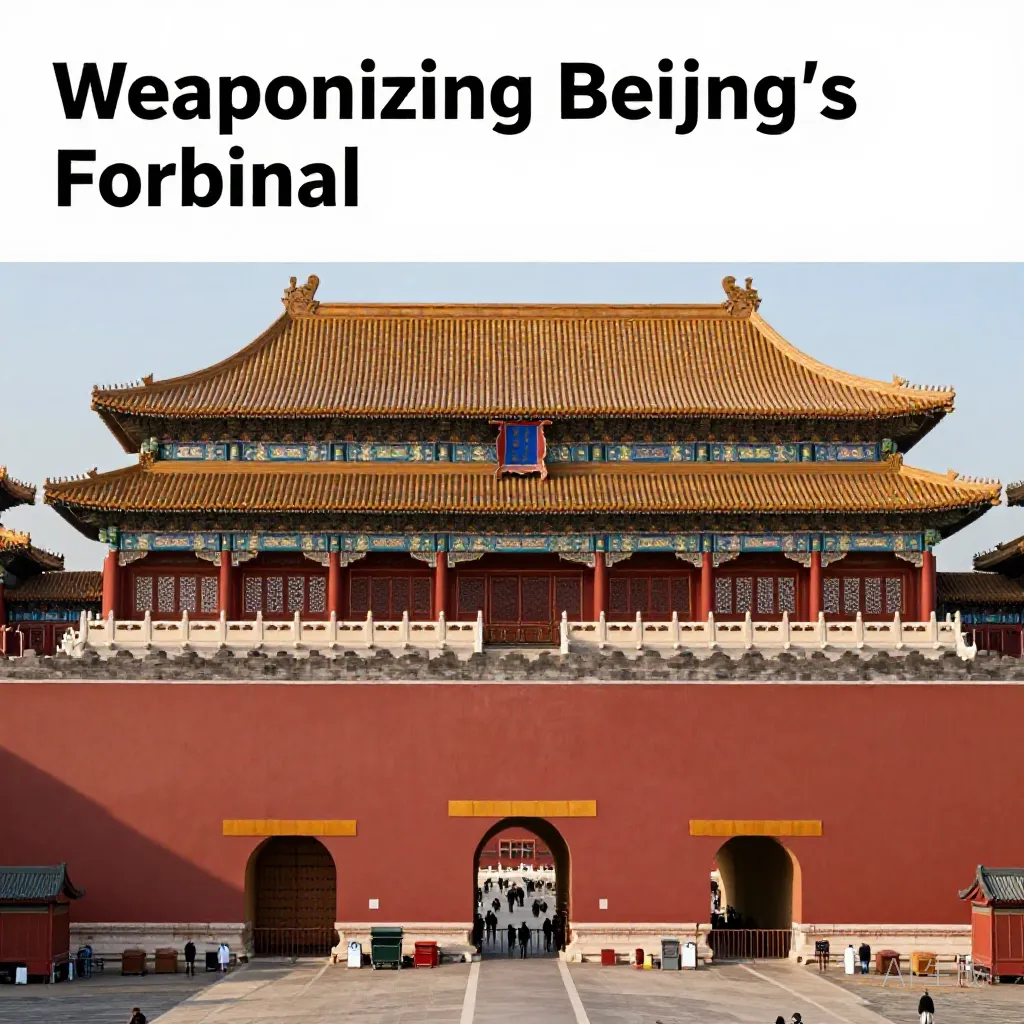
The Tiananmen Gate remains the preeminent ceremonial stage for the state. The Great Hall of the People and National Museum stand as they did since 1959, their original, revolutionary meaning fully restored and celebrated. The unfinished “bigger plan” exists only in the pages of a 1967 magazine, in historical archives, and in academic studies.
The physical space of Beijing’s center has definitively and permanently rejected the vision exposed in The Revolutionary City Plan.
The Enduring Power of the Symbolic
The incident reveals the terrifying power of urban space as a political symbol. Control over the meaning of the Forbidden City and Tiananmen Square has been a constant, high-stakes struggle since 1949. The 1967 magazine was an attempt by one radical faction to seize that meaning permanently, to define the capital’s layout as a testament to Liu Shaoqi’s treason and, by extension, to cement a particular, radical interpretation of the revolution.
Its failure, in the long historical view, is complete. The city’s actual, enduring form enshrines the revolutionary status quo that won out: the Forbidden City is a museum, the square is a people’s forum, and the gate is the threshold of the people’s republic. The rejected plan is now a ghost, a “what-if” that underscores the stability and resilience of the current symbolic order.
A Lesson in the Weaponization of the Technical
The story is a stark lesson in how technical documents—architectural drawings, city plans—can be weaponized in a political system where intent is paramount and evidence is malleable. An old city plan, stripped of its original context of pragmatic debate and reframed through a lens of existential political paranoia, became a lethal instrument. It demonstrates that in a revolutionary context, especially one as intense as the Cultural Revolution, architecture is never just architecture.
It is a record of intent, a map of ambition, and, when properly manipulated, a potential confession. The planners of the 1950s likely never imagined their sketches could be used to destroy a man.
The Rehabilitation and the Strategic Silence
The 1980 Verdict and Its Strategic Omissions
Following Mao's death and the end of the Cultural Revolution, the CCP officially rehabilitated Liu Shaoqi in 1980. The verdict annulled the absurd charges of treason and counter-revolutionary activity, restoring his reputation as a great Marxist and proletarian revolutionary. But, the official documents and historical summaries of the rehabilitation meticulously avoided revisiting the specific “Forbidden City plot.” The charge was not explicitly debunked, labeled a fabrication, or exonerated; it was simply omitted from the revised narrative, as if it had never existed.
This strategic silence was deeply significant. It allowed the Party to repudiate the Cultural Revolution’s general “errors” and excesses without fully dissecting the mechanisms of political persecution, particularly the weaponization of the nation’s most sacred urban space. To fully expose the plot as a fabrication would have required a deeper, more dangerous examination of the Cultural Revolution’s propaganda apparatus and the personal responsibilities of figures beyond the later-condemned Gang of Four.
In addition, the charge touched on the ultimate, enduring taboo of the post-1949 era: the physical integrity and symbolic meaning of the Forbidden City itself. A thorough debunking might have necessitated a public discussion of the 1950s planning debates, potentially reopening awkward questions about the boundaries between preservation, utility, and revolutionary symbolism for the new state. It was politically safer to let the specific allegation fade into obscurity while condemning the general “chaos” of the period.
Why the Ghost Remains Unlaid
The CCP’s reluctance to directly confront and disavow the “plot” stems from its foundational and dangerous power. The charge, however absurd, touched the third rail of Chinese political symbolism: the inviolable status of the Forbidden City as a museum, not a seat of power. Officially declaring it a complete fabrication could be seen as opening the door to questioning why such a plan was even conceivable in the 1950s—a debate that might implicate earlier, still-revered leaders or the very logic of early PRC nation-building.
It could also highlight the extent to which the revolution’s leadership had, at one point, considered occupying the imperial palace. The ghost of the plan was allowed to remain, an unaddressed specter in the official history, because laying it to rest required asking questions the Party preferred to leave buried. Its quiet disappearance from textbooks was itself a form of historical control.
Beijing’s Physical Evolution: The City as Final Arbiter
The 1980s: Conservative Preservation as National Policy
In the reform era beginning in the late 1970s, Beijing’s urban development philosophy shifted dramatically from revolutionary symbolism to pragmatic economic growth. The immediate post-Mao leadership, deeply scarred by the Cultural Revolution’s excesses, adopted a highly conservative stance toward the historic core. The Forbidden City and its vast buffer zone were placed under strict protection.
No new major governmental or ceremonial structures were planned for the immediate vicinity. The focus was on restoration, conservation, and museum development, not expansion. The 1980s saw the meticulous repair of the palace walls, the cataloging of its vast collections, and the beginning of large-scale archaeological work.
This cemented its identity solely as a cultural museum, a repository of civilization, not a potential administrative center. The ghost plan’s vision of administrative integration was completely antithetical to this new ethos of preservation-as-national-pride.
The 1990s Boom and the Logic of the Ring Roads
The economic explosion of the 1990s saw Beijing sprawl outward with astonishing speed. But, this growth was deliberately channeled away from the historic center. Development leapfrogged to the east and west, creating new central business districts like Jianguomenwai and Fuxingren.
The city’s expansion followed the logic of the concentric ring roads, not the ancient imperial north-south axis. This pattern physically enforced the separation between the socialist republic’s administrative and commercial life and the Ming-Qing past. The Forbidden City remained a preserved island, surrounded by a moat of traffic arteries that carried development around it, not through it.
The spatial logic of the 1950s plan—to fill, absorb, and utilize the palace—was decisively rejected by the market-driven geography of the reform era. The city grew vertically and peripherally, not invasively into its historic heart.
The 2008 Olympics: A New, Parallel Symbolic Axis
The 2008 Olympics presented a unique challenge: how to showcase a modern, global, confident China without violating the sanctity of the Forbidden City or overloading the existing ceremonial axis. The solution was to create a new, parallel ceremonial axis to the west. The Olympic Green, with its Bird’s Nest stadium and Water Cube, became the stage for China’s 21st-century soft power and national自信 (zixin).
This new axis deliberately avoided any visual or physical connection to the old imperial center or the Maoist revolutionary square. It proclaimed a future-oriented identity separate from both the imperial past and the revolutionary present. The city’s layout now had two powerful, non-overlapping symbolic centers: the historic Forbidden City/Tiananmen axis representing civilization and revolutionary tradition, and the modern Olympic axis representing dynamism and global engagement.
This bifurcation ensured the 1950s plan’s dream of a unified governmental megastructure, merging old and new, remained permanently unrealized and conceptually obsolete.
A Permanent Lesson: Urban Planning as a Political Minefield
Institutionalized Caution and the “Sensitivity” of Space
The “Forbidden City plot” episode became an enduring, if often unspoken, lesson within China’s planning, architectural, and bureaucratic communities: urban design, especially for capital cities and historic cores, is never neutral. It is a field fraught with symbolic significance and existential political risk. After the Cultural Revolution, professional codes, planning regulations, and approval processes were rewritten or interpreted to emphasize technical expertise, historical preservation, and ideological safety over bold symbolic innovation for sites like the imperial axis.
Planners and architects were trained to recognize the “sensitivities” (shendu) of certain spaces. The Forbidden City, Tiananmen Square, and the surrounding historic axis became zones of extreme caution, where any proposal was filtered through multiple layers of historical, political, and often Party ideological review. The incident instilled a deep-seated institutional fear of inadvertently replicating the “error” of linking new governance structures too closely to old imperial symbolism.
The Inviolable Status of the Forbidden City
The ultimate legacy of the affair is the Forbidden City’s inviolable status. Its physical form is now constitutionally protected in spirit, embedded in national laws on cultural heritage, and enshrined in a powerful national consensus. It is a non-negotiable relic, a museum piece whose primary function is to embody the continuum of Chinese civilization, not to serve as a stage for contemporary state power.
The CCP’s legitimacy now draws more from economic performance, national rejuvenation narratives, and technological achievement than from occupying specific revolutionary geographic sites. The state’s power is projected through the modern skyline of Pudong in Shanghai, the Olympic venues, or the grandeur of the Great Hall—which stands separate from the palace—not from within its walls. The 1950s plan is remembered, if at all, as a bizarre aberration—a reminder of a time when the revolution’s symbolic grammar was still being violently written, and the nation’s heart was a contested text.
Its rejection is not merely a policy choice; it is built into the very stones, roads, and zoning laws of Beijing’s modern layout.
Conclusion: The Unbuilt Ghost and the City’s Verdict
The 1967 issue of The Revolutionary City Plan represents a unique and chilling convergence of urban planning, political propaganda, and historical persecution. It took a speculative, pragmatic proposal from the 1950s—to efficiently utilize the vast, vacant spaces of the Forbidden City for government offices—and through selective omission, radical reinterpretation, and inflammatory text, transformed it into the central exhibit in the case against Liu Shaoqi. The magazine argued that the plan’s scale, its integration with the Great Hall of the People, and its implied erasure of the Tiananmen Gate were proof of a revolutionary ambition to supplant Mao and restore Imperial forms, a spatial blueprint for a coup.
Ultimately, the plan’s power was always symbolic and retrospective. It was never built, not because Liu Shaoqi was personally thwarted, but because the idea was always politically toxic and logistically complex within the existing symbolic framework. Its true, enduring construction occurred not in brick and mortar, but in the realm of political myth-making in 1967. It was built in the minds of the Chinese public as a testament to Liu’s treason.
The “Forbidden City plot” is a ghost in the machine of modern Chinese history—a vision of a different capital that never materialized in stone, but whose memory was weaponized to help destroy one of the revolution’s founding sons. Today, the intact Forbidden City, a world heritage museum, and the open, expansive Tiananmen Square stand as silent, physical witnesses to the plan’s ultimate rejection. Their very arrangement—the preserved palace as museum, the square as forum, the gate as ceremonial threshold—is a permanent, stone-and-mortar rebuttal to the 1967 exposé.
The city itself, through decades of preservation and growth, became the final arbiter. It preserved the revolutionary status quo that won the day and rendered the revolutionary scheme that would have changed it all into nothing more than a phantom limb of a paranoid era, a cautionary tale etched not in palace walls, but in the collective memory of how space can be made to speak lies.
Responses • 0
0/2000
ID: 1326
Chris
Offline
4 hr
Visited
From
Bakersfield, United States
Send Message