The Three Men and the Tiger: Questioning Belief in Ancient China
AI Learn Chinese
6 hr • 0 read
Explore the ancient Chinese fable "Three Men Make a Tiger," examining its lessons on skepticism, mass hysteria, and the power of repetition in shaping belief, set against the backdrop of the Warring States period.
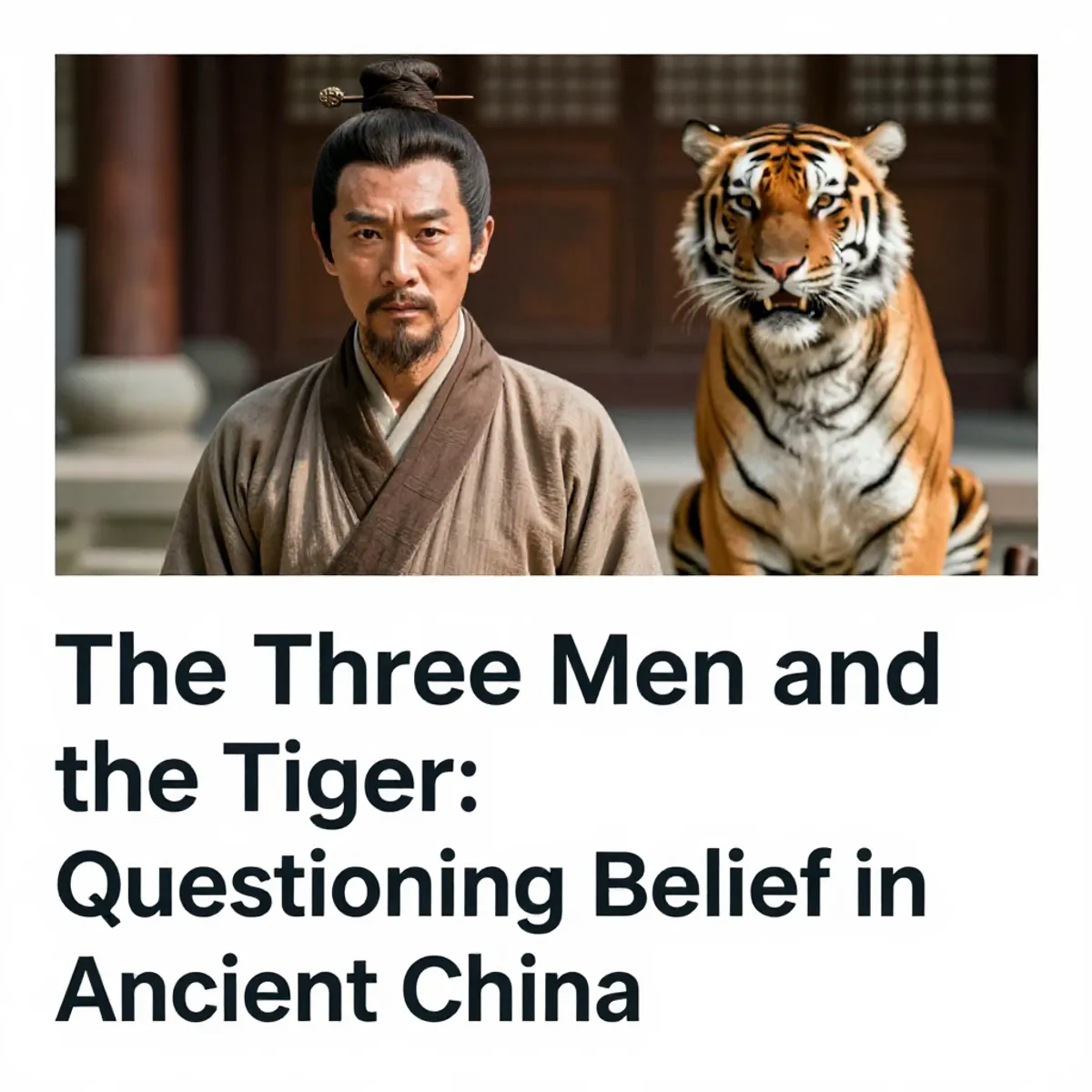
The Origin: A Diplomat's Dilemma and the King's Concern
The story of "Three Men Make a Tiger" originates from the Strategies of the Warring States (Zhanguo Ce), a compendium of political and military anecdotes from one of China's most tumultuous eras. To fully grasp the parable's power, one must first understand the high-stakes, distrustful world from which it emerged. The Warring States period (c.
475–221 BCE) was characterized by constant warfare, shifting alliances, and intricate court diplomacy. States like Wei, Zhao, Chu, and Qin were locked in a deadly struggle for supremacy, where a single diplomatic misstep could trigger invasion or collapse.
The Warring States Period: A Context of Uncertainty
This era was not merely about battlefield clashes; it was a labyrinth of espionage, strategic marriages, and hostage exchanges. Trust was a scarce commodity. Rulers and ministers operated in an environment where information was a weapon as potent as any sword.
News traveled slowly, often through unreliable channels, and was frequently manipulated for political gain. The very act of believing or disbelieving a report could have dire consequences for state security.
The Role of Diplomacy and Hostage-Taking
A common practice to cement alliances was the exchange of royal family members as hostages. By sending his crown prince to the court of Zhao, King Wei of Wei was engaging in a high-stakes gesture of goodwill. The prince's presence in a rival state was both a pledge of Wei's commitment to the alliance and a vulnerable asset.
If relations soured, the prince could become a pawn or a target. This practice inherently created psychological tension for the sending ruler, who was perpetually anxious about his loved one's safety in a potentially hostile environment.
King Wei of Wei: A Ruler's Anxiety
King Wei (r. 356–319 BCE) was a capable ruler who significantly strengthened the state of Wei. Yet, his power did not insulate him from paternal worry.
The distance between Handan (Wei's capital) and the Zhao court meant that any information about the prince arrived filtered through messengers, rumors, and court speculation. The king's fixation on potential threats was a rational response to an irrational situation: he was powerless to protect his son directly yet responsible for his well-being.
The Political Stakes of the Crown Prince's Mission
The prince's mission was not a simple family affair; it was a critical state policy. His treatment in Zhao reflected the health of the alliance. Any perceived slight or danger to the prince could be used as a casus belli by Wei hardliners advocating for war.
Conversely, if the prince were harmed, Wei would be honor-bound to retaliate, potentially shattering the balance of power. Thus, King Wei's anxiety was twofold: personal fear for his son and political dread for his state.
Pang Cong: The Skeptical Advisor
Pang Cong was a prominent minister in King Wei's court, known for his strategic acumen and, as this story reveals, a degree of philosophical skepticism. Advisors in this period held immense influence, tasked with navigating the treacherous waters of court politics and external threats. Their value lay not just in implementing policy but in providing alternative perspectives that could prevent catastrophic errors. Pang Cong's role in this dialogue is to serve as the counterweight to the king's anxiety, embodying reasoned doubt.
The Advisor's Role in Ancient Chinese Governance
The minister-king relationship was foundational to Warring States politics. A good advisor was expected to remonstrate with the ruler, offering blunt truths masked in parable or historical analogy to avoid direct confrontation. The Strategies of the Warring States is filled with such dialogues where advisors use stories to sway opinion. Pang Cong’s approach here is classic: he does not dismiss the king's fear outright but uses a hypothetical to explore the mechanics of belief itself.
The Parable: The King, Pang Cong, and the Unseen Tiger
The dialogue between King Wei and Pang Cong is deceptively simple, yet it methodically deconstructs the process of belief formation. It is a controlled psychological experiment conducted in the royal court. The king, perhaps intuiting a weakness in human cognition or seeking to justify his own fears, constructs a scenario to probe the limits of credulity.
The First Test: A Single, Implausible Witness
The king begins with a vivid, absurd image: a tiger roaming the crowded market (shi) of Handan. Markets were the bustling hearts of cities, teeming with people, goods, and noise. The presence of a large predator would be immediately catastrophic and impossible to miss.
When the king asks if Pang Cong would believe one person's frantic claim, the advisor's "no" is a statement of basic rationality. He cites the market's crowded nature as evidence against the claim's plausibility. A tiger cannot coexist with throngs of unpanicked civilians.
Analyzing Pang Cong's Rational Framework
Pang Cong's reasoning applies Occam's Razor: the simplest explanation is usually correct. The claim of a tiger requires believing in a massive, undetected predator causing chaos while people go about their business. The alternative—that the claimant is mistaken, lying, or delusional—is far more probable.
This is the baseline of critical thinking: evaluate a claim against known reality. The king accepts this logic, establishing the rational starting point.
The Second Test: The Power of Redundancy
The king escalates: what if a second, independent person reports the same thing? Pang Cong concedes that two identical reports introduce a note of caution. The probability of two separate individuals fabricating the exact same improbable story is lower than one doing so.
But, he still finds the core claim questionable. The repetition begins to create a pattern, but the implausibility of the event itself remains a powerful counterweight. This stage represents the first crack in the wall of skepticism—the "maybe" that arises from correlation, not causation.
The Slippery Slope of Corroboration
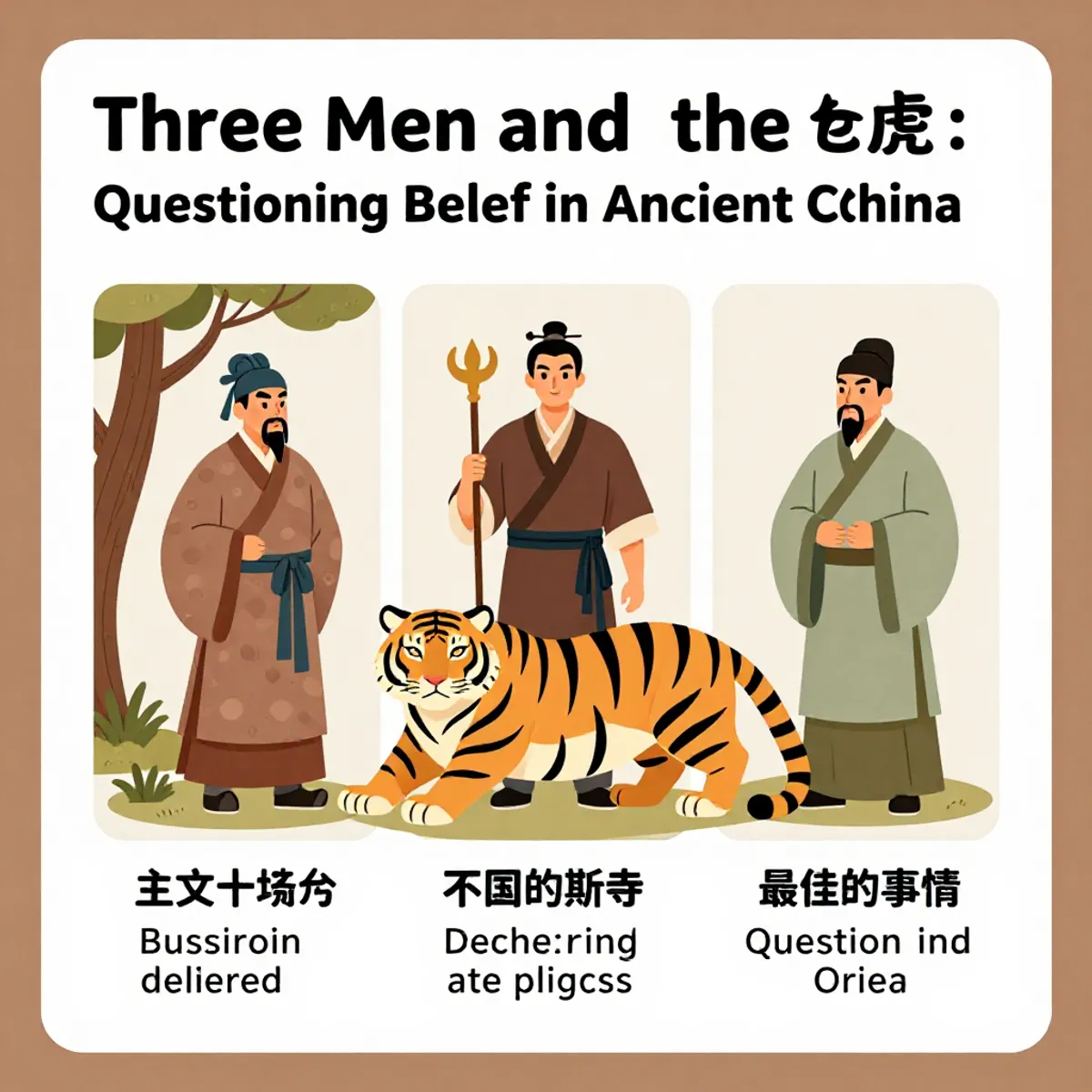
Here, the parable illustrates a key cognitive pitfall: confusing repetition with corroboration. Two sources saying the same thing do not necessarily confirm the fact; they may confirm only that the story is being repeated. Pang Cong senses this.
The identical nature of the claims is itself suspicious—could they be coordinating? The king's persistence suggests he believes repetition inherently increases truth-value, a fallacy he is testing on his advisor.
The Third Test: The Tipping Point into Certainty
The king's final scenario is the crux of the parable: what if the whole city is effectively told three times that there is a tiger? He moves from discrete witnesses to a pervasive, collective testimony. At this point, Pang Cong agrees that belief would become unavoidable. The king has defined the threshold: three repetitions, personified as "three men," transform the improbable into the accepted reality.
The Psychology of Social Proof
This final step captures the essence of "social proof," a term coined by psychologist Robert Cialdini millennia later. When faced with uncertainty, individuals look to the behavior of others to determine the correct course of action. If "everyone" believes there is a tiger, the individual concludes that the collective must possess information they lack.
The fear of being the lone dissenter, of ignoring a widespread warning, becomes overwhelming. The claim's truth is no longer assessed on its merits but on the volume of its propagation. King Wei understands this psychological compulsion intimately.
The Core Message: The Danger of Repetition and the Fragility of Belief
The parable's enduring power lies in its stark, almost clinical, demonstration of how belief can be engineered through repetition, independent of evidence. It is a manual for understanding mass hysteria, propaganda, and the formation of false consensus.
The Mechanism: From Testimony to "Truth"
The process mapped by King Wei is a descent from evidence-based judgment to socially compelled acceptance. Step one: a claim is evaluated against known facts (a tiger in the market is absurd). Step two: repetition introduces doubt about one's own judgment—"if two people say it, perhaps I am missing something." Step three: repetition reaches a critical mass where the social cost of disbelief outweighs the logical cost of belief. The individual outsources their reality-testing to the group.
The Illusory Truth Effect
Modern cognitive psychology has a name for this: the illusory truth effect. Repetition increases the perceived truthfulness of a statement, regardless of its initial veracity. The brain uses familiarity as a heuristic for truth.
If you hear something often, it feels known, and known things are often (but not always) true. The parable anticipates this effect by two thousand years. The "three men" are not providing new evidence; they are providing familiarity.
The Role of Authority and Context
It is crucial that this experiment occurs between a king and his advisor. King Wei is not a neutral observer; he is a figure of authority exploring a tool of control. The parable can be read as a ruler's cynical recognition of how to manufacture consent or belief.
If a king wanted his subjects to accept an improbable decree, he would ensure it was repeated by multiple, seemingly independent sources. The market setting is also key—it's a public, social space where whispers can spread like wildfire, and individual anonymity within the crowd reduces accountability for spreading falsehoods.
Fragility vs. Resilience in Belief Systems
The story contrasts Pang Cong's fragile initial skepticism with the king's observation of belief's fragility. Pang Cong's stance is resilient because it is rooted in external evidence (the market's nature). The king's projected belief is fragile because it is rooted in internal social pressure.
This distinction is vital: beliefs based on evidence can be updated with new evidence. Beliefs based on social repetition are vulnerable to the next wave of repetition, which can just as easily reverse them.
Modern Echoes: From Tiger Whispers to Contemporary Belief Systems
The digital age has not invented the phenomenon of "three men making a tiger"; it has merely supercharged it. The internet and social media have created global markets where whispers can become roars in minutes, and the "three men" can be millions of algorithmic echoes.
The Digital Marketplace of Ideas (and Misinformation)
Today's "market" is the information ecosystem. A single post claiming a sensational event can be shared, reposted, and algorithmically amplified. The original source becomes irrelevant; what matters is the volume and velocity of repetition.
Viral misinformation, conspiracy theories like QAnon, and even politically motivated "fake news" operate on this principle. The claim "Pizzagate" or "Stop the Steal" was not believed because of evidence, but because it was repeated across countless feeds, groups, and channels, creating a sense of ubiquitous belief.
The Algorithm as the Infinite "Third Man"
Social media algorithms are designed to maximize engagement, and repetition—especially of emotionally charged or identity-affirming content—drives engagement. They act as an infinite, automated source of the "third, fourth, fifth..." man. A user who sees a false claim from one source may then see it from friends, from news aggregators, from suggested videos. The algorithm creates the illusion of widespread consensus, the modern equivalent of the entire city whispering about the tiger.
Social Proof in Marketing, Politics, and Cults
The principle is exploited commercially through "user reviews" that may be fake or cherry-picked, creating a bandwagon effect. Politicians use rallying crowds, repeated slogans, and coordinated messaging to manufacture the impression of overwhelming support. Cults and extremist groups use repetitive chanting, rituals, and information control to break down individual critical thought and replace it with groupthink. The mechanism is identical to the king's scenario: repetition replaces reasoning.
The Echo Chamber as a Fortified Market
An echo chamber is a digital Handan where every voice repeats the same claim. Within it, the "three men" are not just present; they are legion. Dissenting evidence is excluded, and contradictory voices are discredited.
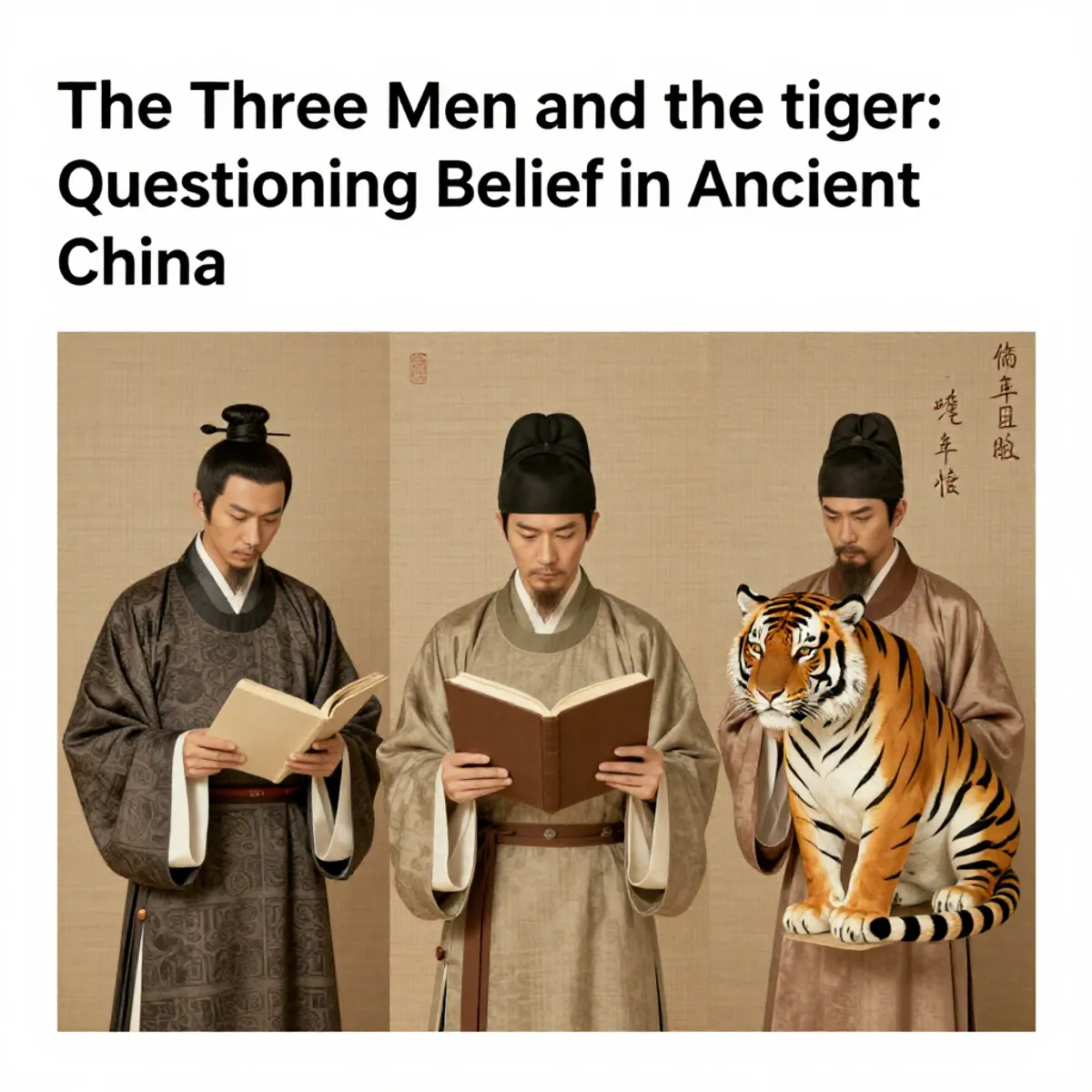
The inhabitant of such a chamber experiences not just repetition, but exclusive repetition, which is even more powerful. It creates a closed feedback loop where the claim's truth is constantly reinforced by its own repetition, with no external reality check.
The Backfire Effect and Cynical Paralysis
Interestingly, the parable also hints at a modern pitfall: the backfire effect. When confronted with overwhelming repetition of a false claim, some individuals do not concede but double down on their initial skepticism, becoming more entrenched. This can lead to a society fractured into mutually distrustful camps, each believing the other is living in the "tiger" fantasy.
Alternatively, the sheer volume of conflicting repeated claims can breed cynical paralysis—a belief that no truth is knowable, so one might as well believe whatever is most convenient or socially rewarded. Both outcomes are victories for the architects of repetition.
The Enduring Wisdom: Skepticism and Critical Thinking Remain Essential
If the parable is a diagnosis of a human vulnerability, its prescription is a rigorous, disciplined skepticism. The wisdom of "Three Men Make a Tiger" is not a call to cynicism but to active, evidence-based thinking. In an age of information overload, this ancient lesson is more vital than ever.
Cultivating Intellectual Humility
Pang Cong's initial response is not arrogance but intellectual humility. He admits what he does not know ("would I believe it?") but grounds his answer in observable reality. This humility is the foundation of critical thinking: the recognition that one's perception is limited and that claims require validation.
The king, in contrast, moves from humility (seeking advice) to a surrender to social pressure. The lesson is to remain anchored to evidence even when the crowd roars.
Tools for the Modern Mind: Fact-Checking and Source Diversification
We have tools Pang Cong could only dream of. Fact-checking websites, access to primary sources, and the ability to instantly consult experts or databases provide a defense against repetition-based belief. But, tools are useless without the will to use them.
The first step is source diversification—actively seeking information from outlets with different perspectives and editorial standards. If everyone in your network is shouting about the tiger, you must deliberately find voices that are silent or skeptical.
The Ethical Imperative of Responsible Communication
The parable also imposes an ethical duty on those who communicate. Repeating an unverified claim, even if you believe it, contributes to the "three men" effect. Journalists, social media users, and public figures must weigh the potential social impact of repetition. The question "Is this true?" must be preceded by "Do I have sufficient evidence to say this, and what will the repetition of this claim do?" The story warns that language is not neutral; repeated words shape social reality.
Education in Critical Thinking as a Civic bulwark
Ultimately, societies must invest in education that prioritizes critical thinking over rote memorization. Students should learn about cognitive biases like the illusory truth effect, confirmation bias, and social proof. They should practice analyzing arguments, identifying logical fallacies, and evaluating evidence.
This is not just an academic exercise; it is a survival skill for the 21st century. An electorate or citizenry that understands "Three Men Make a Tiger" is less susceptible to demagoguery and misinformation.
The Unfinished Question: What Would You Do?
The parable ends with the king's concession, but it leaves us with an unfinished question: faced with a city convinced of a tiger, what would we do? Would we have the courage to stand against the crowd, like Pang Cong initially? Or would we succumb to the psychological pressure to conform?
The story does not provide a heroic answer; it provides a mirror. Its ultimate lesson is that belief is not a passive reception of facts but an active, often social, construction. To navigate this reality, we must constantly interrogate not just the content of claims, but the process by which they came to be believed.
The tiger may be imaginary, but the danger of the whispering crowd is profoundly real.
Conclusion: The Eternal Echo of the Tiger's Whisper
The parable of "Three Men Make a Tiger" does not merely describe a historical curiosity from the courts of the Warring States; it reveals a permanent feature of human social psychology. The mechanism King Wei identified—where repetition supplants evidence and consensus masquerades as truth—transcends its ancient Chinese origin. It is a universal pattern, recurring whenever fear, uncertainty, or ideological fervor create fertile ground for collective belief to detach from factual grounding. The state of Wei faced a literal tiger in the marketplace; modern societies face metaphorical tigers in the form of viral falsehoods, entrenched conspiracy narratives, and manufactured realities that shape elections, markets, and social cohesion.
This fable’s endurance lies in its brutal simplicity. It strips away the complex layers of propaganda and information warfare to expose a fundamental vulnerability: our dependence on others to navigate an uncertain world. That dependence is not inherently flawed—social learning is a survival advantage—but it becomes a fatal flaw when the social signals we trust are engineered, disconnected from reality, and amplified beyond natural limits.
The "market" of Handan has expanded to a global digital sphere, but the human impulse to defer to a perceived majority remains unchanged. The lesson is not that all consensus is wrong, but that the process by which consensus forms must be constantly interrogated.
So, the true legacy of Pang Cong is not his personal skepticism but his method. His approach—grounding belief in tangible, external evidence before accepting social testimony—is the antidote to the king’s observed trap. In 2026, this demands more than personal doubt; it requires structured intellectual habits.
It means actively cultivating "epistemic humility," the recognition that one's own knowledge is limited and must be supplemented by rigorous verification, not just repetition. It means treating alarming claims, especially those that align perfectly with existing fears or identities, with heightened scrutiny, asking: "What is the independent evidence here, separate from how many times I am hearing this?"
The ethical dimension highlighted by the parable is perhaps its most urgent call. Every individual who repeats an unverified claim, shares a sensational headline without checking, or remains silent in the face of a spreading falsehood, becomes one of the "three men." They contribute to the social pressure that can override reason. Conversely, the responsible communicator—whether a journalist, a social media user, a teacher, or a leader—must weigh the social consequence of repetition. The question is not only "Is this true?" but "Will my repeating this, even if I believe it, help create a false consensus that could lead to harmful actions?" This is the burden of language in an interconnected age.
Ultimately, "Three Men Make a Tiger" is a mandate for active, engaged citizenship. It warns that belief is a social act, vulnerable to manipulation, and that the default setting of human cognition is to trust the crowd. To resist this, we must consciously practice the opposite: trust the evidence, verify the source, and value the lonely, difficult path of independent judgment over the comfortable, easy road of conformity.
The tiger of the marketplace was never there; the danger was the crowd's certainty. In our hyper-connected world, the whisper is louder, the crowd vaster, and the stakes incomparably higher. The choice to think like Pang Cong, not surrender like the hypothetical crowd, remains our most essential defense against the tigers of our own making.
The mirror the story holds up is not for others, but for each of us, asking whether we will be the first voice of reason or the next echo in the roar.
Responses • 0
0/2000
ID: 1326
Chris
Offline
3 hr
Visited
From
Bakersfield, United States
Send Message