The Power of TwoWay Language Learning
AI Learn Chinese
2 hr • 0 read
Language exchange for English and Mandarin learners improves skills and cultural learning through partnership.

The Two-Way Street of Language Learning
A Modern Approach to Mastery
The quest to learn a new language often feels like a solitary climb. Textbooks, apps, and classrooms provide structure, but they can lack the vital, messy, human element of real conversation. A growing number of learners are bypassing traditional paths for a more dynamic, reciprocal model: the mutual language exchange.
This approach, where two individuals swap linguistic knowledge, transforms the journey from a academic chore into a shared social adventure. It builds skills in a practical, contextual way while forging a connection that textbooks cannot replicate. For a fluent English speaker beginning Mandarin from zero, and for a Mandarin speaker polishing their English, this is not just a study method; it is a partnership built on mutual respect and a shared goal.
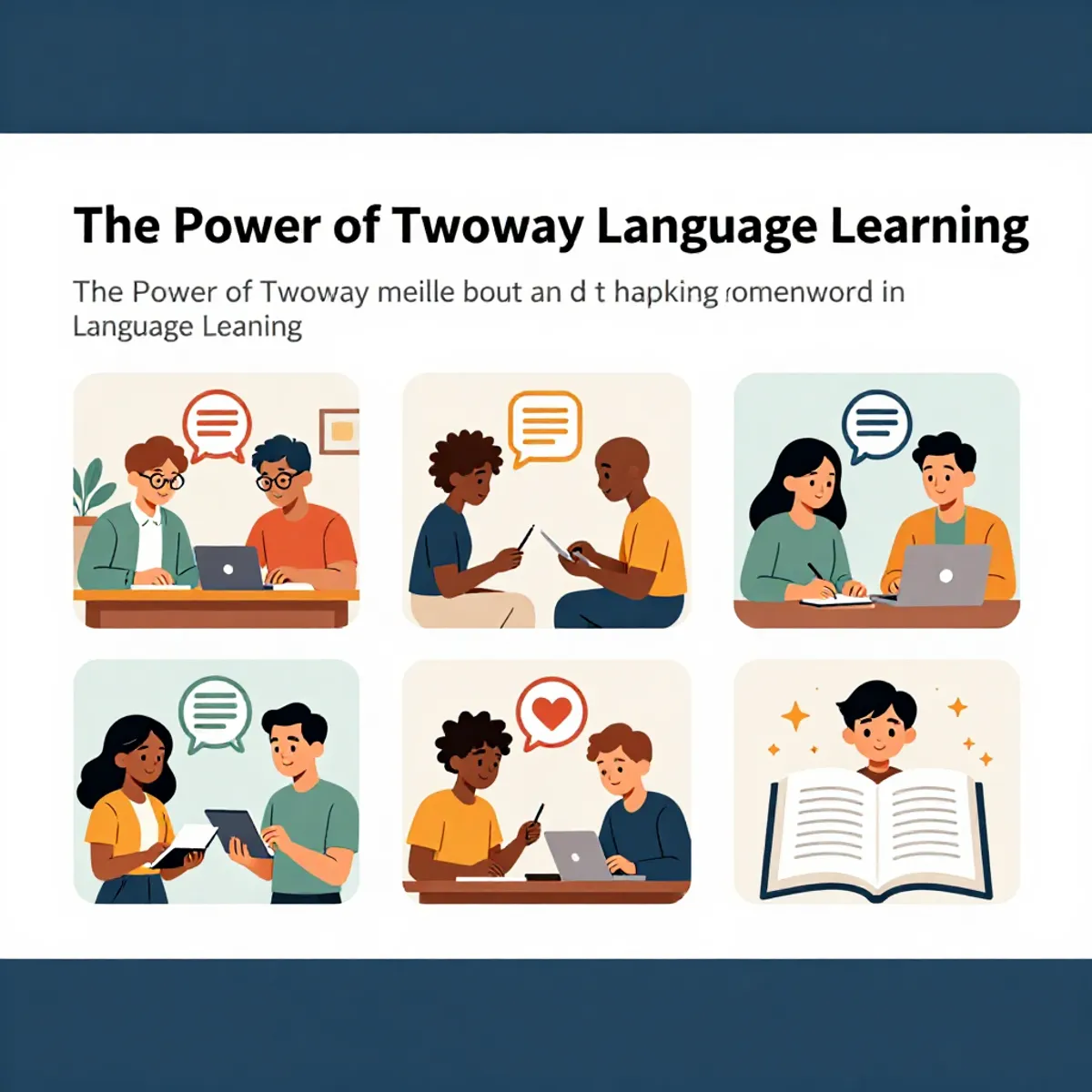
The core premise is beautifully simple. One person dedicates time to helping the other with English—be it through correcting grammar, practicing pronunciation, or engaging in free-flowing conversation. In return, the partner provides the same dedicated support for Mandarin.
This creates an immediate, tangible value exchange. There is no transaction of money, only of time, attention, and expertise. The Reddit post seeking such a partner highlights a key sentiment: the desire for patience from a more advanced speaker, acknowledging the beginner's vulnerability.
This humility is the foundation of a successful exchange. It frames the relationship not as teacher-student, but as fellow travelers on parallel paths, occasionally pointing out obstacles for one another.
This model directly addresses the "language plateau" many solo learners face. Apps can drill vocabulary, but they cannot offer nuanced feedback on tone or natural phrasing. A human partner can.
They can explain why a certain English phrase sounds formal or casual, or help tune the subtle musicality of Mandarin tones. The exchange moves learning from a theoretical exercise into the realm of applied, lived experience. It forces both participants to produce language in real-time, which is the ultimate test of acquisition.
For the Mandarin learner, this means grappling with sentence structure and pronunciation under the gentle, corrective guidance of a native speaker. For the English helper, it might mean explaining the difference between "look," "see," and "watch" in a way that sticks.
In addition, this arrangement embeds cultural learning into every interaction. Language is not neutral; it is woven with history, humor, and social norms. Through regular conversation, learners absorb more than just words.
They learn about daily routines, popular media, social etiquette, and current events from the perspective of someone living within the culture. The Mandarin learner might discuss the significance of 春节 (Chūnjié, Spring Festival) or the nuances of addressing elders. The English helper might explain the cultural context behind idioms like "break a leg" or the British tradition of queuing.
This cultural osmosis happens organically, making the language feel alive and relevant, not a list of disconnected facts to memorize.
Setting up such an exchange requires clarity and intention to avoid mismatched expectations. The initial outreach, like the Reddit post, should specify goals, available time, and preferred communication methods. Is the focus on casual chat, structured grammar lessons, or professional vocabulary?
Does one prefer text-based messaging for thoughtful corrections, or voice calls for immediate pronunciation feedback? Agreeing on a basic schedule—perhaps two 30-minute sessions per week, one in each language—creates reliability. It is also crucial to discuss feedback style.
Some learners prefer gentle correction at the end of a sentence; others want immediate fixes. Establishing this "agreement" upfront prevents frustration and ensures both parties feel their time is valued and their learning style is respected.
The technological landscape of 2026 offers unprecedented tools to facilitate this. Beyond simple voice calls, learners can use shared digital whiteboards to diagram sentences, exchange voice notes for asynchronous pronunciation practice, or co-write short stories in a shared document. Screen sharing allows a partner to point out errors in real-time during a writing exercise.
The key is to choose tools that serve the learning goal, not distract from it. A complicated platform can become a barrier; a simple, reliable method is often best. The goal is to minimize friction between the intent to communicate and the act of communicating itself.
The technology should be an invisible conduit, not the focus of the session.
Patience, as the original poster requested, is the non-negotiable currency of this exchange. Language learning is non-linear, filled with peaks and valleys. There will be days when a tone feels impossible to master or an English phrasal verb seems utterly illogical.
The partner must provide encouragement, not just correction. Celebrating small victories—a correctly used measure word in Mandarin, a naturally contracted English phrase—builds confidence. Conversely, the learner must extend patience to their partner who is tackling the immense challenge of Mandarin.
This mutual forbearance creates a safe space for making mistakes, which is the absolute prerequisite for growth. The exchange becomes a judgment-free zone where the primary metric is effort, not flawless execution.
Overcoming the intermediate hurdle is a common challenge in exchanges. Beginners progress quickly with basic phrases, but the jump to fluid conversation is steep. At this stage, structured materials can complement the free conversation.
A learner might bring a short news article in English to discuss, or a Mandarin podcast snippet to analyze together. This provides a "text" to anchor the conversation, introducing new vocabulary in context. The helper can pre-select articles at an appropriate difficulty level.
This blend of structured input and free-form output prevents conversations from becoming repetitive or stalled by constant vocabulary lookup. It gently pushes both participants into the next stage of comprehension and production.
The cultural exchange deepens as proficiency grows. Conversations naturally evolve from "My weekend was good" to discussing societal values, historical perspectives, or artistic expressions. The English speaker might explain the concept of "small talk" and its social function in Western cultures.
The Mandarin speaker might elucidate the concept of 关系 (guānxi) and its role in social and business life. These are profound cultural lessons embedded in language use. They foster intercultural competence, which is arguably as valuable as linguistic skill in our globalized world.
The exchange becomes a microcosm of cross-cultural understanding, teaching not just how to say words, but how to think within another linguistic framework.
Measuring progress in such an informal setting can be elusive. Unlike a classroom, there are no grades or certificates. The metrics are personal and qualitative.
Can you now understand a faster native speaker? Did you successfully navigate a real-life situation using the language? Did you catch yourself thinking in the target language?
The partner can provide objective feedback on specific improvements—"Your tone on the third tone is much more consistent than last month." Keeping a simple shared log of new words or phrases learned each session can offer tangible evidence of accumulation. The true measurement, however, is the increasing ease and joy of communication. When a joke lands or a complex idea is shared without major struggle, that is the ultimate benchmark.
Looking ahead to 2026 and beyond, the skills cultivated in a language exchange have lasting power. The metacognitive awareness gained—understanding how you learn a language—is transferable to any future skill. The discipline of regular practice, the resilience built from mistakes, and the empathy developed through teaching another are all lifelong assets.
In addition, the personal connection often outlasts the formal exchange period. What begins as a language partnership can evolve into a genuine friendship, a permanent window into another culture. This human network is a reward no standardized test can quantify.
It builds a bridge that facilitates future travel, business, or simply a richer understanding of the world.
To wrap up, the mutual language exchange is a powerful, human-centric model that addresses the core deficits of solitary study. It provides authentic feedback, embeds cultural context, and fosters the crucial element of human connection. For the beginner in Mandarin, finding a patient, engaged partner is the single most valuable step after deciding to learn.
It turns the abstract goal of "learning Chinese" into the concrete, daily reality of "chatting with Li Wei about his job and family." The journey becomes shared, the struggles are halved, and the triumphs are doubled. It is a living testament to the idea that the best way to learn is, ultimately, to teach.
The Foundation of a Successful Exchange
Clarity in Initial Outreach
The first step is crafting a clear and honest request, much like the original Reddit post. Specify your current level (e.g., "absolute beginner in Mandarin," "intermediate English speaker looking for fluency"). State your primary goals: is it conversational fluency, business vocabulary, or exam preparation?
Be explicit about the time commitment you can offer and your preferred times of day. Mention the tools you have access to, such as Zoom, WeChat, or Discord. This transparency filters for compatible partners and sets a professional tone from the outset.
It shows you value the other person's time and are serious about the arrangement.
Defining the "Exchange" Ratio
A common question is how to split the session time. A 50/50 split—equal time in each language—is the most common and fair starting point. But, flexibility is key.
If one partner is a complete beginner, they may need more initial scaffolding in their target language. It is reasonable to start with a 60/40 split favoring the beginner's language, gradually moving to 50/50 as they gain confidence. The important principle is reciprocity over the long term, not minute-by-minute accounting.
The relationship should feel balanced, not transactional. If one week you need extra help with Mandarin measure words, you might naturally spend more time on it, with the understanding you'll provide extra English support the next week.
Establishing Communication Protocols
Agree on the primary platform for your meetings and a backup method in case of technical issues. Decide on a session structure to avoid aimless chatting. A simple framework could be: 10 minutes of warm-up (how was your day?), 20 minutes of focused practice on a pre-agreed topic or grammar point, and 10 minutes of wrap-up and planning for next time.
This provides enough freedom for organic conversation while ensuring focused learning occurs. Also, decide on a policy for between-session contact. Is it okay to send a quick text question?
Setting this boundary prevents misunderstandings and burnout.
Navigating the Practicalities
Scheduling Across Time Zones
For many, the biggest logistical hurdle is the time difference. Use tools like World Time Buddy to find overlapping windows. Be creative: a 30-minute session late in one person's evening might be early morning for the other.
Consider asynchronous exchanges as a supplement. You might exchange daily voice notes describing your day, which the partner listens to and responds to in writing with corrections. This maintains daily contact without requiring simultaneous availability.
The key is consistency—a regular, predictable rhythm is more valuable than occasional long sessions.
Handling Plateaus and Frustration
Every language learner hits a wall where progress feels invisible. In an exchange, this can lead to mutual frustration. The helper might feel their efforts aren't yielding results, and the learner might feel discouraged.
The solution is to re-frame the goal. Instead of "become fluent," focus on micro-goals: "This week, I will use the 把 (bǎ) construction correctly three times." Celebrate the mastery of a specific sound or the understanding of a tricky grammar point. Periodically review old recordings or messages to hear the progress that is too slow to notice day-to-day.
The partner's role here is to be a cheerleader, reminding the learner of how far they've come.
The Art of Giving and Receiving Correction
How you correct is as important as what you correct. Over-correcting can shut down conversation and damage confidence. A good rule is the "one thing at a time" approach.
Focus on a single error category per session (e.g., today we focus on tone errors; tomorrow on verb aspect). For the learner, receiving correction gracefully is a skill. Instead of defending your mistake, simply repeat the correct version.
"Ah, you say zài not zài for 'again'? Okay, zài." This active listening and repetition is a powerful memory tool. The helper should balance correction with genuine praise for what was done right.
The Deep Dive: Culture and Context
Beyond Vocabulary: Pragmatics and Politeness
Language is a social tool. A textbook might teach the Mandarin phrase for "thank you" (谢谢, xièxie), but it won't teach when a slight bow or a small gift is the more appropriate response. An exchange partner is the perfect guide to these pragmatic rules.
They can explain why a direct "no" in English might be softened to "I'm not sure" or "I'll have to check," and why in Mandarin, declining an invitation often requires a polite excuse rather than a flat refusal. These lessons in politeness strategies, turn-taking in conversation, and appropriate topics for different relationships are the hidden curriculum of language fluency.
Unpacking Idioms and Historical Resonances
Every language is a museum of its history. English idioms like "bite the bullet" (to endure hardship) or "spill the beans" (to reveal a secret) are historical artifacts. Mandarin is rich with chengyu (成语), four-character idioms often derived from classical literature or historical stories.
A partner can tell the story behind 画蛇添足 (huà shé tiān zú, "to draw legs on a snake"—to ruin something by adding an unnecessary element). These stories make the language memorable and provide a direct link to the culture's collective memory. They transform abstract phrases into vivid narratives.
Discussing Contemporary Issues
As proficiency grows, the content of conversations should evolve. Move beyond personal topics to discuss news articles, popular TV shows, or social media trends in each other's countries. This exposes the learner to contemporary vocabulary and slang, and it builds the ability to discuss abstract concepts.
It also reveals cultural differences in perspective. A discussion about work-life balance, education systems, or environmental policies will illuminate deep-seated cultural values. This is where language learning matures into critical cultural engagement, moving from tourist phrases to genuine dialogue.
Technology: The Enabler and the Distraction
Choosing the Right Tools for the Task
The ideal toolset is simple and reliable. For real-time conversation, a clear audio/video call platform like Zoom or FaceTime is essential. For written correction, a shared Google Doc is excellent, allowing the helper to use "suggestion" mode to offer edits without altering the original text.
For vocabulary building, a shared flashcard deck on Anki or Quizlet can be created collaboratively. The danger is tool proliferation. Spending 15 minutes figuring out a new app's feature is 15 minutes not spent language learning.
Agree on a small, stable toolkit and master it together.
The Asynchronous Advantage
Not all learning needs to happen live. The power of asynchronous communication—voice notes, text messages, recorded videos—cannot be overstated. It allows for reflection.
A learner can listen to a partner's voice note multiple times, dissecting pronunciation. They can take their time crafting a written response, consulting dictionaries, and learning at a slightly less pressured pace. This is especially valuable for beginners who need processing time.
A good exchange uses both synchronous (live) and asynchronous modes, creating a continuous, low-pressure learning environment that fits into a busy life.
Guarding Against Digital Fatigue
Spending hours staring at a screen for language practice can be draining. It is important to incorporate "analog" elements. Read a physical book or article in the target language and discuss it in your next session.
Listen to a podcast during a walk and summarize it for your partner. Write a letter by hand and mail it. These activities break the digital monotony and engage different cognitive pathways.
They also model how the language is used in the non-digital world, which remains a significant part of life.
Sustaining the Partnership Long-Term
From Partners to Friends
The most successful exchanges often evolve into genuine friendships. The shared vulnerability of language learning creates a unique bond. You are witnesses to each other's struggles and successes.
This social glue is a powerful motivator to keep meeting, even when schedules get busy. You might start sharing memes, recommending music, or discussing personal milestones. The relationship transcends the initial "exchange" framework and becomes a valued personal connection.
This is the ultimate win: gaining a friend and a language skill.
Knowing When to Transition
There comes a point where the formal "exchange" structure may no longer serve. Perhaps one partner has reached a high level of fluency in their target language and the dynamic feels unbalanced. Or, life circumstances change.
It is healthy to have an open conversation about the partnership's future. Perhaps you transition to being "friends who chat in both languages" without the explicit correction and structure. Or you might mutually agree to take a break.
Recognizing this phase is a sign of a mature, honest relationship. The goal was always progress, not perpetuity of a specific format.
Expanding the Circle
Once comfortable with a one-on-one exchange, consider expanding. A small group of 3-4 learners at similar levels can provide more diverse conversation and reduce pressure. Different speakers bring different accents, vocabularies, and personalities.
It mimics a real social environment more accurately. Alternatively, the partnership can be used as a springboard to seek out local conversation groups or cultural events where the target language is spoken. The exchange partner becomes a trusted practice ground and a source of confidence for engaging with the wider language community.
The Intangible Returns
Building Intercultural Empathy
The process of explaining your own culture's idioms and social norms to a curious partner forces you to see them from an outsider's perspective. You become an amateur anthropologist of your own culture. Simultaneously, you learn to see the world through the linguistic lens of your partner.
This dual reframing is a profound exercise in cognitive empathy. It reduces the instinct to judge other cultures as "strange" and increases appreciation for the logic and beauty within different systems. This empathy extends beyond language to all forms of cultural difference.
The Confidence of a Beginner's Mind
Approaching a language from zero, as the Mandarin learner does, requires embracing the beginner's mind—a state of humility, curiosity, and lack of preconception. This mindset, cultivated through the exchange, can spill over into other areas of life. It encourages asking "dumb" questions, tolerating ambiguity, and finding joy in small discoveries.
The English helper, too, experiences this as they grapple with tones and characters. They are reminded what it feels like to be a novice, a valuable lesson for any expert in their field. The exchange keeps both people intellectually humble and perpetually curious.
A Legacy of Connection
The relationship forged in a language exchange often leaves a lasting legacy. Years later, you might still understand a news headline in Mandarin or catch a phrase in a movie. More importantly, you carry the memory of a person who helped you cross a cultural bridge.
This personalizes the entire culture. China is no longer just a place on a map; it is connected to the face and voice of your exchange partner. This personalization is a powerful antidote to stereotypes and geopolitical abstractions.
It creates a human-scale understanding of the world, which is increasingly rare in our digital age.
Conclusion: The Reciprocal Journey
The language exchange is more than a study hack; it is a model for human connection in a fragmented world. It operates on a simple, powerful equation: your knowledge + my time = our mutual growth. It demands vulnerability, patience, and consistency, but it rewards with skills that are deeply practical and personally enriching.
For the fluent English speaker taking their first trembling steps in Mandarin, and for the Mandarin speaker navigating the quirks of English, this path is challenging but deeply human. It turns the daunting task of learning a language into a shared project, a two-way street where both travelers help each other navigate. In doing so, they build not just linguistic competence, but a bridge of understanding that extends far beyond vocabulary and grammar.
The ultimate lesson is that to learn, we must be willing to teach; and to connect, we must be willing to learn. This reciprocal cycle is the heart of the exchange, and it is a lesson worth learning in any language.
Responses • 0
0/2000
ID: 1326
Chris
Offline
2 hr
Visited
From
Bakersfield, United States
Send Message