The Philosophy of the Wanderer's Return
AI Learn Chinese
5 hr • 0 read
MayanZondi's homecoming journey delves into the philosophy of wandering and the evolving concept of home.
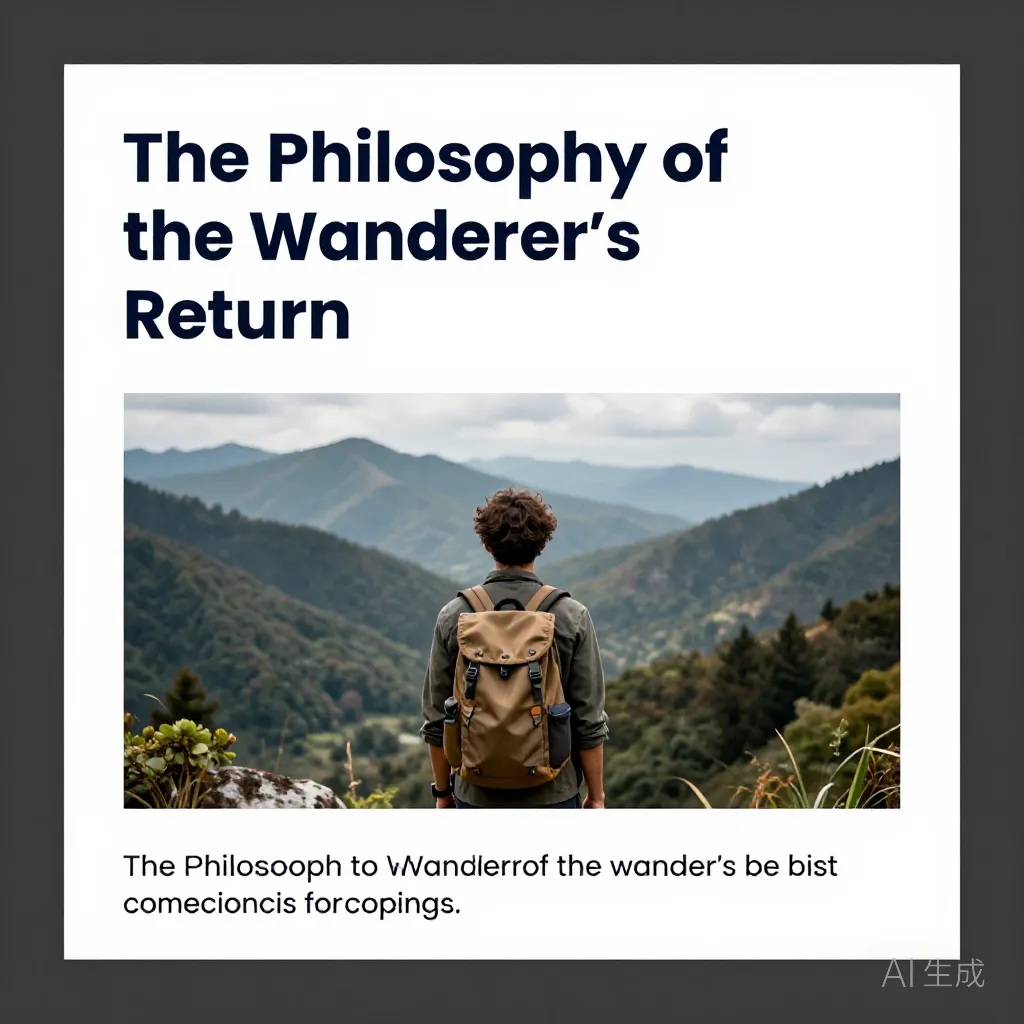
Introduction: The Shadow at the Doorstep
The story of MayanZondi does not begin with a grand departure, but with a silent, unsettling return. It was not the triumphant homecoming of a conquering hero, nor the weary sigh of a pilgrim finally touching sacred ground. It was, instead, the hesitant step across a familiar threshold that now felt like a foreign country.
For years, the name "MayanZondi" had been a story told in fragments—a postcard from a distant port, a rumor of a face seen in a mountain village crowd, a name whispered with a mix of awe and concern by those who remained. Now, the shadow was cast not by a distant sun, but by the figure standing in the doorway of a home that had aged in his absence. This is not merely an account of miles traveled, but a cartography of the inner landscape altered by the outer world.
The return of the wanderer is a universal archetype, a fundamental rhythm of human experience where departure and return form a sacred circle. But what happens when the circle is broken by time and change? What does the wanderer bring back, and what does he find has been irrevocably lost or gained?
MayanZondi’s journey forces us to confront the paradox that the longest journey may not be to the farthest point, but the one that leads back to the starting place, where everything and nothing is as we left it. His silence upon arrival was the first clue: the journey had not ended with the final step; it had merely entered a new, more internal phase.
The Philosophy of the Path: Why Does One Wander?
To understand the return, one must first dissect the departure. The impulse to wander is as ancient as humanity itself, rooted in a complex interplay of necessity, curiosity, and a deep spiritual restlessness. It is more than tourism; it is a chosen state of being, a dialogue with the unknown.
For MayanZondi, the wandering began not with a map, but with a question—a quiet dissatisfaction with the mapped life. The paths we choose to walk are often metaphors for the questions we are trying to answer about ourselves. The physical act of moving through diverse landscapes—the claustrophobic density of a Southeast Asian city, the soul-stretching emptiness of a desert, the dizzying altitude of a Tibetan plateau—becomes a kinetic meditation.
Each step is a rejection of a predetermined script. The wanderer trades the security of routine for the volatility of experience, believing that truth is not found in libraries but in the lived moment, in the unplanned conversation, in the body’s exhaustion after a long day’s walk under an unfamiliar sun. This philosophy is a rejection of stasis, a belief that growth requires the friction of new contexts.
It is a conscious immersion into what the Chinese concept of 游 (yóu) encapsulates: not just traveling, but wandering with a spirit of exploration, freedom, and sometimes, aimless drifting. The goal is not a destination, but the transformation incurred along the way. MayanZondi left to see if he could outpace the ghost of the person he was becoming at home, only to discover that the ghost was an inseparable companion, its weight shaped by every new horizon he crossed.
The Weight of the Unfamiliar: Sensory Overload and Adaptation
The initial phase of a long wander is a sensory assault. The air smells different—of strange spices, of diesel, of damp earth, of woodsmoke. Sounds are layered differently; the call to prayer, the chaotic symphony of a market, the profound silence of a snow-covered forest all compete for attention.
This overload is both exhilarating and exhausting. The mind scrambles to categorize, to file away the new under old labels, but constantly fails. A temple is not just a "building"; it is a scent of incense, a hum of chant, a coolness of stone underfoot, a sight of faded murals.
The wanderer’s first task is adaptation—not just to new climates or foods, but to a new perceptual operating system. This adaptation is a slow, often painful, recalibration. The familiar comforts—the specific texture of one’s own bed sheets, the predictable taste of morning coffee, the unthinking rhythm of a daily routine—become ghost sensations, haunting memories.
In their place, new routines are forged: the ritual of boiling water for tea on a portable stove, the careful negotiation of a price in a market, the simple, profound decision of which direction to walk next. MayanZondi learned to read the sky not for weather, but for omens; to gauge a person’s trustworthiness not by words, but by the set of their shoulders and the duration of their eye contact. His body became an archive of this adaptation—calloused feet, a palate educated by bitter and sweet and sour in combinations he’d never imagined, a circadian rhythm untethered from a single time zone.
This physical and sensory adaptation is the first layer of change, the body’s proof that the journey is real and has left its mark.
The Solitude of the Crowd: Connection and Disconnection in Transit
A paradox of long-term wandering is the profound loneliness that can exist amidst constant human interaction. The wanderer is perpetually a temporary fixture, a "passer-through." Connections are intense but fleeting, forged in the shared heat of a bus or the mutual confusion over a menu. These are bonds of circumstance, not of shared history.
They are beautiful and heartbreaking in their transience. MayanZondi formed a deep friendship with a potter in a Moroccan town, spending weeks learning the rhythm of the wheel, only to leave without a forwarding address, their connection sealed in the memory of shared, wordless labor. He shared nights and stories with fellow travelers in hostels, forming a temporary tribe whose only commonality was a shared state of displacement.
These encounters highlight a key truth: the wanderer often connects more deeply with strangers than with family, because the stakes are lower and the presentation is purer. There is no past to complicate the present. Yet, this very purity underscores a fundamental disconnection.
The wanderer is a collector of other people’s realities without offering his own in full. He is a story without a current chapter. This creates a duality: a rich inner world built from external fragments, and an ever-widening gap between that inner world and the fixed, contextual world he left behind.
He becomes a curator of experiences, but the museum has no permanent home.
The Landscape of the Self: How Travel Forges Identity
The external journey is merely the catalyst for the internal one. The true terrain traversed by the wanderer is the landscape of the self. Stripped of the familiar props—the job title, the family role, the social network that confers identity—the wanderer is forced to confront a raw, unadorned version of themselves.
Who are you when you are no one’s son, employee, or neighbor? This existential confrontation is the core metamorphosis of long-term travel. It is a process of erosion and deposition.
Old, unnecessary parts of the self—petty anxieties, rigid opinions, a sense of entitlement—are worn away by the constant friction of the new. In their place, new qualities are deposited: resilience, a tolerance for ambiguity, a minimalist approach to need, and a profound, hard-won patience. MayanZondi discovered that his previous identity was a fortress built from other people’s expectations.
On the road, the fortress walls crumbled. He was not a "manager," not a "son from a specific town," not a "member of a particular club." He was simply the person who could fix a broken strap with a needle and thread, who could find the way using the stars, who could calm a frightened child with a silent, steady presence. This distilled identity was both terrifying and liberating.
He learned that confidence is not the absence of fear, but the decision to act despite it, a lesson learned while navigating a dark alley in a city where he didn’t speak the language. The journey becomes a series of micro-tests, each one a question posed by the world: Who are you now? The answer is built, brick by experiential brick, in the silent moments after a challenge is overcome.
The Alchemy of Adversity: From Crisis to Core Strength
Adversity is the wanderer’s uninvited but indispensable teacher. It comes in many forms: a stolen passport, a sudden illness in a place with poor medical care, a betrayal by a travel companion, the crushing loneliness of a festival celebrated alone. These are not just inconveniences; they are initiations.
In the safety of home, problems are solved by systems—police, doctors, banks, friends. On the road, the system is you. The crisis forces a complete mobilization of internal resources.
MayanZondi’s most defining moment came not at a majestic vista, but in a grimy bus station bathroom where he was violently ill from bad food, penniless, with a connection to miss. The despair was absolute. And then, a shift.
A practical, cold focus descended. He stopped feeling sorry for himself and started solving: he found water, he rested, he negotiated with a bus driver for a later seat by offering to clean the vehicle, he ate only dry bread for two days. He did not become a hero; he became a mechanic of his own survival.
This alchemy—turning leaden crisis into golden resilience—is the secret wealth of the wanderer. The memory of that bathroom, and the quiet pride in his own resourcefulness that followed, became a permanent touchstone. No future difficulty could match its raw severity, and therefore, no future difficulty could break him.
This core strength, forged in isolation and necessity, is the primary treasure brought home. It is invisible, but it changes the fundamental physics of the individual’s being.
The Mirror of the Other: Seeing Yourself Through Foreign Eyes
Another profound layer of this identity forging is the mirror provided by the "other." Living for an extended period in cultures with vastly different values, social codes, and worldviews acts as a relentless mirror. Your own cultural assumptions, once invisible like air, are thrown into sharp relief. MayanZondi, raised in a culture that prized directness and individual achievement, found himself in a society where harmony, hierarchy, and group consensus were the invisible laws of interaction.
His bluntness was not seen as honest, but as rude and destructive. His pride in personal accomplishment was viewed as boastful and divisive. This constant, gentle (and sometimes not-so-gentle) correction was humbling.
He was forced to see himself not as a universal "self," but as a specific cultural artifact, a product of a particular time and place. This realization can be destabilizing. If your way is not the only way, or even the best way, what is your foundation?
The wanderer must either retreat into cultural defensiveness or begin the difficult work of sifting, keeping what is universal and humane in their own culture while adopting the wisdom of others. MayanZondi learned the power of indirect communication, the value of collective ritual, and the peace found in accepting a slower, less controlled pace of life. He did not become someone else, but he integrated these perspectives, creating a more flexible, culturally agile self.
The home he returns to will see this new self, but will they recognize it? More importantly, will he recognize himself in their old, familiar expectations?
The Geography of Home: What Awaits the Returned
The physical return is the simplest part—a plane ticket, a train ride, a walk down a familiar street. The emotional and psychological return is the vast, uncharted territory. The concept of "home" is not a static place, but a dynamic agreement between a person and a context.
That context has continued to evolve in the wanderer’s absence. The home that was left is a ghost, a snapshot in time. The home that exists now is a different entity, having absorbed new members, lost others, weathered changes, and developed new rhythms.
The returned wanderer is an invasive species in this new ecosystem. They carry the memory of the old home, but their presence disrupts the current balance. The initial reunion is often a surge of emotion—joy, relief, overwhelming love.
But beneath it flows a current of dissonance. The wanderer has changed; the home has changed; the relationship between them must be renegotiated from scratch. The very qualities the wanderer cultivated—independence, tolerance for chaos, a different value system—can be perceived as aloofness, unreliability, or even arrogance by those who stayed.
MayanZondi found his parents’ worries had fossilized into a anxious need to control his immediate movements. His old friends’ conversations, once so stimulating, now revolved around a world of mortgages and promotions that felt alien. The home’s physical space is charged with memory, but the memories are one-sided.
The chair he always sat in is now someone else’s. The tree he climbed as a child is taller, its branches reshaped by storms he did not witness. This is the poignant tragedy and opportunity of the return: to see that home is not a museum to be preserved, but a living organism.
The task is not to pick up where one left off, but to find a new place within the changed whole.
The Unspoken Contract: Navigating Shifts in Family Dynamics
Family is the most intimate and complex layer of the home geography. The roles are deeply ingrained: the child, the sibling, the parent. Long absence severs the daily reinforcement of these roles.
The wanderer returns, consciously or not, expecting to slot back into their old position. The family, however, has adjusted to the absence. The dynamic has found a new equilibrium.
The mother who was a full-time parent may have now embraced a new career or role. The sibling who was the "baby" of the family may have stepped into the space the wanderer vacated. The return disrupts this equilibrium.
There is an unspoken negotiation: What is my place now? This can manifest as gentle friction—parents offering unsolicited advice based on who you were, not who you are. Siblings feeling a mix of joy and resentment at the re-shifting of parental attention. The wanderer, armed with a new sense of self and a perhaps diminished need for familial approval, can seem distant, critical, or ungrateful.
Conversely, the family’s attempts to welcome back the "old you" can feel like a rejection of the new person the wanderer has become. MayanZondi’s mother kept trying to cook his childhood favorite meals, a loving gesture that felt like being fed a ghost. His younger brother, now the de facto head of the household in their father’s eyes, bristled at MayanZondi’s suggestions for how things could be done differently.
The path forward is not a return to the past, but a conscious building of a new, adult-to-adult relationship. It requires patience from the family to see the new person, and vulnerability from the wanderer to share the internal journey, not just the external photos. It is the hardest, most essential piece of the homecoming puzzle.
The Alien Familiar: The Physical Space and Its Ghosts
The physical environment of home is a powerful trigger for memory, but it is a deceptive one. A room, a street, a particular view of the mountains can flood the senses with a perfect, pain-like recall of a past moment. This is Proust’s madeleine, a beautiful and treacherous phenomenon.
The danger is in conflating the memory of an experience with the current reality of the place. The bedroom feels like the one from 18, but the inhabitant is 32. The park bench where a first love was kissed is now just a bench, occupied by a stranger.
The wanderer must perform a constant, quiet translation: This is not the memory. This is the present, which contains the memory. This translation is exhausting. The home is thus both deeply familiar and profoundly strange.
It is a museum of one’s own past, but the exhibits are lived in by other people with their own presents. MayanZondi walked into his childhood bedroom and was instantly eight years old, terrified of the shadow on the wall. Then he looked at the adult-sized desk and books on the shelf and realized he was a stranger in a shrine to a ghost.
The act of "settling" is not about fitting back into the old contours, but about creating new ones. It may mean rearranging furniture, introducing new rituals (a weekly tea ceremony learned in Japan), or simply spending time in the spaces without expectation, allowing the new layers of memory to slowly deposit over the old ones until a new, composite familiarity is built. The home must be re-inhabited, not re-visited.
The Re-entry Shock: When the World Has Moved On
Beyond the family and the physical space, the wider world has continued its relentless spin. News cycles have moved on. Social circles have evolved.
Professional fields have been transformed by new technologies and trends. The wanderer, often by choice, has been offline from these mainstream currents. Their return can feel like a time displacement.
They possess deep, granular knowledge of a remote valley’s farming practices but may not know the latest slang, the new political scandal, or the software update that now standard in their old profession. This creates a subtle, pervasive sense of being out-of-sync. Conversations have inside jokes they weren’t there for.
References are lost. The world has built a new common language, and they speak a dialect of experience that is fascinating but often irrelevant to the daily chatter. This re-entry shock is a quiet crisis of relevance.
The wisdom gained on the road—about patience, simplicity, human connection—can feel abstract and impractical in a world that runs on speed, complexity, and networking. MayanZondi found himself in meetings where his hard-won calm was interpreted as disengagement, and his stories from the road were polite curiosities, not the profound insights he felt them to be. The challenge is to integrate the timeless truths of the journey with the temporal demands of the present.
It is to find a way to translate the language of the road into the dialect of home without losing the meaning. This is the work of the returned wanderer in the community: to be a bridge, not a relic.
Conclusion: The Permanent Pilgrim
The return of MayanZondi, therefore, is not an ending. It is a punctuation mark—a comma, perhaps, or a semicolon—in a sentence that continues. The journey does not conclude at the doorstep; it migrates inward, becoming a permanent part of the wanderer’s internal architecture.
The physical journey provided the catalyst, the raw material, and the contrast. The real journey, the one that lasts a lifetime, is the integration of that foreign experience into the domestic self. The wanderer who returns is not the same person who left, and the home they return to is not the same place they remembered.
The sacred task is to build a new synthesis: a self that holds both the wide world and the hearth, and a concept of home that is not a fixed location but a state of being that one carries within. MayanZondi’s silence at the threshold was not one of speechlessness, but of deep listening—to the echoes of the road within him, to the new rhythms of the house around him, to the difficult, beautiful conversation between the two. He learned that 归 (guī), the Chinese character for "to return," is not just about coming back to a place.
Its ancient form depicts a woman (or person) returning to a dwelling, but its essence is about restoring, about making whole again. The wanderer’s final, greatest journey is the attempt to restore a wholeness within themselves, weaving the threads of the distant lands into the fabric of their original, and now transformed, world. The wanderer never truly stops wandering.
The geography simply changes from the external to the internal, and the most important destinations are the ones found in the quiet, reconciled heart of home.
Responses • 0
0/2000
ID: 1326
Chris
Offline
5 hr
Visited
From
Bakersfield, United States
Send Message