The KMTs Forgotten War on Chinese Folk Faith
AI Learn Chinese
5 hr • 0 read
Chiang Kaisheks KMT actively eradicated native Chinese religion, a history often overlooked when blaming the CCP for cultural destruction.
A Persistent Historical Paradox
A significant paradox exists in popular understandings of modern Chinese history. The common narrative frequently frames the Chinese Communist Party (CCP) as the primary force seeking to destroy traditional Chinese culture and religion. By comparison, the Kuomintang (KMT), led by Chiang Kai-shek, is often remembered as a nationalist party that defended China’s heritage against foreign communist iconoclasm.
This portrayal, however, crumbles under examination of the KMT’s own systematic campaigns against Chinese folk religion and native ritual practice during its rule on the mainland. The evidence suggests that in the realm of religious policy, the KMT’s record was profoundly destructive toward indigenous beliefs, arguably second only to the turmoil of the Cultural Revolution.
This article explores why this historical nuance is so frequently absent from mainstream discourse. It delves into the KMT’s ideological framework, its concrete administrative actions against temples and priests, and a direct comparison with the CCP’s later, more infamous campaigns. The goal is not to equate the two regimes but to dismantle the simplistic dichotomy that paints one as purely destructive and the other as purely preservative of Chinese tradition. The reality is far more complicated, revealing a early 20th-century nationalist project that sought to remake Chinese identity by purging what it deemed “superstitious” folk practices.
The Sentiment of Erasure
The sentiment driving this piece is not one of partisan defense for any single regime. It is a commitment to historical accuracy over convenient mythmaking. The user-provided data points to a clear, documented pattern: the KMT defined native Chinese religion as “superstition” to be eradicated.
The tone must therefore be analytical and evidence-based, presenting documented policies and statements without sensationalism. The positive sentiment here lies in the pursuit of a more complete, truthful historical record that respects the complexity of the past.
Chiang Kai-shek’s Own Words: Faith vs. Superstition
To understand the KMT’s policy, one must first consult its leader’s stated philosophy. In a pivotal April 1938 address titled “Why I Believe in Jesus,” Chiang Kai-shek articulated a clear theological and political hierarchy. He drew a sharp distinction between what he considered positive, “civilizing” religious faith and negative, regressive “superstition.” For Chiang, this was not an abstract debate but a blueprint for national reconstruction.
The Explicit Dual Mandate
Chiang’s speech provides the ideological cornerstone for state action. He declared: “So, while we must eradicate all superstitions, we must at the same time cultivate a strong and positive faith.” This statement is a direct mandate for a dual-track policy: destruction coupled with construction. The object of destruction was explicitly defined as “superstition.” The object of cultivation was “a strong and positive faith,” which in his Christian framework, he plainly advocated.
He further clarified the absoluteness of this stance: “Religious faith ought to exist and ought to be allowed freedom but superstition absolutely ought not to exist and should be thoroughly eradicated.” Here, the language is unequivocal. “Ought to exist” versus “absolutely ought not to exist.” “Allowed freedom” versus “thoroughly eradicated.” The category of “superstition” was not to be reformed or tolerated; it was to be eliminated root and branch. This was a theological and political project presented as essential for national strength and modernity.
Defining the Target: What Was “Superstition”?
The critical, and often overlooked, question is what Chiang and the KMT state classified as “superstition.” The evidence from implementation reveals that the primary target was precisely what we might call Chinese folk religion or native ritual practice. This included: The veneration of local and popular deities through temples and idols. The professional ritual services of Daoist priests, particularly the Zhengyi school.
Practices like fengshui (geomancy) and divination. Native funeral and ancestor worship customs that did not conform to state-promoted norms.
By comparison, “positive faith” was implicitly and explicitly linked to the “world religions” of Christianity, and to a lesser extent, institutional Buddhism and Islam—faiths that fit a Western-modeled template of organized, scriptural religion. The KMT’s definition thus pathologized the diffuse, community-based, and ritual-heavy religiosity of the Chinese countryside as a barrier to progress.
From Doctrine to Action: The Canton Experiment
Theoretical pronouncements from Nanjing were given brutal local expression, most systematically in Guangdong province. The KMT-held city of Canton (Guangzhou) became a laboratory for this anti-superstition campaign in the mid-1930s, providing a clear case study of top-down religious persecution.
The 1936 Decree: A Case Study in Systematic Suppression
In 1936, the Guangzhou municipal government, under KMT control, issued a sweeping order targeting the core of Chinese ritual practice. It commanded all Zhengyi/Daoist ritual halls within police districts to cease operation immediately. These halls were not fringe operations; they were the institutional hubs for a major school of Daoist priests who performed essential life-cycle rituals for the populace—weddings, funerals, house blessings, and festivals.
The order demanded priests remove their signs and public markers of their profession. More consequentially, priests were forced to publicly burn their idols, books, and ritual implements. This was not merely closure; it was ritualized destruction.
The state compelled individuals to destroy their own sacred objects under threat of violence, a profound psychological and cultural assault. The decree concluded with a stark warning: arrest would follow for any violation. This transformed ideological preference into enforceable law, using the police power of the state to terrorize a entire professional class and suppress a millennia-old practice.
The Broader Campaign in Guangdong
This 1936 decree was the apex of a sustained offensive. The KMT administration in Canton had already: Closed and in some cases destroyed temples, repurposing them for schools or government offices. Discouraged and sought to replace native funeral and ancestor worship practices with simplified, “rational” ceremonies, often promoting Christian alternatives.
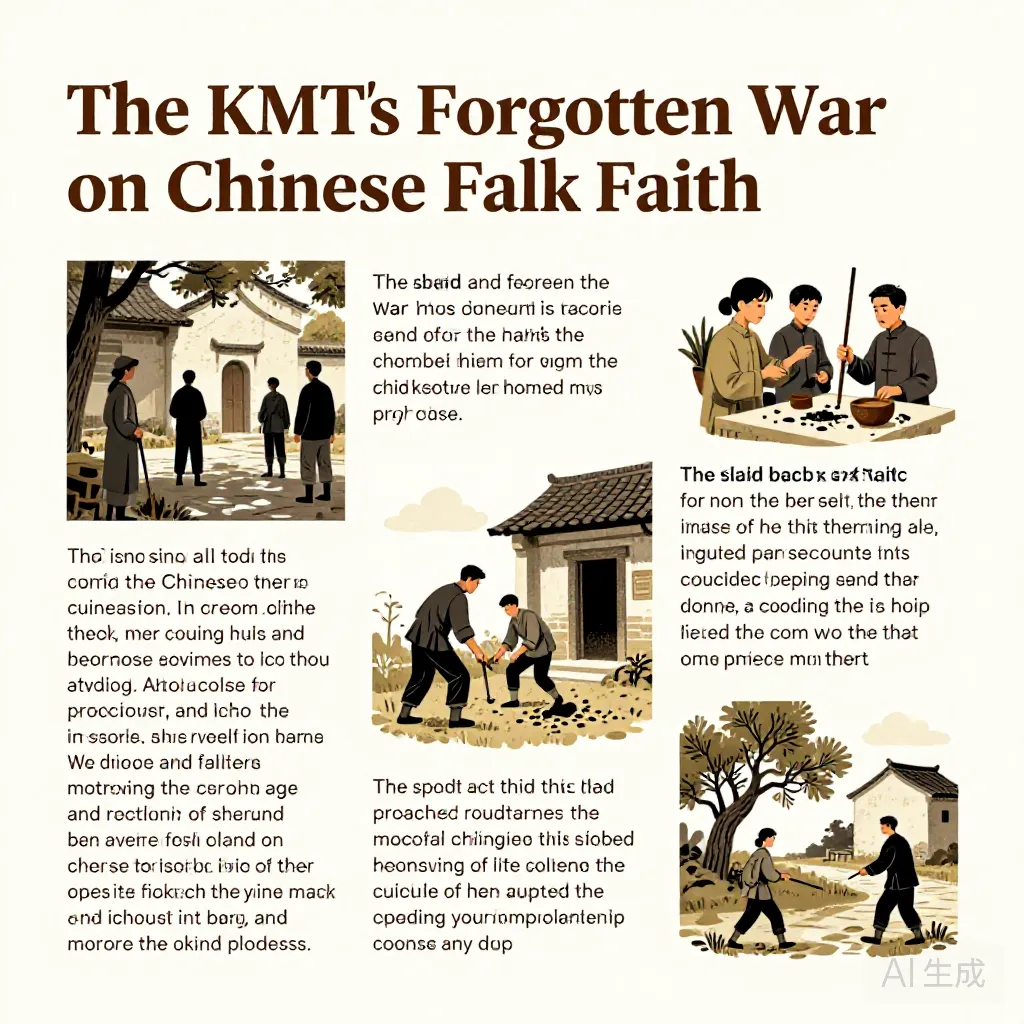
Harassed and marginalized Daoist priests, confiscating their property and limiting their ability to operate. Banned practices like fengshui from official consideration in urban planning and construction.
The goal was to dismantle the physical infrastructure and professional cadre of Chinese folk religion. By attacking the Daoists—the ritual specialists—and their temples and texts, the campaign aimed to sever the transmission of tradition. This was a structural attack on the religion’s very survival, not just a critique of specific beliefs.
The Human Cost: Priests and Communities
The impact on individuals and communities was severe. Daoist priests in Canton faced a brutal choice: abandon their vocation, destroy their sacred heritage, or face arrest. Their livelihoods, identities, and social roles were annihilated by state decree.
For ordinary people, the local temple—often the center of community life, festivals, and mutual aid—was shuttered or seized. The idols of beloved local gods, which represented centuries of communal devotion, were consigned to fire by order of a government claiming to act in the people’s name.
This created a climate of fear and dislocation. Traditional pathways for marking birth, death, and marriage were disrupted. Community cohesion, historically reinforced through shared ritual, was undermined.
The state was not passively allowing change; it was actively enforcing a rupture with the past. The scale and administrative nature of this 1936 campaign in a major city demonstrate that this was official policy, not rogue local enforcement.
The KMT vs. The CCP: Comparing Scales and Methods
A common defense of the KMT’s record is that its actions were limited in scale and geography compared to the nationwide, decades-long campaigns of the CCP, particularly during the Cultural Revolution. While the CCP’s later destruction was indeed vast, this comparison risks minimizing the KMT’s own culpability and misrepresents the CCP’s post-1978 trajectory.
The KMT’s Mainland Campaign: Widespread but Fragmented
On the mainland before 1949, KMT anti-superstition drives were most intense in areas under its firmest control, like Guangzhou, Shanghai, and other major cities in the 1930s and 1940s. The campaign was part of the New Life Movement and broader nationalist modernization efforts. It was systematic where it reached but was not uniformly applied across all of China due to war, regional warlordism, and limited administrative reach. But, where it was applied, it was severe and followed the model seen in Canton: closure, destruction of objects, persecution of priests, and promotion of Christian or “rational” alternatives.
The damage inflicted during this period was significant. It broke the institutional backbone of Zhengyi Daoism in the south, desecrated countless temples, and created a generation of repressed ritual specialists. Scholars note that the cumulative effect of these KMT-era policies, combined with the earlier turmoil of the early Republic and the later Communist campaigns, means the reform era CCP has, in practice, overseen a greater revival and restoration of Chinese folk religion than either previous regime. The KMT’s contribution to this destruction is a foundational layer often forgotten.
The CCP’s Trajectory: Destruction and Then Restoration
The CCP’s record is starkly different in timeline and ultimate outcome. From the 1950s land reforms through the cataclysm of the Cultural Revolution, the CCP engaged in destruction of religious infrastructure and persecution of practitioners on a scale the KMT never achieved. Temples were converted to factories, priests were sent to labor camps, and public worship was banned. The violence was often more chaotic and mass-driven than the KMT’s top-down administrative purges.
But, the story does not end in 1976. Since the reform era began, the CCP has presided over a massive, state-tolerated (and often state-encouraged) revival of Chinese folk religion. Thousands of temples have been rebuilt, often with local government support.
Popular festivals have been revived as “cultural heritage.” Daoist associations have been re-established under state supervision. This pragmatic turn—viewing folk religion as cultural capital and social glue—stands in sharp contrast to the KMT’s earlier ideological purism. The CCP today is a complex actor: it was the greatest destroyer, but under its rule, folk religion has also experienced its most significant modern renaissance.
A Comparative Table of Policies
| Aspect | KMT Era (1930s-40s) | CCP Era (1950s-70s) | CCP Reform Era (Post-1978) |
| :--- | :--- | :--- | :--- |
| Primary Target | Folk religion (as “superstition”), Zhengyi Daoists, temples. | All religion, including folk, Buddhist, Christian, Daoist. | Officially “feudal superstition” but de facto tolerance/revival of folk religion. |
| Primary Method | Administrative decree, police enforcement, forced destruction of objects, closure of institutions. | Mass mobilization, violent struggle, physical destruction, labor camp persecution. | Administrative approval, heritage designation, economic development tied to temple tourism. |
| Scale | Significant in controlled urban centers; fragmented nationally. | Nationwide, catastrophic. | Nationwide revival. |
| Outcome for Folk Religion | Severe institutional damage in targeted areas; suppression of professional ritual classes. | Near-total public eradication; infrastructure destroyed. | Massive restoration and public resurgence; state-managed revival. |
This table underscores why the KMT’s role is so easily overshadowed. Its destructive phase was eclipsed by the CCP’s greater violence, and its legacy is further obscured by the CCP’s later reversal. Yet, the KMT initiated a modern, state-led ideological war on Chinese folk religion that set a precedent.
Why the KMT Gets a Pass: Unpacking the Narrative
Given this documented record, why does the historical memory predominantly absolve the KMT of charges of cultural destruction while heaping them on the CCP? a few intertwined factors explain this persistent narrative gap.
The Power of Defeat and Exile
The KMT lost the civil war and retreated to Taiwan in 1949. Its subsequent history is one of authoritarian rule on that island, but its narrative became frozen in the moment of defeat. In Western and Taiwanese historiography, the KMT is often framed as the “legitimate” Chinese government-in-exile, a bulwark against communism.
This framing inherently casts it as the defender of Chinese tradition against the radical, foreign-inspired CCP. Its pre-1949 actions are frequently contextualized as “necessary modernization” or “anti-superstition campaigns” common to early 20th-century global reformers, rather than as ideologically driven persecution.
Meanwhile, the CCP, having won and ruled the mainland, bears the full weight of its actions. Its later, catastrophic campaigns are seen as the logical endpoint of its revolutionary ideology. The KMT’s similar ideological impulses—its own desire to create a strong, unified, modern nation by purging “backward” elements—are downplayed because its project was interrupted. History is often written by the victors, but in this case, the victor’s (the CCP) own later reversal on religious policy complicates the story, while the loser’s (the KMT) earlier destructive phase is conveniently forgotten in the service of a Cold War-era dichotomy.
The Christian Connection
Chiang Kai-shek’s personal, overt Christian faith is a significant, if often glossed, factor. His April 1938 speech is a Christian testimony. The KMT state actively promoted Christian organizations and missionaries as models of “positive faith.” This creates a powerful, if misleading, association: a Christian leader and a party seen as sympathetic to Western missionaries must, therefore, be protecting “true religion” from “pagan superstition.” This Judeo-Christian framing, common in Western commentary, subtly validates the KMT’s distinction. It portrays the attack on folk religion not as an attack on “Chinese culture” but as a reform against “superstition,” a term with deep roots in both Christian missionary discourse and Enlightenment rationalism.
This narrative conveniently ignores that for the vast majority of Chinese people at the time, their native gods and rituals were their culture. To them, the burning of a local idol by a state that favored a foreign God was an act of cultural imperialism, regardless of the state’s nationalist credentials. The perspective of the devout Daoist or the village elder watching their temple closed is rarely centered in this narrative.
The CCP’s Own Later Reversal
The CCP’s post-1978 policy shift is a masterstroke of historical irony that further buries the KMT’s record. By allowing and even promoting the revival of folk religion as “cultural heritage,” the CCP has effectively positioned itself as the guardian of tradition it once sought to smash. It has co-opted the language of preservation.
This makes it harder to argue that the CCP is inherently anti-tradition, which in turn retroactively makes the KMT’s earlier attacks seem like an aberration or a less severe version of what the CCP would later do on a larger scale. The CCP’s current stance allows its past destruction to be framed as a painful but temporary phase of radicalism, whereas the KMT’s similar actions are simply forgotten.
The Reform Era CCP: An Unlikely Patron?
The current state of Chinese folk religion under the CCP is a testament to pragmatic governance over ideological purity. What was once “feudal superstition” to be eradicated is now “intangible cultural heritage” to be managed and monetized.
A Managed Revival
Across the mainland, local governments often support temple reconstruction. They see it as a way to boost tourism, stimulate local economies, and promote “social harmony.” Daoist associations, officially recognized since the 1980s, operate under state oversight but have rebuilt monasteries and trained new priests. Major festivals like the birthday of the sea goddess Mazu attract millions of pilgrims and state-sanctioned celebrations.
This is not a free, unregulated religious revival; it is a state-managed cultural phenomenon. The state decides which practices are “cultural” and which remain “superstitious” and illegal (e.g., certain healing rituals or large-scale unauthorized processions).
This pragmatic turn highlights the difference between the KMT’s ideological crusade and the CCP’s contemporary utilitarianism. The KMT in the 1930s was trying to sculpt a new citizenry and saw old beliefs as the obstacle. The CCP today sees a controlled version of those old beliefs as a useful tool for stability and national branding. The KMT’s project was one of subtraction; the CCP’s current project is one of curated addition.
Implications for Historical Judgment
This reform era reality complicates the simple “CCP destroys, KMT preserves” story. It shows that attitudes toward Chinese folk religion are not fixed by party label but by political context, perceived utility, and the balance of power within the state. The KMT’s failure to develop such a pragmatic cultural policy before 1949—its insistence on eradication—is a key reason for its historical infamy on this issue, even if its scale was smaller.
It did not live to see the potential benefits of a managed revival. The CCP, having experienced the social costs of total war on culture, adapted. This does not excuse the CCP’s past, but it does mean the KMT cannot claim the moral high ground of cultural preservation it is often granted.
Conclusion: Toward a More Honest Accounting
The historical record is clear. The KMT state, under Chiang Kai-shek’s leadership and through its local administrations like in Canton, conducted a deliberate, ideologically motivated campaign to eradicate Chinese folk religion. It defined native ritual practice as “superstition” to be “thoroughly eradicated.” It used police power to force Daoist priests to burn their idols and books, closed temples, and promoted Christian alternatives. This was not a side effect of war or neglect; it was active policy.
Why, then, does the KMT often escape the charge of trying to destroy Chinese culture? The answer lies in the power of the losing narrative, the resonance of its leader’s Christian faith, and the overwhelming scale of the CCP’s later destruction which overshadows all else. The CCP’s own subsequent reversal on the issue further muddies the waters, allowing its past to be compartmentalized.
A more honest history must acknowledge that the early 20th-century nationalist project, embodied by the KMT, was deeply ambivalent toward China’s own popular religious traditions. It sought to replace them with a rationalized, state-sanctioned, and often Western-influenced model of belief. The damage done in the 1930s and 1940s was real and lasting for the communities and priests targeted.
To remember only the CCP’s violence is to create a false historical dichotomy that excuses one form of cultural engineering by contrasting it with a worse one. True understanding requires seeing both projects in their full, contradictory complexity: the KMT as an aggressive modernizer waging war on “superstition,” and the CCP as a revolutionary destroyer turned pragmatic restorer. Only then can we move beyond polemical simplifications and grasp the true fate of Chinese folk faith in the tumultuous 20th century.
Responses • 0
0/2000
ID: 1326
Chris
Offline
5 hr
Visited
From
Bakersfield, United States
Send Message