The Eternal Lesson: Why Calligraphers Master 永
AI Learn Chinese
4 hr • 0 read
Discover why the single character 永 (yng) is the foundational practice in Chinese calligraphy, compressing eight essential brush movements into one perfect lesson.
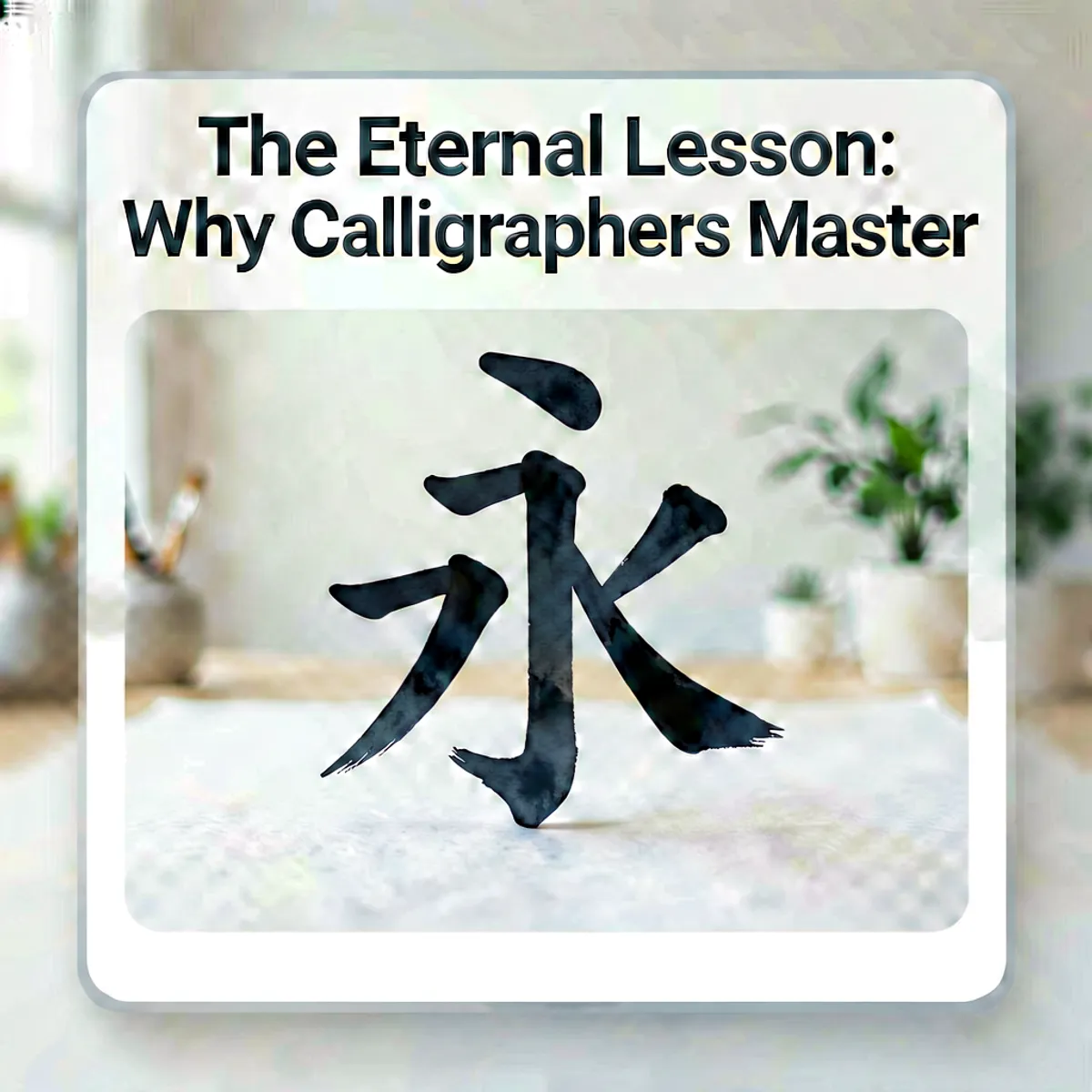
The art of Chinese calligraphy is often first perceived as a visual spectacle—a dance of ink on paper forming elegant, abstract forms. Newcomers are drawn to the finished product: the bold, sweeping lines of a 楷书 (kǎishū, regular script) character, the fluid grace of a 行书 (xíngshū, semi-cursive script). They see beauty in the static result. Yet, the true heart of the practice, the secret whispered from master to student for centuries, lies not in the final shape but in the journey of the brush. It is a lesson in movement, control, and intention, and it is encapsulated perfectly in one deceptively simple character: 永 (yǒng), meaning "forever" or "permanence."
For any serious student of the brush, the character 永 becomes a constant companion. It is the first and last character practiced on any given day, the foundational drill that never loses its relevance. This is not mere tradition for tradition's sake. It is because 永 is a miraculous compression of the core technical vocabulary of the regular-script brush into a single, repeatable form. Within its five strokes, a calligrapher can rehearse, refine, and internalize the eight fundamental brush movements that define the art. Understanding this transforms the practice from simple copying into a profound dialogue between hand, mind, and tool.
The Significance of 永: More Than a Character
Why this particular character? Why not a more complex, visually striking one? The genius of 永 lies in its perfect balance of simplicity and comprehensiveness. It is not so simple as to be trivial (like the stroke for 一, "one"), nor so complex as to overwhelm a beginner with structural concerns. Its five strokes are distinct, yet they flow into one another, creating a miniature composition that teaches both isolated movement and connected energy.
Historically, the standardization of the eight basic movements is often attributed to the great calligrapher 王羲之 (Wáng Xǐzhī) of the Jin Dynasty, though the principles undoubtedly existed before him. His legendary work, the 兰亭序 (Lán Tíng Xù, Preface to the Poems Composed at the Orchid Pavilion), is a masterpiece of flowing cursive, but its power is built upon the absolute control of the regular-script fundamentals that 永 teaches. By the Tang Dynasty, these principles were codified. A 2026 special exhibition at the Smithsonian Institution in Washington, D.C., titled "The Brush's Path: Eight Millennia of Chinese Calligraphy," will feature a dedicated section on practice manuals, showcasing how the 永 character served as the ultimate diagnostic tool for centuries. A calligrapher’s entire technical proficiency could be assessed by their execution of this single word.
For the learner, 永 is a mirror. It reveals flaws in grip, posture, breath, and focus. Is the beginning dot hesitant or firm? Does the horizontal sweep maintain consistent thickness or wobble? Is the hook sharp and decisive or weak and slurred? Each stroke is a separate experiment, yet the whole must feel unified. This duality—practicing parts while feeling the whole—is the first profound lesson.
Deconstructing the Eight Movements: From Ancient Names to Modern Sensation
The traditional names for the eight brush movements are poetic and instructional: 側 (cè), 勒 (lè), 努 (nǔ), 趯 (tì), 策 (cè), 掠 (lüè), 啄 (zhuó), and 磔 (zhé). To the modern student, these terms can seem obscure. But, mapping them to their corresponding strokes in 永 and, more importantly, to the physical sensation they require, unlocks their meaning.
Let us walk through the five strokes of 永 and identify the eight movements within them. The character is typically written left to right in five distinct segments:
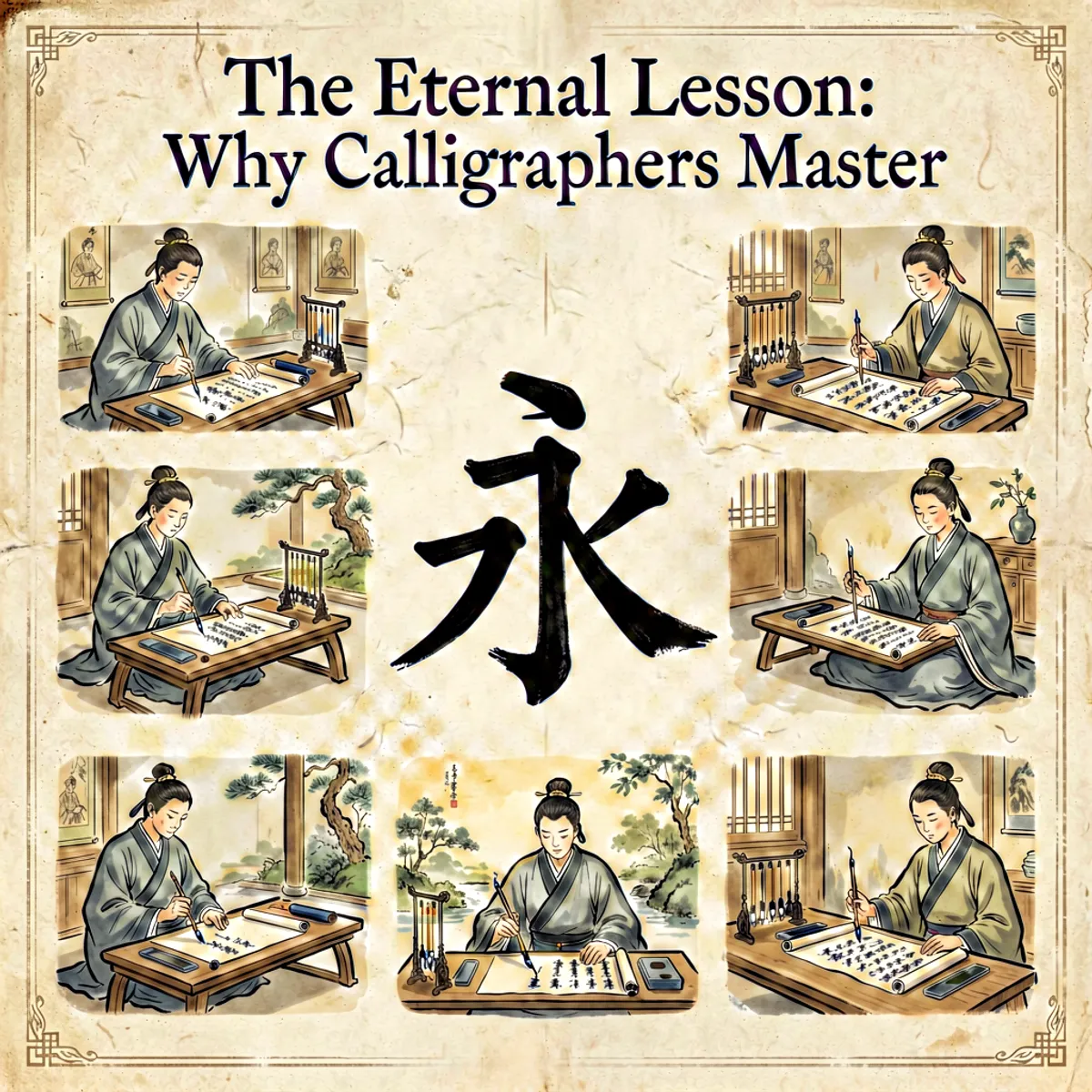
1. The Dot (點, diǎn): This small, rounded mark at the top-left is not a mere dot. It is the embodiment of 側 (cè), which translates to "leaning" or "inclined." The sensation is of the brush tip landing on the paper with a slight, controlled tilt. Imagine setting down a delicate, heavy bead. The pressure is applied as the brush touches down, then immediately released or adjusted for the next movement. It is a moment of arrival and instant readiness. A computer font shows a perfect circle; the calligrapher feels a dynamic point of contact. 2. The Horizontal Stroke (横, héng): The long, sweeping line that follows is where 勒 (lè) and 努 (nǔ) occur. 勒 means "to rein in" or "to restrain." It describes the action of pulling the brush across the page with steady, moderate pressure, like guiding a horse with a taut rein. The stroke should be slightly thinnest at the ends and thicker in the middle, but the change must be gradual and controlled, not abrupt. 努, meaning "to strive" or "to exert," happens at the beginning of this horizontal stroke. It is the initial press-down to set the brush in motion, a focused effort to establish the correct starting thickness and direction. The learner feels: first, a firm "努" to start, then a sustained, controlled "勒" to finish. 3. The Vertical Stroke (竖, shù): The downward stroke on the right side demonstrates 趯 (tì) and 策 (cè). 趯 is often translated as "to spring" or "to flick." It refers to the sharp, upward-tilting hook at the bottom of a vertical stroke. The brush stops, presses, and then flicks upward with a quick, snapping motion of the wrist, leaving a tapered, sharp point. 策, meaning "to urge on" or "to whip," occurs during the main body of the vertical stroke. It is a sense of driving the brush downward with confident, even pressure, maintaining a straight, resilient line. The vertical of 永 does not have a full hook, but the intention for the 趯 flick is prepared in the wrist at the end, while the core of the stroke is pure 策. 4. The Left-Falling Stroke (撇, piě): This long, graceful diagonal falling to the left is the domain of 掠 (lüè), meaning "to skim" or "to graze." The brush enters with a slight angle, moves swiftly and lightly across the surface, and exits with a tapered tip. The pressure is light and constant, like a bird skimming the water's surface. It requires speed and a lack of heavy friction. The sensation is one of effortless, gliding motion. 5. The Right-Falling Stroke (捺, nà): The final, dramatic diagonal falling to the right is where 啄 (zhuó) and 磔 (zhé) come into play. 啄 means "to peck," like a bird's quick, sharp strike. It describes the beginning of this stroke: a swift, angled entry with a sharp point. 磔, meaning "to split" or "to cleave," refers to the broad, powerful sweep and the final, decisive stop where the brush is pressed down and then lifted, creating a characteristic "swallow-tail" or wedge-shaped tip. The stroke starts with the quick "peck" of 啄 and transitions into the heavy, spreading "cleaving" of 磔. This stroke is about controlled power and a dramatic, finished conclusion.
The critical insight is that the old names—側, 勒, 努, etc.—are not labels for shapes. They are verbs for the hand. They command the body: Lean. Rein in. Strive. Spring. Urge on. Skim. Peck. Cleave. A learner copying a static computer font sees eight shapes. The traditional names teach eight movements. This distinction between form and motion is the cornerstone of authentic brushwork.
The Philosophy of Movement: From Shape to Sensation
This is where the practice of 永 transcends mere exercise and becomes a form of moving meditation. The goal is not to produce a perfect replica of a model character, but to internalize the kinesthetic memory of each movement. The calligrapher learns to listen to the feedback from the brush—the resistance of the paper (生紙, shēngzhǐ, raw paper vs. 熟紙, shúzhǐ, prepared paper), the drag of the tip, the spring of the hairs.
Consider the difference in approach:
- Shape-Based Learning: "The dot is a small circle. The horizontal is a straight line, thicker in the middle. The left-fall is a long, thin diagonal." The mind focuses on judging the output against a visual ideal. This leads to stiff, self-conscious copying where the student is constantly looking at the paper, correcting, and never fully feeling the motion. - Movement-Based Learning (via 永): "Begin with 側: feel the brush tip land with a slight tilt. Now, 努: press down firmly to start the horizontal. Transition to 勒: maintain steady pressure as you pull across, feeling the brush hairs flatten slightly." The mind focuses on the process—the sensation in the arm, wrist, and fingers. The correct shape becomes a byproduct of correct movement.
This shift is fundamental. It moves the practice from the eyes (visual) to the hands (tactile/kinaesthetic) and finally to the spirit (intent). The ancient masters called this 意在筆先 (yì zài bǐ xiān), "the intent is before the brush." Before the brush even touches the paper, the mind has already commanded the specific movement—a "勒" for this horizontal, a "磔" for that final fall. The body then executes what the mind has conceived. Practicing 永 is the repetitive drilling of this mind-body connection.
Practical Application: How to Practice 永 for Maximum Gain
Merely writing the character hundreds of times is not enough. Mindless repetition ingrains errors. Purposeful, mindful practice is key. Here is a framework for a transformative 永 drill:
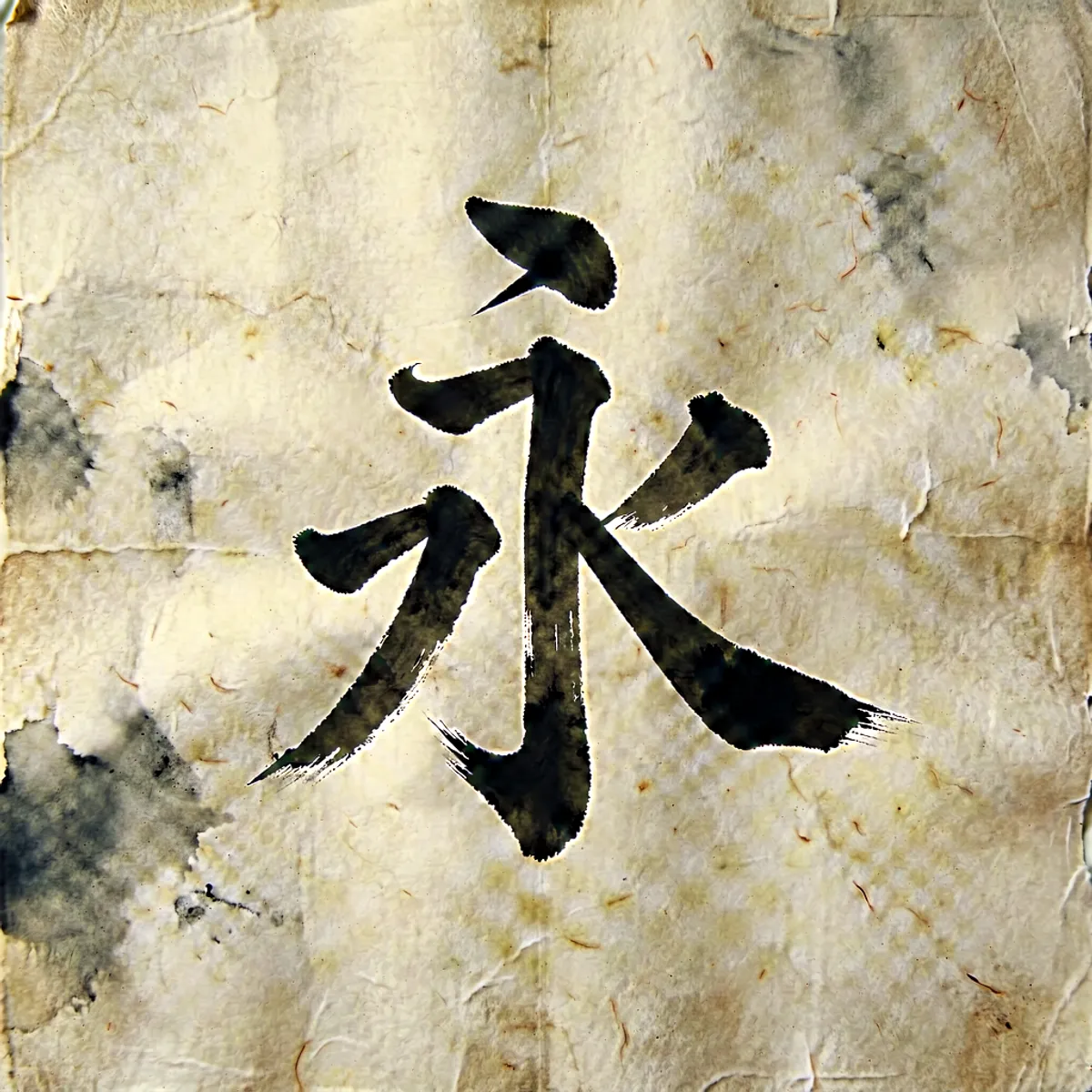
1. Isolate the Strokes: Do not write the whole character for the first hundred attempts. Instead, practice each of the five strokes, and within them, each of the eight movements, on separate sheets. Fill a page with just dots (側). Then a page of just horizontal beginnings (努) and middles (勒). Then a page of verticals focusing on the downward drive (策) and the final flick preparation (趯). This builds muscle memory for the components without the distraction of composition. 2. Extreme Exaggeration: To feel a movement, exaggerate it. For the 磔 (right-fall), practice making the final "swallow-tail" absurdly large and pronounced. Feel the maximum pressure and the sharp lift. Then, gradually reduce the exaggeration until the correct, subtle form emerges. This teaches the body the full range of the motion. 3. Slow-Motion Execution: Perform each stroke at a fraction of normal speed. Feel every micro-adjustment: the rotation of the wrist for 側, the gradual pressure increase for 勒, the sudden release for 啄. Speed will come later from relaxed confidence, not from rushed tension. 4. Focus on Transitions: The magic of 永 is in the connections. How does the dot (側) flow into the horizontal's beginning (努)? How does the end of the horizontal (勒) set up the vertical's start (策)? Practice these two-stroke combinations repeatedly. The breath should be smooth; there should be no dead stops between movements. The energy (氣, qì) must circulate continuously. 5. Use the Right Tools: A 狼毫 (lángháo, weasel hair) brush is traditional for regular script practice due to its firm, elastic tip. A good 宣纸 (xuānzhǐ, Xuan paper) or modern practice paper with a slight absorbency is essential. The 墨 (mò, ink) should be of consistent, creamy consistency—not too thin (which bleeds) nor too thick (which clogs). 6. Mental Rehearsal: Away from the desk, visualize writing 永. See the brush, feel the movements in your mind's eye. This strengthens the neural pathways associated with the skill.
Through this disciplined approach, the practitioner doesn't just learn to write 永. They learn to write anything. The control gained from mastering the "reining in" of 勒 applies to every horizontal. The "peck and cleave" of 啄 and 磔 informs every right-falling stroke in the entire script. The character becomes a portable gym for the brush hand.
Historical Echoes and Modern Relevance
The reverence for 永 is not a quaint antique habit. It is a testament to the efficiency of this pedagogical tool. In the rigorous 科舉 (kējǔ, imperial examination) system of imperial China, a candidate's essay was often judged first by the quality of their calligraphy. A scholar's entire intellectual cultivation was believed to be reflected in their brushwork. The 永 drill was the first filter. If your basics were unsound, your more elaborate compositions would inevitably fail.
This logic holds today. The digital age, with its perfect fonts and touchscreens, has paradoxically heightened the value of authentic brush calligraphy. There is a growing hunger for tactile, process-oriented art that cannot be replicated by a machine. The practice of 永 is the ultimate antidote to digital passivity. It demands full presence. One mistake, one moment of distraction, and the stroke is marred. There is no "undo" button. This builds a profound kind of patience and focus.
In addition, the eight movements provide a precise vocabulary for critique and discussion within the calligraphy community. Instead of vague praise like "nice flow," one can say, "Your 勒 on that horizontal is beautifully steady," or "The 磔 on this 永 feels a bit hesitant." This shared language, rooted in the physical act, creates a deep, non-verbal bond among practitioners.
Beyond Technique: The Deeper Lesson of 永
Ultimately, the endless practice of 永 teaches a philosophy. The character means "forever." The practice is endless. There is no point of final mastery, only deeper refinement. This mirrors the East Asian aesthetic concept of 不易 (bù yì, "not changing") and 變易 (biàn yì, "changing")—the eternal principles (the eight movements) expressed through an infinite variety of momentary expressions (each unique stroke).
The student comes to understand that the goal is not to conquer the character, but to let it work on them. It teaches humility (the brush always reveals your true state), resilience (you must start again after each flawed sheet), and a kind of dynamic stillness. While the hand moves with specific, trained motions, the mind must be calm and clear. This is the state of 心正 (xīn zhèng), "upright heart-mind," that all great calligraphers speak of.
In a world obsessed with quick results and scalable output, the decades-long dedication to perfecting the eight movements within a single character seems anachronistic. Yet, it is precisely this focus on depth over breadth, process over product, that offers a powerful counter-narrative. The value is not in the finished 永 hanging on a wall, but in the calligrapher who, having practiced it ten thousand times, now approaches every line—whether a 永 or a thousand-character essay—with a foundation of absolute control, mindful intent, and a deep, embodied understanding of movement.
The brush, guided by this knowledge, becomes an extension of the self. And in that moment of unity between artist, tool, and art, the meaning of 永—forever—is finally, quietly understood. It is not about time, but about timelessness. The lesson is forever because the learning never truly ends. The practice of 永 is the practice of a lifetime, condensed into five strokes, eight movements, and an endless pursuit of perfection in each fleeting, ink-stained moment.
Responses • 0
0/2000
ID: 1326
Chris
Offline
1 hr
Visited
From
Bakersfield, United States
Send Message