The 80Minute Commute Question
AI Learn Chinese
3 hr • 0 read
Is an 80minute daily commute in Xiamen worth it? We break down the 25minute metro and 15minute bike ride, four days a week.
The Commute Crossroads: Your Real-Life Dilemma
You face a classic modern trade-off. A job opportunity in Xiamen requires a total door-to-door commute of about 80 minutes each day. This journey is not a single mode but a sequence: a 25-minute ride on Xiamen Metro Line 1, followed by a minimum 15-minute bike ride to the final destination.
This schedule only applies four days a week. The core of your uncertainty is simple: is this time investment justified? You are unsure about the practical realities of commuting in Xiamen.
This article will dissect your specific scenario, moving beyond the raw numbers to explore quality of life, cost, and personal fit. We will use your framework to build a universal method for evaluating any significant commute.
Parsing the Numbers: What 80 Minutes Really Means
First, let's translate "80 minutes daily" into weekly and annual terms. For your four-day work week, that is 320 minutes, or 5 hours and 20 minutes, spent commuting each week. Over a 48-week working year (accounting for typical leave), this accumulates to 256 hours.
That is the equivalent of over ten full 24-hour days or six and a half standard 40-hour work weeks purely spent in transit. This quantification is the starting point for any cost-benefit analysis. Time is a finite, non-renewable resource.
The first question is not if you can do it, but what you are willing to trade for this job.
The 80 minutes is a sum of two distinct phases. The 25-minute metro ride on Line 1 is a predictable, scheduled block. You are a passenger, potentially able to read, listen to podcasts, or plan your day.
The subsequent 15-minute bike ride is active, physical, and subject to weather, traffic, and your own energy levels. This bifurcation is crucial. The metro time is allocatable mental space; the bike time is consumed physical effort.
Understanding this split helps assign value and stress factors to each segment separately.
The Xiamen Context: More Than Just a City Name
Your hesitation hinges on "how it is in Xiamen." Xiamen is a sub-provincial city in Fujian Province, known for its scenic coastal location, relatively high GDP per capita, and modern infrastructure compared to many Chinese cities. Its metro system, while younger than Shanghai's or Beijing's, is efficient and clean. Line 1 runs east-west, connecting the island (Siming District) with the mainland (Haicang District). Your commute likely involves this crucial cross-island link.
The bike component places you in a specific urban zone. After the metro, a 15-minute bike ride suggests your workplace is not immediately adjacent to a station but is within a reasonable cycling radius—perhaps 3-5 kilometers. This is common in many Chinese cities where metro stations are hubs, but final destinations sprawl into neighborhoods.
You must consider Xiamen's specific cycling infrastructure. Is there a dedicated, protected bike lane? Or will you be navigating alongside scooters, cars, and pedestrians on narrower streets?
The city's climate is subtropical: expect hot, humid summers with sudden downpours, and mild, damp winters. Cycling in a Xiamen summer rainstorm is a qualitatively different experience from a dry spring ride.
Segment Analysis: The Metro Ride (25 Minutes)
The 25-minute metro segment on Line 1 is the backbone of your commute's reliability. Metro systems in major Chinese cities are famed for their punctuality and frequency. During peak hours, trains on Line 1 likely arrive every 3-5 minutes.
Off-peak, maybe every 7-10. This predictability is a major asset. You can plan your departure to the minute.
The environment is controlled: air-conditioned in summer, heated in winter. The primary variables are crowding and station access.
Crowding is the metro's great variable. If your commute coincides with Xiamen's morning peak (roughly 7:30-9:00 AM), you should expect a packed train. Being able to board without a struggle is a bonus.
You will be standing, likely without a seat, pressed among other commuters. This is physically tolerable but mentally draining for many. The trade-off is you gain 25 minutes of potential productivity or leisure—you can watch a video, study Chinese characters, or simply zone out—something impossible while driving in traffic.
The metro fare will be modest, likely between 4-7 RMB per trip based on distance.
Segment Analysis: The Bike Ride (15 Minutes)
The 15-minute bike ride is the wild card. It introduces physical exertion, weather dependency, and last-mile variability. A 15-minute bike ride at a moderate pace covers about 3-4 kilometers.
This is a healthy distance. The benefits are direct: you get light exercise, avoid any "metro to office" shuttle wait, and have complete control over your departure time from the station. There is no schedule to wait for; you hop on and go.
But, the risks are environmental. Xiamen's rain can be torrential. A sudden summer shower without rain gear will make the ride miserable and potentially dangerous.
Summer heat and humidity combined with physical effort lead to sweating, requiring a change of clothes at the office—a logistical hassle. Winter brings cool, damp winds that feel penetrating on a bike. Traffic safety is paramount.
You must assess the route. Is it a wide, separated bike path? Or a shared lane on a busy road?
The prevalence of didi (ride-hailing) cars and electric scooters (a dominant mode in China) creates a dynamic and sometimes chaotic traffic environment. A minor accident can derail your entire week. The bike itself is a variable: do you own a reliable bike, or will you use a shared bike service like Meituan or Hello bikes?
Shared bikes offer convenience but can be unavailable at your station during peak times or in poor mechanical condition.
The Four-Day Week: A Critical Modifier
The "only 4 days a week" clause dramatically changes the calculus. A five-day, 100-minute weekly commute feels like a grinding, inescapable routine. A four-day commute creates a psychological three-day weekend.
This extended recovery period is a massive quality-of-life buffer. It means the toll of the commute is concentrated and then fully reset. The "cost per hour" of your free time feels lower because you have a longer contiguous block of rest and personal time.
This schedule also opens strategic possibilities. Could you use the non-commute day for errands, socializing, or deep work that would otherwise be eaten by travel fatigue? The four-day week might mean longer daily hours at the office, but the trade-off of a three-day weekend is highly valued by many.
It transforms the commute from a daily drudge into a weekly project with a clear payoff. Your body and mind have 72 hours to recover from the four days of transit and work stress. This modifier should not be underweighted in your decision.
Weighing the Pros: What You Gain
Beyond the job's salary and career prospects, the commute itself has intrinsic benefits. The physical activity from cycling, even 15 minutes each way, adds up to 30 minutes of moderate exercise daily. This combats sedentary office life, improves cardiovascular health, and can boost mood through endorphin release.
The predictable downtime on the metro is a rare commodity in a hyper-connected world. It is sanctioned time for audiobooks, language learning (perfect for practicing Chinese listening), meditation, or strategic thinking—activities often squeezed out of a busy evening.
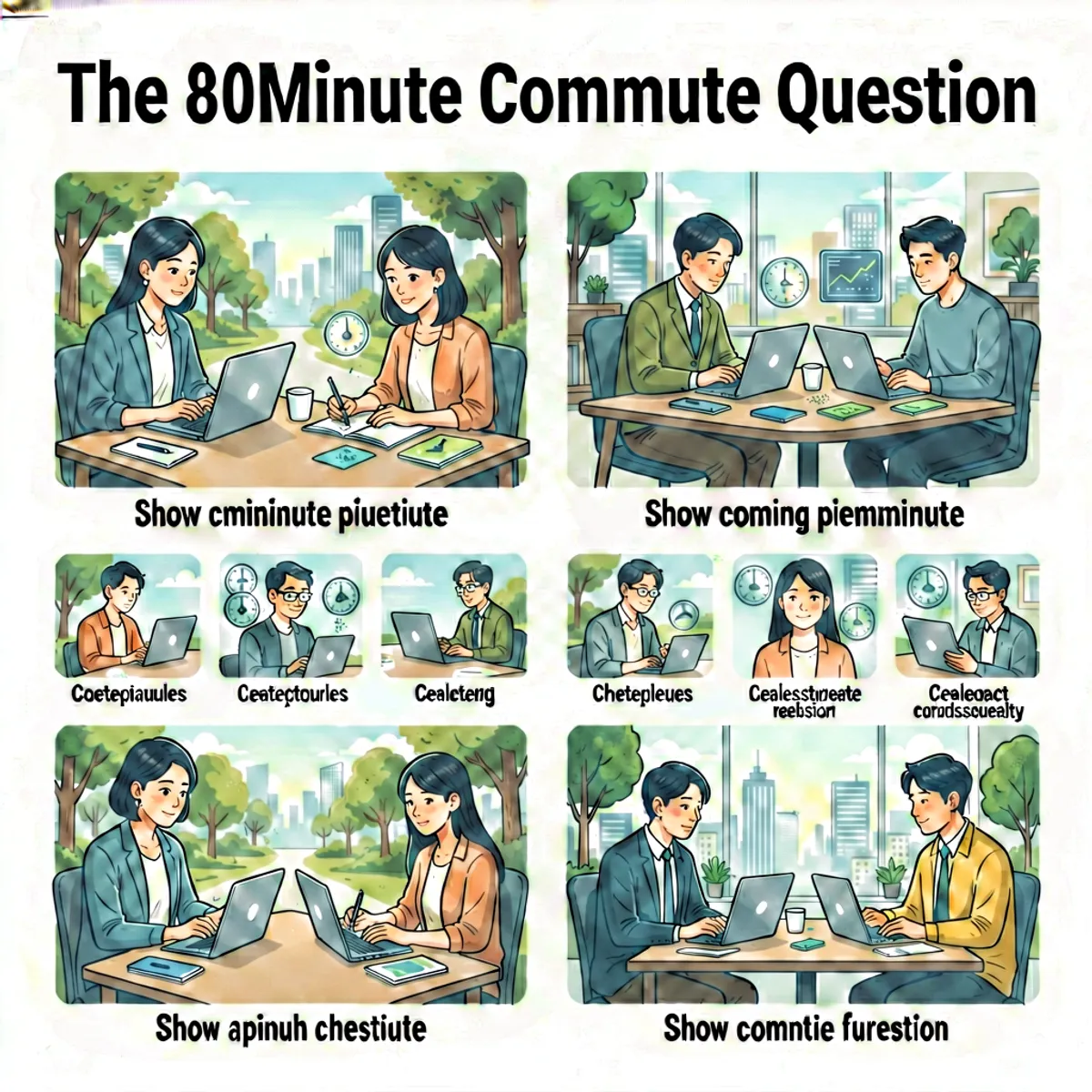
The commute creates a mental buffer zone. The 25 minutes on the metro can serve as a transition between home and work modes. You can use the ride to work to mentally prepare, review agendas, and arrive focused.
The ride home can be a decompression period, letting go of work stresses before stepping into your personal space. This ritualization can improve work-life separation. In addition, mastering a complex urban commute in a Chinese city like Xiamen builds local competence and confidence.
You learn the rhythms of the city, its transit apps, and its hidden pathways, making you feel less like a visitor and more like a resident.
Weighing The Cons: The Hidden Costs
The most obvious cost is time. 256 hours a year is a staggering amount. What could you do with that time?
Learn a new skill, pursue a hobby, spend with family, or simply rest? The commute time is compound lost opportunity. The mental fatigue of crowding, weather worries, and traffic vigilance is real.
Even if you use the metro time productively, the physical act of commuting—especially the active bike segment—is draining. This fatigue accumulates over the week and can leak into your productivity and mood at home.
The weather dependency is a major vulnerability. In Xiamen's rainy season (roughly May-June), you may face multiple days of unpleasant, wet cycling. Do you have a professional, waterproof bag for your laptop and documents?
Do you have a plan for drying clothes? The logistics multiply. Safety is a non-negotiable concern.
A bike accident, even a minor fall, can cause injury, damage property, and lead to missed work. You must honestly assess your cycling skill and the route's danger level. The financial cost, while lower than car ownership or constant taxis, is not zero.
You have metro fares, bike rental or maintenance costs, and potentially higher laundry bills from sweaty or wet clothes.
The Financial Equation: Beyond the Salary
Let's model a simple cost comparison. Assume the job offers a monthly salary of ¥15,000 (a plausible mid-level figure in Xiamen). Your direct commute costs: Metro round trip ~¥12/day * 4 days = ¥48/week.
Bike: if you buy a decent bike for ¥1,500 amortized over 3 years, that's ~¥10/week. Or shared bikes: ~¥2-3/ride 2 4 = ¥16-¥24/week. Let's estimate total direct cost at ¥60-70 per week, or ~¥3,000 annually.
Now, the time cost. If you value your free time at a conservative ¥50/hour (a common freelance or side-hustle rate), your 256 annual commute hours have an opportunity cost of ¥12,800. This is not money you spend, but value you forgo.
To break even on time value alone, the job would need to pay at least ¥12,800 more annually than a local job with a zero-minute commute. This framework shows that a high salary is essential to justify a long commute if you strictly monetize your time. For most, the decision is more emotional and lifestyle-based than purely financial.
Health Implications: The Double-Edged Sword
The bike segment is a clear health positive. 30 minutes of daily cycling aligns with WHO exercise recommendations. It improves leg strength, joint mobility, and aerobic capacity.
It can help manage weight and reduce stress. The active commute is a proactive health choice. But, this benefit is nullified if the stress of the ride—dangerous traffic, bad weather anxiety—outweighs the physical gain.
Chronic stress from a grueling commute is a documented health risk, linked to higher blood pressure, poor sleep, and anxiety.
The metro ride's health impact is neutral-to-negative. Standing in a crowded, potentially noisy carriage for 25 minutes can be physically uncomfortable and mentally taxing. There is also a hygiene consideration in dense public transit, especially post-pandemic.
You are in close contact with many people, increasing exposure to airborne viruses. You must weigh the guaranteed light exercise from cycling against the potential stress and minor health risks of the crowded metro. For the health-conscious, the bike is a win, provided the route is safe.
Psychological and Lifestyle Impact
A long commute can be a psychological sinkhole. It steals time from relationships, hobbies, and self-care. It can lead to resentment towards the job, even if the work itself is rewarding.
The "only 4 days" schedule mitigates this by providing a longer recovery window, but the four commute days will still feel long. You must ask: am I a person who tolerates routine well? Or does a fixed, lengthy daily journey make me irritable and depleted?
Conversely, the commute can be framed as personal time. With the right mindset and tools (noise-cancelling headphones, engaging podcasts, language apps), the metro ride becomes "me time." The bike ride can be invigorating, a daily dose of fresh air and movement. This reframing is powerful but requires discipline.
It is easy to let the commute become dead, wasted time filled with frustration. The psychological impact will be determined more by your attitude and preparation than the raw minutes involved.
The Xiamen-Specific Verdict: Is It "Too Much"?
So, is 80 minutes "too much" in Xiamen? The answer is intensely personal, but we can set local benchmarks. In megacities like Beijing or Shanghai, two-hour round-trip commutes are common and often accepted as the price of a good job.
In Xiamen, a smaller, more livable city, an 80-minute commute is considered substantial but not extreme. The city's manageable size means your 25-minute metro ride is likely crossing a significant portion of the urban area. The bike leg suggests you are in a transition zone—not downtown, not suburb.
The deciding local factors are: 1) The specific bike route safety and infrastructure. A dedicated, scenic bike path along the coast makes the ride a pleasure. A chaotic street intersection makes it a hazard. 2) Your exact workplace location relative to the metro exit. Is the bike ride truly 15 minutes, or does it include searching for parking, waiting at traffic lights, and navigating complex intersections?
Do a trial run on a Saturday to simulate the peak-hour experience. 3) The job's total compensation package. Is the salary high enough to justify the time cost? Does it offer other perks (flexible hours, remote work options on the 5th day) that offset the commute?
In Xiamen's competitive market, a role requiring this commute likely offers a premium.
A Decision-Making Framework for Your Situation
Move from "am I sure?" to a structured test. Step 1: The Trial Period. If possible, negotiate a one-month trial. Commute for real for four weeks.
Track not just time, but your energy levels on arrival, mood after work, and weekend recovery. Keep a simple journal. Step 2: The Financial Stress Test. Calculate your true hourly rate after commute costs (including the time value).
Is it competitive with local opportunities? Step 3: The "Worst Day" Simulation. Imagine a rainy Monday in July. The metro is delayed, the bike ride is a slog through wet streets, you arrive at work damp and late.
Can you handle that? How often might it happen? Step 4: The Alternative Analysis. What are the local job alternatives?
Is there a similar role with a 30-minute commute for 10% less pay? Quantify the trade-off. Step 5: The Life Audit. What will you stop doing with those 256 hours a year?
Be specific. Less time for gym? Friends?
Family dinners? Cooking healthy meals?
Social and Cultural Layers: Commuting as a Shared Experience
In China, commuting is rarely a purely solitary activity; it is woven into the social fabric of urban life. The metro car on Line 1 at 8:00 AM is a microcosm of Xiamen—a silent, packed collective where hundreds of individuals share a brief, intimate space. You will observe the unspoken codes: the downward gaze to preserve personal bubbles, the efficient swapping of seats for the elderly, the synchronized standing and sitting.
This shared experience can foster a sense of belonging to the city's rhythm. Conversely, the bike lane is a more individualistic, kinetic world. Here, you join the stream of electric scooters (didi cars sometimes weaving through), delivery drivers on tight schedules, and fellow cyclists.
Understanding this hierarchy of transport modes—the metro as the city’s disciplined circulatory system and the bike as its nimble, last-mile capillaries—helps you mentally slot into your role. Your commute becomes a daily immersion into Xiamen’s operational culture, not just a transit puzzle.
Seasonal Strategy: Planning for Xiamen’s Climate Cycles
Xiamen’s subtropical climate dictates a commute strategy that changes with the seasons, not just the day. Summer (June-September) is defined by oppressive humidity and sudden, torrential downpours. Your preparation must be military-grade: a compact, high-quality rain shell for your backpack, quick-dry fabrics for your work attire, and a plan for post-ride cooling (perhaps a gym shower facility at the office, if available).
The bike ride in a pre-dawn summer morning might be tolerable, but the return trip in the afternoon heat, after a full workday, is a different trial. Winter (December-February) brings cool, damp winds that seep through layers. A windproof outer layer is essential.
The "shoulder seasons" of spring and autumn are Xiamen’s cycling paradise—ideal for the bike leg. Your decision cannot be based on a single pleasant week in April. You must project yourself into the most challenging 10-day stretch of the rainy season or a cold, windy February afternoon.
If your mental model crumbles under that worst-case simulation, the commute is likely unsustainable.
The Negotiation Leverage: Using the Commute as a Talking Point
Your specific commute burden is not just a personal cost; it is a legitimate point of negotiation. When discussing the job offer, you can frame the 80-minute journey not as a complaint, but as a factor that requires compensation. This moves beyond salary to other perks.
Could the company offer a flexible start time to avoid the absolute peak of metro crowding? Perhaps a remote work option on the fifth, non-commute day, or even one afternoon per week? Does the office have secure bike parking and shower facilities?
These are tangible benefits that directly reduce the friction of your commute. In Xiamen’s competitive talent market, a company serious about attracting talent from across the city may already have policies to support longer commutes. By raising these points, you signal that you are a pragmatic, self-aware candidate who has done the math.
The company’s response—whether they are accommodating or dismissive—is a powerful cultural signal about their employee-centricity.
Deepening the Trial: What to Actually Measure
A simple journal during your proposed trial period must capture more than "tired" or "okay." Implement a structured log. Metric 1: Energy Arrival Score (1-10). How alert and ready to work do you feel 15 minutes after arriving? Metric 2: Commute Stress Index. Rate the metro crowding (1-5) and the bike ride’s perceived danger/stress (1-5) each day.
Metric 3: Weekend Recovery. Do you feel fully recharged by Monday morning, or does fatigue linger? Metric 4: Opportunity Cost Log. For one week, note every single thing you would have done with that 80 minutes if you were home (e.g., "cooked a proper dinner," "called my parents," "went to the gym," "read a chapter of my book"). This creates a visceral inventory of what you are trading.
Metric 5: Social Impact. Did the commute schedule cause you to cancel or reschedule plans with friends or family? Patterns will emerge. Perhaps the bike ride’s exercise boost elevates your morning energy (high Metric 1) but the summer humidity tanks your afternoon focus.
Data beats vague feelings.
The Unspoken Variable: Your Partner’s Commute
If you have a partner or a family, your commute does not exist in a vacuum. Their schedule, location, and tolerance become critical path factors. A 80-minute commute in one direction may force the family to live in a specific area, possibly impacting their commute or access to amenities.
The four-day week means your non-commute day might become a de facto family day, which could be a positive. But it also means your available evenings on commute days are shorter and you may be more fatigued. This creates a household logistics puzzle.
Can family dinners shift? Who handles school runs or evening chores on your commute days? An honest household audit is required.
The commute’s "cost" is distributed across the family unit, not borne solely by the commuter. A supportive partner who values the job’s upside can absorb much of the secondary stress, but if the commute breeds resentment at home, its true cost multiplies exponentially.
The Alternative Urban Model: Could a Different Neighborhood Solve This?
Your analysis must include a spatial what-if. Is there a neighborhood in Xiamen, perhaps closer to your workplace or with a more direct metro line, where you could afford rent/mortgage and have a total commute under 45 minutes? Often, the trade-off is space for time.
A smaller apartment or a less trendy district might slash your commute dramatically. Use Xiamen’s real estate platforms to map commute times from potential alternative residential zones. Factor in the rent difference.
If moving 3 kilometers closer to the office (and thus shortening the bike ride to 5 minutes or eliminating it) costs an extra ¥1,500 per month, that’s ¥18,000 annually. Compare that to your calculated time cost of ¥12,800. In this hypothetical, paying more for proximity is cheaper than your time valuation.
This spatial arbitrage is a powerful tool. The question becomes: is the lifestyle upgrade of a shorter commute worth the financial downgrade of a smaller or farther-out home? This is the core real estate-commute equation playing out in every Chinese city.
Long-Term Horizon: Is This Commute a Bridge or a Destination?
Finally, project this commute two years forward. Is this job a bridge—a high-paying, resume-building role you plan to hold for 18-24 months to achieve a specific goal (save a down payment, gain a key skill), after which you will move on to a role with a better location? If so, the commute is a temporary tax on a clear benefit.
Or is this a destination job—a role you envision holding for 5+ years? A decade of 256 annual hours in transit is a life-shaping commitment. The former can be endured with a light at the end of the tunnel.
The latter demands near-perfect alignment with your health, psychology, and family needs. Be brutally honest about the job’s trajectory. A bridge job with a grueling commute is a calculated sacrifice.
A destination job with the same commute is a potential life liability. Your decision framework must incorporate this temporal dimension. The four-day week softens the blow, but it does not change the fundamental math of years of your life.
Conclusion: The Personal Calculation
There is no universal "too much." For a fitness enthusiast who loves cycling and values a three-day weekend, an 80-minute, four-day commute in Xiamen could be a perfect fit. The metro provides passive time, the bike provides active health, and the schedule allows for full recovery. For someone who treasures every evening hour, dislikes physical exertion in bad weather, or has young children at home, it could be a deal-breaking burden.
Your uncertainty is rational. The key is to replace vague anxiety with concrete data. Test the route.
Price your time. Simulate the bad days. The 80-minute number is just the input.
The output is the quality of your life, health, and relationships over the next few years. In Xiamen, with its generally good infrastructure and climate, this commute is feasible for many. Whether it is desirable is a calculation only you can make, armed with the right questions and a clear-eyed view of both the minutes and the meaning behind them.
Responses • 0
0/2000
ID: 1326
Chris
Offline
1 hr
Visited
From
Bakersfield, United States
Send Message