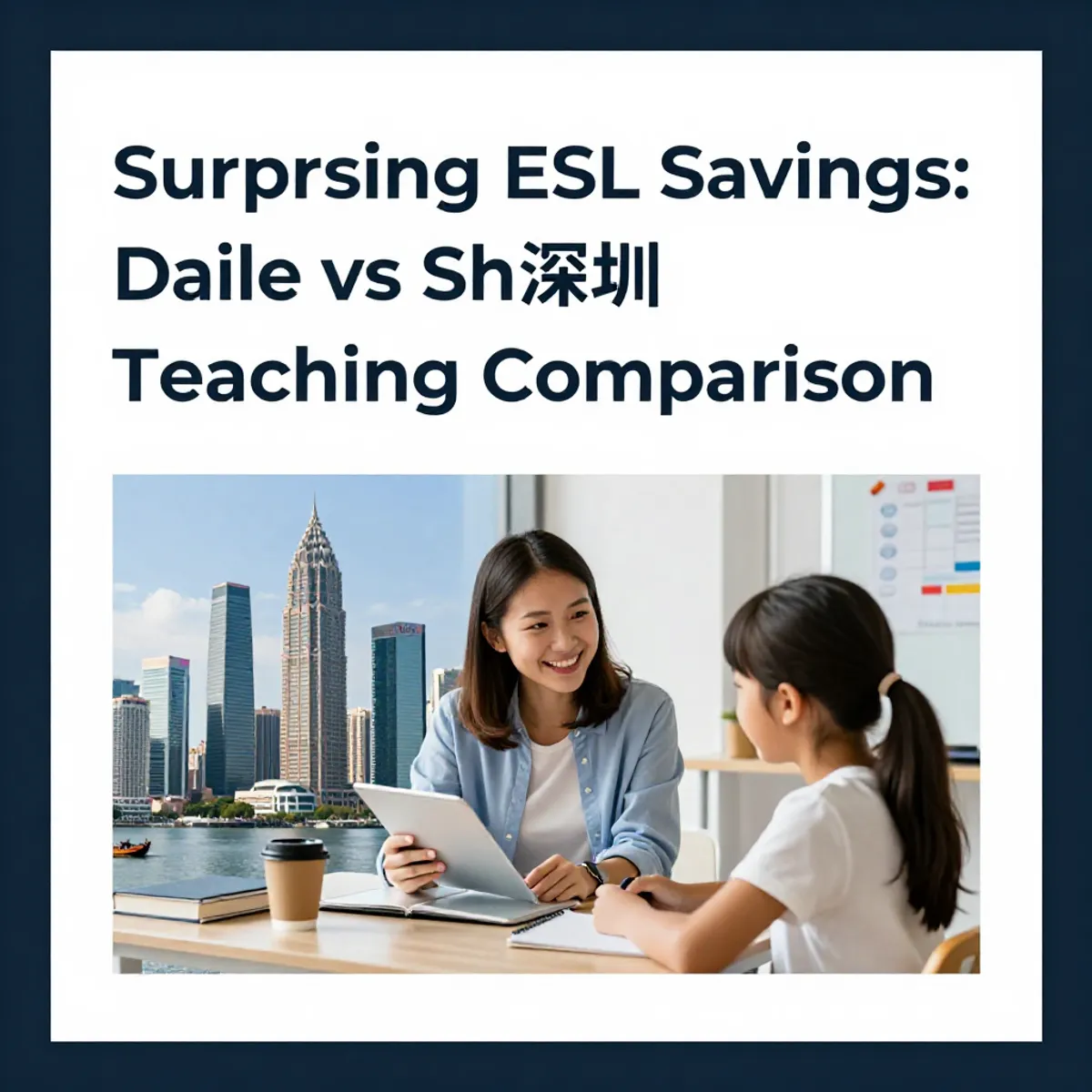
Surprising ESL Savings: Dalian vs Shenzhen Teaching Comparison
AI Learn Chinese
2 hr • 0 read
Compare ESL teaching offers in Dalian vs Shenzhen: salary, housing, and lifestyle benefits for firsttime teachers.
Introduction: The Crossroads of a First ESL Contract
You hold two offer letters, each promising a year of teaching English in China. One is from Shenzhen, a megacity offering 15,000 RMB monthly but no housing. The other is from Dalian, a coastal city offering 12,000 RMB with accommodation included. This isn't just about comparing numbers; it's about choosing the environment where you'll live, work, and grow for the next twelve months.
As a first-time teacher with a degree and TEFL certification, both positions are entry-level. Your challenge is to see past the surface figures and project the real, lived experience of each option. We'll analyze the financial impact of housing, contrast the cities' costs, and evaluate how each choice affects your career trajectory and daily well-being.
The goal is clarity: which offer truly provides a better foundation for your time in China?
Understanding the Shenzhen Offer: High Salary, High Cost
Shenzhen represents the pinnacle of China's rapid development—a vertical, tech-driven metropolis in the Pearl River Delta. The 15,000 RMB monthly salary is competitive for an entry-level position in a tier-one city. But, the absence of housing support fundamentally reshapes your financial reality. This offer is typical of many educational providers in the region, where the base pay appears attractive but leaves the largest expense entirely to you.
The key is to move beyond the gross figure. You must account for Shenzhen's notoriously high rental market, which consumes a significant portion of any teacher's budget. This section breaks down what that 15,000 RMB truly means after securing shelter and covering the city's premium lifestyle costs.
Salary Structure and Tax Implications
Your salary will be paid in RMB through the employer's payroll system. As a foreign employee, your income is subject to China's personal income tax regulations. The tax system uses progressive brackets, but for monthly salaries between 12,000 and 15,000 RMB, the effective tax rate is relatively low, typically around 3-10% after standard deductions. The precise amount depends on your specific deductions and social insurance contributions, which your employer will calculate.
Crucially, the 15,000 RMB is your gross amount. Since housing is not provided, no portion of it is tax-free as a benefit. Your net pay after tax will be the full amount from which you must then pay rent and all other living expenses. This contrasts with a housing-included package, where the accommodation's value is not counted as taxable income.
The Housing Challenge: Market Realities and Your Options
Shenzhen's rental market is one of the most expensive in China. For a decent one-bedroom apartment in expat-favored districts like Nanshan or Futian, expect 4,000–7,000 RMB monthly. A studio in older complexes or a shared room in a larger apartment can range from 2,500–3,500 RMB. But, finding such a place requires navigating a complex landscape.
a number of online listings are outdated or outright scams. Using a reputable real estate agent (中介 zhōngjiè) is common and adds a fee, typically half a month's rent, but provides legitimacy and access to verified properties. You will likely need a Chinese-speaking friend or colleague to assist with negotiations and contract review. Leases usually require three months' rent as a security deposit plus one month's rent as an agent fee upfront—a massive initial cash outlay of 10,000–20,000 RMB before you even move in.
Utilities add another layer: electricity (approximately 0.8 RMB per kilowatt-hour), water (3–5 RMB per ton), gas (if applicable), and internet (100–200 RMB monthly). Monthly utility bills for a single person typically run 300–600 RMB, climbing higher in summer with air conditioning. So, even at the very low end of housing costs (a shared room for 2,500 RMB), your total monthly housing expenditure, including utilities and amortized deposit/agent fees, could easily exceed 3,200 RMB.
Daily Expenses in a Tier-One City
Beyond rent, Shenzhen's cost of living remains high. Groceries and dining are expensive, especially for imported Western goods, organic produce, or specialty items. A weekly grocery run for one person at a supermarket like Walmart or Ole' can easily reach 300–500 RMB if you include cheese, wine, or packaged foods. Dining out at mid-range restaurants costs 80–150 RMB per meal; even a simple local noodle shop might be 25–40 RMB.
Public transportation is efficient and affordable. A monthly metro/bus pass costs 150–300 RMB depending on zones. Taxis and ride-hailing apps like Didi are moderately priced but used frequently due to commute distances. A typical 15-kilometer trip might cost 40–60 RMB.
Healthcare, if not provided by your employer, requires out-of-pocket payments at international clinics (very expensive) or use of public hospitals with lower costs but language barriers. Entertainment—movie tickets (70–100 RMB), gym memberships (300–600 RMB monthly), and nights out in bars or clubs—aligns with other major global cities.
To maintain a comfortable but not lavish lifestyle in Shenzhen, your non-housing monthly budget should be estimated at 3,000–4,500 RMB. This includes groceries, transport, phone, toiletries, and moderate leisure spending.
The Psychological and Practical Toll of Housing Self-Management
The administrative burden of securing your own apartment cannot be overstated. You will spend days—possibly weeks—searching, viewing, and negotiating in a foreign language. The risk of signing a lease with unfavorable terms, hidden fees, or an unscrupulous landlord is real. Once moved in, you are responsible for all maintenance issues, from broken appliances to plumbing problems, coordinating with landlords who may speak little English.
This stress arrives just as you are adjusting to a new country, new job, and new culture. The freedom to choose your living situation is a genuine benefit, but it comes at the cost of significant time, mental energy, and upfront capital. For a first-time teacher, this added layer of complexity can hinder your ability to focus on teaching preparation and cultural exploration.
Understanding the Dalian Offer: Lower Salary, Included Housing
Dalian, a coastal city in Liaoning province, presents a starkly different proposition. The 12,000 RMB monthly salary is lower than Shenzhen's, but the inclusion of housing transforms the financial equation entirely. This offer is typical of many educational institutions in tier-two cities, where attracting foreign talent often hinges on providing a complete, hassle-free package.
Your employer will provide a furnished apartment, typically a studio or one-bedroom unit. This benefit is not part of your taxable income, meaning your entire 12,000 RMB is, in effect, your disposable income minus personal living costs. The value of this arrangement is immense, especially for someone new to China. It eliminates the largest financial and logistical hurdle of moving abroad.
The Housing-Included Advantage: What to Expect
Clarify the specifics of the provided accommodation before signing. Is it a private studio or a shared apartment? What is the location relative to your teaching site?
Are utilities (electricity, water, gas, internet) included? In Dalian's market, a comparable private apartment might rent for 1,500–2,500 RMB monthly, making this a substantial tax-free benefit.
The practical relief is immediate: no security deposit, no agent fees, no lease negotiations. You arrive, collect the keys, and move in. Your employer handles the arrangement, meaning you avoid the nightmare of temporary housing while apartment hunting. This smooths your transition immeasurably, allowing you to direct your energy toward lesson planning and settling into your new city.
The trade-off is choice. You may not love the apartment's size, condition, or distance from your school or downtown. It might be in a older building with basic furnishings. But, for a first-year teacher prioritizing stability, simplicity, and maximum savings, this is a minor concession for a major gain in peace of mind.

Dalian's Cost of Living: A More Manageable Equation
Dalian's overall cost of living is significantly lower than Shenzhen's. It is a popular city for students and expats, known for its clean environment and slower pace. With housing covered, your primary expenses become food, local transportation, utilities (if not included), and personal spending.
Groceries are cheaper, particularly local produce, seafood, and meat. A weekly grocery bill at a local market or supermarket might be 200–350 RMB. Dining out at local restaurants is very affordable; a satisfying meal can cost 30–60 RMB. International or Western-style restaurants exist but are pricier and less common.
Public buses and the metro are inexpensive; a monthly pass is well under 200 RMB. a number of residents use electric scooters for short trips. All things considered, a comfortable monthly budget for personal expenses in Dalian might range from 2,000 to 3,000 RMB. This includes groceries, transport, phone, toiletries, and moderate entertainment.
The Tangible Value of Predictability
Having housing locked in for your contract duration provides financial predictability. You are shielded from Dalian's rental market fluctuations, which, while less volatile than Shenzhen's, can still rise. Your largest expense is fixed and known from day one.
This predictability enables accurate budgeting and savings planning. You can set a monthly savings target with confidence, knowing your rent will not suddenly increase. It also removes the anxiety of finding a new place if your contract is renewed or if you decide to stay longer. The psychological benefit of this security, especially in a foreign country, cannot be quantified but is deeply felt.
Financial Face-Off: Projecting Your Net Disposable Income
Let's construct a realistic monthly budget for both scenarios. These figures assume a single person living moderately: cooking some meals at home, eating locally, using public transport, and enjoying occasional entertainment. All amounts are in RMB.
Monthly Budget Scenarios
Shenzhen Scenario (15,000 RMB Salary, No Housing)
Salary (gross): 15,000 Estimated income tax (approx.): -800 Rent (shared studio in less central area): -3,000 Utilities & Internet: -600 Groceries & Dining (mixed local/imported): -3,500 Transportation (metro/bus + occasional Didi): -250 Miscellaneous (phone, toiletries, leisure, clothing): -1,000 Estimated Net Disposable Income: ~5,850 RMB
Dalian Scenario (12,000 RMB Salary, Housing Included)
Salary (gross): 12,000 Estimated income tax (approx.): -400 (lower taxable income due to no rent deduction needed) Rent & Utilities: 0 (included) Groceries & Dining (mostly local): -2,200 Transportation (shorter commutes, mostly bus/metro): -120 Miscellaneous (phone, toiletries, leisure, clothing): -700 * Estimated Net Disposable Income: ~8,580 RMB
This simplified model shows a potential monthly savings advantage of over 2,700 RMB in Dalian. Even if you find exceptionally cheap housing in Shenzhen (e.g., a shared room for 2,000 RMB), your net disposable income would likely still trail behind Dalian's. The housing benefit is the decisive factor, turning a lower gross salary into a higher net financial outcome.
The Savings Potential Over a Full Contract
Assume a 10-month teaching period (common for many first contracts, with 2 months for summer holiday or travel). Using the conservative net figures above:
Shenzhen: 5,850 RMB/month × 10 months = 58,500 RMB total savings potential. Dalian: 8,580 RMB/month × 10 months = 85,800 RMB total savings potential.
This represents a 27,300 RMB difference—nearly $4,000 USD at current exchange rates. This sum could cover a round-trip flight home, a substantial travel budget throughout Asia, a professional development workshop, or serve as a critical emergency fund. For a first-year teacher likely carrying student debt or seeking to build a financial cushion, this disparity is enormous and cannot be ignored.
The Bigger Picture: Career Growth, Lifestyle, and Practicalities
While the financial analysis heavily favors Dalian for net savings, the decision involves non-monetary factors that profoundly impact your year in China. Your career trajectory, daily happiness, social integration, and long-term plans all play a role. This section examines these elements to help you weigh the full picture.
Career Trajectory and Resume Building
Shenzhen's Market: As a Special Economic Zone and tech hub, Shenzhen hosts a vast array of educational institutions: international schools, private language training centers, corporate training departments, and universities. The sheer volume creates a dense professional network. A year teaching here signals to future employers that you have thrived in a high-pressure, competitive environment.
You will have access to workshops, networking events, and a constant flow of job openings. But, the market is saturated with teachers, meaning competition for the next, better-paying role is fierce. Your experience might be intense but could be less hands-on if you are one of many instructors in a large organization.
Dalian's Market: Dalian's education scene is smaller, centered around Dalian University of Foreign Languages and other universities, plus a handful of international schools and private language centers. The expat teacher community is tight-knit. With fewer colleagues, you may have more opportunity to take on significant responsibilities—curriculum development, student activity coordination, or even administrative tasks.
This can lead to a stronger, more personalized reference from your director. But, the city's lower international profile might be perceived as less prestigious by some future employers in top-tier cities. To offset this, you must actively document your achievements, seek leadership roles, and perhaps pursue additional certifications during your stay.
Social Fabric and Daily Life
The social landscape of your year abroad will be shaped as much by the city's size and demographic as by your salary. Shenzhen's expat community is massive and diverse, a floating population of tech professionals, entrepreneurs, and teachers from every corner of the globe. This makes it remarkably easy to build an English-speaking social circle, find international pubs, and participate in familiar cultural events.
But, this very accessibility can create a comfortable bubble, slowing your integration into local life and reducing daily motivation to practice Chinese beyond basic transactions. You may find your social world centered on other foreigners, which is enriching in its own way but can limit deeper cultural immersion.
Dalian’s expat scene is compact and often revolves around the university and a handful of international schools. The smaller community means you are more likely to encounter the same faces repeatedly, fostering closer-knit relationships. There is less of an "expat bubble" simply because there are fewer expats to form one.
This naturally pushes you toward interacting more with local colleagues, students, and neighbors. The trade-off is a potentially narrower social net; if you don't connect with the few available groups, loneliness can set in more quickly. For the self-motivated, Dalian offers a purer, if sometimes quieter, immersion experience.
Cultural Access and Travel Opportunities
Your free time will be spent exploring, and each city offers a distinct gateway to China's breadth. Shenzhen is a hyper-modern launchpad. Its location in the Pearl River Delta means Guangzhou, Hong Kong (via a quick metro ride), and Macau are all within reach for weekend trips.
The city itself hosts international art galleries, tech expos, and a vibrant music scene. But, the sheer scale means travel within the city can be time-consuming, and the urban environment, while dazzling, can feel homogenous—glass towers and shopping malls replicating a global aesthetic.
Dalian provides a different kind of access. It is the coastal capital of Liaoning, offering a distinct Northeastern Chinese culture with Russian architectural influences and a famous seafood cuisine. The city is clean, green, and walkable in many areas.
Its location makes it an excellent base for exploring Northeast China: the historic port of Lüshun (Port Arthur), the volcanic landscapes of Changbai Mountain, or the imperial palaces of Shenyang. While international travel from Dalian requires a flight, domestic travel to Beijing, Qingdao, or even Seoul (by ferry) is straightforward and often less crowded than from Shenzhen. The pace allows for deeper exploration of a single region rather than constant, hectic traversal of the southern megalopolis.
Health, Safety, and Environmental Factors
Daily well-being is contingent on more than just financial security. Air quality is a perennial concern in China. Shenzhen, being coastal and heavily regulated as a Special Economic Zone, generally enjoys better air quality than many northern cities, though it still experiences smog episodes, especially in winter.
Dalian, also a major port city, is famously clean for Chinese standards, with frequent sea breezes mitigating pollution. For those with respiratory sensitivities, Dalian's air may offer a tangible health advantage.
Safety is high in both cities by global standards. Violent crime against foreigners is rare. Standard urban precautions—guarding belongings in crowds, avoiding poorly lit areas at night—apply equally.
But, Shenzhen's sheer density means a higher incidence of petty theft (pickpocketing, phone snatching) in crowded areas like Huaqiangbei or metro stations. Dalian’s slower pace can feel more relaxed, though no city is crime-free. Healthcare access differs significantly.
Shenzhen boasts several international clinics with English-speaking doctors and Western-style service, but at a very high out-of-pocket cost if not covered by insurance. Public hospitals are affordable but present formidable language barriers. Dalian's international medical options are limited; you would primarily rely on the public system, which is decent for basic care but requires significant linguistic preparation or a translator app for anything complex.
Long-Term Viability and Contract Renewal
Your decision may also hinge on what happens after the first year. Shenzhen's dynamic market means opportunities are constantly emerging. If you excel, a renewal with your current employer or a move to a higher-paying institution is plausible.
The city's growth ensures a steady demand for qualified teachers, but also a steady influx of new graduates, meaning you must continuously upgrade your skills to advance. The high cost of living, however, means even a salary increase might not dramatically improve your savings rate unless you secure a housing allowance.
Dalian offers a different long-term calculus. The lower cost structure means any salary increase translates directly into savings. Some teachers find the lifestyle so agreeable and the savings so substantial that they extend their stay for multiple years, sometimes moving into curriculum design or teacher training roles within their institution.
The smaller market has less churn, potentially offering more job stability if you build a strong reputation locally. But, if your ultimate goal is to move to a tier-one city or return home with a significant nest egg, Shenzhen's resume prestige might outweigh Dalian's savings advantage in the long run. You must ask: is this year a standalone adventure, or the first step in a longer China career?
The Intangible: Pace, Stress, and Personal Resilience
Beyond budgets and job markets lies the daily psychological experience. Shenzhen is a city of relentless momentum. The pace is fast, the work ethic intense, and the competition palpable.
For the ambitious, this energy is stimulating and forces rapid professional growth. For others, it can lead to burnout, especially when compounded by the stress of managing your own housing in a foreign language. The city never sleeps, and neither does the pressure to perform, network, and keep up.
Dalian operates on a more human scale. The pace is relaxed, the coastal environment provides natural stress relief, and the general atmosphere is less frenetic. The included housing removes a major source of anxiety, creating a stable home base from which to explore.
This can be invaluable for your first year, allowing mental energy to be devoted to teaching and cultural learning rather than logistical survival. But, some find the slower rhythm stifling after a while, missing the intellectual and social stimulation of a global hub. Your personal temperament—do you thrive on intensity or require calm to flourish?—should weigh heavily.
Weighing the Intangibles: A Framework for Decision
To synthesize, frame your choice around your primary objectives for the year. If your non-negotiable priority is maximizing savings with minimal hassle, Dalian is the clear winner. The housing-included package converts a lower gross salary into a higher net disposable income, providing a financial cushion that can fund future travel, further education, or debt repayment. The simplicity of arriving to a ready home cannot be overstated for a first-time arrival.
If your priority is professional networking and resume prestige within the ESL field, Shenzhen offers unparalleled density of institutions and industry events. The experience of navigating a high-stakes, high-cost environment is itself a credential. You will learn resilience and resourcefulness quickly, though your savings may be modest.
If deep cultural immersion and language practice are paramount, Dalian’s smaller expat scene and friendlier, less transient local population may offer more organic opportunities to speak Chinese and form genuine local friendships. The city’s regional character is more distinct and accessible.
If lifestyle variety and travel convenience are top concerns, Shenzhen’s status as a transport nexus and its own endless array of dining, entertainment, and cultural activities is compelling. You will never be bored, but you may also never feel truly settled.
Finally, consider your personal resilience. Are you highly organized, patient, and confident in navigating complex bureaucratic systems? You might tackle Shenzhen's housing hunt as an exciting challenge.
Do you prefer a structured, predictable transition where your employer handles the biggest logistical hurdle? Dalian’s package reduces the initial shock and cognitive load, letting you focus on teaching and adjusting.
Ultimately, both paths lead to a year of growth. The "better" offer is the one aligned with your definition of a successful year. Is success measured in yuan saved, professional connections made, Chinese characters learned, or simply stress-free happiness? There is no universally correct answer, only the one that resonates with your circumstances and aspirations for 2026 and beyond.
Responses • 0
0/2000
ID: 1326
Chris
Offline
2 hr
Visited
From
Bakersfield, United States
Send Message