Silent Love in Chinese Lyrics
Learn Chinese
7 hr • 0 read
Analyzing a Chinese song's powerful message: love shown through actions, not words. Explore cultural metaphors and language depth for learners.

The most profound declarations of affection often bypass the phrase "I love you" entirely. This is the central, resonant truth unearthed by a poignant Chinese song that has captivated listeners with its minimalist yet deeply evocative exploration of love's quiet strength. The piece, structured as a gentle dialogue between two voices, one verbal and one silent, dismantles the Western-centric notion that romantic commitment must be constantly vocalized. Instead, it posits that the most enduring and trustworthy love is a lived experience, as fundamental and unassuming as water, air, or the slow aging of fine wine. For students of the Chinese language and culture, this song serves as a masterclass in linguistic nuance and philosophical understatement, offering a gateway into understanding a core aesthetic value: the supremacy of action over empty speech. By 2026, as global interest in nuanced cultural expression grows, such artistic works will become even more critical tools for cross-cultural literacy.
The song’s narrative is deceptively simple. One voice, presumably the partner, persistently asks for verbal affirmation: "nǐ shuō nǐ ài wǒ" (you say you love me), "nǐ wèn wǒ qiān wàn biàn" (you ask me a thousand times, ten thousand times). The other voice, the song’s protagonist, responds not with the requested words but with a series of steadfast refusals to verbalize and a catalog of metaphors illustrating their silent devotion. The repeated line "wǒ zhǐ zuò bù shuō" (I only do, I do not speak) is the song’s unwavering heartbeat. This creates a tension that resolves not in a declaration, but in a profound acceptance of a different love language. The structure itself—a call and response where the response is a refusal to engage on the caller’s terms—is a brilliant lyrical device that embodies the song’s thesis. It forces the listener to sit with the discomfort of unmet expectation and then gradually perceive the immense weight of the unspoken commitment being presented.
To truly grasp the song’s power, one must dissect its central metaphors, each a pillar of traditional Chinese imagery repurposed to describe relational constancy. The first set compares the protagonist’s love to a mountain and the sea. "Xiàng shān bù zhēng gāo, xiàng hǎi bù xián duō" (like a mountain, it does not contend for height; like the sea, it does not resent abundance). This is not merely poetic; it is philosophical. A mountain’s greatness is inherent, not a result of competition. Its stability is unquestioned. The sea’s depth and volume are boundless, never feeling that it has "enough" or that others have taken from its abundance. These are not active, boastful qualities but passive, immense ones. The love described here is not striving to be "more" than another’s love or feeling diminished by the partner’s need for reassurance. It simply is, vast and immovable. For a learner, understanding the cultural weight of "shān" (mountain) as a symbol of steadfastness and "hǎi" (sea) as a symbol of depth and generosity is key. These are not random nature comparisons; they are loaded cultural signifiers.
The second set of metaphors shifts to the domestic and the elemental: "lǎo jiǔ zì piāo xiāng, gǔ jǐng bù qǐ bō" (old wine spontaneously fragrant, ancient well without ripples). Here, the imagery becomes even more potent in its stillness. "Lǎo jiǔ" (old wine) improves with age silently; its value is intrinsic and becomes apparent over time without any fanfare. "Gǔ jǐng" (ancient well) suggests a deep, perhaps forgotten, source of pure water. Its surface is calm ("bù qǐ bō" – no waves), undisturbed, reliable. The love is not a sparkling, agitated fountain; it is a deep, still, life-sustaining resource. This contrasts sharply with the partner's anxious, rippling questions. The protagonist’s love is the ancient well—it exists, it is pure, but it does not advertise its presence. Its utility is proven only when one draws from it, which requires the partner to trust and engage differently, to seek the still depth rather than demand a surface splash.
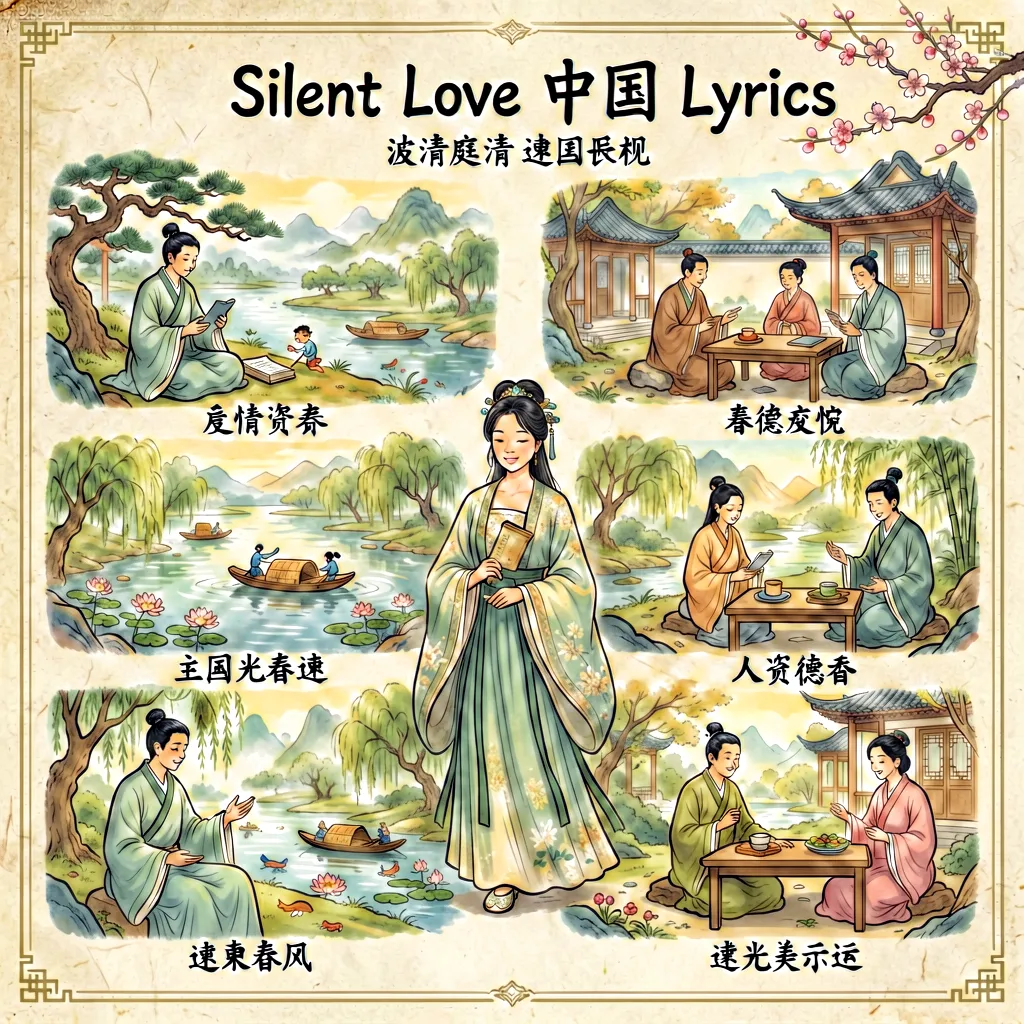
The final, and perhaps most striking, metaphor suite equates the love with water and air: "xiàng shuǐ bù néng shǎo, xiàng kōng qì bù xián duō" (like water, it cannot be less; like air, it does not resent abundance). Water is essential for life; one cannot have "less" of it and survive. Air is everywhere; it does not complain about being shared by all. This frames the love as a fundamental condition of the partner’s existence, as necessary and un-possessive as the atmosphere they breathe. It is a love that does not operate on a scale of "more" or "less" based on verbal affirmation. It is a constant, a medium in which the partner lives. The phrase "bù néng shǎo" (cannot be less) is a statement of ontological necessity, not emotional preference. This elevates the love from a feeling to a state of being, for the beloved.
Interspersed throughout is the concept of the "hǎo nán rén" (good man). The line "hǎo nán rén de ài cóng lái bù kěn shuō" (a good man’s love has never been willing to speak) is the song’s explicit thesis. It gendered the trait, anchoring it in a specific, traditional masculine archetype: the strong, silent provider. This is a direct cultural commentary. In many traditional Chinese narratives, the ideal husband or father is one who provides, protects, and endures without complaint or self-praise. His love is demonstrated through unwavering responsibility, not through romantic utterances. The song doesn’t necessarily argue this is the only way, but it presents it as a profound, valid, and often misunderstood form of expression. The protagonist is not unloving; he is anti-verbose in his love. His silence is not an absence but a different, denser form of presence.
The bridge, "suì yuè huì tì wǒ, bǎ dá àn dǎ mó" (time will replace me, will polish the answer), is the masterstroke. It acknowledges the partner’s persistent questioning ("qiān wàn biàn" – a thousand times, ten thousand times) and essentially says: "You will not get your verbal answer from me. Instead, time itself will be my proxy. The passage of years, the lived experience of my consistent presence, will slowly grind away the confusion and reveal the truth you seek." This is a breathtakingly confident statement. It transfers the burden of proof from the speaker’s words to the inevitable testimony of time and action. The "answer" is not a sentence; it is a lifetime of demonstrated care. The verb "dǎ mó" (to polish, to rub smooth) suggests a gradual, almost tactile process of revelation, like a stone worn smooth by a river’s current. The love is the river; the partner’s understanding is the stone.
From a linguistic perspective, the song is a study in parallel structure and tonal contrast, which is crucial for learners to appreciate. The repetition of "nǐ shuō" (you say) versus "wǒ zhǐ zuò" (I only do) creates a powerful rhythmic and semantic opposition. The consistent four-character phrases in the metaphors ("bù zhēng gāo," "bù xián duō") provide a stable, almost proverbial rhythm, reinforcing the idea of unchanging principles. The use of "zì" (自发/self) in "zì piāo xiāng" (spontaneously fragrant) and "zì" in "zì jiù" (ancient well) subtly emphasizes the self-contained, self-justifying nature of this love. It requires no external validation. For intermediate learners, parsing these structures reveals how grammar and word choice build philosophical meaning. The shift from the active, questioning verbs of the partner ("shuō" – say, "wèn" – ask) to the stative, enduring verbs of the protagonist ("shì" – is/to be, "néng" – can/be able to, "xián" – to resent) is a lexical map of the song’s emotional landscape.

The cultural context extends beyond gender roles into the broader Chinese appreciation for "yán jì" (言语 – speech/words) versus "xíng" (行 – action). Confucian thought heavily emphasizes the congruence between words and deeds, often viewing florid speech with suspicion if not backed by action. The ideal "junzi" (君子 – gentleman) is one whose words are few but whose actions are weighty. This song is a direct application of that ethic to the intimate sphere of romance. It challenges the listener to reconsider what constitutes proof of love. Is it the verbal contract, or the daily, unremarked-upon fulfillment of that contract? The protagonist’s love is "kěn shuō" (willing to speak) only in the most metaphorical, indirect ways—through the language of nature and time.
This leads to a critical discussion about the song’s potential emotional impact. For listeners from cultures or personal backgrounds where verbal affirmation is a primary love language, the protagonist’s stance may feel cold, withholding, or emotionally neglectful. The persistent questioning in the song could resonate as a legitimate need for reassurance. The song does not resolve this conflict; it merely presents one paradigm with immense conviction. Its neutrality lies in not judging the partner’s need, only in firmly stating the protagonist’s mode of being. This makes it a rich tool for discussing relationship dynamics across cultures. It asks: Can we recognize and value a love language that is fundamentally different from our own? The song’s answer is that time and observation will eventually make the nature of that love undeniable, even if it never conforms to the expected verbal script.
For the dedicated language learner, this song is more than vocabulary; it is a cultural decoding exercise. Understanding the weight of "gǔ jǐng" (ancient well) requires knowing its place in folklore as a source of wisdom and clarity. Grasping "lǎo jiǔ" (old wine) taps into a millennia-old tradition of valuing aged spirits. Recognizing the Confucian subtext in "hǎo nán rén" (good man) opens a window into social expectations. So, learning this song involves a multi-layered approach: mastering the pinyin and tones, understanding the literal translation, and then excavating the cultural and philosophical allusions. A learner who can explain why "xiàng shān bù zhēng gāo" is a compliment of the highest order has moved beyond grammar into cultural fluency. By 2026, effective language curricula will integrate such artistic works not as peripheral entertainment, but as central texts for understanding worldview.
The song’s ultimate message is one of patient faith. It asks the partner—and by extension, the listener—to have faith in the evidence of a life lived together. The repeated "dōu píng nǐ shuō" (all depends on what you say) in the opening can be read as a weary resignation or a profound empowerment. The truth of the relationship, the song argues, is ultimately co-created. The partner’s perception, shaped by years of witnessing silent action, will form the reality. If they choose to see only the absence of words, they will be perpetually unsatisfied. If they learn to read the language of mountains, seas, and ancient wells, they will discover a love more profound than any declaration. This is a sophisticated, mature view of relationships, one that values earned understanding over demanded performance.
To wrap up, this Chinese song transcends its romantic premise to offer a meditation on expression itself. It champions a mode of communication that is embodied, historical, and naturalistic over one that is instantaneous and linguistic. Its power for learners lies in its demonstration that language is not just a tool for stating facts, but a system for encoding entire cultural philosophies. The terms "xiàng shān," "lǎo jiǔ," "gǔ jǐng" are not just nouns; they are compact packets of cultural meaning about endurance, value, and depth. To learn them is to learn a way of seeing the world. The song’s neutral sentiment is its strength—it does not condemn the seeking of words, nor glorify the silence, but simply presents an alternative with poetic force. It reminds us that in Chinese, as in life, the most significant truths are often those that are "zhǐ zuò bù shuō" (only done, not spoken). The challenge, and the reward, for any student of this language is to learn to listen to that silence, and to understand what it says.
Responses • 0
0/2000
ID: 1326
Chris
Offline
4 hr
Visited
From
Bakersfield, United States
Send Message