Shenzhen's Sidewalk Struggle
AI Learn Chinese
5 hr • 0 read
Explore walkability challenges in Shenzhen, comparing moped issues with Shanghai and other Chinese cities.
Introduction: A Three-Day Glimpse into Shenzhen
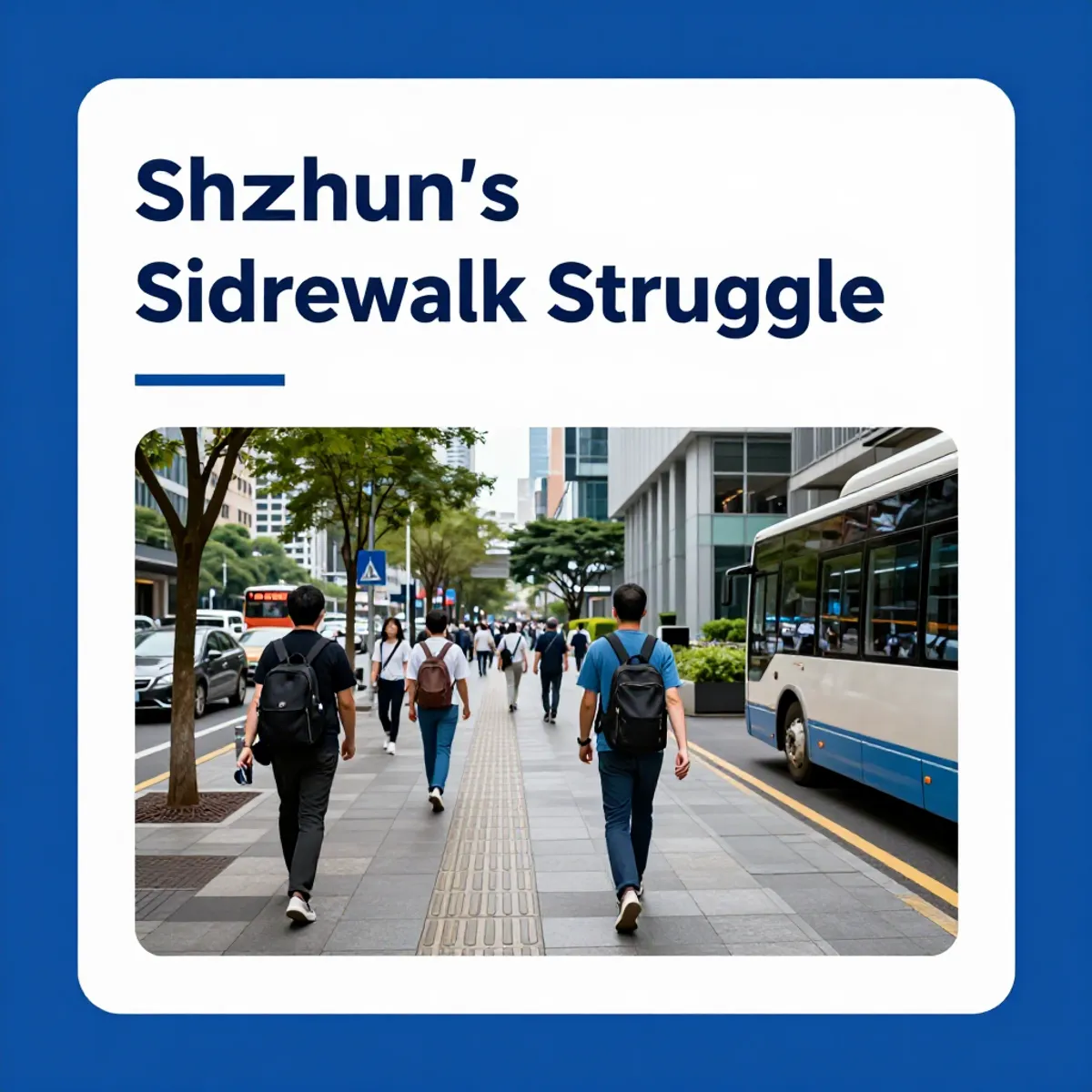
Two years ago, I spent only three days in Shenzhen, lodging in the Futian district. The overwhelming impression was positive; the city felt dynamic, clean, and futuristic. Yet, a persistent tension defined my short stay: the constant negotiation for space on sidewalks.
This brief visit sparked a deeper curiosity about urban walkability in China’s megacities. How does a city celebrated for innovation and efficiency grapple with such a fundamental element of daily life? My experience in Shenzhen served as a compelling entry point into a broader investigation of pedestrian environments across major Chinese urban centers, from the electric car quietude to the moped mayhem.
The contrast between Shenzhen’s polished surfaces and its chaotic sidewalks was striking. One moment, you’d be admiring a sleek, silent electric vehicle gliding past. The next, you’d be forced to step off the curb to avoid a delivery moped speeding against the pedestrian flow.
This duality—high-tech order mixed with low-tech sidewalk anarchy—seemed emblematic of a city in rapid, sometimes contradictory, transition. It raised a core question: in the race to become a “smart city,” has the simple act of walking been overlooked? This article unpacks that question by examining Shenzhen’s specific challenges and then benchmarking its walkability against other major Chinese cities like Shanghai, Nanjing, Chengdu, and Hangzhou.
My analysis draws on firsthand observation, comparative urban studies, and policy reports. The goal is not to crown a “most walkable” city but to understand the unique pressures shaping pedestrian life in each. From historical urban layouts to modern regulatory battles, the story of walking in China is one of adaptation, conflict, and ongoing engineering. By the end, we’ll see if Shenzhen’s issues are a temporary growing pain or a permanent feature of its identity, and what other cities can teach us about creating spaces where people, not just vehicles, can thrive.
The Silent Rush: Electric Cars and Hidden Dangers
Shenzhen’s fleet of electric cars is a point of pride and a source of subtle peril. The absence of engine noise creates a serene soundscape absent in many global metropolises. This silence, however, breeds a dangerous complacency.
Pedestrians, accustomed to auditory cues from combustion engines, often fail to notice approaching vehicles until they are very close. Drivers, insulated in their quiet cabins, may also exhibit a slight detachment from the immediate street environment. The result is a streetscape where visual alertness must be constant, as the usual soundscape warning system has been disabled by progress.
This technological shift has not been matched by a corresponding shift in driver or pedestrian behavior. During my three days in Futian, I witnessed near-misses at crosswalks where drivers, perhaps lulled by the quiet, accelerated through turns with less caution than one might expect. The cars are not necessarily driven more rashly than in other cities, but their stealth amplifies the risk of a collision.
It’s a paradox: a green technology that inadvertently increases vulnerability for the most unprotected street users. Urban planners in Shenzhen are now grappling with whether to introduce artificial sounds for electric vehicles, a concept that feels both retrograde and necessary.
The city’s push for electrification is comprehensive, extending to public buses and taxis. While this drastically reduces local air pollution, it does little to address the fundamental spatial competition on the roads. An electric car still occupies the same lane width and generates the same aerodynamic turbulence as its gasoline predecessor.
The noise reduction is a quality-of-life improvement for residents in high-rises, but at street level, it merely changes the sensory inputs without resolving the core issue of excessive vehicle volume and speed in dense areas. The quiet, therefore, can be misleading, creating a false sense of safety that must be actively countered through design and education.
Sidewalk Siege: The Moped Menace
If the electric cars are a quiet threat, the mopeds—often electric bicycles or light motorcycles—are an overt and pervasive invasion. In Shenzhen, sidewalks are not sacrosanct pedestrian zones; they are auxiliary lanes for two-wheeled traffic. Delivery riders, commuters, and casual users alike weave through crowds, using the sidewalk as a shortcut or a primary thoroughfare. The experience of walking is constantly interrupted by the need to dodge, step aside, or press against a shopfront as a moped zips by, sometimes against the designated flow.
This phenomenon is not unique to Shenzhen, but its scale and intensity seem particularly acute. The reasons are multifaceted: dense urban fabric, a culture of time-sensitive deliveries for the booming e-commerce sector, and historically inadequate cycling infrastructure that pushes all two-wheeled traffic onto the sidewalk. The moped’s small size and agility make it the ideal vehicle for navigating Shenzhen’s gridlock, but its choice of venue—the sidewalk—declares pedestrian space a low priority. A simple walk to a metro station becomes a slalom course, undermining the very walkability a dense, transit-oriented city should cultivate.
The psychological impact is significant. Walkers adopt a defensive posture, heads on swivels, ears tuned to the high-pitched whine of a moped motor. The activity ceases to be relaxing or efficient.
This erodes the public realm’s function as a space for leisure, socializing, and casual commerce. Shop owners may complain about mopeds scaring away customers, while pedestrians simply feel harassed. The moped menace represents a profound failure of urban governance: the inability to allocate and defend space for the most basic mode of transport.
It turns sidewalks from assets into liabilities, actively discouraging the very foot traffic that supports local businesses and community health.
Shanghai Contrast: A Walkable Exception?
My visit to Shanghai, also about two years ago, presented a stark contrast. In the core downtown—areas like the French Concession, Pudong’s Lujiazui, and parts of Jing’an—walking felt comparatively civilized. Sidewalks were wider, more consistently paved, and enforcement against two-wheeled vehicles seemed stricter.
The historical layout, with its mix of narrow lilong lanes and grand boulevards, creates a more human-scaled environment in many districts. Yet, my stay was only in the core downtown, a carefully curated zone of international businesses and tourism. Does this represent the real Shanghai, or just its most performative face?
The key difference appears to be a combination of historical urban form and different regulatory enforcement. Shanghai’s older neighborhoods developed with a stronger pedestrian tradition, and the city has invested in iconic, wide promenades along the Huangpu River. There is also a palpable cultural stigma against riding mopeds on sidewalks in these central areas; it feels less tolerated.
But, venture into outer districts or less-touristed neighborhoods, and the Shenzhen-style sidewalk chaos emerges. Shanghai’s walkability is thus highly geographically uneven, a privilege of location and economic status.
In addition, Shanghai’s sheer scale means that even in walkable cores, long-distance travel often requires the metro. The metro system is superb, but its stations are vast, and transfers involve lengthy walks underground. This “walk to the metro” segment is part of the overall pedestrian experience, and here Shanghai generally excels with clear signage and ample space.
Shenzhen’s metro is also modern and extensive, but the final approach to stations—the “last 500 meters”—is often where the moped conflict is most intense. So while Shanghai’s downtown may offer a superior quality of walk, Shenzhen’s challenge is more about the availability of safe walking space throughout its entire urban expanse.
Beyond the Megacities: Nanjing, Chengdu, Hangzhou
To understand if Shenzhen’s struggle is typical, we must look beyond the first-tier giants. Nanjing, with its profound history as a capital city, has a compact historic core around Xinjiekou and the Confucius Temple area. The city walls and the Qinhuai River create natural boundaries that channel pedestrian flows.
Walking here feels purposeful and often scenic, though modern ring roads and overpasses can sever neighborhoods. The number of tourists in historic areas naturally elevates pedestrian priority, creating car-free zones that work well. But, in newer development zones, the Shenzhen pattern of sidewalk competition reappears.
Chengdu presents another model. Its famed teahouse culture and relaxed peng (alley) system foster a street life that is inherently pedestrian-friendly. The city has actively promoted “park city” concepts, integrating greenways into the urban fabric.
Yet, Chengdu’s rapid growth has spawned sprawling new districts where walking is an afterthought. The contrast between the historic center and Tianfu New Area is jarring. The vibe in the old quarters is one of flânerie—strolling for pleasure—while in the new areas, walking is a utilitarian necessity often conducted in the shadow of construction and amidst scooter traffic.
Hangzhou, driven by tech industry might, has invested heavily in public transit and bicycle-sharing (though dockless scooters have complicated this). The West Lake scenic area is a pedestrian paradise, but the city’s tech corridors see heavy two-wheeled traffic. Interestingly, Hangzhou has been more aggressive in using technology for enforcement—camera systems that automatically fine mopeds on sidewalks.
This points to a potential path forward: leveraging the same tech innovation that defines these cities to solve their livability problems. Each city’s walkability is a palimpsest of its history, economic focus, and policy choices.
Roots of the Problem: Planning and Policy
The sidewalk conflict is not an accident; it is the logical outcome of decades of urban planning priorities. Chinese cities, after the Reform and Opening-Up, were rebuilt for speed and scale. The private car became a symbol of modernity and success.
Roads were widened, pedestrian scales were ignored, and density was achieved through high-rises separated by wide arterial roads. This created environments where walking between destinations became long, unpleasant, and unsafe. The initial response was to build metros, but the “last mile” problem was never adequately solved, leaving a vacuum filled by nimble, low-cost mopeds.
Policy has consistently lagged behind practice. Regulations regarding mopeds—their licensing, speed limits, and where they can ride—are often ambiguous or poorly enforced at the local district level. Cities like Shenzhen have attempted outright bans on mopeds in certain districts, but the demand for cheap, flexible transport, especially for the gig economy, proves too strong.
The result is a whack-a-mole situation: ban them from one road, and they flood the sidewalks. The planning system failed to provide a viable, legal alternative—protected, connected bike lanes—that could have absorbed this mode without conflicting with pedestrians.
In addition, the sheer speed of urban development meant that many new residential and commercial compounds were built with internal circulation for cars but poor connections to the outside world for walkers. Sidewalks are often narrow, discontinuous, and obstructed by street furniture, utility poles, and temporary vendor stalls. The design philosophy prioritized vehicle throughput and real estate efficiency over human comfort.
This legacy is now baked into the urban fabric, making retroactive correction expensive and politically complex. The problem is therefore systemic, residing in the DNA of how these cities were physically constructed over the past thirty years.
Engineering Solutions: Tech and Urban Design
Cities are responding with a mix of technological and physical interventions. Shenzhen has experimented with “smart” enforcement: AI-powered cameras that identify and fine mopeds on sidewalks. This aligns with its identity as a tech hub.
But, technology alone is a policing tool, not a planning solution. It can deter but not eliminate the behavior if the underlying need for mobility remains unmet. The more sustainable approach is engineering mopeds out of the sidewalk by providing a superior alternative.
This means building extensive, physically protected bike lanes that are wide enough for both bicycles and light electric vehicles. Cities like Hangzhou and Shanghai have made strides here, but networks are still incomplete. A truly effective system requires integration with metro stations, secure parking, and consistent maintenance.
It must be so convenient and safe that choosing the sidewalk becomes the irrational choice for a moped rider. Urban design tweaks also help: installing bollards, planters, or curbs that physically prevent mopeds from entering pedestrian zones. These are low-cost, high-impact solutions.
Another innovative approach is “complete streets” redesigns that rebalance road space. This involves narrowing car lanes, extending curbs at intersections to reduce crossing distance, and widening sidewalks. Shenzhen has piloted such projects in select areas like the Civic Center, with positive results.
The challenge is scaling these interventions across thousands of kilometers of street. It requires political will, funding, and a shift from vehicle-centric to people-centric metrics of success. The engineering solutions exist; the barrier is their prioritization in a system still geared toward moving cars quickly.
The Human Factor: Behavior and Enforcement
No amount of infrastructure can succeed without addressing human behavior and consistent enforcement. Delivery riders, often under intense time pressure from app-based platforms, are the most frequent sidewalk offenders. The business model of instant delivery incentivizes speed and route flexibility, which sidewalks erroneously provide.
Regulating the platforms—requiring them to factor in realistic travel times and penalize violations—is a crucial but difficult step. It moves the problem from the rider to the corporation, where systemic change is possible.
Public education campaigns are another tool, though their efficacy is questionable against ingrained habits. Making examples of high-profile violations, perhaps through publicized fines or mandatory safety courses, can create a deterrent effect. But, enforcement must be perceived as fair and universal.
If crackdowns are sporadic or only target certain groups, they breed resentment and are ignored. A consistent, visible presence of traffic officers or automated systems is needed to change norms over time.
There is also a cultural dimension. In many Chinese cities, the sidewalk has long been a flexible, multi-use space—for street vending, casual parking, and now mopeds. Redefining it as exclusively for pedestrians requires a shift in public understanding.
This can be fostered through design that clearly signals purpose: different paving materials, street furniture arrangements, and greenery that physically and psychologically demarcate pedestrian territory. The human factor is the most stubborn variable, but it can be reshaped by persistent environmental cues and clear, consistently applied rules.
Looking to 2026: Trends and Predictions
As we look toward 2026, several trends will shape the walkability landscape. First, the electrification of micro-mobility will accelerate. More e-scooters and e-bikes will flood streets, potentially worsening sidewalk conflicts unless regulated.
Cities may respond with mandatory geofencing that automatically slows or disables these vehicles in pedestrian zones—a technological fix that respects the spatial boundary. Second, the maturation of autonomous vehicle technology, while focused on cars, could indirectly benefit walkers if implemented with strict safety protocols and reduced urban speed limits.
Policy will likely bifurcate. Historic and central districts in cities like Nanjing and Shanghai will see continued pedestrianization and strict enforcement, creating walkable islands. The frontier of debate will be the sprawling new districts of Shenzhen, Chengdu, and Hangzhou.
Will planners learn from past mistakes and build in walkability from the start? Early signs are mixed, with some new towns still designed around car ownership. But, public demand for healthier, quieter neighborhoods is growing, especially among the middle class.
This may force developers to incorporate better pedestrian networks as a selling point.
Finally, data will play a larger role. Cities are deploying sensors to measure pedestrian flows, near-misses, and air/noise quality. This evidence can justify investments in walkability.
By 2026, we might see “pedestrian priority” indices officially adopted alongside traditional traffic metrics. The goal is to make the invisible cost of bad walkability—reduced commerce, poorer health, higher emissions—visible and quantifiable.
The Social Compact: Public Pressure and Private Gain
The battle for the sidewalk is increasingly fought not just in city council chambers but in the court of public opinion. Social media platforms have become powerful amplifiers for pedestrian grievances. Short videos of near-misses with delivery mopeds, or photos of obstructed walkways, routinely go viral, creating bottom-up pressure for change.
This digital activism is particularly potent among China's younger, urban middle class, who have grown up with global imagery of walkable cities and increasingly view a safe, pleasant public realm as a non-negotiable component of a high-quality life. Their expectations are reshaping the political calculus for local governments, for whom maintaining social harmony now includes managing the "walkability discontent."
This public sentiment is beginning to align with a compelling economic argument. A growing body of evidence, both international and emerging from Chinese pilot districts, demonstrates that investment in pedestrian infrastructure yields significant private returns. Retail sales in areas with improved walkability often see measurable increases, as window-shopping and impulse purchases thrive in slower, safer environments.
Property values in truly walkable neighborhoods command a premium. Forward-thinking commercial developers and business improvement districts are thus becoming unlikely allies for pedestrian advocates, funding streetscape upgrades and lobbying for stricter enforcement to protect their investments. The sidewalk is being re-framed from a public cost center to an economic asset.
A Global Lens: Learning from the "Flâneur's" Playbook
Chinese urban planners are looking beyond domestic examples. The pedestrian-first revolutions of cities like Copenhagen, Paris, and Tokyo offer potent models, though direct transplantation is impossible due to differing historical urban fabrics and regulatory contexts. The key lesson is not a specific design template but a philosophical shift: prioritizing the pedestrian as the primary user of central urban space, with all other modes accommodated secondarily.
This is evident in the growing popularity of "open street" initiatives in cities like Guangzhou and Beijing, where entire corridors are temporarily or permanently closed to private vehicles on weekends. These events, often framed as promoting community and health, serve as large-scale experiments that build public appetite for more permanent change. They demonstrate that a car-light city is not only possible but popular. The influence of this global discourse is filtering into professional planning circles and university curricula, creating a new generation of designers and officials who see walkability as a mark of a truly sophisticated, mature city—a status symbol on par with having a stock exchange or a major airport.
The Governance Gap: District vs. City
A persistent and often overlooked challenge is the fragmentation of authority. While city-wide master plans may espouse walkability goals, implementation and day-to-day enforcement are typically the responsibility of district (qu) and even sub-district (jiedao) governments. These lower-level authorities are often more immediately responsive to local business interests (which may favor customer parking or delivery access) and face different fiscal pressures.
This can lead to a patchwork of enforcement intensity and design quality. A street might have beautiful, wide sidewalks in one district only to encounter a chaotic, moped-clogged transition at the boundary into the next. Solving Shenzhen's sidewalk siege requires not just a city policy but a meticulously coordinated inter-district compact, with aligned standards, shared enforcement data, and pooled funding for connective infrastructure projects that cross administrative borders.
The Unseen Variable: Climate and Comfort
The discussion of walkability in China has so far centered on safety and convenience, but a critical, often under-addresses variable is environmental comfort. In a country with extreme seasonal variation—from the bitter cold of a Shenzhen winter (with its damp chill) to the oppressive humidity and rain of summer—walkability is intrinsically tied to microclimate management. A wide, unobstructed sidewalk is of little use if it offers no shade from a brutal summer sun or no protection from a sudden downpour.
The most successful pedestrian zones integrate continuous tree canopy, covered walkways, and passive cooling designs like water features and ventilation corridors. Shenzhen's tropical climate makes this especially urgent. The city's future walkability may depend less on banning mopeds and more on creating an outdoor environment so thermally comfortable that people choose to walk, extending the viable walking season and distance dramatically.
This requires integrating landscape architecture with transportation planning in a way that is still rare in China's fast-paced development cycles.
The Final 500 Meters: A Microcosm of Conflict
The area immediately surrounding metro stations—the "final 500 meters"—is the most intensely contested and revealing space in the urban ecosystem. It is here that the pressures of density, transit efficiency, and last-mile connectivity collide. In Shenzhen, these zones are frequently overwhelmed, with sidewalks morphing into impromptu moped parking lots, vendor agglomerations, and queuing areas for ride-hailing apps.
The design failure is profound: stations are engineered for high-volume passenger throughput into the station, but the exit experience onto the street is an afterthought. This creates a pedestrian bottleneck that degrades the entire transit experience. Contrast this with Shanghai's newer stations, where integrated, sunken, or elevated pedestrian passages often channel walkers directly to key destinations without intersecting with chaotic street-level traffic.
Redesigning these micro-environments—with dedicated, clearly marked loading zones for deliveries, organized two-wheeler parking, and widened, unobstructed exit corridors—could single-handedly improve the daily experience for millions of commuters, making the metro-first strategy genuinely walkable.
Conclusion: Balancing Innovation and Livability
Shenzhen’s sidewalk struggle is a microcosm of a global challenge: how to retrofit 21st-century innovation onto 20th-century urban forms, or worse, onto forms built without a clear precedent at all. The city’s electric car quietude and moped cacophony exist in uncomfortable tandem, reflecting a technological optimism that overlooked the simplest human activity. My short stay in Futian crystallized this tension.
Yet, comparing Shenzhen to Shanghai’s curated walkability, Nanjing’s historic cores, Chengdu’s alley culture, and Hangzhou’s tech-enabled enforcement reveals that no city has a perfect, universal solution. Walkability is always contextual, a product of history, geography, policy, and culture.
The path forward requires a fundamental reordering of priorities. It means designing streets for people first and vehicles second, even in a car-obsessed culture. It means regulating the gig economy’s mobility demands and investing in protected infrastructure that makes the safe choice the easy choice.
It means using the very technological prowess of cities like Shenzhen not just for surveillance and fining, but for creating seamless, multi-modal networks where walking is a delight, not a hazard. The goal is not to eliminate mopeds or electric cars, but to allocate them their proper, non-conflicting space.
Ultimately, a city’s greatness is measured not by its GDP or its skyscrapers, but by the quality of its public realm. Can an eight-year-old walk safely to school? Can an elderly person cross the street without anxiety?
Can a tourist wander without constant vigilance? These are the tests of a truly advanced city. Shenzhen, with its blend of ambition and growing pains, has the potential to lead in solving this problem.
By 2026, let’s hope its sidewalks tell a story of resolved conflict, where innovation finally serves the pedestrian, not the other way around. The walkable city is not a nostalgic dream; it is an engineering and social necessity for the urban future.
Responses • 0
0/2000
ID: 1326
Chris
Offline
30 min
Visited
From
Bakersfield, United States
Send Message