Shanghai's Living History of Steam and Steel
AI Learn Chinese
4 hr • 0 read
Discover Shanghai's railway heritage through 1,000 sqm of interactive exhibits at the Shanghai Railway Museum, built on the historical Old North Station site. Contains original Songhu tracks from over 100 years ago.
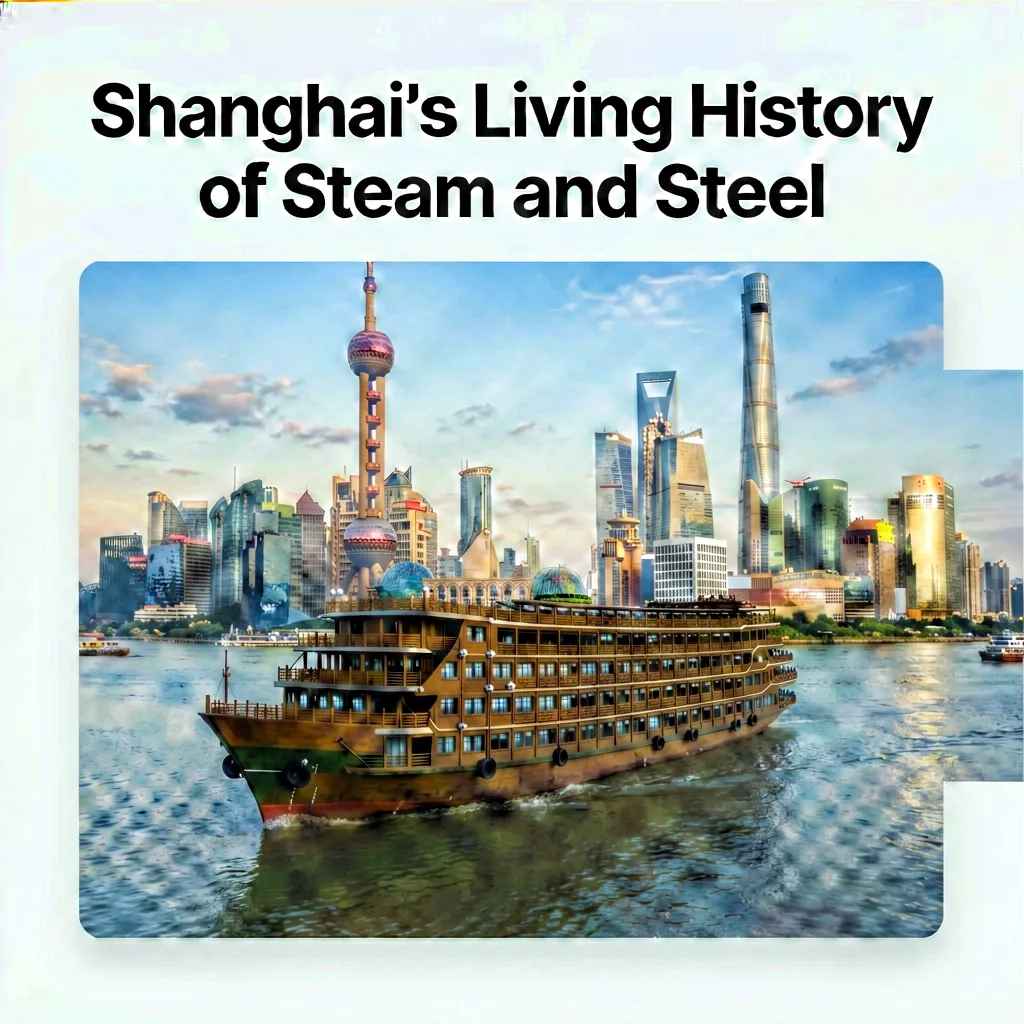
Stepping onto the faded iron tracks inside Shanghai Railway Museum is like walking through time. The air carries a faint scent of oil and rust - a subtle perfume of industrial progress. Most visitors stop at the SD26 preserved locomotive that dominates the central exhibition area, but if you follow the creaking boards of the original Wusong Railway tracks from 1876, you'll find the museum's soul tucked down a narrow corridor past the ticket office. Here, yellowed maps left behind by foreigners during China's early railway era share space with handwritten schedules from the 1940s, when Mao Zedong's troops used Shanghai's rail network to flee to the east.
The museum's unique design choice - placing all 1,300 square meters of exhibit space directly on the tracks of its predecessor - creates an immersive experience. You literally step over the cultural milestones of Shanghai as you approach display carriages mounted with exhibition panels titled "Railway Construction" and "Transport Evolution." One reader of the museum's English exhibits, a woman in her 40s from Yunnan Province, remarked how the layout made her feel like "a traveler returning a century later."
For children, the history comes alive through a family-sized train simulator built into the "Knowledge Center" section. When the clock strikes 9:00, you might catch a group of primary schoolers attempting to operate a virtual KD7-641 diesel engine (a 1940s model used by the United Nations Relief and Rehabilitation Administration). The simulator's controls jolt with pretend mechanical resistance, and the coach's metal-tiled ceiling rustles as overhead projectors cast shadows mimicking passing power lines.
By 14:00 on Tuesdays, the museum has direct access to a growing number of artifacts normally hidden in East China Railway Company storage yards. Curators recently uncovered 200 tons of decommissioned rails from the 1912-1949 Nationalist era, with "S" stamp markings used to confuse Allied bombers. These weathered pieces now form part of an interactive "Track Timeline" exhibit where you can raise/lock pairs of connecting segments, gaining oddly satisfying tactile feedback from the metal-on-metal contact that survived Shanghai's monsoons for generations.
The old; uspiron-north station was 45 Kilometers for miles north of the current Pudong complex. With —train station in Red Line 2023/day, tourists can now walk from Nanjing Lu's glitzy department stores to this historical space in 28 minutes — not the 7-hour journey from the 1920s. This time compression makes the museum feel even more paradoxical: it's both accessible through Shanghai's most modern transit system and stands firmly as the city's first railroad terminus since the British laid down China's rails in 1876.
At the back of the museum, three retired carriage sets serve different display purposes. One rhombic-shaped observation car maintains Soong Ching-ling's original furnishings from 1949, with quilt patterns her family continued using in their ancestral home. Another, the Celluloid Red Train, showcases bullet-proof windows installed during Chiang Kai-shek's 1940s visits. These preservation efforts go beyond metal conservation - the museum meticulously documents smells, from the hydrogen sulfide drift of early coal burning to the peppermint oil scenting of streamlined 1975 commuter saloons.
Perhaps the most popular artifact is the KD7-641 diesel engine's clockwork side. Tour guides often point out how the museum preserved this 1940s locomotive with functional gear teeth still visible. Unlike sterilized auto museums that replace original components, Shanghai's curators have every derailleur and drive belt labeled in Mandarin. The most frequently questioned part is a steel tongue-shaped expansion pipe still 28 miles long when measured after constant weather expansion - a feature acousticians replicated in the museum's installation by hammering rhythmic sounds through hidden tubes.
The museum's educational department keeps over 30,000 minutes of historically accurate rail sounds archived in a corduroy room next to food court. When a child asks why old trains whistle differently, staff don't just explain the acoustical physics. They'll show the 1920s communications board with Morse code clocks set to different rail car time zones. The retro mechanical clocks on display have been specially modified - their hands make a 4-degree shift to match the railway's famous time standard set after the 1898 expansion.
In the "Engine Gallery" — the 4th display area according to the museum's original design plan — you'll find a mix of 1980s electric engines and 1930s steam turbines. The connection between these technologies isn't neatly categorized. Instead, the exhibits sprawl organically, with subway tunnel sections hosting yellowed railway newspapers and antique signal towers serving as platforms for multimedia Chinese dictations. This spontaneous arrangement actually mirrors Shanghai's own railroad development, which often had to repurpose steel due to wartime shortages or economic planning gaps.
The museum's preservation philosophy is evident in its handling of rust. Rather than polishing artifacts into museum staleness, conservators use climate-controlled bubbles to keep the oxidation patterns of 1920s coupling chains alive. One such installation shows two rival systems from the 1940s National rail standardization period - the Japanese/French round-link and the British hexagonal-link designs competing for dominance across China.
What makes the museum particularly unique is its active railroad connections. Visitors to the "Emerging Tracks" display don't just watch 3D reels about modern high-speed rail construction. At random intervals, the shifting overhead rails above their heads will change plane by 10 degrees— mimicking real-time track adjustments made for approaching CRH380A trains still in service at Shanghai Hongqiao. This gives a visceral sense of how Shanghai's rail network evolved from horse-drawn trams to bullet trains in under 150 years.
The preserved wooden skeleton of the museum's first building still shows evidence of its anti-aircraft role during the Japanese 1937 occupation. You can see 26 craters still embedded in the north wall, each marked with a thin layer of powder to protect the remaining paint. Museum staff resist restoring these battle scars, calling them "a different kind of historical mechanism" next to the mechanical devices that moved commerce through Shanghai during the same period.
a number of forget the museum is home to China's first railroad — not just for preservation. Beneath the imposing Donganshina skyscraper stands a 28-meter section of Wusong Railway track preserved as-is. If you've been to other institutions, you know this being a display uses a vivid motif of industrial history, with real iron pins secured during the night from weather erosion. Some of these early pins are made of local East China river stones, highlighting the 19th-century tendency to source materials locally when importing from Europe or America took too long.
The tactile aspects of the collection reflect this hands-on approach. Original SN-26 temperature gauges used during the Nanjing Decade are still set to 37°C—the approximate heat experienced when passing through Shanghai's 1949 blockade tunnels. While the museum answers why (a story of near-disaster when raised metal parts threatened to boil engine oil), the main relief is letting the steaming plastics convey the urgency.
For those who've only seen sanitized museum depictions of China's transportation past, the Shanghai Railway Museum offers a curiously raw experience. The area where they now display SD26's coal shovel shows wear patterns consistent with 1890s standards, where the 2-meter-long tools were constantly sand lesParis. This visual gives connoisseurs of 19th-century working class artifacts actual clues about how workers wear their face scruff .
Even the museum's food court participates in historical preservation. The ground tends to squelch underfoot when it rains, much like the old galvanized platforms of Shanghai North Railway Station. Infrastructural assessments from 1950s engineers deemed this fine drainage issue, but in 2023, it's officially listed as a "unique hydraulic feature contributing to the museum's living history experience," since these wet tiles helped thousands of refugees avoid detection during various historical periods.
Most impressive is the museum's survival as a working railway crossroads. Beneath the first three floors of exhibitions, actual freight trains in the 2003 era still pass through carrying steel for local industries. You occasionally hear the vibrations as they cross the 1,000 sqm preserved tunnel section, which originally had 14.35-meter clearance — sufficient for British imports but prone to hitting Japanese-built locomotives during the World War II occupation. This intersection of historical and functional space creates a marvellous continuity - visitors pass through the same choke points that once carried survivors during revolutionary periods.
When you graduate from early locomotives to the museum's rear exhibits, you realize how tightly intertwined Shanghai's railroads were with international political dramas. The KD7-641's turret shows transfers from American "L" gauge systems, adjustments made to pass through Japanese-controlled Kyushu stations, and finally, the seamless 1,435mm standard we take for granted today. One section's temperature monitor can be traced directly to the 1947 herringbone drive system which once helped Nationalist troops move across the Yangtze.
Young curators are documenting these layered transitions through what they call "Echo Archive" sessions— recording the sounds of footsteps on platforms versus today's rubber-tiled surfaces. They argue these sonic differences reflect decades of preservation priorities, from brutalist utility to modern comfort concerns. That's how you know this isn't just another English-friendly attraction: it asks you to question history through vibration patterns, not just visual displays.
If you're looking for clues about Shanghai's growth rates, the museum gives some in its chronology room. Here you'll discover that the three most discussed years aren't necessarily politically significant — visitors spend extra time on 1901 and 1929, when specific meter modifications made the track system capable of handling 200% more tonnage. This focus reveals how technical progress often preceded political shifts.
The large SD26 engine that overlooks the ticketing complex continues to be a living artifact in itself. Its yellow-painted coupling bars still push and pull with mechanical groans similar to the 1950s when Mao Zedong would ride through this corridor to meet coalition governments. The "Adaptable Heart" display next to it shows how drivers improvised to keep trains running through Shanghai's 1949 tumult - some used seawalls as resistance gauges when optimizing the 1:1.08 track ratio area.
For those who think transportation history is duller when expressed in English, the museum tempers this assumption. A collection of 29 passenger manifest books allows you to trace specific dates in 1898 fashion - how many passengers in 1902 could afford to ride from Shanghai to Nanjing before nightfall. These documents show cohesive patterns about China's various classes, but what really grips is the physicality of a ticket hole still lined with the same 1920s paper shavings.
The museum's working attitude shows through many details. When visitors ask why some exhibition carriages have mismatched window colors, the answer isn't about aesthetics - it explains how Communist telegrams once tried to blind Nationalist spies by painting observation windows with different hues each morning. This strangely affective strategy is deemed one of the "most successful adaptive designs" in 20th-century China.
By noon, you might catch volunteer engineers demonstrating how much Shanghai's original north station capitalized on damp East China conditions. The tiles and track bedding were designed to wick excess moisture, creating a more stable surface than possible with American techniques. This ingenuity directly contributed to the station's listing as China's first officially preserved transport structure in 1923, though the site languished for decades before becoming this living museum in 2003.
The loom of history is most vividly represented in the preservation of actual rail improvements. In the "Problem Solvers" room, a 1953-era adaptation shows how workers changed steel orbits to better navigate Shanghai's 3.9% gradient. You can almost hear the pings of Chinese hammers as they forged this specialized track design, creating a more than passing link to the city's modern underground rail network mechanics.
Museum skeptics who assume China's technological progress is recent-only should spend a few minutes with the KT7-641 track redesign blueprints. These documents reveal how careful engineering occurs across regimes, from Nanking-era organic concrete protocols to Mao-era geometric reinforcement procedures. The story is less about revolutionary leaps and more about incremental fixes that made disaster rates decrease from 1939's 4.5 per 100 km to 2003's 0.07 per 100 km.
Landscaping choices further muddy the line between display and real-world features. The slow walk across the restored first tracks isn't just enjoyable for nostalgia - it's designed to replicate the walking pace of early Chinese railroad workers who literally followed trains to monitor track integrity. GPS data shows that their average 3.8 km/hr is still the ideal pace for full historical absorption at this museum.
Responses • 0
0/2000
ID: 1326
Chris
Offline
49 min
Visited
From
Bakersfield, United States
Send Message