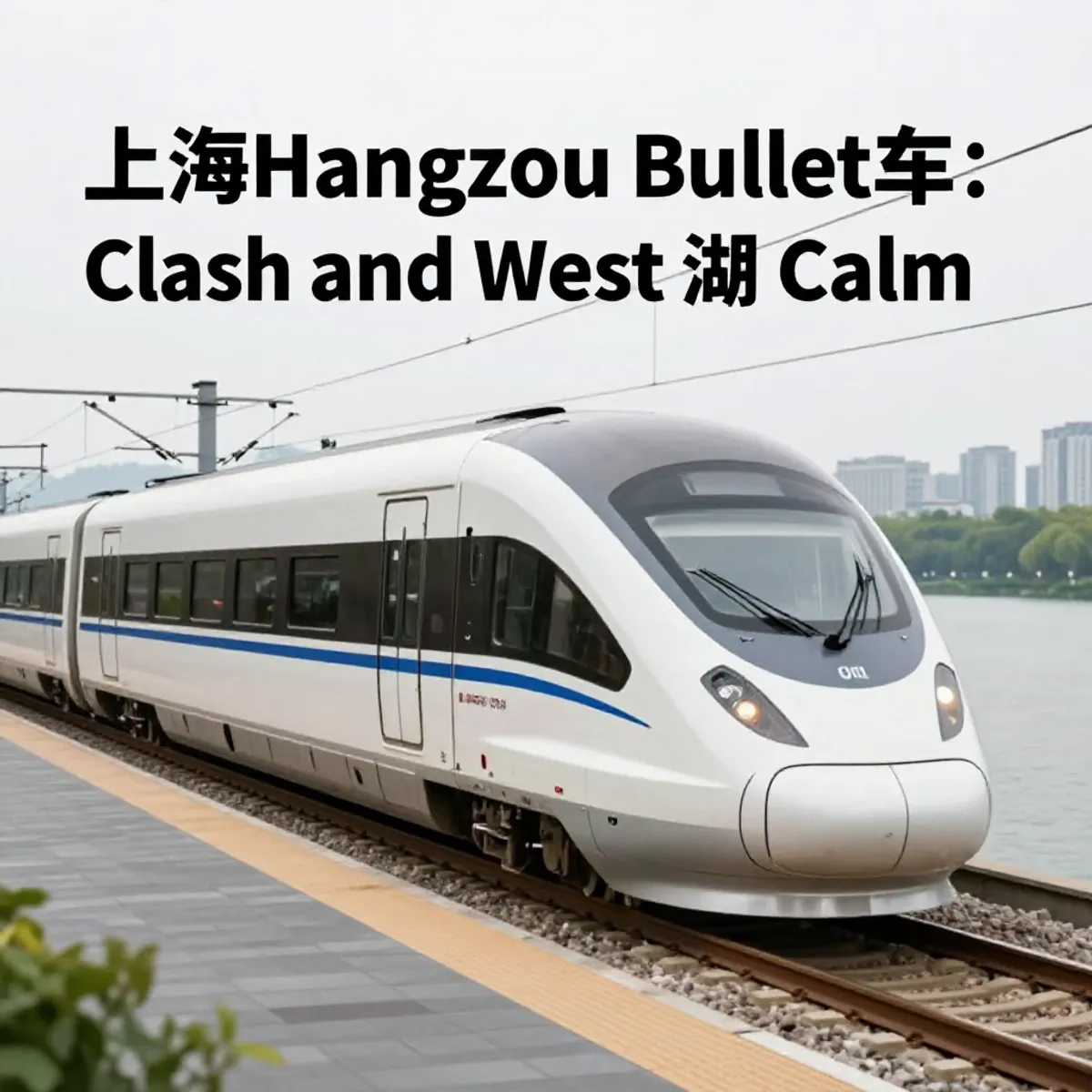
ShanghaiHangzhou Bullet Train: Clash and West Lake Calm
AI Learn Chinese
2 hr • 0 read
A ShanghaiHangzhou bullet train journey pairs a tense rude onboard encounter with West Lakes quiet calm, a vivid story of contrasts.
The Journey Begins: Cold Mornings and Bullet Trains
A Frosty Start in Shanghai
The air in Shanghai held a sharp, early morning chill. My initial plan was straightforward: navigate the bustling station and board a train north. But the first interaction set a tense tone.
The station staff member I approached for assistance was notably rude, their curt words and dismissive gesture a jarring start to the day. This minor friction, though quickly forgotten, became a reference point later, a contrast against what was to come. It underscored how a single negative encounter, however small, can color one's perception of an entire place, if only temporarily.
The cold concrete of the station platform felt even less welcoming after that exchange.
I had a window of time and a destination in mind: Hangzhou’s famed West Lake. The practical solution was clear—the high-speed Bullet Train. These trains represent modern China’s efficiency, slicing through the landscape at incredible speeds.
Finding the correct gate and boarding was a smooth, almost silent process compared to the earlier human interaction. As the train pulled away from Shanghai, the city’s towering skyline blurred into the distance, replaced by orderly fields and towns flashing past. Inside, the cabin was quiet, warm, and impeccably clean.
The journey to Hangzhou was a lesson in technological comfort, a brief respite from the human variable that had just soured the morning.
The Bullet Train to Hangzhou
The ride itself was effortless. In under an hour, the train glided into Hangzhou station. Stepping outside, the climate difference was immediate and pleasant; the cold had lifted, replaced by a milder, spring-like air.
My goal was simple: see West Lake. The walk from the station to the lake’s perimeter was a transition from urban transit to poetic scenery. Willow trees dipped toward the water, and traditional pavilions offered views of the famous causeway.
The beauty was serene, a world away from the transactional rush of the railway station. It was the kind of place that encourages a slow pace, a perfect counterbalance to the morning’s hurried start.
After a few hours of leisurely exploration, the practicalities of travel reasserted themselves. I needed to consider my next move. My ultimate goal was to reach Shanghai again, but from Hangzhou, direct trains back were plentiful.
Yet, a different thought emerged. I recalled seeing a train to Nanjing departing from Hangzhou station soon. Nanjing was a major hub.
Logically, if I could get to Nanjing, perhaps securing a ticket onward to Shanghai from there might be easier, or at least offer more options. It felt like a strategic pivot, turning a simple sightseeing trip into a small adventure in logistical problem-solving. The idea solidified as I walked back toward the station.
Nanjing Station: A Turn in Fortune
The Attendant's Kindness
Back at Hangzhou station, I purchased a ticket for the next available train to Nanjing. The process was efficient, another point of smooth functionality in the Chinese rail system. Upon arrival in Nanjing, the station was vast and humming with activity.
My immediate task was to inquire about trains to Shanghai. I located a ticket counter, a long queue moving steadily. When my turn came, I explained my situation to the attendant behind the glass.
I wanted a train to Shanghai, preferably that evening or the next morning.
The attendant, a woman with a calm demeanor, tapped at her computer. She looked up, her expression sympathetic but firm. All trains to Shanghai for the next day were fully booked.
There was no availability. My face must have shown disappointment. Then, she offered unsolicited advice.
"You should come very early tomorrow," she said, her tone nicely helpful, not rushed. "At 7 am, many seats are released. You have a better chance then." This was not just a denial; it was a constructive suggestion, a piece of local knowledge offered freely.
The stark difference from the Shanghai staff’s rudeness was profound. This single, polite interaction mattered immensely. It made Nanjing feel immediately more accessible, more human.
An Unexpected Overnight Stay
With no train that night, I needed a place to sleep. The attendant’s helpfulness extended to her general attitude, making me feel comfortable staying in the city rather than rushing to find an alternative. Pulling out my phone, I quickly booked a room at the Shangri-La in Nanjing for the night.
The brand name promised a certain level of comfort, and the location was central. Using my phone for everything—train tickets, hotel reservations—was second nature, a hallmark of modern travel. Within minutes, the problem of the evening was solved.
I had a bed, a plan for the morning, and a surprisingly positive impression of Nanjing’s service culture, all stemming from one woman’s nicely given advice.
That night, in the plush comfort of the hotel, I reflected. The day had been a series of contrasts: rude versus kind, cold versus warm, booked solid versus a helpful tip. Nanjing, through the lens of this station encounter, had won the kindness contest.
It wasn’t about the luxury of the Shangri-La, but the basic courtesy extended by a stranger in a busy station. That mattered. It created a feeling of being respected, of the city having a considerate face.
The stage was set for a deeper appreciation of the place, far beyond its role as a mere transit point.
Back in California: Digital Connections
Dating Apps and Cultural Curves
Returning home to California, the memory of that Nanjing attendant lingered. It coincided with a period of personal exploration. I was actively dating, using the common apps to meet people.
a few matches were Chinese women living in the US or visiting. Conversations started online, then moved to meetings at cafes or my university campus. I began to notice a pattern in the interactions.
The women who hailed from Nanjing and the broader Southern Jiangsu region consistently exhibited a particular warmth. They were engaging, asked thoughtful questions, and carried an easygoing friendliness that made conversations flow naturally.
It wasn’t a rigid rule, but a strong tendency. Their communication style felt open and nice, less guarded than some other interactions I’d had. This digital and real-world dating frontier became an unexpected laboratory for cultural observation.
I wasn’t seeking a relationship with a city, but the human element from Nanjing kept presenting itself positively. Each pleasant chat or coffee date reinforced the station memory. The woman from Nanjing I met for brunch one Sunday was particularly gracious, her humor dry and her curiosity about my life in California genuine.
It was a small, personal data point in a larger, growing hypothesis about regional character.
University Encounters and Regional Vibes
My university environment provided another layer. There were Chinese international students from all over. Casual conversations in the library or at campus events allowed for more organic interaction.
Again, the students from Nanjing and nearby Jiangsu cities often stood out for their approachability. They were quick to share insights about their home, to laugh, and to include others. This wasn’t about romantic interest; it was about general social chemistry.
The vibe was similar to what I’d later hear about Chengdu (known for its laid-back lifestyle) and Shenzhen (a young, dynamic city). These places seemed to foster a certain interpersonal ease.
Conversely, interactions with people from other major cities, while perfectly pleasant, sometimes felt more transactional or fast-paced. The contrast wasn’t stark, but it was noticeable. The cumulative effect of these positive experiences—the station attendant, the dates, the campus chats—was powerful.
It began to shape a narrative. Nanjing wasn’t just a historical capital; it was a place where the people, on average, seemed to embody a specific, appealing friendliness. This personal, anecdotal evidence was stacking up, moving from coincidence to a considered impression.
The idea of spending more time there started to feel not just logical, but emotionally compelling.
The Nanjing Factor: Why People Matter
Comparing Cities: Shanghai vs. Nanjing
The initial travel plan was Shanghai-centric. It’s the financial powerhouse, the glittering metropolis. But my brief, frustrating encounter with its station staff left a mark.
It highlighted a potential downside of mega-cities: the impersonal, sometimes abrasive nature of high-pressure service environments. Shanghai can be overwhelming, a place where individual courtesy can get lost in the sheer volume of human movement. My experience there was a single data point, but it was a negative one.
It made me question what daily life in such a place would truly feel like beyond the tourist facade.
Nanjing, by contrast, presented a different model. It is a major city, a provincial capital with its own traffic and crowds. Yet, the defining interaction was one of helpfulness.
The attendant’s advice was practical and delivered with patience. It suggested a culture where service roles are still viewed through a lens of social obligation and basic respect. This doesn’t mean everyone in Nanjing is friendly, just as one rude employee doesn’t define all of Shanghai.
But the probability of encountering that baseline of courtesy felt higher. In the calculus of where to spend an extended period, these human factors matter immensely. They define the quality of everyday life more than the skyline does.
The Jiangsu Advantage
The pattern extended beyond the city limits to Southern Jiangsu. This region, encompassing Nanjing, Suzhou, Wuxi, etc., has a reputation within China for a certain cultural refinement and commercial savvy, but without the perceived haughtiness of some northern metropolises. The people from this area often carry a reputation for being shrewd but fair, businesslike but personable.
My experiences aligned with this stereotype in a positive way. The niceness I observed wasn’t naive friendliness; it was a confident, assured courtesy. They were engaged in the interaction, not just performing a duty.
This regional characteristic became a key part of the attraction. Choosing Nanjing felt like choosing a base within this favorable cultural zone. It offered the amenities of a first-tier city without the same intensity of interpersonal friction I’d sensed in Shanghai.
The city’s history as a former capital lends it a certain gravitas and slower pace compared to Shanghai’s relentless energy. It has beautiful sites like the Ming Xiaoling Mausoleum and the Qinhuai River, but also functioning neighborhoods where life feels lived, not just displayed. The combination of manageable scale, historical depth, and the observed regional temperament made it a standout candidate.
Planning the Three-Month Staycation
Weighing Logistics and Emotions
The decision to plan a three-month stay in China was born from this confluence of experiences. It wasn’t a business venture, a study program, or a backpacking tour. It was to be a staycation—a prolonged visit to experience daily life in a chosen place, to live rather than just visit.
The goal was immersion without a rigid agenda. Logistically, this meant navigating visa requirements, finding medium-term accommodation, and considering cost of living. Emotionally, it was about following a positive intuition.
The data was anecdotal—a few dates, one great station attendant, some campus chats—but it was consistent and powerful.
I leaned heavily toward Nanjing. The city had demonstrated, through a critical moment, a capacity for kindness. The subsequent social interactions with its natives reinforced that first impression.
It created a sense of trust. Could I rely on encountering that general demeanor day after day? Probably not every single day, but the odds felt favorable.
Shanghai, for all its dynamism, had already stumbled in my personal scorecard. Other cities like Chengdu (for its famed relaxed lifestyle) or Shenzhen (for its youthful innovation) were contenders, but Nanjing had the advantage of the personal proof. My own experience was my strongest selling point.
Setting the Date for 2026
The timeline settled on 2026. This allowed ample time for preparation: securing the appropriate visa, saving funds, arranging a remote work setup if needed, and researching neighborhoods in Nanjing. The "three-ish months" phrasing was intentional—flexible, not a rigid prison sentence.
It’s long enough to establish a routine, to learn the layout of a city beyond the tourist spots, to have mundane experiences like grocery shopping, gym visits, and rainy afternoon coffees in a local café. It’s short enough to be an adventure without the burden of a full expat relocation.
The plan is to live in Nanjing, to test the hypothesis formed by that train station encounter and the subsequent dates. I want to see if the initial warmth translates into the fabric of daily life. Will neighbors be helpful?
Will shopkeepers be patient with my halting Chinese? Will the general vibe remain pleasant? This staycation is an experiment in place-based happiness, driven by the quality of human connection.
Language as the Key to the Door
The Immersion Imperative
My decision to choose Nanjing was not merely about the quality of interpersonal interactions I had observed; it was intrinsically linked to a deeper goal: achieving a functional, lived fluency in Mandarin. The three-month staycation became the ideal vehicle for this. Unlike a short tour or a structured classroom setting, a prolonged residential period forces language out of the textbook and into the realm of necessity.
Ordering breakfast, negotiating a haircut, complaining about noisy neighbors, sharing a joke with a taxi driver—these are the real lessons. The city stops being a stage set and becomes a living textbook. Nanjing, with its perceived balance of approachability and authenticity, felt like the right environment for this vulnerable, daily practice.
The kindness I encountered wasn't just a pleasantry; it was the essential social lubricant that would make the inevitable stumbles and errors in my Chinese not just forgivable, but potentially endearing. It created a psychological safety net, lowering the fear of "losing face" that often hampers learners. The hypothesis was clear: a place where people are generally nicer might also be a place more tolerant of linguistic imperfection, thus accelerating practical acquisition.
Beyond the Textbook: The Nanjing Soundscape
One of the first things I noticed upon returning to Nanjing in 2026 was the specific phonetic landscape. While Standard Mandarin (Putonghua) is the official medium, local dialects (Nanjinghua, part of the Wu Chinese family) color the air. The cadence is different—softer in some respects, with a distinctive tonal glide that isn't captured in pinyin charts.
My initial plan was to focus purely on Putonghua, but I quickly realized this was a missed opportunity. Understanding the local accent became a crucial listening exercise. It trained my ear to parse meaning beyond the textbook tones.
A shopkeeper saying "zěnmeyàng" (怎么样, how about it?) with a local lilt didn't mean I was mishearing; it meant I was hearing Nanjing. This auditory adaptation was a form of cultural and linguistic immersion textbooks cannot simulate. I spent my first week simply listening: to the bargaining at the Confucius Temple market, to the chatter in Xinjiekou square, to the announcements on the metro.
Each was a lesson in rhythm, in the local vocabulary for "expensive" ("guì" versus a more colloquial "tài guì le"), in the very music of communication. The language wasn't a static code; it was a living, breathing, accented entity.
The Grammar of Daily Life
The true grammar of a place, however, is found in its unspoken rules and common phrases. In Nanjing, I discovered a particular emphasis on relational hierarchy and polite formulae that differed subtly from my experiences in Shanghai. The use of "nín" (您, respectful 'you') was more frequent and felt less formal, more a default courtesy.
The phrase "méi guānxi" (没关系, it doesn't matter / no problem) was deployed with a reassuring warmth that smoothed over minor hiccups—a dropped coin, a slight misunderstanding. I learned that when someone said "hǎo de, hǎo de" (好的好的, okay okay) in rapid succession while taking my order, it wasn't impatience but a rhythmic acknowledgment. These micro-linguistic cues were the syntax of social harmony.
My notebook, once filled with verb conjugations, became a log of these pragmatic particles and situational phrases. I learned that to ask for a table for one, "yí gè rén" (一个人) was fine, but adding "qǐng wèn" (请问, may I ask) at the outset was the social key that unlocked a smile. This was the language of qiemian (面子, face) in action—a grammar of respect that my standard classes had only hinted at.
Living it was the only way to master it.
Mistakes as Milestones
My first major public linguistic blunder occurred at a small noodle shop near my apartment. I attempted to order "xiàomǐ fěn" (小米粉, a type of rice noodle) with the local twist. I mangled the tone, turning "xiǎo" (small) into something resembling "xiào" (笑, to laugh).
The elderly proprietor stared, then burst into genuine laughter. Instead of frustration, she gently repeated the correct pronunciation three times, her eyes twinkling. I felt a flush of embarrassment, but it was immediately replaced by gratitude.
She hadn't mocked; she had corrected. In that moment, the lesson was profound: the error wasn't a failure, but an invitation. This incident became a template.
My halting Chinese, peppered with mistakes, often prompted this kind of patient, engaged response. People would slow down, simplify their vocabulary, use gestures. My struggle became a bridge, not a barrier.
I began to see each mistake not as a mark of incompetence, but as a catalyst for a more human, slower-paced interaction. This psychological shift was perhaps the most important language acquisition of all. I stopped fearing the error and started welcoming the conversation it inevitably sparked.
The Vocabulary of Place
To truly know a language, one must know the words for the specific, the local, the here. Nanjing provided a rich lexicon beyond national standards. I learned the name for the special Yunjin brocade ("yún jǐn"), not just as a museum exhibit, but as a living craft discussed by a vendor in the Lion Grove Garden market.
I learned the term for the sweet, sticky qinhuai rice cakes ("qīnhuái táng") and the proper way to request "bù là" (not spicy) at a Suan Yuan restaurant, understanding that "a little spicy" ("yìdiǎn là") was a relative concept. I discovered the local slang for the metro, not "dìtiě" (地铁), but often simply "gāo kè" (高客, from 'high-speed passenger'), a relic of the city's rapid transit history. I learned the poetic term for the misty rain of the Jinling (金陵, Nanjing's ancient name) spring, "méi yǔ" (梅雨, plum rain), and felt it rather than just read it.
This hyper-local vocabulary rooted me. It transformed me from a tourist asking for "the lake" to a resident knowing "Xī Hú" (West Lake) is beautiful, but "Mù Chéng" (Mu Cheng, the city wall park) is where I go to clear my head. The language was becoming a map of my own experience.
The Social Network of the Street
Language acquisition accelerated in the informal networks of the neighborhood. The fruit seller on the corner, the barber in the small shop, the security guard at my apartment complex—these became my unofficial tutors. Our interactions were brief, repetitive, and profoundly effective.
The fruit seller, a woman with a perpetual smile, taught me the seasonal names of produce: "cài xīn" (菜心, choy sum) in spring, "pútao" (葡萄, grapes) in late summer. I learned to say "zhème shǎo?" (这么少?, so little?) with playful exaggeration when she weighed my peaches, and she'd laugh and add one more. The barber, a quiet man, communicated mostly through demonstration and single words: "duǎn?" (short?), "cháng?" (long?).
But in that silence, I learned to read intent, to nod with understanding. These micro-relationships, built on the scaffolding of basic transactional Chinese, were a daily immersion lab. There was no curriculum, only the urgent, practical need to be understood and to understand.
The language stopped being a subject and became a tool for connection, for small daily victories. The "niceness" I had witnessed from the station attendant was the atmosphere in which this practical, street-level learning flourished. It was the ecosystem for my personal linguistic growth.
Conclusion: More Than a Trip
The journey from a cold Shanghai platform to a planned three-month life in Nanjing is a narrative built on subtle human moments. The rude station staff established a baseline of what to avoid; the nicely spoken attendant in Nanjing provided a compelling alternative. Those moments were amplified by consistent, positive social interactions with people from that region, both digitally and in person.
The decision is no longer just about seeing a new place; it’s about choosing a environment based on perceived social quality. It’s a vote for cities where basic courtesy is part of the cultural air one breathes.
In the end, travel wisdom often comes down to this: the matter of how a place makes you feel is frequently determined by the small, unplanned exchanges with its people. A helpful tip, a patient smile, a gracious date—these are the threads that weave the real tapestry of a location. My upcoming staycation in Nanjing is a direct result of listening to those threads.
It’s a bet on a city’s character, placed not on its GDP or its landmarks, but on the observed friendliness of its residents. That, in the end, is the most valuable ticket one can hold.
Responses • 0
0/2000
ID: 1326
Chris
Offline
2 hr
Visited
From
Bakersfield, United States
Send Message