Shanghai: CloseKnit Community vs. Polished Modern Makeover
AI Learn Chinese
6 hr • 1 read
Uncover Shanghai's urban transformation: 5 losses and 5 gains across social fabric, infrastructure and cultural authenticity.
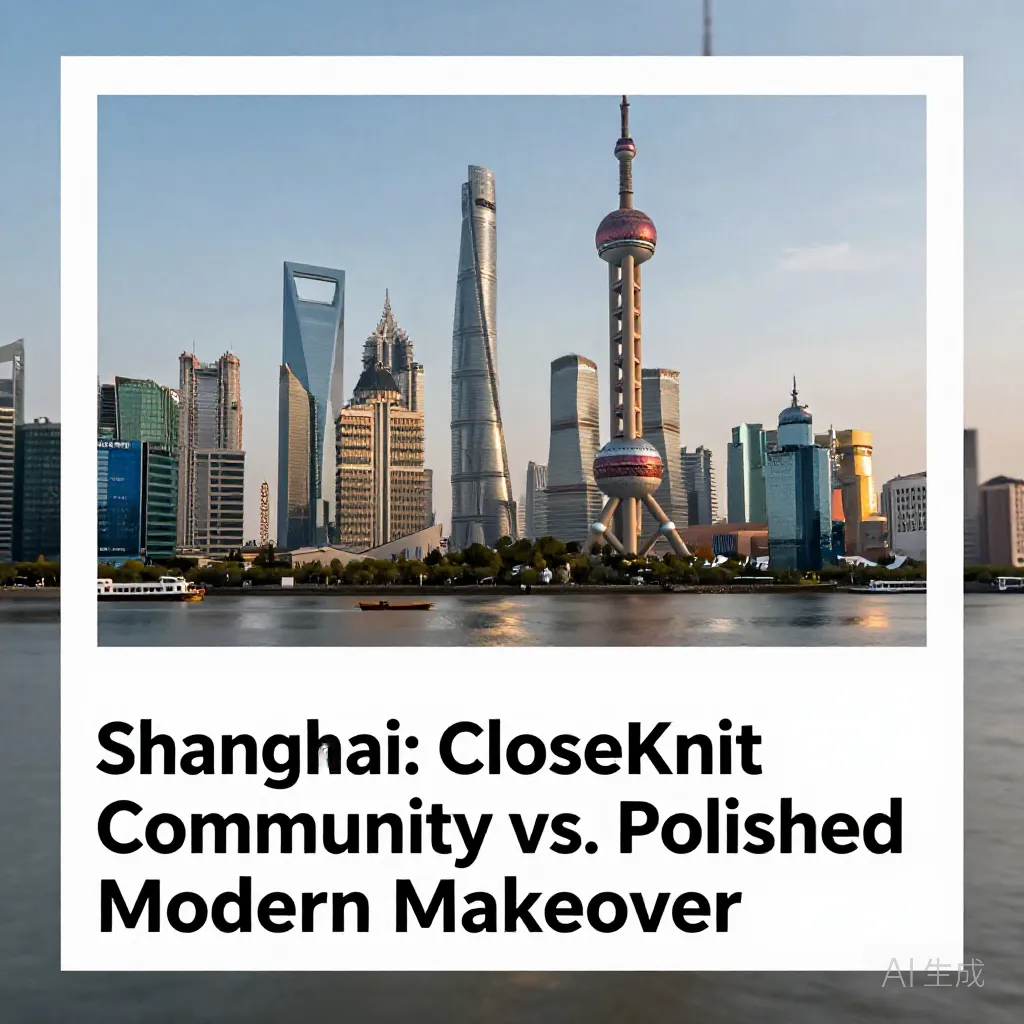
Introduction: The Great Shanghai Pivot – A Dialectic of Progress
The Shanghai of 2026 presents a breathtaking spectacle—a forest of glass towers reflected in the Huangpu River, a hyper-efficient metro map spanning the metropolis, a culinary landscape boasting Michelin stars from every continent. Yet, for those who remember the city before 2018, this spectacle is often accompanied by a quiet, persistent ache of loss. This is not simple nostalgia for a bygone time; it is a professional and personal reckoning with a specific urban quality that has been irrevocably altered.
The city’s essence shifted from an intimate, close-knit organism, discovered through wandering and word-of-mouth, to a polished, design-conscious global hub optimized for consumption and convenience. To have a meaningful discussion, we must define our benchmarks. “more effective then” refers to a unique social fabric, a spirit of spontaneous discovery, and a raw, uncurated energy that defined the pre-2018 era. “more effective now” acknowledges monumental, often life-improving, gains in infrastructure, public services, safety, and the scale of formal cultural offerings.
This article is not a blanket condemnation of progress. It is a forensic examination of what was sacrificed and what was gained during Shanghai’s accelerated metamorphosis into what one long-term resident called “a design object with a coffee shop in it.” The comparison is stark, personal, and rooted in the daily lived experience of the city, weighing intangible social magic against tangible material gains. The transformation represents a fundamental dialectic: the tension between an emergent, organic, and often chaotic urban vitality and a planned, efficient, and homogenized global perfection.
Part I: The Pre-2018 Prime – An Unrepeatable Era of Organic Discovery
A City That Felt Like a Secret
Before 2018, Shanghai operated on a different epistemological wavelength. Its primary charm was not in curated, reviewable experiences but in unexpected discovery. A narrow lóngtáng (弄堂) alley, seemingly leading nowhere, might open onto a decades-old wǎngshā (网纱) fabric shop humming with local tailors or a private cāntīng (餐厅) accessible only by a whispered password and a nod from the shīfu (师傅).
This was a city you had to know to truly access. The information economy was less dominant; word-of-mouth, personal exploration, and happy accident were the primary modes of navigation. You felt like an insider simply by wandering without a plan, by following a smell, a sound, or a faded sign. The city itself was the primary attraction, not its commercialized representations on a screen.
This organic, un-mapped quality created a constant, low-grade sense of possibility. A wrong turn could yield the best xiǎochī (小吃) of your life—a sizzling cōngyóubǐng (葱油饼) from a griddle behind a corrugated iron door—a chance encounter with a fascinating local artist painting in a shared studio, or a glimpse into a residential shikumen (石库门) courtyard life now largely hidden behind high-end boutique facades. The narrative of the city was co-authored by its residents in real time, not pre-written by marketing teams.
The Golden Age of Democratic Immersion
Financial accessibility was a cornerstone of the old Shanghai’s social ecosystem. For a few US dollars, one could enjoy a luxurious, bone-marrow-rich hóngshāo ròu (红烧肉) meal with infinite rice in a family-run lǎopǔ (老铺), the tablecloth slightly sticky, the owner refilling your tea with a gruff kindness. A full day of exploration across multiple neighborhoods—hopping from a cháfáng (茶坊) to a bookshop to a live music venue—could cost less than a single artisanal pour-over coffee in many current establishments.
This affordability wasn’t about being cheap; it was about democratic access to the city’s soul. Artists on residencies, students on gap years, and long-term expats on modest budgets could live deeply, eat widely, and participate in a vibrant, multi-layered scene without financial precarity. The economy of experience was not gated by premium pricing. This allowed a true cross-section of society—from shàng hǎi nán (上海男) in their silk pajamas to foreign freelancers—to mingle in the same cheap beer halls, experimental art galleries, and public parks, creating a rich, layered social tapestry that has since fractured along stark economic lines.
Spontaneous Community and Organic Culture
The social fabric was tightly woven through shared space and necessity. In shikumen neighborhoods, life spilled into the alleyways. You knew your neighbors by sight, the fruit seller’s family by name, the āyí (阿姨) who watched the street and scolded you for wearing shorts in autumn. Community was a byproduct of proximity and lack of privatized space.
Cultural events—small poetry readings in a bookstore back room, underground punk shows in a basement, film screenings on a projector hung from a clothesline—happened because someone with passion and a few hundred yuan made them happen, not because a venue manager identified a profitable demographic gap. There was a palpable sense of collective ownership. The famous “Shanghai vibe” was an emergent property of millions of individual, uncoordinated interactions, not a branded aesthetic sold in a gift shop.
This culture was messy, imperfect, and often rough around the edges, but it was alive and owned by its residents. Its disappearance represents the most significant thing lost: a living, breathing, resident-generated community culture versus a performed, professionalized one for an audience.
The Unvarnished Authenticity
Pre-2018 Shanghai wore its history visibly and sometimes uncomfortably. The crumbling plaster of a French Concession mansion next to a gleaming 1990s tower was not a staged contrast for Instagram; it was just reality. The contrast between the Bentley parked outside a lǎopǔ and the elderly resident sweeping the threshold was stark and present.
This rawness was integral to the city’s character. You could feel the weight of its tumultuous history—the foreign concessions, the occupation, the revolutionary periods, the economic reforms—in the very stones and in the juxtaposition of styles.
There was no pervasive pressure to aestheticize every moment, to turn life into a content piece. A meal was for eating, a bar was for drinking, a park was for resting. The city did not constantly remind you that you were in a “special” place with branded signage and heritage plaques on every corner.
Its authenticity was uncurated, which made it feel profoundly real and unselfconscious. This lack of a filter is what many now miss most intensely: the permission to simply be in the city without being a consumer of it.
A Sense of Frontier Mentality
There was a unique, exhilarating feeling of being in a place that was still writing its own story, where the rules felt flexible and the possibilities endless. Entrepreneurs launched ventures in unused warehouse spaces with minimal red tape. Artists squatted in lóngtáng slated for demolition, creating ephemeral studios. The boundary between legal and extra-legal was often blurred and personally negotiated.
This frontier spirit bred incredible creativity and a resilient “can-do” attitude. Failure was not a permanent stigma but a frequent, often humorous, part of the adventure, shared over cheap beer. The city was evolving at a dizzying pace, and everyone, regardless of formal credentials, felt they could be part of that change.
It created a powerful, collective, DIY energy. It was a great time to be a risk-taker in Shanghai, where an idea could become a reality overnight with a little hustle.
That specific, wide-open entrepreneurial and creative energy—unmediated by layers of permits, brand guidelines, and investment capital—has since been institutionalized, regulated, and in many ways, commercialized out of existence. It has been replaced by a more professionalized, capitalized, but less anarchic and less accessible environment. The frontier has been paved over and zoned.
Part II: The Modern Metropolis – Gains of a Global City
Unmatched Infrastructure and Convenience
The Shanghai of 2026 is a masterclass in urban systems engineering. The metro system is expansive, spotless, and punctual to the second, connecting every corner of the metropolis with stunning ease and multilingual signage. Digital payment systems via Alipay and WeChat Pay are truly universal, rendering cash an archaic relic. Food delivery apps bring any cuisine, from shāng hǎi cài to sichuan to Somali, to your door in under 30 minutes with real-time tracking.
Public services—from hospital appointments to government permits—are highly digitized and generally responsive. This layer of seamless, 24/7 convenience is a fine achievement of modern urban planning, saving countless hours of friction and frustration. For residents who value time, predictability, and cleanliness, the current city is infinitely superior.
The daily irritations of hunting for an ATM that accepted foreign cards, a restaurant that didn’t add an automatic fuwu fèi (服务费), or a taxi driver who understood your destination—these are memories of a bygone era. The sheer functional quality of daily logistical life has been elevated dramatically, creating a baseline of comfort unimaginable a decade prior.
World-Class Cultural and Culinary Offerings
The sheer scale, depth, and funding of Shanghai’s formal cultural scene now are undeniable and impressive. Major international museum branches, like the Power Station of Art and the newly expanded China Art Museum, host blockbuster exhibitions on par with London or New York. The theater scene features long-run Broadway-caliber tours, sophisticated píngjù (评剧) revivals, and avant-garde local productions in state-of-the-art venues.
The culinary landscape has exploded beyond shāng hǎi cài to include some of the world’s best examples of virtually every global cuisine, often at the highest technical level. This is not just about luxury dining; it’s about depth and diversity. A well-funded, professional gallery scene supports both internationally renowned Chinese artists and emerging talent.
While the spontaneous basement punk show is rarer, the professional presentation, curation, and preservation of both classic and contemporary art are vastly improved. For a connoisseur, the absolute peak experiences available now—a perfect French pâtisserie, a sublime Shanghai Symphony Orchestra performance, a meticulously restored Kunqu opera—are objectively superior in technical execution to what was possible in the earlier, more amateurish era.
Enhanced Safety, Order, and Public Hygiene
The transformation in public order and sanitation is one of the most tangible, universally appreciated improvements. The streets are remarkably safe, day and night, a result of pervasive security infrastructure, widespread CCTV, and community policing initiatives. The once-common sight of public spitting or littering has been drastically reduced through sustained campaigns, higher fines, and powerful social pressure. Air quality, while still a seasonal challenge, is incomparably better than during the industrial peak years of the early 2000s.
Public spaces like the Bund promenade, Century Park, or the newly opened riverfront walkways are meticulously maintained, with clean facilities, clear signage, and professional landscaping. This creates a more pleasant, orderly environment for strolling, cycling, and outdoor leisure for all ages. The feeling of a city that is under control and cared for at a municipal level is a great comfort, especially for families, the elderly, and those accustomed to higher global standards of public hygiene. This is a clear, non-negotiable thing better now, with direct benefits to public health and quality of life.
Professionalization and Elite Career Opportunities
The job market for both locals and international talent has matured beyond recognition. Pre-2018 opportunities for expats were heavily skewed towards teaching English, basic trade, and a nascent, often precarious startup scene. Today, Shanghai is a definitive global hub for finance (Lujiazui), tech (Zhangjiang), luxury management, advanced R&D, and corporate headquarters for multinationals.
Career paths are more structured, salaries in key sectors are globally competitive, and professional networks are deeper and more formalized. For a young professional aiming for a fine corporate or specialized career, the current city offers unparalleled opportunities, mentorship, and compensation. The “wild west” freelance teaching gig has been supplemented—and often surpassed—by stable, high-value positions with clear advancement tracks.
This professional gravity attracts top global talent, further enriching the city’s intellectual and business environment in a sustainable, tax-generating way that the earlier, more transient and informal scene could not match. The city now competes directly with Singapore and Hong Kong for high-value human capital.
Curated Preservation of Heritage and Hǎipài Identity
There is a new, state-backed seriousness about preserving Shanghai’s architectural and cultural heritage, albeit often through a lens of tourism and branding. The restoration of the Bund’s historic Gothic, Art Deco, and Neoclassical buildings is exemplary and has UNESCO recognition. Entire lóngtáng neighborhoods have been transformed into beautiful, functional mixed-use spaces like Tianzifang and Xintiandi. While heavily criticized for sanitization and commodification, these projects have saved dozens of historically significant shikumen structures from decay and demolition.
Museums dedicated to Shanghai’s history, like the Shanghai History Museum, are more sophisticated in their curation. There is a conscious, well-funded effort to package and promote hǎipài (海派) culture—the city’s unique blend of Chinese and Western influences from the early 20th century—as a coherent, marketable brand. This curated preservation, while sometimes lacking the organic, lived-in feel of the past, has well-preserved physical artifacts and artistic traditions that would have otherwise been lost to unchecked, profit-driven development. It provides a tangible, accessible, and polished link to history that was previously crumbling and ignored, making heritage a visible part of the modern cityscape.
Part III: The Heart of the Divide – Where Gains Become Losses
The Casualty of the Authentic “Third Place”
The most profound and irreplaceable loss is the erosion of the authentic “third place”—the informal, affordable, resident-driven social hub that was neither home nor work. The neighborhood cháfáng where old men played májiàng (麻将) for hours, the tiny bar where the owner knew everyone’s order and their stories, the park bench that was a permanent meeting point for local retirees—these have been largely replaced by their sanitized, commercialized counterparts. Their modern equivalents are either too expensive, too crowded with tourists seeking the “Shanghai experience,” or too curated and theme-parked to feel spontaneous or owned by the locals.
The social infrastructure that supported casual, daily, low-stakes interaction has been commercialized and priced out. You now miss the effortless sense of belonging that came from simply being a regular face in your lóngtáng, where shopkeepers greeted you by name. The modern city offers fantastic designed experiences, but the un-designed, happenstance community encounters are few and far between.
This has made Shanghai feel more socially isolating and lonely despite being denser and more connected digitally. The connective tissue of weak ties—the brief chats with the āyí, the nod to the security guard—has been weakened.
The Algorithmic City vs. The Human City
Pre-2018 discovery was a human, serendipitous process: a friend’s tip, a faded sign glimpsed from a bus, a curious smell drifting from an open door. Now, discovery is overwhelmingly mediated by algorithms—Dianping reviews, Xiaohongshu (Little Red Book) guides, Meituan promotions. The city is experienced through a screen first, then secondarily in person.
This creates a paradox: we have more information than ever, but the experiences are often homogenized, pre-vetted, and optimized for mass appeal. The thrill of the unknown, the potentially bad but authentic meal that became a legend, the closed door you knocked on anyway out of curiosity—these risks and rewards are algorithmically minimized. The city feels safer and more predictable, but also more like a product and less like a living, surprising organism.
The human element of stumbling, of trusting a stranger’s passionate recommendation over a five-star rating from hundreds of anonymous reviewers, has been streamlined out of existence. This is a trade-off many accept for reliability, but it fundamentally alters the emotional texture and personal narrative of urban life. Your experience is pre-filtered by the crowd, not forged by your own curiosity.
The Gentrification of the Everyday Aesthetic
The influx of capital and premium branding has gentrified not just neighborhoods, but the very concept of “everyday.” What was once a functional, no-frills mílòu (米楼) rice shop selling bulk grain by the jīn (斤) is now an artisanal grain boutique with imported ceramic containers and tasting notes. A utilitarian public toilet is a high-tech, perfumed pod with touchless fixtures. The aesthetic of improvement, of “upgrading,” is everywhere, often at the explicit expense of utility, history, and character.
This makes the city visually cleaner and more “world-class,” but it scrubs away the textures, scars, and patina of ordinary life. The fine details of wear, tear, repair, and history are polished away in the pursuit of a seamless visual brand. For those who valued the city’s rough authenticity—the exposed conduit, the repaired awning, the faded poster—this is a profound aesthetic and cultural loss. The city’s visual language has shifted from one of accumulated use to one of instantaneous, pristine consumption.
The Silence of the Shanghainese Dialect
Alongside the physical transformation, a quieter, more profound cultural erosion has occurred: the rapid, near-terminal decline of the Shanghainese dialect (shànghǎihuà 上海话). Pre-2018, the melodic, rapid-fire cadence of local speech was the city’s auditory bedrock, its true soundtrack. It was the language of the lóngtáng courtyard gossip, the market haggles, the familial jokes, and the intimate banter that bound the local community together. It signaled deep, generational belonging in a way Mandarin never could.
Now, in 2026, Shanghainese is increasingly a language of the older generation in private spaces. Public signage, official communications, education, and even casual conversation among younger residents are overwhelmingly in Putonghua (Mandarin). The relentless influx of domestic migrants from other provinces and international expats, coupled with an education system and media landscape that actively prioritize Mandarin, has rendered the local tongue a heritage artifact rather than a living medium of daily exchange.
This linguistic shift is more than practical; it severs an intangible thread of identity. The dialect carried the city’s specific history, its unique humor, its emotional subtleties, and its rhythm. Its marginalization represents the final victory of a standardized, globally legible Shanghai over the idiosyncratic, insider version.
The city’s unique voice is being silenced, replaced by a uniform national and international tongue. You can no longer feel you are in Shanghai simply by listening to the cadence of conversations around you; the auditory landscape has been homogenized.
The “Smart City” and the Erosion of Friction
Shanghai’s rise as a paradigm “smart city” is a cornerstone of its modern identity. By 2026, facial recognition at subway gates, IoT-enabled public services, and hyper-personalized app ecosystems have created an environment of astonishing, almost unnerving, efficiency. The friction of urban life—the need to ask for directions, negotiate prices, carry cash, or even wait in line—has been systematically engineered away.
This convenience is undeniable and life-improving for many, but it removes the human intermediary, the point of potential serendipity and weak-tie connection. The grumpy didi driver who gave you a life-hack shortcut through a backstreet, the street vendor who slipped you an extra jiǎozi (饺子) on a rainy day, the āyí who scolded you for not wearing enough layers—these micro-interactions, often born of mild inconvenience or personal judgment, were the glue of social texture. They created moments of unpredictable human warmth.
The algorithmic city optimizes for transaction speed, data collection, and error reduction, not human warmth or spontaneous generosity. It creates a sterile, predictable environment where every need is anticipated and met by a screen, not a person. The city becomes a series of solved problems, and in solving them all with technology, it solves away the very messiness, unpredictability, and human-scaled negotiation that made it feel alive. We have traded the anxiety of the unknown for the alienation of the perfectly managed, frictionless system.
Homogenization: Shanghai as Another Global Node
The curated preservation of hǎipài culture and the gleaming towers of Pudong have a deeply ironic, paradoxical effect: Shanghai risks losing what made it distinct and magnetically interesting in the first place. The global playbook for “successful,” “world-class” cities—iconic starchitecture, luxury retail districts, concentrations of Michelin stars, photogenic, sanitized heritage strips—has been applied with remarkable, uniform consistency.
Stroll through the redeveloped lóngtáng zones of Xintiandi, the French Concession’s main streets, or the Pudong skyline-facing promenades, and you encounter a familiar, globally recognizable aesthetic. The independent, dusty bookstore is replaced by a branded concept store from Beijing or Seoul; the local craft beer bar shares an identical design language with its counterpart in Berlin or Tokyo. The “Shanghai vibe” is now a marketable brand, packaged, replicated, and sold.
This creates a profound sense of placelessness. The raw, contradictory, historically specific, and often dysfunctional Shanghai—where a 1950s Communist-era canteen sat beside a 1930s Art Deco lounge, where immense global wealth brushed against working-class shikumen life in the same block—is being smoothed into a coherent, appealing, but globally generic product. The city’s soul was in its unresolved tensions and organic juxtapositions; the new city’s strength is in its resolved, profitable, and predictable aesthetics.
For the traveler or resident seeking authentic difference, the pre-2018 Shanghai offered a world unto itself. The 2026 Shanghai offers a world-class, familiar version of everywhere.
Part IV: Psychological and Environmental Dimensions of the Transformation
The Psychology of Nostalgia and Loss
It is intellectually crucial and ethically necessary to acknowledge that the “better then” narrative is filtered through the lens of nostalgia and, often, a specific form of privilege. The pre-2018 city was gritty, inconvenient, frustratingly opaque, and could be genuinely difficult for those without social connections or language skills. Its charms were not evenly distributed; the lack of safety nets, basic sanitation in some areas, and accessible public services was a daily reality for many residents, not a romantic adventure. The “frontier mentality” meant a lack of regulation that could also mean exploitation, instability, and legal vulnerability.
The critique, therefore, is not for a naïve return to that exact, often harsh, reality. It is a mourning for a specific quality of urban experience—the unscripted, the affordable, the community-owned, the serendipitous—that has been systematically sacrificed on the altar of efficiency, safety, global prestige, and capital optimization. The loss is not of a perfect past, but of a set of conditions that fostered a particular kind of social magic: the magic of the unplanned, the un-monetized, and the un-curated.
This creates a psychological schism for long-term residents and those who formed deep attachments during the earlier era. They live in a physically superior, safer, more convenient city that feels, in many fundamental social and sensory ways, like a stranger. The places, rhythms, and informal networks that shaped their memories and identities are either gone, sanitized beyond recognition, or priced into irrelevance.
They are citizens of a place that no longer feels like their place, even as it objectively “improves” by conventional metrics of development. This is a form of grief for a lost perceptual and social world.
The Vanishing of the Productive City
Pre-2018 Shanghai still bore the visible, audible, and olfactory marks of production. You saw workshops, small-scale manufacturers, wholesalers, and repair shops nested in the urban fabric. You heard the clang of metal, the hum of sewing machines, the shouts of logistics crews.
The city made things, not just sold and consumed them. This created a different, grounded rhythm—the delivery trucks loading at dawn, the practical, no-nonsense utility of spaces, the smell of wood shavings or dye.
This productive layer has been largely exiled to the city’s distant peripheries or erased entirely. The new Shanghai is a city of consumption and presentation. Its core function is to be looked at, photographed, experienced, and purchased.
The mílòu that sold rice by the jīn is now a boutique selling heirloom grains in beautifully labeled jars at a premium. The auto repair lane is a café with minimalist furniture and pour-over coffee.
This shift from a productive to a purely consumptive identity has sanitized the city’s visual and auditory landscape, but it has also made it less real, less grounded in the tangible processes of life. There is a profound difference between a space that exists to serve a functional, everyday need and one that exists to serve an aspirational, experiential desire. The former grounds you in the tangible reality of living—maintenance, repair, creation.
The latter places you in a permanent state of tourism, of passive appreciation, even if you never leave your neighborhood. The city’s soul was partly in its workaday grit, its sense of being a place where things were done; that grit has been polished into a showroom floor.
The Environmental Cost of “Clean”
The pre-2018 city’s rawness included a certain environmental roughness: the smell of coal heating in winter, the haze from nearby factories on still days, the occasional litter in less-maintained corners, the wild, weedy patches along railway lines. This was part of its unvarnished, industrial-charm reality, a sensory marker of its complex history. The modern city’s environmental gains—stricter emissions controls, widespread electrification of heating and transport, meticulous street cleaning—are a monumental public health victory.
But, the relentless pursuit of a seamlessly clean, green, and “natural” urban experience has involved a subtle, often unnoticed sanitization of nature itself. Waterways are so managed and lined with sterile promenades they appear almost sterile, lacking the messy biodiversity of riverbanks. Parks are so designed with curated flowerbeds and non-native species they feel like manicured landscapes rather than dynamic ecosystems. The wild, weedy, slightly unkempt patches where actual biodiversity thrived have been replaced by orderly, photogenic, but ecologically simpler floral displays.
The “clean” city is a controlled city. It removes the organic, the spontaneous growth, and the messy processes of nature that, in their own way, mirrored the messy processes of a living community. The air may be clearer, but the city’s ecological story is now one of managed perfection, not dynamic, sometimes gritty, interaction. We have gained undeniable health benefits but may have lost a visceral, unmediated connection to a less-constrained natural world within the metropolis—the weeds that grew through cracks, the birds that nested in unused gutters.
The Paradox of Choice and the Death of Serendipity
The modern Shanghai resident is inundated with choice. A hundred restaurants, a thousand events, a million recommendations are available at a tap. Yet, this cornucopia often leads to decision fatigue and a paradoxical narrowing of experience. Algorithms feed us more of what we already like, creating personalized echo chambers that mimic the narrowness of the old lóngtáng community, but without its organic, trust-based bonds or its physical proximity.
The pre-2018 city, with fewer curated options and less aggregated data, forced a kind of happy accident. With fewer “top 10” lists, you had to explore. You took a chance on a place with no reviews because it was there, because its sign looked interesting.
You talked to the stranger on the bench instead of checking their online profile. The constraints of information scarcity bred a different kind of richness—one of personal discovery, unique non-replicable stories, and the development of one’s own taste through trial and error.
Now, we have optimized our way out of surprise. We can know everything about a venue before we arrive, from the menu to the ambiance to the wait time to the owner’s political opinions. The room for the unknown, for the “bad” but authentic meal that became a legend shared only with friends, has been algorithmically minimized.
The city’s narrative is no longer something you co-write through your own wanderings and missteps; it is a pre-written, pre-rated script you select from a dropdown menu. The loss is not necessarily of quality, but of authorship and agency over one’s own urban experience. The city has become a product with infinite variants, but the user is still just a consumer.
Conclusion: The Price of Perfection – An Unresolved Dialectic
Shanghai in 2026 is, by any objective measure of urban development, a safer, cleaner, more convenient, and culturally richer city in terms of formal, scalable offerings. Its achievements in infrastructure, public health, global business stature, and the presentation of high culture are great and undeniable. One can enjoy a fine meal of any global cuisine prepared by a master chef, attend a world-class performance in an acoustically perfect hall, and navigate the vast metropolis with effortless, digital ease. These are not minor gains; they define a 21st-century global capital.
Yet, the trade-off has been the quiet, comprehensive exodus of the city’s soul—the spontaneous community, the affordable immersion, the unvarnished authenticity, and the frontier mentality. These have been largely priced, planned, regulated, and polished away in the pursuit of global benchmarks. You know you are in a special, world-class place now, but it is a feeling engineered by developers, marketers, and city planners, not one that emerges organically, unpredictably, from the streets and the daily interactions of its people.
The thing most missed is not a specific restaurant or bar, long since closed, but the connective tissue of casual, unmonetized human interaction that made the old city feel alive, surprising, and owned by its residents. The new Shanghai is a masterpiece of urban design, a testament to what capital and coordination can achieve. The old Shanghai was a living, breathing, often messy organism, full of contradictions and unplanned vitality.
We have gained a world-class city and lost a unique world. Whether that is a fair, sustainable, or desirable exchange depends entirely on what you know you value most: the curated, perfected, and predictable experience of the design object, or the chaotic, close-knit, and emergent heart of the place that was. The transformation is complete, but the debate over its ultimate value—the balance between the great gains and the profound losses—will define Shanghai’s identity for generations to come. The city stands as a monument to both progress and erasure, asking us to consider what, in the end, we mean by “better.” It is not a question with a final answer, but a permanent tension, written into the very pavement and whispered in the fading cadence of a dialect, between the city as a perfected product and the city as an unfinished, collective poem.
Responses • 0
0/2000
ID: 1326
Chris
Offline
54 min
Visited
From
Bakersfield, United States
Send Message