Roca's WallMounted Toilet Mystery
AI Learn Chinese
2 hr • 0 read
Confused by Roca's wallmounted toilet controls in China? Decode the icons, power source, and why it sometimes needs multiple presses.
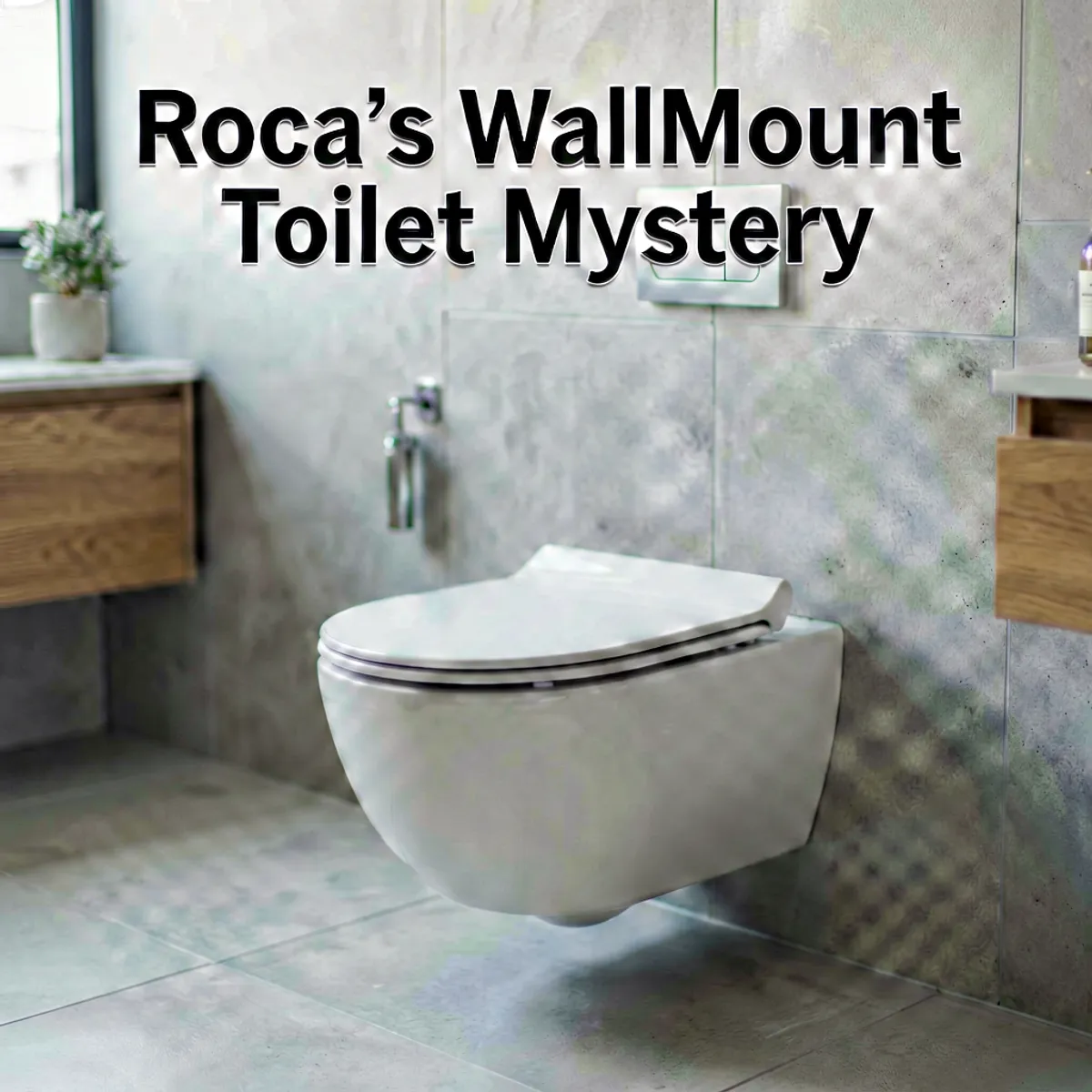
The Puzzling Panel in the Chinese Hotel Bathroom
You step into a sleek, modern hotel bathroom in China. The space is minimalist, dominated by a wall-hung toilet and a small, elegant panel mounted on the tiled wall. It has a couple of buttons and some cryptic icons—a key, a water droplet, maybe a flush symbol.
You press what you think is the flush button. Sometimes it works instantly. Other times, nothing happens.
You press again, and again, until finally, a roar of water answers. What is this thing? Why is it so inconsistent?
This is a common point of confusion for frequent visitors to China, where wall-mounted toilet systems with sophisticated controls are standard in many modern hotels and upscale residences. The panel isn't just a button; it's a command center for a complex hydraulic and electronic system designed for efficiency, hygiene, and water conservation.
The core of the mystery usually revolves around three questions: What brand is this? How is it powered? And what do all the symbols mean?
The brand is very likely Roca, a Spanish multinational that is one of the world's largest manufacturers of bathroom products and holds a significant market share in China's premium plumbing fixture sector. Their wall-hung systems, like the popular GAP or Meridian collections, integrate the cistern and flush mechanism entirely within the wall, leaving only a thin, discreet user interface on the surface. This design creates a clean, seamless aesthetic that is highly prized in contemporary architecture.
The inconsistency you experience—flushing on the first press versus requiring several—is not a fault, but often a deliberate feature or a side effect of the system's design philosophy, which prioritizes water saving and user customization.
Understanding this panel requires moving beyond the assumption that it is a simple, direct mechanical switch. It is an electronic interface. Your press is not directly opening a valve.
Instead, it sends a signal. This fundamental shift from mechanical to electronic control is what creates the learning curve. The system is engineered to manage water usage precisely, to offer different flush modes, and to integrate with other bathroom technologies.
Your frustration is the friction between a user expecting instant, direct mechanical feedback and a system operating on programmed logic and sensors. Decoding it means learning its language of icons, signals, and modes.
Roca: The Brand Behind the Button
Roca is not a generic Chinese manufacturer; it is a global design and engineering leader headquartered in Barcelona, Spain. Founded in 1917, the company has a century-long history of innovation in sanitaryware. Its presence in China is substantial, with manufacturing plants, design centers, and a vast distribution network catering to both commercial projects (like your hotel) and the high-end residential market. When you see that distinctive, minimalist panel, you are almost certainly interacting with a Roca product or a system using their core flush technology licensed to other brands.
The reason Roca's system is so prevalent in Chinese hotels is twofold: aesthetic alignment and water policy. China's rapid urbanization has seen a surge in construction of international-standard hotels and luxury apartments. Architects and developers specify wall-hung toilets and concealed cisterns for their clean lines and space-saving benefits, which align perfectly with modern minimalist interior design trends popular across East Asia.
In addition, China has implemented strict national water efficiency standards. Roca's electronic flush systems are engineered to meet and exceed these standards, offering dual-flush options (partial and full) that significantly reduce water consumption compared to traditional single-flush gravity toilets. For a hotel manager, installing these systems is a compliance and cost-saving decision.
It's important to distinguish the panel from the system. The panel you touch is the user interface (UI). The real work happens invisibly behind the wall: a sturdy steel or plastic frame supports the ceramic toilet bowl, a durable plastic or metal cistern holds the water, and a powerful, silent flush valve—often a pressurized or piston-type valve—propels the water into the bowl with enough force to clear waste efficiently using less water than a standard gravity-fed system.
The UI's job is to communicate your intent to the electronic control module (ECM) inside the cistern, which then activates the valve for a programmed duration. This separation of the user interface from the mechanical core is what allows for such slim, elegant panels and is the source of the "delay" or "multiple press" sensation you might feel.
Decoding the Interface: Icons and Their Meanings
The symbols on the panel are not arbitrary; they are a standardized visual language, though variations exist between Roca's own product lines and panels made by other manufacturers using Roca technology. The most common icons you will encounter are the lock/unlock symbols and the water droplet(s). Understanding these is key to mastering the system.
The lock icon (often a padlock or a keyhole) is the most frequently misunderstood. It does not secure the toilet against use. It indicates the manual/automatic flush mode.
When the lock is open (unlocked), the system is in automatic mode. In this mode, the toilet is designed to flush automatically after use, triggered by a built-in infrared (IR) proximity sensor located on the panel or near the toilet. You don't need to press anything.
The sensor detects when a user stands up and moves away, then signals the ECM to initiate a flush cycle, typically a smaller "half-flush" for liquid waste. The open lock symbol signifies this automatic function is active.
When you press the button with the lock icon, you are toggling the system into manual mode. The lock symbol will change to a closed or locked state on some models, or a small LED might illuminate. In manual mode, the automatic sensor is disabled.
The toilet will only flush when you press a flush button. This is useful in private homes where you don't want the toilet flushing unexpectedly, or in hotels during cleaning when staff want to test flush without triggering the sensor. To return to automatic sensor mode, you press the lock button again.
The act of pressing the lock button is the command to switch modes, not a security measure.
The water droplet icon(s) represent the flush volume. A single large droplet typically signifies the full flush (for solid waste). Two or three smaller droplets arranged together usually indicate the partial or half-flush (for liquid waste).
On panels with separate buttons, pressing the single-droplet button will activate the longer, higher-volume flush cycle. Pressing the multi-droplet button activates the shorter, lower-volume cycle. On single-button panels, a quick press might trigger the half-flush, while a long press (2-3 seconds) might trigger the full flush.
This is a common source of the "press once, nothing happens" experience—you may have given a quick press, but the system interpreted it as an incomplete or unintended command, waiting for a longer, definitive press to execute a full flush. The system's logic is designed to prevent accidental full flushes to save water.
The Power Question: Wired or Battery?
This is a critical point of clarity. The vast majority of Roca wall-mounted toilet systems installed in hotels and apartments in China, and indeed globally, are battery-powered. They are not hardwired into the building's electrical grid. The entire electronic control module, the sensor, and the valve actuator are powered by a set of standard alkaline D-cell batteries (usually 2 or 4 batteries) housed in a compartment accessible from the front of the panel or, in some models, from a removable access panel on the wall just above the toilet tank.
The reason for battery power is installation simplicity and reliability. Wiring a bathroom for a toilet would require an electrician, a dedicated circuit, and compliance with complex electrical codes in wet locations. A battery system can be installed by a plumber in minutes.
It also means the system is completely isolated from the building's electrical system, eliminating any risk of electrical fault in a high-moisture environment. For hotels, it means no ongoing electrical maintenance for the toilet system. Battery life is engineered to be exceptionally long.
Roca states that under normal residential use (with a mix of automatic and manual flushes), the batteries can last 2 to 5 years, sometimes longer. In a hotel with very high usage, the lifespan might be on the lower end of that range, but still measured in years, not months.
There are hardwired versions of these systems, but they are rare and typically specified for very specialized commercial applications where ultra-low maintenance is required and a permanent power source is already planned. You would almost certainly not encounter one in a standard hotel room. The panel itself will not have a visible power cord.
If you could remove the panel (which you should not do in a hotel), you would find a sealed battery compartment. The "low battery" indication is usually a slow blinking LED on the panel or, in some advanced models, a series of beeps. Hotel maintenance staff are trained to replace the batteries during routine room servicing, which is why you almost never see a "dead" panel—the housekeeping schedule includes this task.
So, you can rest assured the system is working as intended; its power source is simply hidden and long-lasting.
The Science of the Flush: Why Multiple Presses?
Your observation—"sometimes it flushes with one press, other times I have to press it two or three times"—gets to the heart of the system's intelligence and its two primary operating modes: automatic sensor flush and manual button flush. The inconsistency you perceive is the system executing different programs based on its current mode and your input.
First, consider the automatic mode (unlocked lock icon). Here, you should not press anything. The IR sensor is constantly scanning.
When it detects a person approaching and then leaving the vicinity of the toilet (often calibrated to trigger after you stand up and take a step or two away), it automatically initiates a flush cycle. If you are pressing buttons while in automatic mode, you are likely just interrupting or confusing the sensor's process. The system might ignore your press because it is already executing an automatic cycle, or it might register your press as a manual override command, which can lead to the "press multiple times" effect as it tries to reconcile conflicting inputs.
The simplest solution in automatic mode is: do not press the buttons. Use the toilet, step away, and let the sensor do its job.
Second, in manual mode (locked lock icon), the sensor is disabled. The toilet will only flush when you press a button. Here, the "multiple press" issue has two main causes.
Cause one: button press duration. As mentioned, a very quick, light tap may be registered by the capacitive touch sensor as an "intent to press" but not a "confirmed command." The system's software has a built-in debounce and hold timer. It waits for a clean, sustained contact (usually 0.5 to 1 second) before sending the flush signal to avoid accidental triggers from a bump or a brief touch. If you press and release too quickly, it may ignore it.
Pressing again more firmly or for a longer duration will succeed. Cause two: dual-flush logic on a single button. On panels with only one flush button (common in hotels for simplicity), the system uses press duration to differentiate half-flush from full-flush. A short press (sub-second) commands a half-flush.
A long press (2-3 seconds) commands a full-flush. If you give a medium-length press (say, 1 second), the system might not register it as a valid command for either cycle, leading to no flush. Your subsequent presses, with varying unconscious durations, eventually hit the correct timing window for one of the cycles, causing the delayed flush.
Third, there is a system reset/ready state factor. After any flush cycle completes, the valve needs a few seconds to refill the cistern and the ECM to reset. If you press the button again during this refill period (which can take 15-30 seconds for a full flush in these water-saving systems), the press may be ignored because the system is not yet ready to initiate a new cycle.
This creates the illusion that the button is unresponsive, when in fact it is correctly following its programmed sequence. You must wait for the refill sound to stop and for any status LEDs to return to their idle state before pressing again. In a busy hotel bathroom, this 20-30 second wait can feel like an eternity, leading to increasingly frantic pressing, which only exacerbates the problem by sending multiple, potentially conflicting signals to a system that is still busy.
A Practical Guide for the Hotel Guest
So, you're in your room in Beijing or Shanghai, faced with this sleek panel. What do you do? Follow this simple decision tree.
Step 1: Identify the current mode. Look for the lock icon. Is it an open padlock or a key? Or is there no lock symbol at all?
If you see an open lock or a key symbol, the system is in automatic mode. Your job is to use the toilet and then walk away. Do not press any buttons.
Stand up, take one or two steps back from the toilet, and wait 2-5 seconds. You should hear the flush initiate automatically. If it doesn't, the sensor may be dirty, obstructed, or the hotel may have deliberately disabled the sensor (some hotels prefer manual-only for control).
In that case, proceed to Step 2.
Step 2: Switch to manual mode. Find the button with the lock icon. Press and hold it firmly for 2 full seconds. You should see a small LED next to the lock symbol illuminate or change state (e.g., from off to steady on, or from blinking to solid).
This indicates manual mode is now active and the sensor is off. The lock icon might visually change to a closed lock on some models. Now you are in control.
Step 3: Flush correctly in manual mode. Locate your flush buttons. If there are two separate buttons (often differentiated by size or icon—one with a single droplet, one with multiple), use the smaller/multi-droplet button for a half-flush after urination. Use the larger/single-droplet button for a full flush after defecation.
Press each button with a firm, deliberate press lasting about 1 second. If there is only one button, your press duration is everything. For a half-flush, press and release quickly (less than 1 second).
For a full flush, press and hold for 2-3 seconds until you hear the valve activate or see a light flash. You will hear a distinct difference in the flush duration and power.
Step 4: Be patient after flushing. After any flush, listen. The loud rushing water will stop, and you will hear a quieter, gurgling sound as the cistern refills. This refill cycle takes time.
Wait until this refill sound completely ceases before attempting another flush. Pressing during refill is the most common reason for "it won't flush again." The system is literally busy refilling and cannot initiate a new cycle until full. This wait period is a key feature of water-conserving systems; it prevents you from draining the cistern dry.
Step 5: Report issues appropriately. If, after following these steps, the panel is completely unresponsive (no lights, no sound, no flush after multiple correct attempts in manual mode), the batteries may be critically low or the system has a fault. In a hotel, report this to the front desk or maintenance. Do not try to dismantle the panel.
If the automatic sensor is overly sensitive (flushing as you approach) or completely dead (never flushing automatically), you can toggle it off using the lock button and use manual mode exclusively during your stay. Remember, the goal of this system is to save water. Your "inconvenience" is its primary function in action.
Beyond the Hotel: Residential Use and Advanced Features
While the hotel experience is often one of initial confusion, the same Roca systems are the choice of discerning homeowners and designers in China and worldwide for compelling reasons. In a residential setting, the user has the advantage of time to learn and customize the system. The panel can often be configured, via hidden button combinations or even a simple remote control, to adjust sensor sensitivity, flush duration, and default flush volume. A family can set the half-flush and full-flush volumes to their preference, balancing cleaning effectiveness with water savings.
Some higher-end Roca models integrate with home automation systems. The panel can communicate via protocols like Zigbee or Bluetooth to a central hub. This allows for features like usage tracking (how many flushes per day), remote diagnostics (the system can alert a plumber via an app if a valve is stuck or a battery is low), and even hygiene functions.
Certain panels include a "hygiene flush" or "rinse" function, activated by a separate button or a long press, which releases a small amount of water into the bowl periodically to prevent odors and stains when the toilet is not in frequent use. This is a premium feature aimed at maintaining a pristine bowl with minimal manual scrubbing.
The wall-mounted design itself offers benefits beyond aesthetics. Because the heavy cistern is concealed in the wall, supported by a robust steel frame fixed to the building structure, the toilet bowl appears to float. This makes cleaning the floor underneath incredibly easy—no awkward spaces around a base.
It also allows for flexible bowl height adjustment during installation, which is an ergonomic advantage. For the user, the only interaction is with that small, cool, smooth panel. The engineering behind it—the pressurized water system, the quiet solenoid valve, the low-power IR sensor—represents a convergence of fluid dynamics, electronics, and industrial design.
The "mystery" is simply sophisticated, user-configurable technology hidden behind a minimalist facade.
Troubleshooting Common Scenarios
Let's directly address the specific behaviors you described. Scenario A: "I press the button, and sometimes it flushes right away, other times nothing happens." This is almost certainly a manual-mode issue with press duration or system readiness. Ensure the lock is closed (manual mode).
If using a single button, experiment: try a very quick tap (half-flush) and a firm 3-second hold (full-flush). If using two buttons, make sure you are pressing the correct one for your need. After any successful flush, wait for the refill sound to stop before pressing again.
Scenario B: "The automatic flush sometimes goes off when I'm not done." This is a sensor sensitivity issue. The IR sensor has a detection zone. If you lean forward excessively or wave your hand near the panel, it may think you have left.
The solution is to switch to manual mode using the lock button while using the toilet, then switch back to automatic when you are truly finished and stepping away. Scenario C: "The lock icon is on, but the sensor still flushes automatically." This suggests the manual mode toggle didn't engage properly. Press and hold the lock button again firmly for 3 seconds.
Look for a confirming light change. If the light doesn't change, the panel may be faulty. Scenario D: "No lights, no response at all." This points to dead batteries or a complete system failure.
As a guest, your only action is to report it. As a homeowner, you would replace the D-cell batteries in the panel's back compartment (ensure the toilet water supply is turned off first!).
A related frequent point of confusion is the "standby" or "sleep" mode. To save the minuscule amount of battery power, the sensor and panel electronics enter a deep sleep state after a period of inactivity (e.g., 30 seconds). The first wave of your hand or your first press might be needed just to "wake up" the panel before it registers a command.
This can feel like unresponsiveness. The solution is the same: be deliberate with your press after a period of non-use. The panel's LED, if it has one, will usually glow dimly when awake and off when asleep.
The Philosophy of the Invisible Flush
This entire system embodies a specific philosophy of bathroom design that has gained traction globally but is particularly prevalent in modern Asian architecture: the removal of visible hardware. The goal is a seamless, monolithic look. The toilet is not an object on the floor; it is an aperture in the wall.
The flush control is not a lever or a button; it is a subtle, integrated detail. This aesthetic demands that all functional elements be hidden or minimized. The trade-off is a loss of immediate, tactile feedback.
You cannot feel a mechanical lever connecting to a valve. You must learn a new, indirect language of lights, sounds, and timed delays.
For the culture of efficiency that pervades modern China, this system makes logical sense. It enforces water conservation through its very design. The dual-flush option is a direct response to the national Water Conservation Law and the desire to reduce per-capita water usage in dense urban environments.
The automatic sensor, while sometimes finicky, promotes touchless hygiene—a major selling point in a post-pandemic world. The long battery life aligns with a "set it and forget it" maintenance model suitable for large-scale hotel operations. What feels like a nuisance to a transient guest is, from an operational and environmental standpoint, a well-optimized solution.
Your repeated pressing is, in a way, a clash of interaction paradigms. You are applying a direct mechanical action model (push button, get result) to a state-based electronic system (set mode, wait for ready state, send correct signal). Once you understand the states—automatic/manual, awake/asleep, refilling/ready—and the commands—short press/long press, lock toggle—the inconsistency vanishes.
It becomes predictable. The system isn't broken; it's just speaking a different language. Learning that language transforms the experience from frustrating to fascinating, and allows you to use what is arguably one of the most advanced and water-efficient flush systems available in any hotel bathroom today.
Conclusion: Decoding the Code
The next time you encounter that blank wall panel with its cryptic icons in a Chinese hotel, you can approach it with confidence. You now know it is likely a Roca electronic flush system, powered by long-life batteries hidden within the wall. The lock icon is a mode switch between automatic sensor flush and manual button flush.
The droplet icons dictate flush volume, with press duration being critical on single-button panels. The need for multiple presses stems from incorrect mode selection, too-short press duration, or pressing during the system's mandatory refill cycle.
This technology represents a significant evolution from the simple lever-and-chain toilets of the past. It is a system built for the 21st century: minimalist, hygienic, and frugal with water. Its complexity is the price of its elegance and efficiency.
By taking a moment to read the icons, toggle the lock, and respect the system's timing, you move from frustrated user to informed operator. You are not dealing with a broken or cheap fixture; you are interacting with a piece of precision plumbing engineering that, once understood, works flawlessly and silently, contributing to a cleaner, more modern bathroom experience. The mystery is solved, not by force, but by understanding.
Responses • 0
0/2000
ID: 1326
Chris
Offline
2 hr
Visited
From
Bakersfield, United States
Send Message