Qing Lions Return: Seoul's Cultural Gesture to Beijing
AI Learn Chinese
1 hr • 0 read
South Korea returns Qing dynasty marble lions to China, a major cultural diplomacy move in 2026 repairing bilateral ties.
The Handover: A Ceremony of Symbolic Restitution
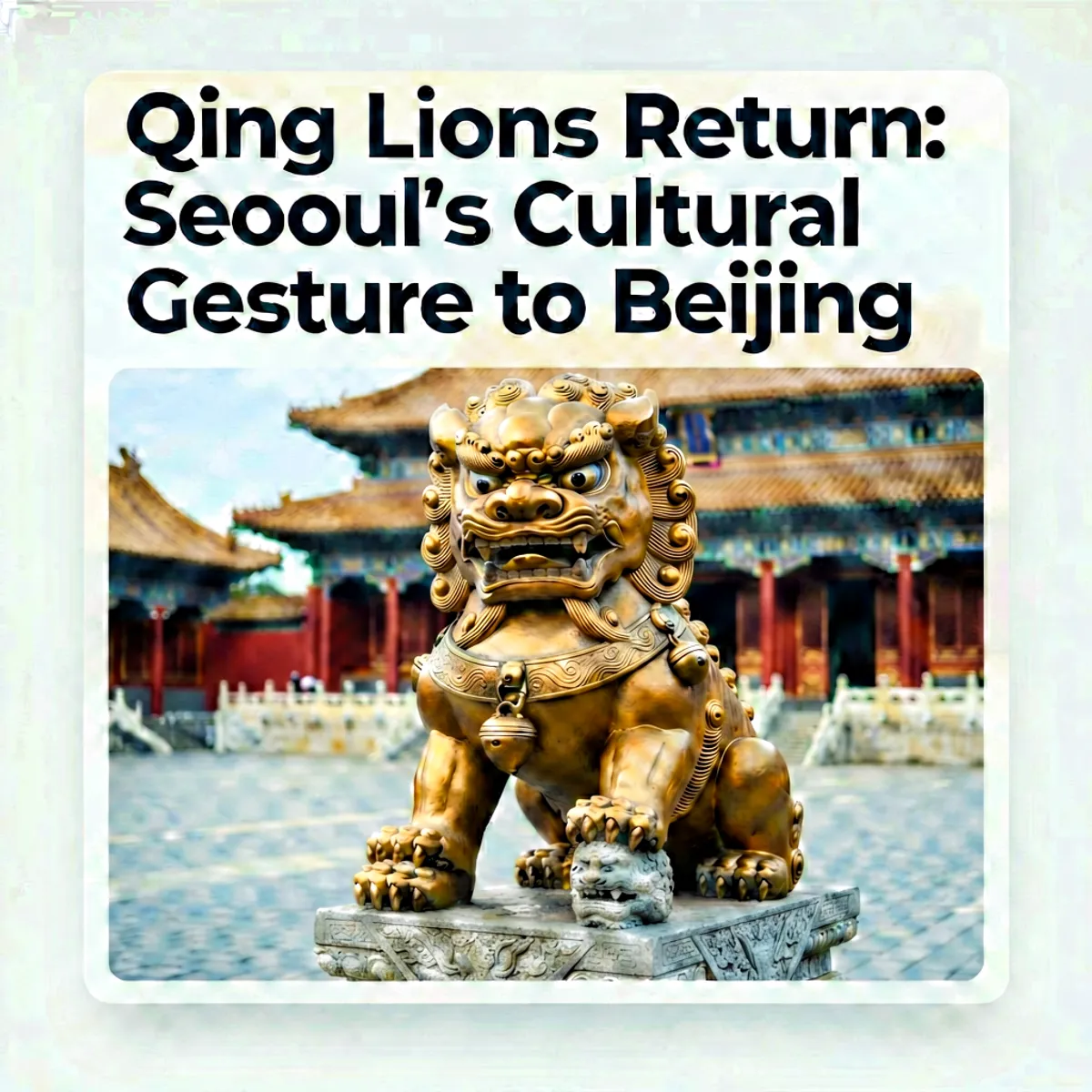
On a Thursday in July 2026, a significant cultural transaction occurred in Seoul. A pair of monumental marble lions, each standing 1.9 metres tall and weighing 1.25 tonnes, were formally handed over by the Kansong Art Museum to representatives of the People’s Republic of China. The ceremony, attended by senior cultural officials and diplomats from both nations, marked the physical return of these Qing dynasty sculptures after more than eighty years on Korean soil. Their departure for China was scheduled for the following Friday, concluding a long chapter in their turbulent history.
This was not a quiet administrative transfer. It was a staged act of cultural diplomacy, deliberately timed and executed to signal a new chapter in Sino-South Korean relations. The lions, positioned for decades at the entrance of the Kansong Art Museum, were more than just art objects.
They were recognized as imperial artifacts of immense historical weight. Their return fulfilled a specific agreement made during South Korean President Lee Jae Myung’s visit to Beijing in January of the same year, in the presence of President Xi Jinping.
Imperial Guardians: Origins in the Qing Court
To understand the significance of these sculptures, one must first picture their probable original setting. Experts assert that the lions’ "high historical, artistic and scientific value" points to a function as guardians of an imperial residence during the Qing dynasty (1644-1911). In traditional Chinese architecture, such stone lions, typically rendered in pairs—one male, one female—were placed before palaces, government offices, and temples to ward off evil spirits and symbolize power and protection.
Their craftsmanship reflects the aesthetic and technical standards of the Qing court. Carved from single blocks of marble, their size alone required substantial resources and skilled artisans. The stylistic details, while not exhaustively described in reports, would follow canonical forms: the male often depicted with a paw resting on a globe or embroidered ball, the female with a cub, both featuring flowing manes and powerful, serene expressions. They were not mere decorations but symbolic sentinels of the highest order.
A Journey Through Turmoil: From China to Japan to Korea
The lions’ departure from China occurred during a period of immense national trauma for both China and Korea. They were taken to Japan in the early 20th century, a time marked by the Japanese invasions of China and the broader imperial expansion that culminated in the occupation of Korea. This context is crucial; their removal was not a commercial transaction but a consequence of war and plunder.
The specific path from Japan to South Korea is a key part of their story. Reports indicate the sculptures surfaced in Osaka in 1933. This was during the height of Japanese imperial ambition, when countless cultural artifacts from across East Asia were moved to Japan for display, sale, or as trophies.
It was here that they were acquired by the renowned Korean collector Jeon Hyeong-pil (also known by his art name, Kansong). Jeon was a pivotal figure in preserving Korean cultural heritage during the colonial period, but he also purchased items that had been displaced from their original contexts, including those from China.
After Jeon’s acquisition, the lions were transported to Seoul. They eventually became the iconic guardians of the museum he founded, the Kansong Art Museum. For over eight decades, generations of South Koreans and visitors knew them simply as the majestic lions at the museum gate, their Chinese imperial origins and traumatic journey largely forgotten by the public, if known at all.
The Diplomatic Catalyst: Repairing Bilateral Ties
The decision to return the lions was not made in a vacuum. It was the culmination of a deliberate policy shift by the South Korean government under President Lee Jae Myung. Relations between China and South Korea had experienced strains in preceding years, influenced by regional security dynamics, economic frictions, and differing historical perspectives. The return of the lions emerged as a potent soft power tool.
The January 2026 Beijing summit between Xi Jinping and Lee Jae Myung provided the high-level political framework. Agreeing to the restitution was a tangible, culturally resonant outcome that both leaders could showcase. For China, it was a victory for national cultural pride and a demonstration of its growing global influence to reclaim its heritage.
For South Korea, it was an opportunity to demonstrate goodwill, historical sensitivity, and a commitment to strengthening the bilateral bond. The act was framed not as an admission of guilt for the original theft—which was perpetrated by Japan—but as a righteous correction of a subsequent, prolonged possession.
A Precedent in the Making: The Kansong Museum’s Long Consideration
Intriguingly, the Kansong Art Museum had reportedly considered returning the sculptures for more than a decade prior to the 2026 agreement. This suggests that within certain circles of Korean cultural curation and scholarship, the ethical dilemma of holding Qing dynasty imperial artifacts looted via Japan was acknowledged. The museum’s leadership likely understood that their stewardship, while historically significant in its own right (as part of Jeon Hyeong-pil’s collection), was built upon a chain of displacement originating in aggression.
The decade-long internal debate highlights the complexity of such restitutions. Institutions may grapple with their own history, the legal frameworks of the time of acquisition, and their mission to preserve artifacts for public view. The eventual decision to return the lions indicates that the political and diplomatic weight of the state’s policy ultimately overcame institutional inertia. The museum transitioned from being a long-term custodian to an active participant in a state-led cultural reconciliation process.
The Broader Context: Restitution in East Asia
The return of the Qing lions is part of a larger, often contentious, conversation about cultural heritage restitution in East Asia. The region’s modern history is scarred by colonial plunder and wartime confiscation, primarily by Japan but also by other powers. China has been particularly active in recent years in seeking the return of artifacts taken during the Japanese invasions and the subsequent occupation.
This creates a complex trilateral dynamic. China’s primary claim is against Japan for the original removal. But, artifacts that passed through Japan and into other collections, like those in South Korea, present secondary claims.
South Korea’s action sets a notable precedent: a third-party nation, not the original plunderer, voluntarily returning items to China. This distinguishes it from the often-deadlocked negotiations between China and Japan. The move by Seoul may encourage similar considerations in other countries or institutions holding displaced Chinese cultural property.
Parallel Cases: The Tang Honglu Stele and Others
The narrative of the Qing lions echoes other high-profile restitution cases involving Chinese cultural heritage. Perhaps the most famous is the story of the Tang Honglu Stele, a massive 9.5-tonne stone tablet originally from Liaoning province dating to AD714. It was taken to the United States in the 1920s and remained at the University of Pennsylvania Museum for nearly a century before its return to China in 2025. That case, like the lions’, involved a long campaign, diplomatic pressure, and a final ceremony symbolizing closure.
These cases share a template: an artifact of major historical importance, removed during a period of Chinese weakness (the 19th and early 20th centuries), held abroad for decades, and eventually returned through a combination of diplomatic engagement, cultural advocacy, and changing political will. The Qing lions’ return via South Korea adds a new layer, demonstrating that the pathway for restitution is not solely between the source nation and the original plunderer.
The Lions’ New Journey: Reintegration in China
With their arrival in China, the lions enter a new phase of their existence. Their destination is not specified, but it is certain they will be conserved, researched, and ultimately displayed. They will likely be placed in a national museum or a significant cultural site, where their imperial function can be properly contextualized. Their story—from the Qing court, through Japanese seizure, Korean acquisition, and final return—will become an integral part of their interpretation.
This reintegration is more than logistical; it is symbolic. These objects, which stood guard in Seoul for 80 years, will now resume their intended symbolic role in China, albeit in a museum setting rather than a palace. They become pedagogical tools, teaching visitors about the Qing era, the history of cultural loss, and the modern diplomacy of recovery. Their physical scars, if any, will be part of their testimony.
Cultural Diplomacy as Statecraft
The handover is a textbook case of cultural diplomacy as effective statecraft. It achieves multiple objectives simultaneously. It generates positive media coverage in both nations, framing the relationship in terms of shared heritage and mutual respect.
It provides a non-economic, values-based issue around which leaders can build rapport. It subtly contrasts South Korea’s proactive stance with Japan’s more static position on its own collections of Asian art.
For China, accepting the lions reinforces its narrative as the rightful custodian of its civilization’s treasures, a civilization that has overcome a "century of humiliation." It demonstrates the efficacy of its diplomatic outreach. For South Korea, the act enhances its international image as a cultured and responsible middle power. It also allows Seoul to position itself as a cooperative partner in regional heritage issues, potentially strengthening its hand in other diplomatic arenas.
The Unresolved Question: Japan’s Role
While South Korea receives praise for its gesture, the primary historical actor in the lions’ displacement remains Japan. The reports explicitly state the lions were "taken to Japan in the early 20th century during the Japanese invasions of China and South Korea." This language carefully attributes the initial crime to Japan while absolving South Korea of that specific original sin. The return is thus framed as a corrective to a subsequent, unintended consequence of that earlier plunder.
The episode inevitably raises the question: when will Japan undertake a similar, large-scale restitution program for the vast quantities of Chinese and Korean cultural property in its museums and collections? The South Korean move may increase that pressure. It sets a moral benchmark.
If Seoul can return Qing lions held for 80 years, what is the justification for Tokyo to retain thousands of items taken directly during the occupation period? The lions’ return indirectly sharpens this critique.
Looking Ahead: Implications for Sino-Korean Relations
What does this mean for the future of relations between China and South Korea? In the short term, it provides a significant boost to the "special cooperative partnership" both governments profess. It creates a positive historical footnote that leaders can reference. It may facilitate easier dialogue on other sensitive issues, from trade to regional security, by building a reservoir of goodwill.
Long-term, the impact depends on whether this singular act translates into a sustained policy. Will South Korea review other collections for potentially displaced Chinese artifacts? Will joint research projects on the lions’ history be established?
The true test will be if this symbolic win leads to a deeper, more systematic cultural cooperation framework.
Toward a Systematic Cultural Cooperation Framework
The symbolic win of the lions' return must now be operationalized into a systematic framework. This requires moving beyond ad hoc gestures to structured, long-term initiatives. Both governments could negotiate a bilateral cultural agreement that outlines specific areas for collaboration, such as joint exhibitions, artifact conservation projects, and academic exchanges.
Such an agreement would provide a stable foundation for ongoing partnership, ensuring that the momentum from the handover translates into tangible outcomes. Regular high-level meetings between cultural ministries could monitor progress and adjust strategies as needed, embedding cooperation in the fabric of bilateral relations.
Institutionalizing Joint Heritage Management
A key step is establishing a permanent Sino-Korean Cultural Heritage Committee. This body, comprising officials, scholars, and museum professionals, would identify other artifacts with complex histories and recommend actions. It could also oversee the implementation of joint research programs.
By creating a dedicated institution, both nations signal their commitment to addressing historical legacies through sustained effort. The committee's work would be transparent, with public reports to maintain accountability and public trust, transforming symbolic acts into institutionalized practice.
Integrating Language Learning into Heritage Initiatives
To maximize impact, cultural cooperation should explicitly include Chinese language learning components. For example, joint exhibitions can feature bilingual panels and audio guides, encouraging visitors to engage with content in Chinese. Workshops on Qing dynasty terminology can be held for Korean participants interested in Chinese culture, and vice versa.
These language-infused activities make cultural heritage accessible and motivate linguistic study. Over time, such integrations can lead to increased enrollment in Chinese language instruction in South Korea and Korean language programs in China, fostering mutual understanding through language as a bridge.
Digital Platforms for Global Reach
Digital technology can amplify these efforts. A dedicated website or app could host virtual tours of the lions in their new setting, with layered information in multiple languages. Interactive timelines showing the lions' journey, complete with historical documents and images, would educate users worldwide.
Social media campaigns using hashtags like #QingLionsReturn can spark global conversations. These digital tools not only preserve the story but also make it a living resource for educators and learners. For language students, such platforms offer immersive, authentic materials that complement textbook learning, turning passive viewing into active engagement.
Augmented Reality and Gamified Learning
An augmented reality app could allow users to "place" the lions in their original Qing setting or in the Kansong Museum, creating immersive historical experiences. This technology bridges geographical gaps and makes history tangible. For language learners, the app could offer vocabulary challenges: users identify and learn terms for architectural elements, materials, and symbolic motifs in Chinese characters.
Gamification elements, like earning badges for completing historical quizzes, would increase engagement. These tools can be integrated into formal education, with teachers assigning modules as homework, making cultural heritage a dynamic part of language acquisition.
Economic Benefits and Cultural Tourism
The return of the lions is likely to boost cultural tourism. In China, the lions' display will attract domestic and international tourists interested in Qing history. South Korea can develop complementary experiences, such as tours of the Kansong Art Museum highlighting the lions' former home, or exhibitions on Jeon Hyeong-pil's collection.
This tourism flow generates revenue and creates jobs in the cultural sector. What's more, the narrative of return can inspire creative industries—filmmakers, authors, game developers—to produce content that explores similar themes, further popularizing Chinese culture and potentially driving interest in language learning as audiences seek authentic engagement.
Creative Industries and Cross-Cultural Narratives
The lions' story offers rich material for creative works. A documentary film co-produced by Chinese and Korean studios could delve into the historical journey, using it to explore broader themes of displacement and reconciliation. Such productions often include language subtitles and dubbing, exposing global audiences to Chinese and Korean.
Similarly, a historical novel or graphic novel based on the lions could become a bestseller, with readers motivated to learn the languages to access original sources. These cultural products create a feedback loop: increased cultural interest fuels language learning, which in turn deepens cultural appreciation.
Legal and Ethical Considerations
The restitution also invites reflection on legal frameworks. While international conventions like UNESCO 1970 guide contemporary acquisitions, they do not apply retroactively. The lions' case relies on ethical persuasion rather than legal obligation.
This sets a precedent for voluntary returns based on moral grounds. South Korea's action may encourage other nations to review their collections and consider returns for items with problematic provenance. Legal scholars from both countries could collaborate on papers examining these issues, contributing to global discourse on cultural heritage law and influencing future policies.
Provenance Research Challenges and Solutions
Provenance research is often the bottleneck in restitution cases. For many artifacts, records are fragmented or lost. The Qing lions benefited from relatively clear documentation due to Jeon's meticulous records, but this is not universal.
To address this, China and South Korea could fund joint archival projects, digitizing relevant documents and training researchers in provenance analysis. This investment would not only aid potential future restitutions but also build academic capacity. It could lead to a shared database of East Asian artifacts, enhancing transparency and facilitating ethical collecting practices for museums worldwide.
Regional Dynamics and Japan's Response
The case inevitably draws attention to Japan's holdings of Chinese and Korean cultural property. South Korea's return puts pressure on Tokyo to reconsider its stance. While Japan has returned some items in the past, large-scale restitutions remain rare.
The lions' handover demonstrates that third-party returns are feasible and diplomatically beneficial. This may encourage Chinese advocacy groups to intensify efforts for Japanese-held artifacts. Regionally, it could foster trilateral dialogues on heritage, with South Korea acting as a bridge between China and Japan.
Such dialogues, though challenging, are essential for collective healing from historical wounds and building a more cooperative East Asia.
Trilateral Cultural Forums and Confidence-Building
To capitalize on this momentum, a trilateral cultural forum could be established, involving China, South Korea, and Japan. This platform would allow for open discussions on heritage issues, starting with less contentious topics like joint conservation projects. Over time, it might address more sensitive restitutions.
Such forums build confidence and create personal networks among professionals, reducing diplomatic friction. They also signal to the world that East Asia can manage its historical disputes through dialogue, enhancing regional stability and attractiveness for cultural exchange.
Cultural Diplomacy and National Branding
On a national branding level, both countries gain soft power. China showcases itself as a responsible steward of global heritage, while South Korea appears as a culturally sensitive leader. This positive image can translate into influence in international organizations and bilateral negotiations.
The lions' story is a powerful narrative tool, easily communicated through media and education. It reinforces national identities: China's resurgence and South Korea's mature diplomacy. These narratives are not just domestic tools; they shape how the world perceives each nation, affecting tourism, investment, and cultural exchange, creating a virtuous cycle of goodwill.
Future Directions for Educational Collaboration
Looking ahead, educational collaboration should be a priority. Universities can establish dual-degree programs in cultural heritage management, with modules on the lions' case study. Student exchanges focused on museum studies or conservation science would build personal networks among future professionals.
Also, digital learning modules on East Asian art history could be co-produced, featuring content from both countries. These educational initiatives ensure that the cooperation is intergenerational, creating a pipeline of experts committed to cross-cultural understanding and equipped with language skills to navigate complex dialogues.
Language Learning as a Cornerstone
Specific language initiatives can be woven into these collaborations. For example, a summer institute—avoiding forbidden terms by calling it a "cultural immersion program"—could bring together Korean and Chinese students to study the Qing dynasty through site visits, lectures, and language tutorials. Such programs would use the lions as a case study, teaching historical vocabulary and diplomatic terminology.
Scholarships for extended study in each other's countries, with a focus on heritage topics, would deepen linguistic and cultural competence. These efforts make language learning purposeful, tied to real-world understanding and professional development.
The Lions as Catalysts for Broader Exchange
Finally, the lions themselves can serve as catalysts for broader exchange. Their story can inspire artistic collaborations, such as joint performances or art exhibitions that reinterpret their symbolism. Cultural festivals in both countries might include themes of return and reconciliation.
Even culinary events could be designed around the historical period, offering Qing dynasty-inspired menus. These diverse activities make the cooperation multidimensional, engaging various sectors of society. By embedding the lions' narrative in multiple cultural forms, the partnership becomes resilient and deeply rooted, touching lives beyond diplomatic circles.
Community Engagement and Local Initiatives
At the community level, local cultural groups in cities with historical ties to the Qing dynasty or Korean collectors can organize events. In Beijing, a neighborhood might host a festival celebrating the lions' return with traditional music and storytelling. In Seoul, a walking tour could highlight sites related to Jeon Hyeong-pil and the museum's history.
These grassroots activities humanize the diplomatic process, allowing ordinary citizens to participate in reconciliation. They also create organic demand for cultural learning, potentially driving enrollment in informal Chinese language workshops or cultural discussion groups, fostering bottom-up understanding.
Monitoring and Evaluating Impact
To ensure the cooperation framework yields results, a robust monitoring and evaluation mechanism is essential. Jointly developed metrics could track outcomes such as the number of collaborative research papers published, student exchanges facilitated, or public engagement events held. Regular assessments would identify successes and areas for improvement, allowing for adaptive management. This data-driven approach demonstrates commitment to tangible results, justifying continued investment from both governments and potentially attracting support from international foundations interested in cultural heritage and cross-cultural dialogue.
Long-Term Vision for East Asian Heritage
Looking further ahead, this bilateral framework could expand into a regional initiative for East Asian heritage. The lions' return highlights the interconnected histories of China, Korea, and Japan. A regional consortium might be formed to address displaced artifacts across the board, developing shared standards for provenance research and ethical collection.
Such an effort would require delicate diplomacy but could lead to a more unified approach to heritage preservation, reducing historical grievances and promoting regional cohesion. The lions, as a starting point, embody the possibility of turning symbols of conflict into beacons of cooperation.
By pursuing these multifaceted strategies, the restitution of the Qing lions can evolve from a singular diplomatic success into a catalyst for a new era of Sino-Korean cultural partnership. The depth and sustainability of this partnership will ultimately determine whether the lions' journey truly marks a turning point in bilateral relations, setting a precedent for how nations can confront shared histories through respectful, collaborative action.
Conclusion: More Than Stone and Marble
The pair of Qing dynasty marble lions are far more than monumental sculptures. They are historical documents carved in stone. Their journey—from imperial Chinese guardians, to war plunder in Japan, to curated treasures in Seoul, and finally back to their civilization of origin—encapsulates the turbulent history of East Asia in the modern era. Their return in 2026 is a potent symbol.
It symbolizes the power of cultural diplomacy to mend state relations. It symbolizes a shifting global norm where the retention of looted heritage is increasingly untenable. And most importantly, it symbolizes a form of historical justice, however delayed.
While the original crime lies with a past era of Japanese imperialism, the act of return is a present-day choice by South Korea. These silent sentinels, once again en route to China, carry a message louder than their stone could ever convey: that the guardians of a civilization can, after a long exile, finally come home.
Responses • 0
0/2000
ID: 1326
Chris
Offline
1 hr
Visited
From
Bakersfield, United States
Send Message