PicturePerfect Chinese Learning
AI Learn Chinese
4 hr • 0 read
Discover Chinese learning picture books featuring pinyin, English support, and interactive readaloud PDFs designed for beginners and intermediate learners.
Introduction: The Persistent Challenge of Chinese Literacy
For decades, learners of Chinese have navigated a steep and often isolating path. The journey is famously difficult, marked by the daunting task of mastering thousands of unique characters, each with its own intricate strokes and nuanced pronunciations. Traditional textbooks, while comprehensive, can sometimes feel abstract, presenting vocabulary lists and grammar rules detached from the vibrant, living context of the language.
This disconnect can lead to frustration, slow progress, and a loss of motivation, especially for beginners who need to see immediate, tangible connections between their studies and real-world communication. The core challenge is not merely memorizing symbols but building a bridge from those symbols to meaning, sound, and cultural resonance. a number of learners struggle to find resources that seamlessly integrate visual cues, phonetic guidance, and comprehension support in a single, cohesive package.
This gap between pedagogical theory and practical, engaging material has long hindered the attainment of fluent, enjoyable reading in Chinese. What if the solution lay not in abandoning traditional methods but in enriching them with a powerful, intuitive layer of visual and interactive support? The emergence of purpose-designed picture books for Chinese learning aims to do exactly that, reimagining the reading experience as a multi-sensory adventure rather than a solitary decoding exercise.
The Picture Book Revolution: More Than Just Children's Stories
The term "picture book" might initially evoke memories of simple childhood stories with large images and minimal text. In the context of Chinese language acquisition, however, this format undergoes a significant transformation. These are not merely simplified stories for toddlers; they are sophisticated, pedagogically structured tools crafted for adolescents and adults.
The core innovation is the deliberate and strategic pairing of authentic or adapted Chinese text with complementary, original illustrations. Every image is not just decorative but functional, directly visualizing the narrative, setting, or key vocabulary described on the page. This creates an immediate, intuitive feedback loop.
When a learner encounters a new character sequence, their brain can reference the accompanying picture to hypothesize meaning before even consulting pinyin or translations. This process mimics first-language acquisition, where context and visuals provide crucial clues. The format lowers the affective filter—the anxiety that impedes learning—by making the text feel approachable and less intimidating.
A page filled with unfamiliar characters becomes a puzzle with a visual guide, transforming potential frustration into curiosity. In addition, these books often curate excerpts from modern Chinese literature, essays, or contemporary writing, moving beyond overly simplified or archaic language to expose learners to the rhythm and style of the language as it is used today. This bridges the critical gap between controlled textbook dialogues and the messy, beautiful reality of native-level content.
Why Pictures Work: Cognitive Foundations
The efficacy of this approach is rooted in well-established cognitive science. The dual-coding theory posits that information is processed more effectively when it is presented in both verbal and visual forms. When a Chinese sentence is paired with a relevant image, the brain creates two separate mental representations of the same piece of information, doubling the retrieval pathways.
For a language with a logographic writing system like Chinese, where characters themselves are visual symbols, this is particularly powerful. The illustration provides a semantic context that helps solidify the connection between the abstract character shape and its concrete meaning. For example, seeing the characters for "mountain" (山) and "river" (河) alongside a detailed drawing of a landscape scene embeds the vocabulary in a memorable scene.
This method also combats the common pitfall of rote character memorization without understanding. Learners are encouraged to guess, infer, and confirm meaning through context, fostering deeper cognitive engagement than passive lookup. The picture acts as a constant, gentle scaffold, allowing learners to tackle slightly more complex texts than they might attempt with plain text alone.
It builds confidence by providing a safety net; if the reading falters, the visual narrative can still be followed, maintaining comprehension and engagement.
Bridging the Gap: From Textbook to Real World
Traditional language learning often follows a "synthetic" approach, breaking down the language into discrete components—grammar points, vocabulary lists, isolated sentences. While necessary for building accuracy, this can result in a fragmented knowledge base. Learners may know individual words and grammar rules but struggle to parse a continuous, authentic paragraph.
Picture books for Chinese learning employ an analytic or holistic approach. Learners engage with complete, meaningful texts from the very beginning. The supporting features—pinyin, glosses, notes—are integrated around the primary text, not as replacements for it.
This mirrors how we encounter language in the real world: as flowing discourse, not as isolated items. The carefully selected excerpts from modern Chinese literature are chosen not just for their grammatical suitability but for their cultural relevance and narrative interest. A paragraph about a family gathering, a cityscape, or a traditional festival becomes a window into Chinese life.
The learner is not just studying "the sentence with the 把 structure"; they are reading a relatable story that happens to use that structure. This contextual embedding makes grammatical forms stick because they serve a clear communicative purpose within a memorable scenario. The picture book, therefore, acts as a crucial stepping stone, graduating learners from decontextualized practice to the rich, contextualized language of literature and media.
Decoding the Page: A Multi-Layered Support System
A typical page in these advanced picture books is a masterclass in layered information design. The central focus is, of course, the Chinese text itself, presented in a clear, legible font. Directly above or beside it, in a less obtrusive style, is the pinyin.
This phonetic transcription is not merely a crutch but a dynamic tool for pronunciation practice and character recognition. For beginners, it provides the essential sound bridge. For intermediate learners, it offers a quick reference for less common or easily misread characters.
The placement is key—it is visually linked to its corresponding character(s) but does not overwhelm the primary text, encouraging a gradual weaning off reliance as character recognition improves. Flanking the text block are often key vocabulary boxes or marginal glosses. These are not exhaustive dictionaries but curated selections of the most challenging or pivotal words on that page, typically providing the English equivalent.
This selective approach prevents information overload and directs attention to the highest-impact terms. Finally, cultural notes may appear in sidebars or at the page bottom, explaining idioms, historical references, or social nuances that a direct translation would miss. For instance, a phrase like "吃老本" (chī lǎo běn – to live off past glory) would be glossed literally but also explained with its cultural implication.
This multi-tiered system allows learners at different levels to interact with the same page: a novice might focus on pinyin and key vocab, while an advanced learner might skim pinyin and delve into cultural notes, all while the illustration provides a constant, unifying context.
The Strategic Role of Pinyin: Friend, Not Crutch
The inclusion of pinyin is one of the most debated features in Chinese pedagogy. Critics argue it inhibits character memorization. Proponents see it as an indispensable phonetic ladder.
In these picture books, pinyin is implemented with a clear pedagogical intent. Its presentation is often subtle—smaller font, grayed out—to visually de-emphasize it compared to the characters. The design subtly signals: "Look at the characters first, use pinyin as a check." In addition, pinyin is used strategically.
For highly common, simple characters that the learner is expected to know at a given level, pinyin might be omitted entirely on later pages or in review sections. This graduated exposure forces active recall. The audio component, discussed later, synergizes perfectly with the printed pinyin.
A learner can see the pinyin, hear the correct pronunciation via the audio icon, and then attempt to say it, creating a powerful audio-visual-phonetic triad. This integrated approach uses pinyin to build accurate pronunciation and tonal awareness from day one, preventing the fossilization of incorrect habits. It is a temporary scaffold, and the book's structure, with its increasing complexity and decreasing pinyin prominence, is designed to help the learner gradually remove that scaffold as their own internalized knowledge grows strong enough to support independent reading.
English Reading Support: Precision over Translation
The English support provided is typically not a full, line-by-line translation. Such an approach would defeat the purpose of encouraging reading in Chinese. Instead, it functions as a precision glossary and a comprehension anchor.
Key vocabulary words are listed with their most context-appropriate English equivalents. For phrases or sentences where the meaning is highly idiomatic or complex, a brief, clarifying English paraphrase might be provided in a footnote or margin. This respects the integrity of the Chinese text while ensuring the learner's comprehension does not stall on a single, crucial point.
The goal is to maintain the flow of reading in Chinese, using English support only when necessary to unlock meaning. This method trains learners to tolerate ambiguity and use context clues—a vital skill for real-world reading. It also prevents the common tendency to "read the English first," which bypasses the Chinese processing entirely.
By keeping the English support minimal and targeted, the book encourages the brain to engage with the Chinese script as the primary carrier of meaning, using English as a diagnostic tool rather than a substitute. This builds the mental muscle needed to eventually consume native materials without any external aid.
The Visual Edge: Illustrations as Learning Tools
The original, textbook-style illustrations are the cornerstone of this format's effectiveness. They are created specifically for the pedagogical purpose, not repurposed from other contexts. An illustrator works closely with linguists or curriculum designers to ensure every visual element serves a learning objective.
This means the illustration will depict the exact scene described in the text, with characters, objects, and actions rendered clearly and recognizably. Ambiguity is minimized; if the text mentions a "red car," the car in the picture is unequivocally red. This visual specificity provides concrete anchors for abstract words.
For descriptive passages about scenery, weather, or people's appearances, the illustration becomes a rich repository of vocabulary. A learner can point to elements in the picture and name them in Chinese, turning passive reading into active reinforcement. What's more, illustrations excel at conveying emotion, spatial relationships, and action sequences that can be grammatically complex in Chinese.
A sequence of panels showing someone "walking into a room, sitting down, and opening a book" visually diagrams a series of verbs that might be confusing in text alone. For cultural elements—a specific type of traditional clothing, a layout of a Chinese courtyard, a festival food—the illustration is an authentic visual reference that a textual description can only approximate. This visual immersion builds a mental schema for Chinese environments and lifestyles, making future encounters with similar contexts in native media feel familiar rather than foreign.
Beyond Decoration: Illustration as Context and Memory Hook
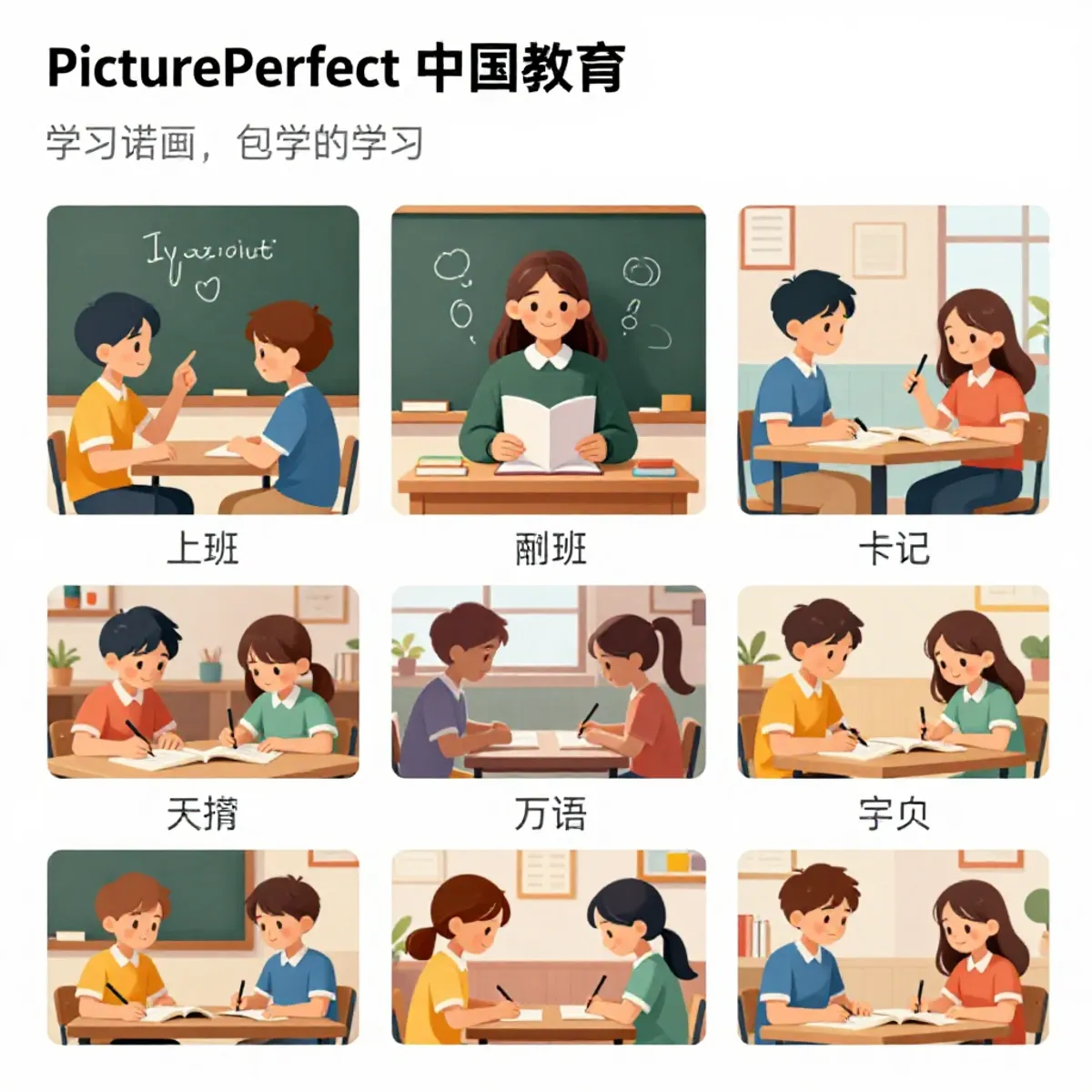
The mnemonic power of a well-integrated illustration cannot be overstated. Cognitive psychology highlights the picture superiority effect, where images are more likely to be remembered than words. When a learner reads a sentence and simultaneously sees its visual representation, the two memories are linked.
Later, when trying to recall the Chinese sentence, the mental image can trigger the verbal memory. This is especially valuable for Chinese, where character forms can seem arbitrary. Associating a character like "骑" (qí, to ride) with a clear picture of someone on a bicycle or a horse creates a lasting, concrete association.
Illustrations also provide unambiguous context for words with multiple meanings. The character "打" (dǎ) can mean "hit," "dial," "play (a game)," etc. Seeing it used in a picture of someone "dialing a phone" or "playing basketball" immediately resolves the ambiguity in a way a dictionary definition cannot. This context-rich learning prevents the incorrect generalization of vocabulary.
In addition, for longer passages, a single, cohesive illustration that captures the essence of the entire paragraph or page serves as a visual summary. After reading, a learner can look at the picture and mentally reconstruct the narrative or description, practicing retrieval in a guided, supported way. This moves beyond simple recognition to active recall, which is essential for long-term retention.
Audio Integration: Listening and Pronunciation Perfected
The development of an interactive ready-to-read PDF version addresses the critical, often-neglected skill of listening comprehension and accurate pronunciation. In the printed book, the learner has the text and the picture. The audio component adds the vital dimension of sound.
The feature is elegantly simple: a speaker icon on each page or section. A click plays a clear, native-speaker recording of that exact text. The pacing is deliberate and learner-focused, neither too fast nor artificially slow, modeling natural Chinese speech at a speed suitable for comprehension.
This allows for shadowing practice—the learner can listen and repeat simultaneously, mimicking the rhythm, intonation, and tone contours. The separation of audio by page or section means the learner can focus on a manageable chunk of text, replaying it as many times as needed. This is invaluable for mastering tone production, the most challenging aspect of spoken Chinese for most learners.
Hearing the correct tone in context, linked to a specific word within a sentence, is far more effective than hearing a word in isolation. The audio also trains the ear to the connected speech patterns of Chinese, where words blend and tones shift slightly in rapid conversation. In addition, for self-study, the audio provides an objective model.
Learners can record themselves and compare, or simply use the audio to check their reading aloud. This multi-modal input—seeing the text, saying it, and hearing it—engages multiple sensory pathways, solidifying neural connections more robustly than reading alone. It transforms the static page into a dynamic, interactive lesson.
Designing for the Learner's Ear: Speed and Clarity
The choice of audio speed is a deliberate pedagogical decision. It is not "slow Chinese" designed for absolute beginners, nor is it native-speed news broadcasts. It targets a comprehensible input level—slightly below native speed but authentically pronounced.
This "sweet spot" challenges the learner's listening skills without causing overwhelming frustration. The recordings are made by professional voice talents or trained speakers with clear, standard pronunciation (typically based on the Beijing dialect, or Putonghua). This ensures learners are not inadvertently picking up regional accents or speech quirks unless the text itself specifies them.
The audio files are of high quality, with minimal background noise, allowing for clear differentiation of similar sounds like "zh" versus "z" or "sh" versus "x." For tonal accuracy, the speakers are coached to produce distinct, consistent tones, which is crucial for learners whose native languages are non-tonal. The integration into a PDF is seamless; the icon is intuitive, and the playback requires no special software beyond a standard PDF reader with multimedia capabilities. This means the resource is highly accessible and portable, fitting into a learner's existing digital workflow on a computer, tablet, or even phone.
The audio component completes the sensory loop: the eye sees the character and pinyin, the ear hears the sound, and the mouth reproduces it, creating a full-circle learning experience for each page.
The Interactive PDF: Beyond the Printed Page
The move to an interactive PDF represents a significant evolution from the static printed page. While the physical book offers a tactile, distraction-free experience, the digital version unlocks new layers of utility and personalization. The core text, pinyin, and illustrations remain, but they are now embedded in a responsive format.
The clickable speaker icon is the most obvious feature, but the interactivity can extend further. Hypothetical advanced features might include clickable vocabulary words that pop up a more detailed definition or example sentence, or the ability to highlight text and have it read aloud in a continuous stream rather than page-by-page. The PDF format ensures that the layout—the precise relationship between the Chinese text, pinyin, illustration, and support boxes—is preserved exactly as designed, which is often lost in ebook conversions that reflow text unpredictably.
This fidelity is crucial for a resource where visual layout is part of the pedagogy. The digital file is also easily searchable, allowing learners to quickly find specific characters or vocabulary they wish to review. For teachers, it facilitates projection in a classroom setting.
Perhaps most importantly, the PDF is a living document. Unlike a printed book that is fixed upon publication, the PDF can be updated. Errata can be corrected, audio files can be re-recorded for quality, and supplementary materials can be added in appendices.
This aligns with a modern, iterative approach to educational resource development, where user feedback directly informs future versions. The PDF slated for 2026 is not just a digital copy of the book; it is an enhanced, adaptable platform for Chinese reading practice.
Technical and Pedagogical Advantages of the PDF Format
From a technical standpoint, the PDF offers universal compatibility and ease of distribution. A single file can be downloaded and used across operating systems and devices without licensing issues or platform-specific apps. This removes barriers to access.
From a pedagogical perspective, the format enables features that deepen engagement. One can imagine a "listen-first" mode where the audio plays and the corresponding text is highlighted in sync, training eye-ear coordination. Or a "pinyin toggle" that allows the learner to hide pinyin after a first read-through, creating a self-test.
The static nature of the printed book is its strength for focused, analog reading, but the PDF's potential for dynamic, personalized review cycles is its strength. It can also incorporate hyperlinks to external resources—a link from a cultural note about the Mid-Autumn Festival to a short video of celebrations, for instance. This creates a networked learning experience, where the book is a hub connecting to broader authentic materials.
The development of this PDF is being informed by alpha and beta testing with actual learners, observing how they use the audio, which features they engage with most, and where they struggle. This data-driven refinement ensures the final 2026 release is not just a technological upgrade but a pedagogically optimized tool, shaped by real-world use cases. It represents a commitment to meeting learners where they are in their digital lives while maintaining the core, evidence-based design of the picture book approach.
Who Benefits Most? Tailoring to Learner Profiles
This resource is not a one-size-fits-all solution, but its design makes it uniquely suitable for several distinct learner profiles. The most obvious beneficiary is the true beginner who has perhaps mastered pinyin and a few hundred basic characters but finds dense, unillustrated text paralyzing. For them, the picture book is a confidence-builder.
The visual context allows them to grasp the gist of a paragraph, experiencing the satisfaction of "reading" a meaningful piece of Chinese from an early stage. The pinyin and key vocab provide the necessary supports to decode the specifics, building accuracy alongside comprehension. The intermediate learner, often stuck in a plateau of textbook Chinese, finds here a bridge to authentic materials.
The literature excerpts expose them to the syntax, word choice, and pacing of real writing, while the scaffolding prevents the overwhelm that comes with diving straight into novels or newspapers. The cultural notes are particularly valuable for this group, filling in knowledge gaps about Chinese society that hinder deeper understanding. Self-directed learners and homeschoolers appreciate the all-in-one, self-contained nature of each page.
The resource provides a complete lesson—text, support, comprehension check (discussion questions), and cultural enrichment—without requiring a separate teacher or additional materials. It facilitates independent study with built-in feedback mechanisms. Finally, instructors and tutors can use these books as powerful classroom supplements.
The illustrations spark discussion, the discussion questions provide ready-made speaking prompts, and the audio can be used for listening exercises. The book becomes a catalyst for interactive teaching rather than a passive textbook.
Special Considerations for Heritage Learners and Families
An often-overlooked group is heritage learners—those who speak Chinese at home but lack formal literacy training. For them, the challenge is not vocabulary or basic grammar but the formal, written register and character recognition. These picture books, using modern literary prose, expose them to the standardized written language (wenyan vs. baihua distinction is nuanced, but this focuses on modern written style).
The pinyin helps them connect the spoken language they know with its written form, and the illustrations provide context that may be missing if their home language use is conversational and domain-specific. For family reading, the book offers a shared activity. A parent with stronger Chinese skills can read aloud using the audio as a guide, while a child follows the text and pictures.
The discussion questions at the end of each section provide natural conversation starters about the story and its cultural themes, turning reading time into quality bonding and language practice. The "suitable for beginners or those with a certain foundation" claim is accurate because the layered support system allows each reader to engage at their own level within the same physical space. A family can sit together, each processing the page differently—one focusing on pinyin, one on the picture story, one on the English glosses—and then discuss, creating a rich, multi-level learning environment.
Cultural Context: More Than Just Words
Language is a vessel for culture, and these learning materials treat that connection as fundamental, not optional. The cultural notes are strategically placed to illuminate, not distract. They explain the "why" behind the "what." Why is a character eating at a round table?
Why does a story mention giving "red envelopes"? Why is a specific idiom used in a particular situation? These notes prevent misinterpretation and foster cultural competence, which is essential for true communication.
For example, a passage describing a weekend visit to a teahouse will include a note on the social role of teahouses in Chinese society, the typical activities there (chatting, playing mahjong, simply relaxing), and perhaps the regional variations. This transforms a simple reading exercise about going to a place into a lesson on a facet of Chinese social life. The illustrations themselves are cultural artifacts.
They are not generic "Asian-style" drawings but are researched to accurately depict clothing, architecture, interior design, and everyday objects from contemporary China (or the historical period the text might evoke). A picture of a living room will show the typical arrangement of furniture, the presence of a TV set, perhaps a family photo on the wall—details that build a mental model of a Chinese home. This visual ethnography is invaluable.
It counters stereotypes and provides a grounded, realistic view. The selected literature excerpts also play a role. By choosing modern works, the book presents a vision of China that is current, diverse, and relatable, moving beyond ancient poetry or revolutionary slogans to show how people live, think, and feel today.
This cultural immersion through reading is a powerful motivator; learners are not just studying a language but discovering a world.
Navigating Nuance: Idioms, Humor, and Social Norms
Some of the most challenging yet rewarding aspects of Chinese are its chengyu (four-character idioms), colloquialisms, and subtle social cues. The picture book format is uniquely suited to unpacking these. An idiom like "对牛弹琴" (duì niú tán qín – to play the lute to a cow; to talk to an unappreciative audience) is perfectly illustrated with a humorous scene of a musician performing for a bored cow.
The visual gag makes the meaning unforgettable. The note explains the origin story and its modern usage. Similarly, humor in Chinese often relies on wordplay or situational irony that is lost in a direct translation.
The illustration can rescue this by showing the comedic situation, allowing the learner to understand the joke's structure even if the precise linguistic pun is explained separately. Social norms, such as the importance of giving face (面子, miànzi), showing deference to elders, or the protocols of gift-giving, are often embedded in dialogues. A picture showing a slight bow, a two-handed presentation of a business card, or the seating arrangement at a dinner table can convey these unspoken rules more effectively than a paragraph of explanation.
The book thus becomes a course in pragmatic competence—knowing how language is used appropriately in context. This is the advanced skill that separates functional speakers from fluent, culturally astute communicators. By consistently pairing text with visuals that decode these layers of meaning, the resource builds this competence alongside linguistic knowledge.
Discussion Questions: From Comprehension to Conversation
Each section or chapter concludes with a set of discussion questions. This is a critical component that shifts the activity from passive reception to active production. The questions are carefully crafted to move from basic comprehension to personal engagement and critical thinking.
The first questions might check literal understanding: "What did the protagonist buy at the market?" or "Describe the weather in the story." These ensure foundational comprehension is in place. The next set ventures into inference: "Why do you think the character felt sad after the phone call?" or "What might happen next?" This requires learners to read between the lines, using context and cultural knowledge to hypothesize. The final, most valuable questions are personal and comparative: "Have you ever had a similar experience?" "How is this tradition different from one in your culture?" "Do you agree with the author's viewpoint?
Why or why not?" These questions force the learner to internalize the content, connect it to their own life, and formulate an opinion in Chinese (or in their native language first, then attempt Chinese). For self-learners, these questions provide a self-test and a prompt for journaling or speaking practice. For teachers, they are ready-made prompts for classroom discussion, pair work, or writing assignments.
They transform the book from a reading text into a conversation starter and a writing prompt. The questions also model how to engage critically with a text, a skill essential for academic or professional use of Chinese. They encourage learners to see language as a tool for expressing their own thoughts, not just for consuming others'.
This active production phase is where language truly becomes consolidated and personalized.
Adapting Questions for Different Settings
The versatility of the discussion questions lies in their adaptability. In a solo study context, a learner can answer the questions in writing, perhaps first drafting in their native language to organize thoughts, then attempting a Chinese response using vocabulary from the text. They can record themselves speaking the answers, practicing monologue skills.
In a tutoring session, the tutor can use the questions to guide conversation, correct mistakes in real-time, and expand on the learner's answers with follow-up queries. In a classroom, the questions can fuel small-group discussions before whole-class sharing. The teacher can assign different questions to different groups, ensuring all aspects of the text are covered.
The questions can also be modified for difficulty. For a less confident class, the teacher might provide sentence starters or key vocabulary lists related to the question. For an advanced class, they might omit the comprehension questions entirely and jump straight to the critical thinking prompts.
The presence of these questions on the page signals that reading is not an end in itself but a means to an end: communication, reflection, and connection. It aligns perfectly with the communicative language teaching approach that prioritizes meaningful interaction. By building this bridge from page to conversation, the picture book fulfills its ultimate goal of developing practical, usable Chinese.
The Development Journey: Iterating for 2026
The project described is not a static product but an evolving initiative with a clear timeline toward a refined 2026 release. The current research and pilot versions have provided invaluable insights into how learners actually use such a resource. The development process is iterative and user-centered.
Early prototypes might have had pinyin in a larger font, which users reported as visually distracting. The design was adjusted. Initial audio recordings might have been too slow, sounding unnatural; pacing was recalibrated based on user feedback.
The selection of literature excerpts is continuously evaluated; passages that consistently cause confusion are replaced, while those that spark the most discussion are highlighted. The "interactive ready-to-read PDF" in development is the culmination of this feedback loop. Its specific features—beyond the basic audio icon—are being defined by observed user behavior.
Do learners want a vocabulary list they can quiz themselves on? Should there be a "hide all support" mode for a pure reading test? Is there demand for a simplified character version alongside the standard (traditional) one?
These questions are being answered by the community of early adopters. The year 2026 serves as a tangible milestone for this refinement process. It signals that the resource will have undergone sufficient testing, revision, and technical polishing to offer a stable, feature-rich, and pedagogically sound final product.
This timeline also allows for the creation of supplementary materials—teacher's guides, audio-only files for listening on the go, perhaps even a companion app for spaced-repetition vocabulary review drawn from the book's word lists. The development journey itself is a story of listening to learners, which mirrors the book's own ethos of being suitable for its audience.
From Pilot to Publication: The Role of Community Feedback
The explicit invitation for comments and suggestions is not a polite formality but a core part of the development methodology. The creator is acting as a learner-centered designer. By soliciting feedback directly from the target audience—those studying Chinese for personal, professional, or family reasons—the project taps into a vast, distributed source of expertise.
What works for a learner in Berlin might not work for one in São Paulo. Cultural references might need adjusting. The pacing of audio might suit European languages speakers differently than native English speakers.
This open feedback loop allows for the identification of niche needs and universal pain points. For instance, multiple users might request a feature to slow down audio without changing pitch, or to loop a single sentence. These are technical features that directly address learning bottlenecks.
Suggestions about content are equally important. "The illustration on page 42 didn't match the text about the subway station," or "The cultural note on tea ceremony was too brief," provide concrete, actionable data. This process democratizes the resource's evolution.
The final 2026 version will be a collaborative artifact, shaped by the collective experience of its early users. It moves away from the traditional top-down textbook model, where content is dictated by a distant editorial board, toward a more agile, responsive model. This not only improves the product but also builds a community of invested users who feel ownership over the resource, increasing its adoption and impact.
The project's transparency about being "developed" and "iterated" builds trust; it signals a commitment to quality and relevance, not just a one-time publication.
Conclusion: A New Chapter in Chinese Literacy
The landscape of Chinese language learning is being quietly reshaped by resources that respect the complexity of the script while embracing the power of multi-sensory, contextual learning. The picture book approach, with its integrated pinyin, English support, original illustrations, and interactive audio, represents a significant step forward. It does not claim to be the sole solution but rather a highly effective bridge.
It bridges the gap between intimidating authenticity and comprehensible input. It bridges the gap between visual recognition and auditory comprehension. It bridges the gap between solitary study and interactive communication.
By packaging carefully selected modern literature within a scaffolded, visually rich format, it makes the profound experience of reading Chinese accessible earlier in the learning journey. The psychological impact is as important as the pedagogical one: turning a page of Chinese from a source of anxiety into a source of curiosity and accomplishment. The development of the interactive PDF for 2026, informed by real user feedback, ensures this bridge will be sturdy, user-friendly, and continually improved.
For the beginner, it offers a gentle, supported entry. For the intermediate learner, it provides a much-needed ladder to authentic materials. For teachers and families, it furnishes a ready-made tool for engagement.
Ultimately, this model reaffirms a simple truth: language is meant to be seen, heard, and used in context. By designing resources that honor this truth, we empower a new generation of learners to not just decode Chinese, but to truly read it—to experience its stories, its nuances, and its cultural heartbeat, one beautifully illustrated page at a time. The invitation to comment and suggest is an open door, ensuring this evolution continues to serve the diverse and growing community of Chinese learners worldwide.
Responses • 0
0/2000
ID: 1326
Chris
Online
From
Bakersfield, United States
Send Message