Pass HSK 3 Faster: Ace Hanzi Recognition, Skip Handwriting
AI Learn Chinese
4 hr • 0 read
Learn why focusing on Hanzi recognition instead of perfect handwriting is the fastest way to pass the HSK 3 exam, plus sciencebacked study methods.
The Beginner's Dilemma: Recognition vs. Reproduction
You started learning Chinese a few days ago. Your current focus is on basic radicals, stroke order, and vocabulary linked to Pinyin. A looming concern is the fear of forgetting the characters you encounter.
Your goal is clear: pass the HSK 3 exam. A glance at past papers revealed a daunting truth: they are virtually all in Hanzi, and you can't read a single word yet. This leads to a critical strategic question.
Since the HSK 3 exam is computer-based, should your primary focus shift to recognizing characters rather than hand-writing each one perfectly? Is prioritizing recognition over production a valid and effective learning approach, or does it create a dangerous gap in your knowledge? This article argues that for the specific goal of passing HSK 3, a heavy emphasis on recognition is not only acceptable but is the most efficient path to success.
We will explore the cognitive science behind this, practical techniques to build robust recognition skills, and how to incorporate minimal, targeted writing for maximum payoff.
The anxiety you feel is common and rational. The Hanzi writing system can appear as an insurmountable wall of complex strokes. The traditional pedagogy often emphasizes repetitive copying, a method that feels slow and disconnected from the immediate goal of reading comprehension.
Your instinct to question this method for a reading-based exam is sharp. The HSK 3 exam does not require you to write essays by hand; it requires you to read passages, understand questions, and select answers, all presented in typed Hanzi. So, your study energy must align with the exam's demands.
Building a vast, reliable mental library of visual character forms—a skill known as orthographic knowledge—is the cornerstone of HSK 3 success. Handwriting, while a valuable skill for long-term mastery, is a separate, more motor-skill-intensive process that can be de-prioritized in the initial sprint to HSK 3.
This article will dismantle the assumption that you must handwrite every character to "know" it. We will differentiate between types of memory and show how recognition memory is faster to build and more directly applicable to your exam. You will learn a toolkit of methods specifically designed to train your brain to instantly identify and assign meaning to Hanzi forms.
The plan outlined here is for the learner who wants to pass HSK 3 in 2026 or soon after, using their limited time with surgical precision. It is a pragmatic guide for the modern student, leveraging digital tools and cognitive principles to avoid the burnout of endless, unfocused repetition.
The HSK 3 Exam: A Test of Recognition, Not Penmanship
The Structure of HSK 3
The HSK 3 exam is a standardized test for basic intermediate proficiency. It consists of two parts: listening and reading. The writing section, which exists in higher levels, is absent.
The reading component includes sentence completion, paragraph matching, and short reading comprehension. Every single item you will encounter is presented in clean, digital Hanzi on a computer screen. There is no scenario in the HSK 3 test where you will be asked to produce a character with a pen or pencil.
Your task is solely to see a character or a string of characters, access its meaning and pronunciation from your memory, and use that information to answer a multiple-choice question. This fundamental fact reshapes your entire learning objective. Your "knowledge" of a character for HSK 3 purposes is defined by your ability to recognize it visually and connect it to its pinyin and core meaning(s).
Computer-Based Testing Advantages for Learners
The computer-based format works to your advantage when adopting a recognition-first strategy. On screen, characters are displayed in a consistent, clear font. You do not need to decipher messy handwriting or varying styles, a skill required for reading authentic materials like handwritten notes or calligraphy.
Your study can therefore focus on a single, standard glyph form for each character. This simplifies the recognition task immensely. You are not learning a character's shape in isolation; you are learning its shape as it appears in the primary digital font used in textbooks and exams.
This allows you to build a clean, unambiguous mental template for each Hanzi. Your practice can and should use this same font—many apps and digital flashcards offer the standard "Song" or "Hei" typefaces common in print.
The Vocabulary List as a Recognition Map
The official HSK 3 vocabulary list contains approximately 600 words. This is your target set. The goal is not to be able to write all 600 words from memory by hand.
The goal is to see any of the 600 words' constituent characters and immediately know, "Ah, that is the character for 'big' (大), or 'to go' (去), or the 'water' radical (氵)." You must recognize both the standalone characters and how they combine into words. For example, the word 学生 (xuéshēng, student) contains the character 学 (xué, to study) and 生 (shēng, life, to be born). Your recognition training must cover both.
By focusing on recognition, you are directly training for the exact cognitive task the exam will demand. You are building a network of visual forms linked to meaning and sound, which is precisely what reading requires.
The Cognitive Science: Why Recognition is Faster to Build
Two Types of Memory: Recall vs. Recognition
Cognitive psychology distinguishes between two primary types of memory retrieval: recall and recognition. Recall is the ability to produce information from memory without cues, like writing a character from scratch or answering an open-ended question. It is a high-demand, generative process.
Recognition is the ability to identify information when presented with it, like selecting the correct character from a multiple-choice list or knowing a word when you see it. It is a lower-demand, comparative process. For the HSK 3 exam, you are almost exclusively tested on recognition.
You see a sentence with a blank and choose the correct character from options. You see a short text and answer questions about it. You are never asked to generate a character unaided.
So, training your recognition memory is a direct match for the test. Training recall memory (handwriting) is an indirect and more strenuous path to the same goal.
Building strong recognition for a Hanzi can happen much faster than building flawless recall. When you see a character repeatedly in different contexts—in a flashcard, in a simple sentence, in a vocabulary list—your brain creates strong neural pathways for that visual pattern. You learn to distinguish it from similar-looking characters (e.g., 己 jǐ vs. 已 yǐ vs. 巳 sì).
This visual discrimination is the core skill. The act of physically writing the character, engaging your fine motor cortex, is a completely different neural circuit. It strengthens memory through a different mechanism (kinesthetic memory) but requires more time and conscious effort per character.
For a time-constrained learner, investing that effort in repeated visual exposure yields a faster return in reading proficiency.
The Spacing Effect and Efficient Repetition
The key to efficient memorization is not the amount of time spent per session, but the timing of repetitions. This is the spacing effect, one of the most robust findings in learning science. Cramming 50 repetitions of writing a character in one hour is far less effective than seeing that character for a few seconds, ten times, spread over several days.
Recognition-based study methods, particularly digital flashcards using spaced repetition systems (SRS) like Anki, are engineered to exploit this. Anki algorithmically schedules each card to appear just as you are about to forget it. This means you spend your precious study seconds on the characters you actually struggle with, while the ones you know well fade into the background.
You can review hundreds of character cards in a 20-minute session, building recognition breadth at a pace impossible with handwriting drills. The SRS turns the monumental task of learning 600+ Hanzi into a manageable, daily queue of reviews.
Context is King: Learning in Chunks
Hanzi are not used in isolation; they form words and sentences. Learning a character in a meaningful context—as part of a vocabulary word you are learning for HSK 3—dramatically improves retention. When you learn the word 医院 (yīyuàn, hospital), you see the characters 医 (yī, medicine) and 院 (yuàn, courtyard, institution) together.
Your brain learns not just two isolated glyphs, but a semantic pair. Later, when you see 医 in another word like 医生 (yīshēng, doctor), recognition is easier because you have a pre-existing "node" for 医 linked to the concept of medicine. This creates a web of knowledge.
Focusing on vocabulary-first, character-second is a powerful recognition strategy. You are learning the building blocks within the structures you will actually encounter on the exam. Handwriting practice, if done, should also use these vocabulary chunks, not isolated characters, to maximize contextual benefit.
Building Unshakeable Hanzi Recognition: Practical Techniques
The Flashcard Revolution: From Pinyin to Hanzi
Your current study likely involves Pinyin. This is a necessary scaffold, but it must be dismantled as quickly as possible for true Hanzi recognition. The single most effective tool is a well-constructed flashcard deck.
The card should show the Hanzi on the front. The back should show the pinyin and the primary English meaning(s). Critically, the front should NOT show the pinyin.
You must force your brain to retrieve the sound and meaning from the visual form alone. This is active recall, the engine of memory. If you always see the pinyin first, you are learning to associate sound with character, but not character to meaning/sound independently.
For HSK 3, you need the latter. Use an HSK 3-specific deck. a number of high-quality, community-created decks exist for apps like Anki or Pleco.
They are pre-made, saving you hours of card creation.
Start your day with your SRS review queue. This is your non-negotiable foundation. It will take 15-30 minutes.
As you review, if a character is difficult, don't just sigh and click "Again." Pause. Analyze it. What radical is it?
Does it contain a phonetic component? (e.g., 河 hé, river, has the water radical 氵 and the phonetic 可 kě). This analytical layer, discussed next, deepens recognition.
Radical and Component Analysis: The Key to Decoding
Hanzi are not random squiggles. They are largely composites of smaller, meaningful parts called radicals and components. Learning the most common radicals (like 人 rén, person; 口 kǒu, mouth; 心 xīn, heart; 手 shǒu, hand) is like learning the alphabet of Hanzi architecture.
When you see a new character, you can break it down. Take 想 (xiǎng, to think). It's composed of 相 (xiāng, mutual) and 心 (xīn, heart).
The heart radical at the bottom signals a relation to emotion or thought. This decomposition gives you hooks to hang the character on. You are not memorizing a 12-stroke blob; you are recognizing a familiar component (相) plus a familiar radical (心).
This skill transfer is huge. A character like 怕 (pà, fear) has the "heart" radical? No, it has the "mind" radical 忄, which is a variant of 心.
Learning these relationships is fundamental. Dedicate 10-15 minutes, a few times a week, to studying new radicals and seeing them in action within your vocabulary words.
This analytical approach directly combats forgetting. When the visual form is fuzzy, the logical breakdown can trigger the memory. It turns recognition from a passive image into an active decoding process.
Resources like "The Hanzi Movie Method" or apps that highlight components can automate this. Your goal is to move from "that looks like a bunch of lines" to "that's the 'speak' radical 言 next to the 'city' 市, which together mean 'to say'—it's 说说 (shuōshuō) but in this word it's part of 解释 (jiěshì, explanation)."
Graded Reading: Applying Recognition in Context
Recognition must be practiced in flowing text, not just isolated flashcards. This is where graded readers become indispensable. These are books or apps written with a strict vocabulary limit.
For HSK 3, you need readers that use only HSK 3 (and lower) words. Start with extremely simple sentences. Read aloud slowly.
Your goal is to see the Hanzi and instantly comprehend. You will encounter your flashcards in their natural habitat. This reinforces the connection.
When you see a character you know from flashcards in a sentence, it gains another layer of context. You see how it grammatically interacts with other words. This contextual web makes recognition more robust and flexible.
Aim for 15-20 minutes of graded reading daily. It will be slow at first, painstakingly slow. That is okay.
The act of struggling through a simple sentence, looking up 1-2 unknown words (but trying to guess from context first), is a powerful learning event. It forces active engagement with the Hanzi. Apps like DuChinese, The Chairman's Bao (with HSK filters), or even simple PDF graded readers are perfect.
The sense of progress as you move from single words to full sentences is a major motivator and directly trains the skill tested in the reading comprehension sections of HSK 3.
The Targeted, Minimal Role of Handwriting
When Writing is Actually Beneficial
Handwriting is not useless. It is a powerful mnemonic tool when used correctly. The physical act of drawing the strokes creates a proprioceptive and motor memory that can complement visual recognition.
But, its benefits are maximized only when applied to characters you already mostly recognize. The mistake is using handwriting as the primary introduction to a character. The correct sequence is: 1) See & Recognize (via flashcards/reading), 2) Write to Reinforce.
If you try to write a character you've only seen twice, you are guessing and likely reinforcing errors. If you write a character you can recognize and know the stroke order for, you are solidifying that neural pathway through a different channel.
So, handwriting should be a supplement, not a core. Once a character graduates from your "Learning" pile in your SRS to your "Review" pile (meaning you can recognize it reliably), that is the time to practice writing it. A quick, 5-10 minute session where you write the last 20-30 characters you reviewed that day can be highly effective.
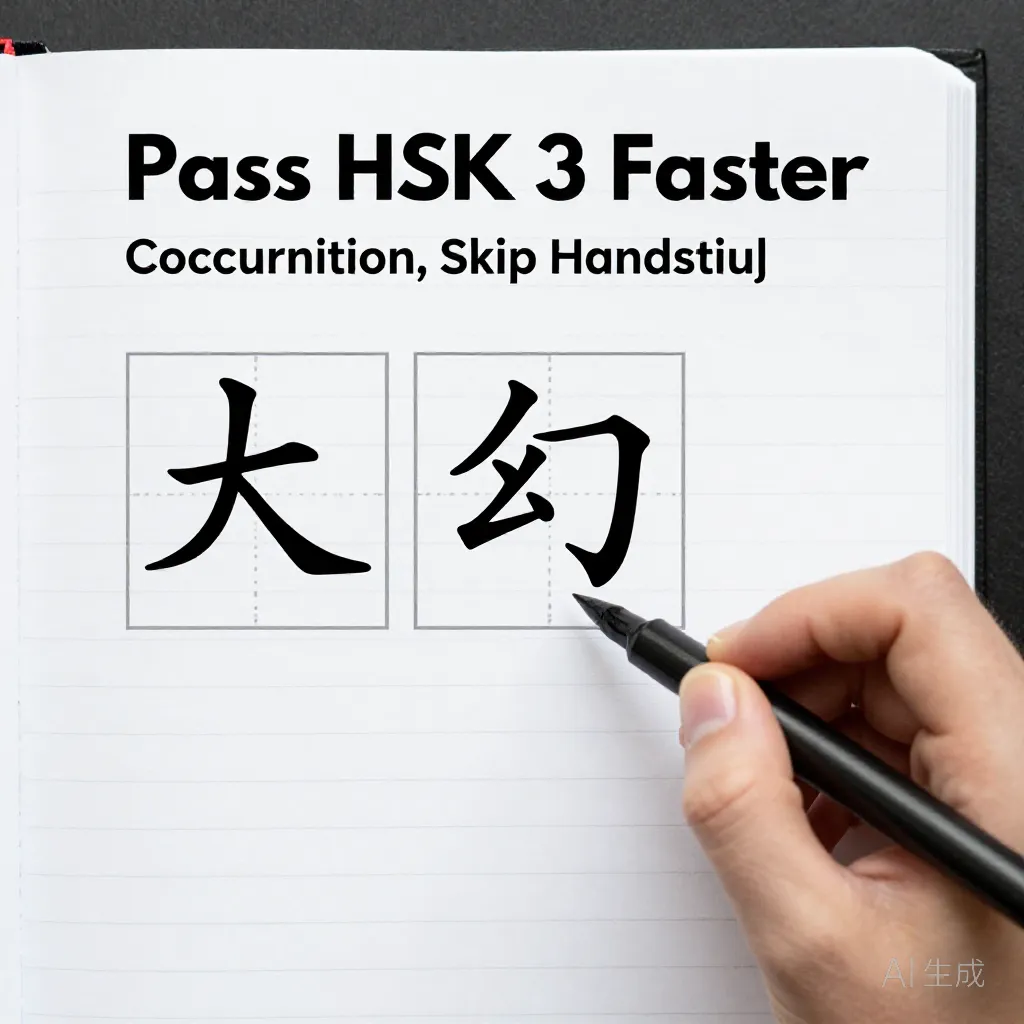
Focus on correct stroke order. Use a notebook with grid lines. The goal is not beautiful calligraphy, but accurate reproduction of the standard form.
This practice will help you avoid common shape confusion (like 土 tǔ vs. 士 shì) and will be invaluable if you ever need to input characters via a touchscreen or handwriting recognition software, a common feature on computers and phones in China.
The "Write to Learn" Exception: Complex Components
There is one area where early, focused writing is highly recommended: complex radicals and components. Some components are visually intricate and benefit from the motor memory of being drawn. The "speak" radical 言, the "insect" radical 虫, or the "turtle" radical 龜 are good examples.
Spending a few sessions purely writing these components from memory, while saying their name and meaning aloud, can build a strong foundation. When you later see them inside a character like 信 (xìn, trust) which contains 人 (person) and 言 (speak), the complex component is already cemented. This is a surgical use of writing time for high-leverage parts of the system.
The Long-Term View: Writing for Fluency
For your immediate HSK 3 goal, handwriting is a low priority. But, if your Chinese journey extends beyond the exam, writing ability becomes important for composition, note-taking, and deeper cultural engagement. But this is a later-stage skill.
You must first build a vast ocean of recognizable Hanzi. Trying to learn to write while also learning to read is like trying to learn to compose symphonies while learning to recognize musical notes—it's an unnecessary coupling of two distinct, though related, skills. Defer the symphony until you can read the sheet music fluently.
For now, your "sheet music" is the Hanzi on the HSK 3 exam, and your task is to read it, not compose it.
Integrating Skills: A Balanced Weekly Study Plan
The HSK 3 Sprint Schedule
For a learner with a goal of passing HSK 3 within 6-12 months, a weekly plan might look like this, with total daily time at 60-90 minutes. The emphasis is overwhelmingly on recognition.
Daily (20-30 min): Spaced Repetition Flashcard Review. This is the bedrock. rarely skip it. It maintains and grows your character vocabulary. Daily (15-20 min): Graded Reading. Read one or two short passages from an HSK 3-level reader. Read for gist first, then for detail. Look up only absolutely essential words. Daily (10-15 min): Vocabulary & Grammar Study. Work through your HSK 3 textbook or app. Learn 5-10 new words as vocabulary items. See them in example sentences. Focus on their Hanzi form first. 3x per week (10 min): Targeted Handwriting. Take the 20-30 newest or most difficult characters from your recent study. Write each one 3-5 times, focusing on stroke order and structure. Use this time to practice tricky components. * 1x per week (30 min): Mock Exam / Past Paper. Under timed conditions, do a reading section from a past HSK 3 paper. This is the ultimate recognition pressure test. Analyze your mistakes—were they vocabulary gaps or misreading? Adjust your study accordingly.
The "Start Right, Spend Time" Mindset
The user's keywords—start, right, spend, time—form the core philosophy. You must start with the right mental model: recognition is the exam skill. You must spend your limited time on the activities that directly build that skill (SRS, reading) and minimize those that build a different, less immediately relevant skill (isolated, repetitive writing).
This is not being lazy; it is being strategic. It is respecting the exam's format and your own time. By starting with this efficient framework, you build momentum and confidence.
You will see your reading ability grow week by week, which is incredibly motivating. The frustration of "writing the same character 100 times and still forgetting it" is replaced by the satisfaction of "I just read a whole sentence and understood it!"
Overcoming the "I Should Be Writing" Guilt
Cultural and Traditional Weight of Handwriting
a number of Chinese learning resources, especially older ones or those from a Chinese educational context, place monumental importance on handwriting (写 xiě). The cultural reverence for the written word and calligraphy is deep. You may feel you are "not really learning Chinese" if you can't write characters.
This is a powerful psychological barrier. It is essential to consciously reframe this. You are learning communication, not calligraphy.
The primary vehicle of modern Chinese communication, especially for a foreigner, is reading (texts, signs, articles) and typing (on phones/computers). The ability to handwrite is a niche, low-frequency skill for most non-native speakers. Prioritizing it over reading is like prioritizing learning to carve marble sculptures over learning to read books, when your goal is to become a literature scholar.
Your goal is functional literacy for HSK 3. That means seeing a character and knowing what it means and how it sounds. That is a monumental achievement in itself.
Mastering handwriting for 600+ words is a separate, years-long project for most learners. Give yourself permission to focus. Tell yourself, "I will learn to write these characters after I can recognize them all comfortably." This sequencing is faster.
You will find that once you can recognize a character perfectly, learning to write it takes only a few focused attempts because the visual blueprint is already crystal clear in your mind.
The Proof is in the Past Papers
The ultimate arbiter is the exam itself. Take a past HSK 3 reading section now, before you start this plan. Score it.
You will likely get a low score. Now, implement this recognition-focused plan for two months. Do not add significant handwriting practice.
Then, take another past paper. Your score will have skyrocketed, not because you learned to write hundreds of characters, but because you learned to see and understand them. This is the empirical evidence.
The exam is a reading test. Train for the test. The methods described here are the direct training regimen for that specific athletic event.
Handwriting is cross-training—good for overall fitness, but not the specific event you are running next month.
Conclusion: The Smart Path to HSK 3
Your journey began a few days ago with a worry that feels overwhelming: the mountain of Hanzi. The traditional path up that mountain is a slow, switchback climb of endless repetition. This article proposes a cable car: a direct, efficient ascent by targeting the specific skill the exam requires.
You do not need to spend "forever writing each character." You need to spend focused, intelligent time seeing each character in contexts that matter. Build your recognition through spaced repetition flashcards, decode them with radical analysis, and cement them through graded reading. Use minimal, targeted handwriting only as a reinforcement tool for characters you already recognize, and to master complex components.
This approach is grounded in cognitive science, tailored to the computer-based HSK 3 exam format, and respectful of your limited time. It replaces anxiety with a clear system. Start today.
Build your first Anki deck with the HSK 3 list. Find a graded reader. Dismiss the guilt of not writing.
Your mission is to read. In 2026, when you sit for the exam, your eyes will scan the screen, and hundreds of Hanzi will leap out as familiar friends, their meanings and sounds instantly accessible. That is the victory.
That is the result of focusing on the right skill from the start and spending your time where it counts. Now, begin.
Responses • 0
0/2000
ID: 1326
Chris
Offline
1 hr
Visited
From
Bakersfield, United States
Send Message