Panda Diplomacy
Original
Chinese History
Nov 21 • 1541 read
Panda diplomacy refers to China using giant pandas as diplomacy gifts to other countries. They live in the forests of mountains in Western China. However, their popularity has gone far beyond the forests.
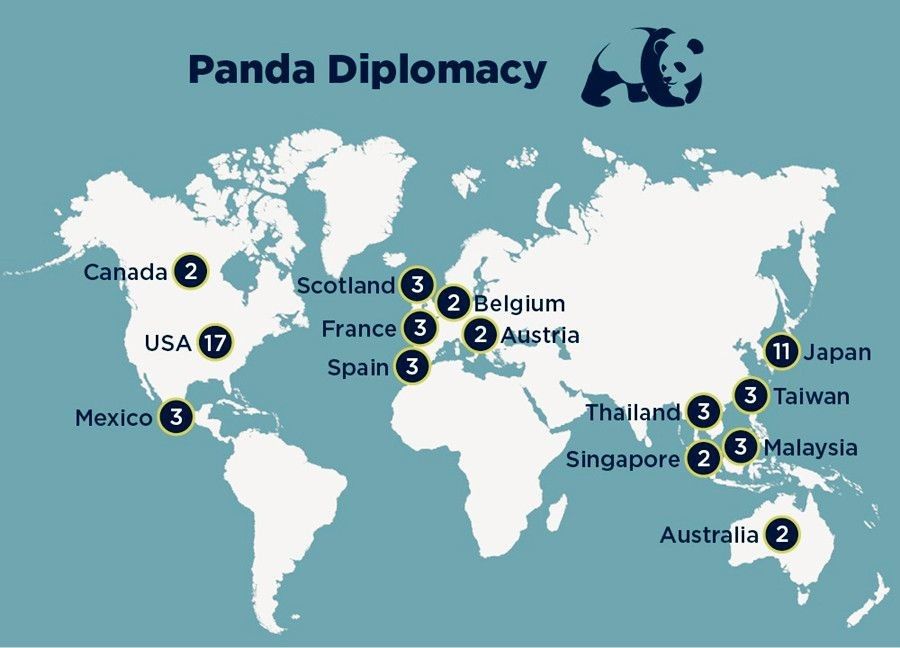
Native to China and adored around the world, the furry black-and-white animals have played an important role in the country’s diplomacy.
China has made a point of lending out pairs of pandas to various countries around the world to help develop both diplomatic ties. The most renowned one was China’s gift of two pandas, Ling Ling and Hsing Hsing, to the United States in 1972 after ex-president Richard Nixon’s visit to China. This news was published in newspapers worldwide. Thousands of Americans welcomed their arrival in spite of the rain. On average, more than 3 million American citizens went to the National Zoo in Washington D. C. every year thereafter. The practice can be traced to the seventh century when Empress Wu Zetian delivered a pair of pandas to the emperor of Japan. During 1957-1982, China had given 23 pandas to nine different countries. Today, Chinese-born pandas reside in locales as far-flung as San Diego, Edinburgh, and Chiang Mai.
Development
Ancient times
Panda diplomacy has a long history. During the reign of Empress Wu Zetian (625-705), she sent a pair of pandas and 70 panda’s skin to the Japanese emperor as a gesture of goodwill in 658 AD. The Japanese Imperial yearbook also made similar records.
The giant panda has long been known as China’s goodwill ambassador. It actively promoted friendship and mutual understanding between China and foreign countries. So in that sense, pandas have always been a political tool.
Modern times (1936-1945)
In total, Chiang's government gave 14 pandas to various western countries. In 1941, Soong May-Ling (Madame Chiang Kai-shek) gave a pair of pandas to the Americans in appreciation of their help to China during World War II. It was the first time that China has delivered any live panda in the name of the government.
The British government asked for a panda donation in exchange for providing a master's degree in zoology to China free. In 1946, Panda Lien Ho and a Chinese biologist arrived in London. Since that time, pandas have shown up in the west mostly as a political gift.
After the foundation of new China
(1957-1982) – diplomatic gift: During that time, the panda’s destination more reflects China‘s foreign policy: The People's Republic of China presented two giant pandas to the Soviet Union in 1957 during the Cold War, as a symbolic gesture of thanks for recognizing the founding of the People's Republic of China. The Soviet Union is the first country in the world that has established diplomatic relations with China. China gave away five giant pandas Yi Hao, Er Hao, Ling Ling, San Xing, and Dan Dan to the DPRK from 1965 to 1880.
In the 1970s, the relationship between China and the United States was relaxed. Pandas are suddenly popular in western countries. One highlight of panda diplomacy was the Chinese government's gift of two pandas, Ling Ling and Hsing Hsing, to the United States in 1972 after President Richard Nixon's historic visit to China.
France hosted a panda couple Yen Yen and Li Li in Zoo de Vincennes during the term of President Pompidou that was offered to him as a gift in 1973. France is the first Western power that established diplomatic relations with China in 1964.
By 1982, China had given 23 pandas to nine different countries as a gift are Mexico, the UK, Spain, Germany, and Japan.
1957 Russia Ping Ping and An An
1965-1980 North Korea Dan Dan, San Xing, Lin Lin (total five pandas)
1972 America Ling Ling and Xing Xing
1972 Japan Lan Lan and Kang Kang
1973 French Yan Yan and Li Li
1974 UK Jia Jia and Jing Jing
1974 Germany Tian Tian and Bao Bao
1975 Mexico Shao Shao and Qiang Qiang
1980 Japan Huan Huan
1982 Japan Fei Fei
(1982-1994)Ten years loans: Since the early 1980s, China has stopped giving away pandas for free due to the dwindling number of pandas. Instead, the animals are loaned to other countries. In 1984, China and the US reached a three-month loan agreement on one pair of giant pandas. Yong Yong and Ying Xin from Beijing Zoo became their first tour. The two giant pandas arrived on loan at the San Francisco Zoo, which caused an influx of foreign zoos signing short panda leases with Chinese zoos. Between 1984 and 1988, more than 14 cities in North America got at least a panda-on-tour deal.
(1994-now)Panda breeding research program: From 1994, the loans shifted to an emphasis on the partnership of scientific studies to protect the endangered species. In 1994, China and Japan jointly launched a panda breeding research program, marking the new shift of panda diplomacy. Panda couple Mei Mei and Yong Ming was sent to Japan.
1994 Japan MeiMei and YongMing
2003 Austria Long Hui and YangYang
2009 Australia WangWang and FuNi
2011 Britain TianTia and YangGuang
2011 Japan BiLi and XianNv
2012 France HuanHuan and YuanZai
2013 Canada DaMao and ErShun
2014 Belgium XingHui and HaoHao
2016 Korea YuanXin and HuaNi
Interesting Stories about Panda Diplomacy
/fit-in/0x0/img/201911/5928244365948663-article-1574298886.jpg)
Bao Bao born in 1978, he was given to the West German Chancellor Helmut Schmidt by the Chinese leader Hua Guofeng during a state visit in 1980. When Bao Bao arrived in Germany, he quickly conquered the hearts of the Berlin people. The giant panda is receiving even more grand reception than the head of a state.
Bao Bao was the zoo's only panda, and several attempts to mate him with females were unsuccessful. He was presented together with a female panda, Tjen Tjen, but she died in 1984 without giving birth. From 1991 to 1993, he was loaned to London zoo in another unsuccessful attempt to mate him with a female panda called Ming Ming.
Another female panda, Yan Yan, was sent to Berlin in 1995 following a visit to Germany by the Chinese leader at the time, Li Peng, but once again no baby pandas were produced. In order to help Yan Yan have a pregnant, the zoo attempt to artificial insemination for eight consecutive years, but they all failed. In 2007, Yan Yan died of acute intestinal obstruction. Bao Bao spent the rest of his life alone. Bao Bao is one of the oldest male giant pandas in the world who has died at Berlin zoo aged 34.
Jia Jia became the oldest giant panda. Jia Jia, a giant panda, living at an amusement park in Hong Kong, celebrated her 37th birthday on Tuesday and broke two Guinness World Records. In human years, Jia Jia would be more than 100 years old. Giant pandas’ average life expectancy is 25 years.
Jia Jia was born in the wild in Sichuan province, China, in 1978 and was given to the Hong Kong Special Administrative Region in 1999 to celebrate the two-year anniversary of the founding of HKSAR.
/fit-in/0x0/img/201911/29983317337733895-article-1574298887.jpg)
Do you know which is treated by the highest treatment panda in the world? October 28, 1972, the giant panda Lan Lan and Kang Kang fly to Japan when the "Lan Lan" and "Kang Hong" plane flew into the Japanese territorial airspace, a few Japanese air force fighter planes immediately escorted to Tokyo. Cabinet Minister II Hall into the bureaucrats personally led to meet China's "Peace Messenger." In close vigilance, the giant panda directs the car to the Ueno Zoo. After a week of physical examination and adapted to the autumn wind in Tokyo, before the official appearance. In the first nine months, every day to visit as many as 30 million people, forming a "panda fever." September 1979, "Lan Lan" died in Tokyo, unfortunately, 30 million Japanese to "Lan Lan" to pay tribute. Japanese Prime Minister also made a speech, mourn "Lan Lan" died.
Do you know the most famous panda in the world? Chi Chi was a well-known giant panda at London Zoo in England. Chi Chi’s image is used as the logo of the World Wildlife Fund. Born in 1957, she was caught in December 1957 in Sichuan and moved to Peking Zoo in January 1958. The Austrian animal broker Heini Demmer acquired Chi Chi in exchange for an impressive collection of African hoof stock in May 1958 and brought the animal to Moscow Zoo. One week later the panda went on a journey to Tierpark Berlin, the zoo in the eastern part of the city then divided the city. By then Chi Chi had already been sold to a zoo in the United States, but the American government had ceased all trade with communist China due to political reasons. Therefore, Chi Chi was refused entry to the USA.
Frankfurt Zoo provided a temporary home for the panda until Demmer decided to hire the animal out to European zoos for a limited time. The next visit was the Copenhagen Zoo before Chi Chi arrived at London Zoo on 5 September 1958. The Zoological Society of London had stated that it would not encourage the collection of wild pandas but accepted Chi Chi as she had already been collected. Although Chi Chi's visit was initially planned to last for only three weeks, a British citizen decided to buy her for the amount of GBP 12,000. Chi Chi became the property of London Zoo on 26 September 1958.
Inspired by Chi Chi, Sir Peter Scott's designed the distinctive but straightforward black and white logo of the World Wildlife Fund. There had been unsuccessful attempts to mate Chi Chi with An An of Moscow Zoo. Chi Chi died on 22 July 1972and was mourned by the nation.
Goodwill ambassador
/fit-in/0x0/img/201911/23619908197527417-article-1574298887.jpg)
China and Netherlands: Wu Wen and Xing Ya, two Chinese giant pandas arrived on Wednesday evening at Schiphol airport in Amsterdam for a 15-year stay in a Dutch zoo, making The Netherlands the seventh European country that hosts this endangered and adorable black and white bear. They were briefly displayed in cages at the airport before being transported to Ouwehand Zoo in Rhenen, a city of about 20,000 people in central Holland. "It’s a small step for Wu Wen and Xing Ya, but a big step for the history of Sino-Dutch relations," said Wu Ken, Chinese ambassador to the Netherlands. 2017 marks the forty-fifth anniversary of the establishment of diplomatic ties between China and the Netherlands.
China and Belgium: Two giant pandas, the male and female pair, Xing Hui and Hao Hao arrived in Belgium on a fifteen-year loan on a Sunday. They got the type of welcome usually reserved for visiting dignitaries or celebrities. Belgium's Prime Minister Elio Di Rupo looks at the giant panda, Hao Hao in the airport on February 23, 2014. The pandas will live at Pairi Daiza, a wildlife park about 50 km (30miles) southwest of Brussels. And June 2, 2016, Hao Hao gave birth to a baby in Belgium. The baby is in good condition now.
/fit-in/0x0/img/201911/13334742833191005-article-1574298887.jpg)
Michelle Obama and Peng Liyuan welcome baby panda: On March 23, 2013, the cub of Mei Xiang and Tian Tian, Bao Bao is a result of artificial insemination of Mei Xiang. Bao Bao was named over the weekend to mark her 100th day according to Chinese tradition, both countries’ first ladies released video greetings to welcome Bao Bao. The naming ceremony was held at the Smithsonian National Zoo in Washington. It was held after more than 123,000 people voted for the cub’s new name, which means “precious treasure.”
The Significance of Panda Diplomacy
/fit-in/0x0/img/201911/1953017070414922-article-1574298887.jpg)
From the beginning, China donated the pandas to breed the research program later. Panda diplomacy is a strategy of soft power embodied in the new international situation. It embodies a culture of strong and flexible Taiji Culture. And it is a display of China's profound cultural heritage. The giant panda has made a huge contribution to China's diplomacy, the contributions of politics, economy, and culture are indelible.
Panda is China’s symbol of the goodwill ambassador. Panda diplomacy is one of the special diplomatic methods since the founding of new China, which has opened up the situation for our country's external relations. After the reform and opening up, panda diplomacy underwent a series of changes. Panda diplomacy plays an important role in the promotion of China's peace image even comprehensive soft power.
The role of panda diplomacy mainly has three aspects: it is more conducive to China's peaceful international image; Multi-channel transmission can be carried out in combination with worldwide panda related derivatives; we can promote cooperation between China and international organizations.
Responses • 0
0/2000
ID: 322
Matthias
Offline
2 day
Visited
From
Orlando, United States
Send Message