Navigating Chinese Food Allergies
AI Learn Chinese
2 hr • 0 read
Strategies for managing nut allergies in Chinese cuisine, including communication, labeling, and crosscontamination awareness.
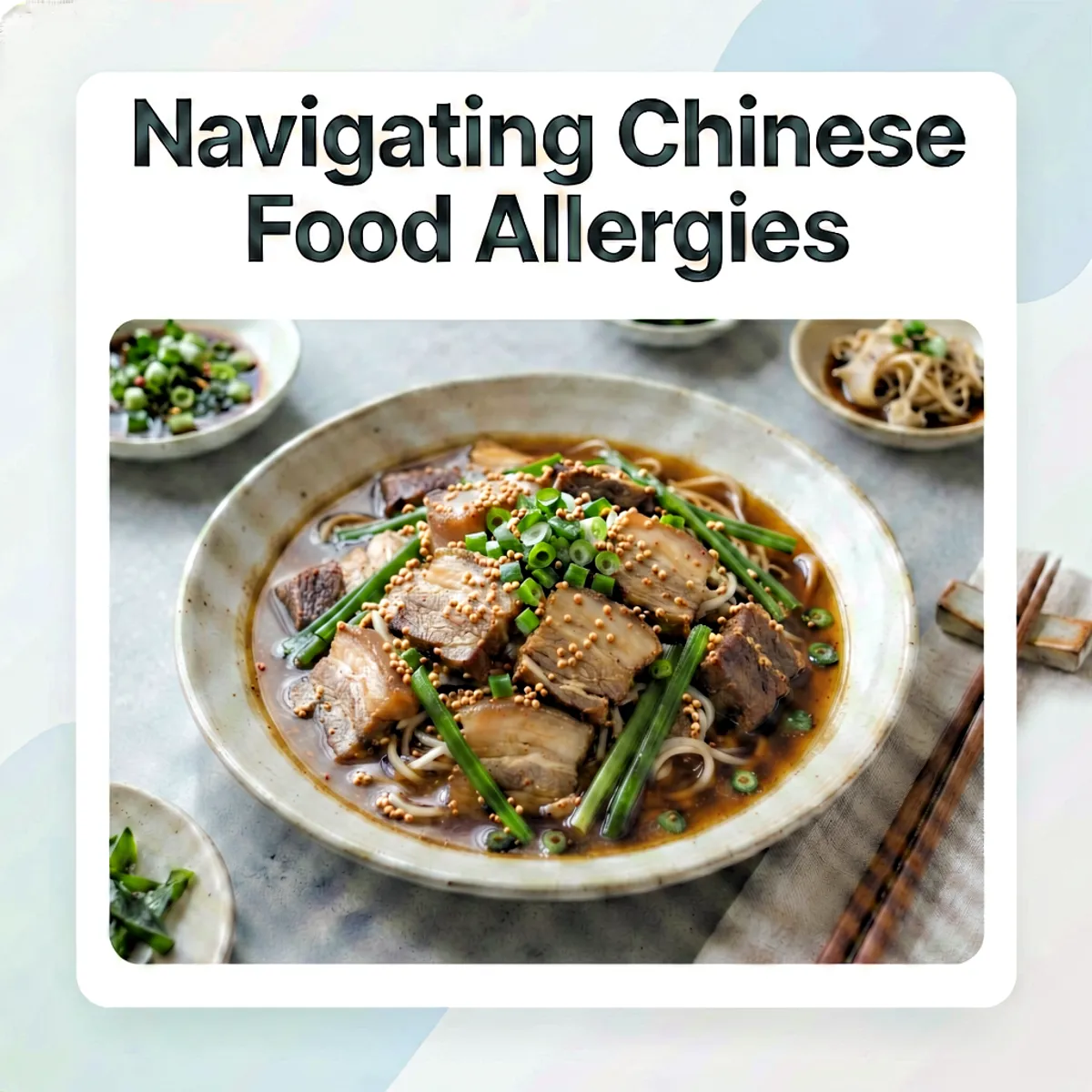
Understanding the Chinese Food Landscape and Allergen Management
Chinese cuisine is incredibly diverse, featuring ingredients and cooking methods unfamiliar to many Western diners. While wheat gluten (huangfei), soy sauce (shaoxiangjiu is a liquor but soy sauce is youtiao or soy sauce itself), and rice are staples, the preparation often involves shared kitchens and a wide array of potential allergens. Unlike many Western countries where common food allergens are strictly regulated and ingredient labeling is standard practice, the Chinese system is still evolving regarding allergies. Awareness varies significantly, and cross-contamination, although a recognized issue, might not always be addressed proactively.
Your specific allergy profile, where only certain nuts are tolerated while others are strictly forbidden, adds another layer of complexity. In China, identifying hidden sources of the problematic nuts can be challenging, as labeling may not be as meticulous as in other regions. But, it's encouraging to note that awareness of common allergens like milk and eggs is growing, particularly in urban centers, although comprehensive understanding of tree nut allergies might lag behind. Understanding this landscape is the first step towards navigating it effectively.
Communicating Dietary Needs Effectively in Chinese Restaurants
Clear and effective communication is paramount when dining out with a severe allergy. While laminated cards are a good start, their effectiveness hinges on the understanding of the server and kitchen staff. Mandarin-speaking individuals may or may not be familiar with the specific terminology for allergies or the severity implied by phrases like "it's vital." It's advisable to carry multiple copies of your allergy card or use apps that can translate your restrictions clearly. Practicing the explanation with native speakers before your trip can be beneficial, although perfect understanding isn't guaranteed everywhere.
Beyond cards, direct and repeated communication with your server is crucial. state your allergy name (e.g., "I have a severe nut allergy") and emphasize the specific nuts to avoid ("This includes almonds, walnuts, cashews, etc.") and explain why it's life-threatening ("Anaphylaxis is a real risk"). Repeat your restrictions at the table if you feel comfortable.
While some establishments, particularly tourist-focused ones, might be more accommodating, traditional family-run restaurants or smaller eateries might be less equipped or understanding. Building rapport with your server and being explicit about your needs can significantly increase safety.
Practical Strategies for Dining Out and Restaurant Selection
Pre-trip research can make a difference. Look for restaurants known for tourist crowds or international menus, as these establishments might be more accustomed to dietary requests. Major hotel restaurants in cities like Beijing (e.g., near Tiananmen Square) and Chongqing often cater to a wide range of guests and might have staff familiar with basic dietary restrictions. Consider asking your hotel concierge or reputable travel companions for recommendations on places likely to be accommodating.
When making reservations, especially at higher-end establishments, it's worth mentioning your severe allergy to the restaurant. While not all chefs or kitchens will be equipped to handle such allergies with absolute certainty, some might offer dedicated preparation areas or be willing to modify dishes significantly. Be prepared to explain your needs clearly again upon arrival.
If eating out is uncertain on a particular evening, there are often Western-style bakeries or cafes in major cities where you can find safer options, although ingredient scrutiny is still necessary. often prioritize restaurants where you feel confident the communication has been successful and the environment seems controlled.
Travel Considerations and Personal Preparedness
Traveling with a severe allergy requires more than just communication strategies; it involves personal preparedness and managing expectations. Carry your adrenaline autoinjector (EpiPen or similar) at all times, knowing its location. Keep an ample supply with you and consider carrying a letter from your doctor detailing your allergy and requiring emergency treatment. Learning basic Mandarin phrases related to food and allergies ("不吃花生" means "Do not eat peanuts," although translating other specific nuts might be harder) can be helpful but is often secondary to clear visual aids and repetition with staff.
Embrace flexibility and don't hesitate to skip a meal or choose simpler options if you're unsure about the safety of a dish. While the desire to fully experience local cuisine is understandable, your health and safety must remain the top priority. Your interest in China is strong, and while the allergy presents challenges, with careful planning, clear communication, and vigilance, it is entirely possible to navigate these challenges and enjoy an authentic and memorable travel experience in cities like Beijing and Chongqing.
Regional Nuances: Allergen Awareness Across China’s Culinary Landscape
The variance in allergen management between Beijing and Chongqing illustrates a broader national spectrum. Beijing, as the capital and a global metropolis, generally exhibits higher awareness of international dietary restrictions, particularly in establishments frequented by expatriates and tourists. Here, you may encounter servers who recognize the term "allergy" (guòmǐn) and understand the gravity of cross-contamination.
But, this awareness is not uniform; smaller local hutong eateries may still operate with traditional, less formalized kitchen practices. Conversely, Chongqing’s famed spicy cuisine, while sensational, introduces unique hidden allergen risks. The region’s signature mala (numbing-spicy) broths and sauces frequently incorporate ground nuts like peanuts or walnuts as thickeners and flavor enhancers, often blended into pastes where identification is impossible without explicit disclosure.
The fast-paced, communal nature of Chongqing’s hot pot restaurants, with shared pots and dipping sauces, creates a high-risk environment for cross-contact that requires extra vigilance.
Understanding these regional distinctions is crucial for tailoring your communication strategy. In Beijing, leveraging the relative familiarity with allergies by using precise terms like "shengwu guòmǐn" (biological allergy) might yield better results. In Chongqing, your approach must shift from general allergy warnings to specific, ingredient-focused inquiries about every component of a dish, especially sauces and condiments.
The culinary pride in both cities means that refusal of a dish can sometimes be taken personally; framing your restrictions as a medical necessity rather than a culinary preference is essential. This regional fluidity means that strategies successful in one city may fail in another, demanding constant adaptation and a refusal to become complacent based on past positive experiences.
The Urban-Rural Divide in Allergen Protocols
Beyond the major municipalities, a significant disparity exists between urban centers and smaller towns or rural areas. In tier-one cities like Shanghai or Shenzhen, Western supermarket chains and international bakeries often provide ingredient lists, and some high-end restaurants employ staff trained in basic allergen protocols. The influence of global food safety standards is palpable.
Yet, venture into a county-level city or a village restaurant, and the concept of a food allergy may be virtually unknown. Kitchens are typically single-purpose, family-run affairs where the cook is also the server and the owner. They source ingredients locally and seasonally, with no standardized recipes or labeling.
The very notion of preparing a "safe" meal for an allergic individual might be seen as an absurd complication, potentially leading to refusal of service or, worse, well-intentioned but dangerously incorrect substitutions.
This divide necessitates a risk-assessment mindset. For the traveler with a severe allergy, dining in rural China should be approached with extreme caution, often limited to meticulously prepared meals from trusted hotel kitchens or self-catering with carefully sourced packaged goods from large supermarkets. The allure of "authentic" local cooking in remote areas must be weighed against the near-impossibility of guaranteeing safety.
Your travel itinerary should reflect this reality, allocating more flexible meal times in regions where you can control your food sources, rather than assuming restaurant accommodation is feasible nationwide. The year 2026 may see incremental improvements in awareness, but the foundational gap in food safety culture between cosmopolitan hubs and the countryside will likely persist for years.
Decoding Menus and Ingredient Lists: A Linguistic Challenge
Menu translation in China is often literal, creative, or woefully incomplete, presenting a major hurdle for allergen avoidance. A dish named "Kung Pao Chicken" (Gōngbǎo Jīdīng) might list only its primary components, omitting crucial details like the presence of crushed peanuts in the sauce or the use of sesame oil in the wok. Even when ingredients are listed, terms can be ambiguous.
"Nuts" might be translated as "hezi" (kernel) or "guo" (fruit), but specific varieties like "xingren" (apricot kernel, which is toxic in large quantities) or "hetao" (walnut) require precise vocabulary. In addition, many traditional dishes rely on proprietary pastes, powders, and stocks—such as the liao (paste) bases for Sichuan cuisine—whose contents are closely guarded secrets and never disclosed on public menus.
Overcoming this requires a multi-pronged linguistic strategy. First, master the Chinese names for your specific forbidden nuts. "Almond" is xingren, "walnut" is hetao, "cashew" is yiguo, and "pecan" is beiqiao.
Carry these terms written clearly on your allergy card. Second, learn to ask the critical follow-up questions: "Zhège cài yǒu ma?" (Does this dish have ?) and "Shicai li yǒu ma?" (Are there in the ingredients?). Third, understand that a "no" answer may not be fully informed.
A cook might say no because they don't consciously add whole nuts, not realizing a premade sauce contains them. This is where visual aids and repeated, firm explanations become non-negotiable. The burden of proof lies with you to extract information from a system not designed to provide it.
The Complexities of Partial Nut Tolerance
Your specific condition—tolerating some nuts while reacting severely to others—complicates communication in a culture that often categorizes foods broadly. In Western contexts, you might explain, "I am allergic to tree nuts except for almonds and hazelnuts." In China, this nuanced distinction can be lost in translation or met with confusion. The common umbrella term for nuts, guo, may not convey the botanical differences between, for example, a cashew (a drupe, not a true nut) and a walnut. A server might hear "no nuts" and assume you mean all hard-shelled fruits, potentially excluding safe items like chestnuts (lizi) from your diet unnecessarily, or conversely, might include a forbidden nut under a different local name.
To navigate this, your communication must be exceptionally precise and visual. Your allergy card should not just list forbidden nuts but should include a clear "SAFE" section with pictures or Chinese characters for the nuts you can eat. For instance: "SAFE: Lìzi (Chestnut), Hé táo (Walnut—if tolerated).
FORBIDDEN: Xìngrén (Almond), Yǐguǒ (Cashew), etc." This binary visual guide helps bridge the language gap. When speaking, use the phrase: "Wǒ duì guòmǐn, dàn kěyǐ chī hé ." (I am allergic to , but I can eat and .) Practice this sentence until it’s automatic. Be prepared for follow-up questions; a curious cook might ask why some are safe, to which a simple, firm "Yīsī, wǒ bù zhīdào, dàn wǒ kěyǐ chī." (It's just the way it is, I don't know why, but I can eat them.) often suffuses to shut down further debate while maintaining clarity.
Managing the "May Contain" Dilemma
In Western countries, "may contain" or "processed in a facility with" warnings are regulated and commonplace. In China, such voluntary disclosures are rare outside of large, export-oriented manufacturers or international brands. The concept of trace allergen cross-contamination is not widely understood or legally mandated.
A factory producing both nut-based and nut-free snacks might not label this risk, and a restaurant kitchen using the same wok for a peanut-based dish and then for your ordered stir-fry will almost never volunteer this information. Your strategy, therefore, cannot rely on labeling but must instead focus on proactive kitchen interrogation and observation.
When ordering, your questions must drill down to preparation methods. "Zhège wō shì yòng guò de ma?" (Has this wok been used with ?) is a direct but necessary query. Observe the kitchen flow if possible; in open-kitchen concepts, watch for shared fryers or cutting boards.
In establishments without transparency, assume cross-contamination is a high probability unless you can explicitly confirm dedicated equipment for your meal. This often means opting for simplest dishes—steamed rice, clear-broth noodles, or boiled vegetables—where the ingredient list is minimal and preparation is less complex. The "may contain" risk is an invisible, omnipresent threat in Chinese dining, and your vigilance must be calibrated accordingly, treating every shared surface and utensil as a potential vector for your allergen.
Cross-Contamination: The Unspoken Hazard in Chinese Kitchens
The very techniques that define Chinese culinary artistry—high-heat wok cooking, deep-frying in shared oil, and the use of potent pastes—are the same practices that maximize cross-contamination risk. A traditional wok is seasoned and used for myriad dishes throughout a service. A single ladle used to stir a peanut sauce can introduce allergens into an otherwise safe dish.
Deep fryers are often used for everything from youtiao (fried dough) to chicken to spring rolls, meaning cooking oil becomes a universal allergen carrier. These are not failures of protocol but inherent characteristics of the cuisine, rarely acknowledged as hazards because the allergen-aware framework is absent.
Your only defense is to request, and if necessary, insist on procedures that mitigate these risks. This means asking for a freshly cleaned wok ("qǐng yòng xīn de wō") or for your dish to be prepared first in the cooking sequence before any allergenic ingredients are introduced. For fried foods, inquire if there is a dedicated fryer for non-nut items; the answer will often be no, making fried selections particularly perilous.
When sharing a table with others, be acutely aware of communal serving utensils and shared plates, which can transfer allergens. In a hot pot setting, request a separate, clean pot and individual dipping sauces. These requests may be seen as burdensome, so offering a generous tip upfront or choosing quieter meal times when the kitchen is less rushed can improve compliance.
Understanding that you are asking the kitchen to deviate from its standard, efficient workflow is key to framing your requests with appropriate respect and clear justification.
Street Food and Market Stalls: Highest Risk, Highest Reward
The sensory delight of China’s street food scene—the sizzling skewers, the fragrant pancakes, the steaming dumplings—is also its greatest allergen trap. These mobile or stall-based vendors operate with minimal equipment, often a single griddle or deep-pot. Ingredients are pre-mixed in large containers, and there is no concept of allergen segregation. A vendor making jianbing (savory crepe) might use the same spatula for all components, and a sauce jar could contain a nut-based paste disguised as a generic "savory sauce." The turnover is fast, the focus is on flavor and speed, and any question about allergens is likely to be met with a polite but vacant smile.
For the severe allergy sufferer, the calculus is straightforward: the risk vastly outweighs the reward. The potential for anaphylaxis in a crowded, unfamiliar alley without immediate access to emergency medical care is too great. This does not mean you must abstain entirely; you can observe the vibrant street food culture from a safe distance, perhaps purchasing non-allergenic items like plain roasted sweet potatoes (hóngshǔ) or steamed buns (mantou) from vendors whose processes you can scrutinize.
The safest approach is to enjoy street food as a spectator sport, appreciating the craft and atmosphere while consuming only items you have personally sourced from controlled environments. The memory of the sights and smells will be vivid enough without the accompanying peril.
Emergency Protocols: Navigating a Medical Crisis in China
Despite exhaustive precautions, accidental exposure remains a possibility. Your emergency plan must be robust, culturally adapted, and practiced. The first and non-negotiable step is to carry your adrenaline autoinjector(s) at all times, in an accessible, non-temperature-extreme location.
A medical alert bracelet in Chinese stating your allergy and the need for shènghuànyù (adrenaline) is a valuable secondary identifier. Familiarize yourself and your travel companions with the exact administration procedure. In a crisis, clarity and speed are paramount.
Should a reaction occur, your immediate action is to administer the autoinjector and call emergency services. The number is 120. But, the operator will almost certainly speak only Mandarin.
Have a pre-written, laminated card in Chinese that states: "Wǒ duì guòmǐn, yǐjīng shènghuànyù, qǐng kuài jiùyī!" (I have a allergy, have taken adrenaline, please send an ambulance!). Hand this to a bystander to relay to the operator. Specify your location clearly, using landmarks or a map screenshot.
While waiting for the ambulance, do not assume any local medical facility can treat anaphylaxis. You must direct the ambulance to a large, international hospital in a major city like Beijing United Family Hospital or Chongqing Health Management Center for Foreigners, which have English-speaking staff and appropriate medications. Smaller local clinics may lack epinephrine or the understanding to use it effectively.
The Doctor’s Note: Your Essential Travel Document
Carry a doctor’s letter, written in English and formally translated into Chinese by a certified translator. This document should detail your specific allergy, the fact that it is life-threatening, the necessity of carrying and using an adrenaline autoinjector, and a list of the specific nuts to avoid. This serves two critical purposes.
First, it can facilitate the purchase of additional autoinjectors in China if needed, as regulations around prescription drugs can be complex. Second, and more importantly, it provides authoritative, unambiguous documentation for medical personnel in an emergency. When presenting it, point emphatically to the translated section and the Chinese terms for your allergens.
This document reduces the chance of misdiagnosis or dismissal of your symptoms as simple indigestion or "heat rash."
It is also advisable to register your travel itinerary with your country’s embassy or consulate in China. While they will not provide medical care, they can offer consular assistance in a crisis, such as helping to communicate with local authorities or facilitating evacuation if necessary. Keep their contact information, along with your embassy’s emergency number, readily available.
This layered approach—personal medication, clear communication tools, a doctor’s note, and consular backup—forms a comprehensive safety net. The goal is to make every second of a reaction response as efficient as possible, minimizing the language and systemic barriers that could cost precious time.
Cultural Considerations: Dining Etiquette and Social Dynamics
Managing an allergy in China is not merely a logistical challenge but a social one, deeply intertwined with dining etiquette. Chinese meals are communal, with shared dishes placed at the center of the table. Refusing food can be interpreted as a rejection of the host’s generosity and hospitality.
The concept of mianzi (face) means that openly refusing a dish, especially one specially ordered for you, can cause embarrassment. Your allergy, therefore, must be presented not as a personal preference but as an immutable medical law, beyond your control. The phrasing "Wǒ bù néng chī, yīsī dōu bù néng" (I cannot eat it, not even a little) is more definitive than "I don’t like" or "I’m avoiding."
Navigating group meals requires pre-emptive strategies. If invited to a home dinner, communicate your allergy to the host well in advance, again using your card and emphasizing its severity. Offer to bring a dish you know is safe to share, framing it as a contribution rather than a limitation.
In restaurant group settings, consider discreetly speaking to the manager or your most understanding companion before ordering begins, explaining your situation and asking for their help in guiding the group toward safer choices. You may need to politely decline dishes as they arrive, using a pre-prepared phrase like "Zhège wǒ bù néng chī, guòmǐn, xièxie!" (I can’t eat this, allergy, thank you!). Rehearsing this with a smile and genuine gratitude helps soften the refusal.
The social pressure to conform is significant, but your health must be the unyielding priority. Most hosts, once they truly understand the life-threatening nature, will become allies in your safe dining.
The Gift-Giving Trap
Food gifts are a common and meaningful part of Chinese social interaction, especially during festivals or as a thank-you. These gifts—boxes of premium nuts, gift baskets containing mixed snacks, homemade specialties—are presented with great warmth. Accepting them is a social imperative, but for you, they are a potential minefield.
The solution is a policy of gracious but firm refusal. Have a simple, apologetic explanation ready: "Wǒ duì guòmǐn, hěn bù xìng, wǒ bù néng shōu." (I have a allergy, unfortunately, I cannot accept it.) Pair this with a smile and a change of subject. If pressed, show your allergy card.
Do not accept the gift "just to be polite" and then dispose of it; the act of accepting creates obligation and further complicates future interactions. If you must accept to avoid grave offense (e.g., from an elderly relative), accept it with thanks, express your inability to consume it due to your "doctor’s strict orders," and immediately set it aside or give it to a companion. The cultural value of the gesture is in the giving, not necessarily in the consuming, and your sincere, regretful refusal will usually be understood if framed correctly as a medical constraint.
Technology as a Bridge: Apps and Digital Tools for the Allergic Traveler
While traditional communication is vital, technology provides powerful supplementary tools. Download robust translation apps like Pleco or Google Translate (with offline Chinese packs) before arrival. Pre-program your allergy explanation and key questions into these apps for quick access.
Some apps allow you to save custom phrases and even voice them in Mandarin, which can be useful for showing a server the spoken question. But, do not rely solely on a phone screen; the connection may fail, the battery may die, and the speaker volume might be insufficient in a noisy restaurant.
More promising are emerging allergen-specific apps. While China lacks a comprehensive national allergen labeling database, some third-party apps scan barcodes of packaged goods sold in large supermarkets and provide ingredient breakdowns, sometimes flagging common allergens. Their coverage is spotty and focused on mass-market products, but they can offer a degree of reassurance for snacks, drinks, or instant noodles you purchase for self-catering.
For restaurants, platforms like Dianping (Meituan) or Ele.me sometimes include user-uploaded photos and reviews. Scouring these for mentions of "allergy-friendly" or "kěyǐ tiáojiě" (can modify) can help you pre-select venues. Use these digital footprints as one data point among many, not as definitive proof of safety.
Building a Personal Digital Allergy Passport
Create a comprehensive digital folder on your phone and in cloud storage. This should contain: 1. A high-resolution scan of your doctor’s note (English and Chinese versions).
2. Multiple copies of your allergy card image. 3.
A list of safe and forbidden foods in Chinese, with pictures. 4. A map of hospitals with emergency departments and English-speaking capability in each city you visit.
5. Pre-written emergency text messages in Chinese to send to local contacts or emergency services. 6.
Photos of your autoinjector and its instructions in Chinese.
This "allergy passport" ensures that even if you are incapacitated, a companion or first responder has instant access to critical information. The year 2026 will likely see more integrated solutions, but for now, this manual compilation is your best digital shield. Ensure your travel companions know how to access this folder. Technology is an enabler, not a replacement for personal vigilance and clear verbal communication; it is the backup system for when your voice fails or your memory falters under stress.
Conclusion: Weaving Caution into the Tapestry of Chinese Travel
Navigating China with a severe, nuanced nut allergy is a profound exercise in preparation, communication, and cultural humility. It transforms travel from a passive consumption of experiences into an active, daily negotiation with a complex food system. The strategies outlined—from the meticulous crafting of bilingual allergy cards and the regional tailoring of your approach, to the unwavering insistence on kitchen protocols and the social choreography of refusing hospitality—form a cohesive framework for risk mitigation. Success does not mean the elimination of all risk, which is an impossible standard, but rather its reduction to a tolerable level through relentless, informed vigilance.
Your journey through Beijing’s hutongs or along Chongqing’s riverbanks will be different from that of an average tourist. You will experience the culinary landscape with a heightened, almost forensic awareness. You will learn to read kitchens as closely as menus, to value simplicity over complexity, and to find profound satisfaction in a perfectly steamed bun or a clear broth that you know, beyond doubt, is safe. This very constraint can deepen your engagement, forcing you to ask questions, build rapport with chefs, and appreciate the fundamental ingredients of Chinese cuisine in their purest form.
Ultimately, the goal is to reclaim the joy of travel. The anxiety of potential exposure is a heavy burden, but it is a burden that can be managed. By embedding these strategies into your travel DNA, you shift from a posture of fear to one of empowered caution.
You honor your health while still honoring the culture. The aromas of Sichuan peppercorns, the sizzle of a fresh jianbing, the convivial atmosphere of a hot pot meal—these experiences remain within your reach. They simply require a map, a plan, and the courage to advocate for yourself unwaveringly.
With these tools, China’s immense and beautiful culinary world is not a forbidden territory but a landscape to be explored thoughtfully, safely, and with all the wonder it so richly deserves.
Responses • 0
0/2000
ID: 1326
Chris
Offline
1 hr
Visited
From
Bakersfield, United States
Send Message