Naoii Community: Real Chinese from Real Native Speakers
AI Learn Chinese
4 hr • 0 read
Free native speaker community for real, natural Mandarin. Share everyday sentences you actually use, get corrections, and learn the why behind them.

The Persistent Gap Between Textbook Chinese and Real Life
a number of dedicated learners of Mandarin face a frustrating, common plateau. They can conjugate verbs, recognize hundreds of characters, and pass structured exams. Yet, when attempting to express a simple, personal thought, the resulting sentence feels...
off. It might be grammatically correct according to a textbook, but it lacks the natural flow, the subtle word choice, or the authentic tone a native speaker would use. This creates a barrier to genuine communication, leaving learners feeling like perpetual outsiders despite their hard-earned knowledge.
The problem isn't a lack of vocabulary or grammar rules; it's a lack of exposure to and practice with the living, breathing language as it's used in daily life, online chats, casual meetups, and family dinners.
This gap exists for several fundamental reasons. Textbooks and standardized courses prioritize grammatical accuracy and a controlled vocabulary list. They teach "correct" forms that are often formal, dated, or simply not the first choice in a casual conversation.
They rarely cover the rich world of slang, regional variations, or the pragmatic choices that make language feel human. In addition, traditional learning environments offer limited, often nerve-wracking, opportunities for spontaneous production. Students are usually responding to preset questions or following scripted dialogues, not generating their own original ideas and desires.
The result is a linguistic toolkit that is technically functional but stylistically inept.
The High Cost of "Correct" But Unnatural Chinese
Pursuing only grammatical correctness can be counterproductive. A sentence can be 100% structurally sound yet completely unnatural, leading to confusion or awkwardness. Consider the direct translation of "I am very hungry" from English.
A learner might say "我 very 饿" (Wǒ very è), mixing languages, or the more textbook "我非常饿" (Wǒ fēicháng è). While understandable, a native speaker in a casual setting is far more likely to say "我饿死了" (Wǒ è sǐ le – I'm starving) or "我快饿扁了" (Wǒ kuài è biǎn le – I'm about to starve). The latter options carry emotional weight and colloquial flavor that textbooks omit.
Without feedback on these nuances, learners miss the chance to sound relatable and integrated.
Why Traditional Feedback Loops Fall Short
Language exchange apps and tutoring platforms exist, but they often replicate the same issues. Sessions can be transactional, focused on error correction rather than organic expression. The learner might prepare a list of questions, the tutor answers, and the cycle repeats.
There's little space for the learner to post an unfiltered, spontaneous thought—the exact thing they struggle to articulate—and receive nuanced feedback on its naturalness. The feedback is also typically one-on-one, limiting the learner's exposure to a diversity of native perspectives. What's needed is a community-driven, asynchronous model where the focus is on the idea first and its linguistic execution second.
Introducing Naoii: A Community Built on Authentic Expression
This is where the concept for Naoii emerges. Naoii is a completely free, community-focused platform designed from the ground up to bridge that critical gap. Its core philosophy is simple yet powerful: you share what you actually want to say. There are no prompts, no preset topics, no artificial scenarios.
Whether it's a reaction to a news article, a description of your day, a joke you want to tell, or a deep personal question, you post your genuine, unpolished Chinese attempt. The community, composed of native speakers and advanced learners, then responds. The goal is not just to point out errors, but to provide more natural alternatives and explain why one phrasing sounds better than another.
The name "Naoii" (脑脑) evokes the idea of "brains" or "thinking together" (脑 meaning brain). It symbolizes the collective intelligence of the community refining individual expression. It is not a course.
It is not a school. It is a social space for linguistic collaboration. The creator, a native Chinese speaker, is an active participant within this community, not a distant instructor.
This blurs the line between teacher and peer, creating a more egalitarian and supportive environment where learning is a shared, social activity rather than a top-down instruction.
The Creator's Perspective: A Native Speaker's Motivation
The driving force behind Naoii comes from a native speaker's desire to help others achieve genuine connection. The creator observes that many learners, despite years of study, produce Chinese that sounds "translated." They want to move learners beyond textbook Mandarin into the realm of actual communication. This personal investment means the platform is curated with an insider's understanding of what sounds authentic.
The creator is not just an administrator; they are a frequent contributor, offering detailed explanations on grammar subtleties, vocabulary connotations, tone usage in context, and the ever-evolving landscape of slang and internet language. This direct access to a native perspective, freely given, is a cornerstone of Naoii's value.
Completely Free: Removing All Barriers to Access
A non-negotiable principle of Naoii is that it is, and will always be, completely free. There are no premium tiers, no hidden fees for advanced features, no "freemium" traps. This decision is crucial.
It ensures the community is open to everyone, regardless of economic background, and that its sole focus remains on linguistic exchange and mutual help, not on conversion or profit. The sustainability model, if any, is community-based and transparent, but the core service of posting, receiving corrections, and accessing saved expressions remains untouched by monetary barriers. This purity of intent attracts users who are genuinely passionate about language, not just looking for a transactional service.
How Naoii Works: From Post to Personal Lexicon
The user experience is intentionally streamlined to lower friction and encourage spontaneous participation. The workflow is a closed loop that turns every interaction into a learning opportunity.
Step One: Post Your Authentic "Want-to-Say"
A user navigates to the platform and creates a post. The content is entirely up to them. It could be a paragraph about their weekend, a reaction to a movie, a confused question about a phrase they heard, or even a single sentence they are unsure about.
The key is that it originates from a real communicative need. This is the critical differentiator from textbook exercises. The user is not practicing a grammar point; they are trying to express a real thought or feeling.
This authentic motivation makes the subsequent feedback immediately relevant and memorable.
Step Two: Community Corrections and Natural Alternatives
Other users, particularly native speakers and proficient learners, respond to the post. A high-quality response does more than just mark a character wrong. It provides a corrected, more natural version of the entire sentence or paragraph.
For example, if a learner posts "我今天去超市买了很多东西" (Wǒ jīntiān qù chāoshì mǎi le hěn duō dōngxi – I went to the supermarket today and bought many things), a native might suggest "我今天去超市采购了一堆东西" (Wǒ jīntiān qù chāoshì cǎigòu le yī duī dōngxi – I did a big shop at the supermarket today) or "我今天去超市买了一大袋东西" (Wǒ jīntiān qù chāoshì mǎi le yī dà dài dōngxi – I bought a big bag of stuff at the supermarket today). The response explains why "采购" (cǎigòu – to procure/shop in bulk) or "一大袋" (yī dà dài – a big bag) is more specific and natural in that context than the vague "很多" (hěn duō – many).
Step Three: Understanding the "Why"
This explanatory layer is where deep learning occurs. Responders are encouraged to briefly note why their alternative is better. Is it a matter of collocation (words that naturally go together)?
Is it about register (formal vs. informal)? Is it a cultural nuance? For instance, explaining that "买" (mǎi – to buy) is fine but "采购" (cǎigòu) implies a larger, more purposeful shopping trip adds profound depth.
The learner doesn't just get a "better sentence"; they understand the semantic and pragmatic reasoning behind it. This builds a mental framework for making similar choices independently in the future.
Step Four: Saving and Organizing Your Personal Lexicon
Every user has a personal space to save expressions they find useful. When they see a great alternative—a killer slang phrase, a perfect idiom for a situation, a elegant turn of phrase—they can save it directly from the correction thread. These saved expressions are tagged, searchable, and become a personalized phrasebook built from real-world usage.
This transforms passive learning (seeing a correction) into active accumulation (curating a personal toolkit). Over time, a user's saved collection becomes a map of their linguistic growth, filled with phrases that have already been vetted by native speakers as actually used.
The Dual Benefit: Learners and Native Speakers Thrive
Naoii’s model creates value for two primary groups, and the magic lies in how their participation synergistically benefits the entire ecosystem.
For the Chinese Learner: From Passive Knowledge to Active Fluency
For learners, Naoii directly attacks the "translation mindset." By forcing them to generate their own thoughts first, they practice the hardest skill: spontaneous production. The feedback is contextual and relevant, making corrections stick. The exposure to multiple native alternatives for a single idea shows the spectrum of natural expression, teaching that there is often no single "right" answer, but many "good" ones depending on nuance.
The saved expressions feature turns the platform into a living, personalized textbook written by natives. In addition, the low-pressure, asynchronous nature reduces anxiety. You can post, walk away, and return to thoughtful feedback, which is less intimidating than a live conversation where errors happen in real-time.

For the Native Speaker: A New Form of Casual Engagement and Impact
Native speakers, often busy with their own lives, find a unique outlet in Naoii. They can contribute in minutes, during a commute or a break. It’s a low-commitment way to use their innate knowledge to help others, which can be personally rewarding.
They see firsthand the struggles and breakthroughs of learners, which can foster patience and a deeper appreciation for their own language. For many, it’s also a fun puzzle: "How would I actually say this?" It keeps their own language skills sharp as they articulate explanations. The community aspect means they are part of a supportive network, not just a service provider.
This transforms the dynamic from "expert-novice" to "peer collaborator."
The Synergy: A Self-Sustaining Learning Ecosystem
As more learners post authentic content, the pool of real-world example sentences grows. As more natives contribute, the quality and diversity of feedback improve. A learner struggling with how to politely decline an invitation might find five different, equally valid native suggestions in the archives, each with its own slight shade of meaning.
This collective intelligence becomes a rich, searchable database of pragmatic Chinese. The platform essentially builds its own curriculum from the ground up, based on what learners actually need to say, not what a syllabus dictates. This creates a powerful, self-reinforcing cycle of value.
The Critical Role of the "More Natural Alternative"
The heart of Naoii’s pedagogy is the pursuit of the "more natural alternative." This concept moves beyond binary right/wrong. It acknowledges that a learner's sentence is often a valid, logical construction that simply isn't the preferred choice of a native in a given context.
Decoding Collocation and Word Pairing
Chinese is deeply reliant on collocation—words that habitually appear together. A learner might know the word for "heavy" (重, zhòng) and "rain" (雨, yǔ), but might not know that we say "大雨" (dà yǔ – big rain) not "重雨" (zhòng yǔ). A native correction pointing to "下大雨了" (xià dà yǔ le) instead of a literal translation of "it's raining heavily" teaches this fundamental principle.
The "why" here is about lexical bundles. Naoii surfaces these essential pairings constantly, embedding them in the learner's memory through real examples.
Navigating Register: When Formality Matters
Register—the level of formality—is a minefield for learners. The polite "您" (nín) versus "你" (nǐ) is a classic example, but it extends to vocabulary. "自行车" (zìxíngchē) is the standard word for "bicycle," but in casual speech, many say "单车" (dānchē), especially in Southern China.
A learner might use the textbook term correctly but sound stiff. A native alternative suggesting "我骑单车去" (Wǒ qí dānchē qù – I went by bike) teaches the colloquial register. The community helps learners calibrate their language to the social context, whether talking to a friend, a boss, or writing an online post.
Embracing Slang, Idioms, and Cultural References
This is where textbooks fail most dramatically. Slang changes rapidly and varies by region. Idioms (成语, chéngyǔ) carry historical stories and condensed meaning.
Naoii becomes a vital conduit for this living layer of language. A learner trying to say someone is "very experienced" might write "他很有经验" (Tā hěn yǒu jīngyàn). A native might offer the idiomatic "他老江湖了" (Tā lǎo jiānghú le – he's a seasoned veteran, literally "old river and lake"), explaining it's used for someone with vast, hard-won experience in a field.
This teaches not just a phrase, but a cultural concept. The platform demystifies these dense, efficient packets of meaning that make speech vivid and native-like.
The Power of Peer-to-Peer Learning Dynamics
While the native speaker's role is central, the peer-to-peer dynamic among learners at different stages is equally powerful. A common misconception is that only natives can provide valuable feedback. In Naoii, advanced learners often provide excellent corrections and explanations, sometimes even more patient and detailed than natives, as they remember the struggle.
Seeing how other non-natives approach the same problem offers multiple learning pathways. A learner might see three different ways to phrase a request, from a very simple version to a more complex, idiomatic one, and choose the one that fits their current level. This creates a scaffolded learning environment within the community itself.
The "Near Peer" Effect
Research in language acquisition highlights the "near peer" effect—learning is often most effective from someone slightly more proficient than you. In Naoii, a learner at HSK 4 seeing corrections and suggestions from someone at HSK 5 or a non-native who has achieved fluency provides a tangible, relatable model of progress. The gap feels bridgeable.
The feedback from this near peer can be less intimidating and more strategically focused on the next step, rather than overwhelming the learner with every nuance at once. It provides a graded roadmap of improvement visible in real-time discussions.
Democratizing Expertise
This model democratizes linguistic authority. It challenges the hierarchy where only certified teachers or born natives have valid insights. On Naoii, the quality of a contribution is judged by its clarity, accuracy, and helpfulness, not by the contributor's credentials.
A well-reasoned suggestion from an advanced learner that gains upvotes or thanks carries as much weight as one from a native. This encourages thoughtful participation from everyone and builds a culture where helping is the currency. It makes the community resilient and rich, as the "correct" answer often emerges from a consensus of clear explanations, not from a single authoritative source.
This is the educational engine of Naoii. A correction without an explanation is a temporary fix; a correction with a "why" is a permanent lesson. The platform incentivizes and normalizes providing this rationale.
From Intuition to Articulated Rule
Native speakers often know what sounds right but can't always explain the grammatical or lexical rule behind it. The act of articulating "why" in a correction—whether it's about word order, the use of a specific measure word, the implication of a certain aspect particle like 了 (le) or 过 (guo)—forces the native to reflect on their own language. This reflection often leads to more precise and helpful explanations.
For the learner, moving from "that sounds better" to "that sounds better because..." is the transformation from passive recipient to active analyst of the language. It builds metalinguistic awareness, the ability to think about language itself.
Common "Why" Categories in Naoii Discussions
Discussions on the platform naturally cluster around recurring themes of naturalness: Pragmatic Framing: Why use "我想问一下" (Wǒ xiǎng wèn yīxià – I'd like to ask...) instead of just "我问" (Wǒ wèn – I ask)? (It softens the request). Conciseness: Why is "由于天气原因,活动取消了" (Yóuyú tiānqì yuányīn, huódòng qǔxiāo le – Due to weather reasons, the event was canceled) more formal, while "因为下雨,活动不搞了" (Yīnwèi xià yǔ, huódòng bù gǎo le – Because it's raining, the event's not happening) is casual?
(Vocabulary choice: "原因" vs. "因为", "取消" vs. "不搞了"). * Cultural Connotation: Why might "加油" (jiāyóu – add oil/cheer up) be a better response to "我明天要考试" (Wǒ míngtiān yào kǎoshì – I have an exam tomorrow) than "祝你成功" (Zhù nǐ chénggōng – wish you success)? (The former is a ubiquitous, casual cheer; the latter is more formal).
These recurring patterns become a shared knowledge base for the entire community.
Saving Expressions: Building Your Personal, Vetted Phrasebank
The save feature is not a trivial bookmark. It is the primary tool for curating personal mastery. A user doesn't save every correction; they save the ones that resonate—phrases they can imagine themselves using, that fill a gap in their expressive ability.
From Ephemeral Feedback to Permanent Asset
Without a save function, a brilliant correction in a thread is easily lost. The learner might remember the gist but forget the precise wording. Saving freezes that moment of insight.
Over months and years, a user's saved collection grows into a highly personalized, context-rich phrasebank. Unlike a generic dictionary, each entry is tied to a specific need the user once had ("How do I say I'm swamped with work?"). This emotional and situational anchor makes recall far more likely.
It becomes a go-to resource for writing posts, preparing for conversations, or clarifying doubts.
Organizing for Retrieval and Review
The ability to tag, categorize, and search saved expressions is crucial. A user might tag phrases with "business," "casual chat," "complaint," or "slang." They can then pull up all saved phrases for "making plans" when they need to coordinate with friends. This transforms passive accumulation into an active learning system.
Regularly reviewing one's saved list reinforces neural pathways. The platform effectively helps users build their own advanced textbook, one vetted, natural expression at a time.
The Personal Touch: Direct Access to the Native Creator
While the community is the engine, the direct involvement of the native creator, the person who built Naoii, provides a unique value layer. This isn't about getting private lessons; it's about modeling and amplification.
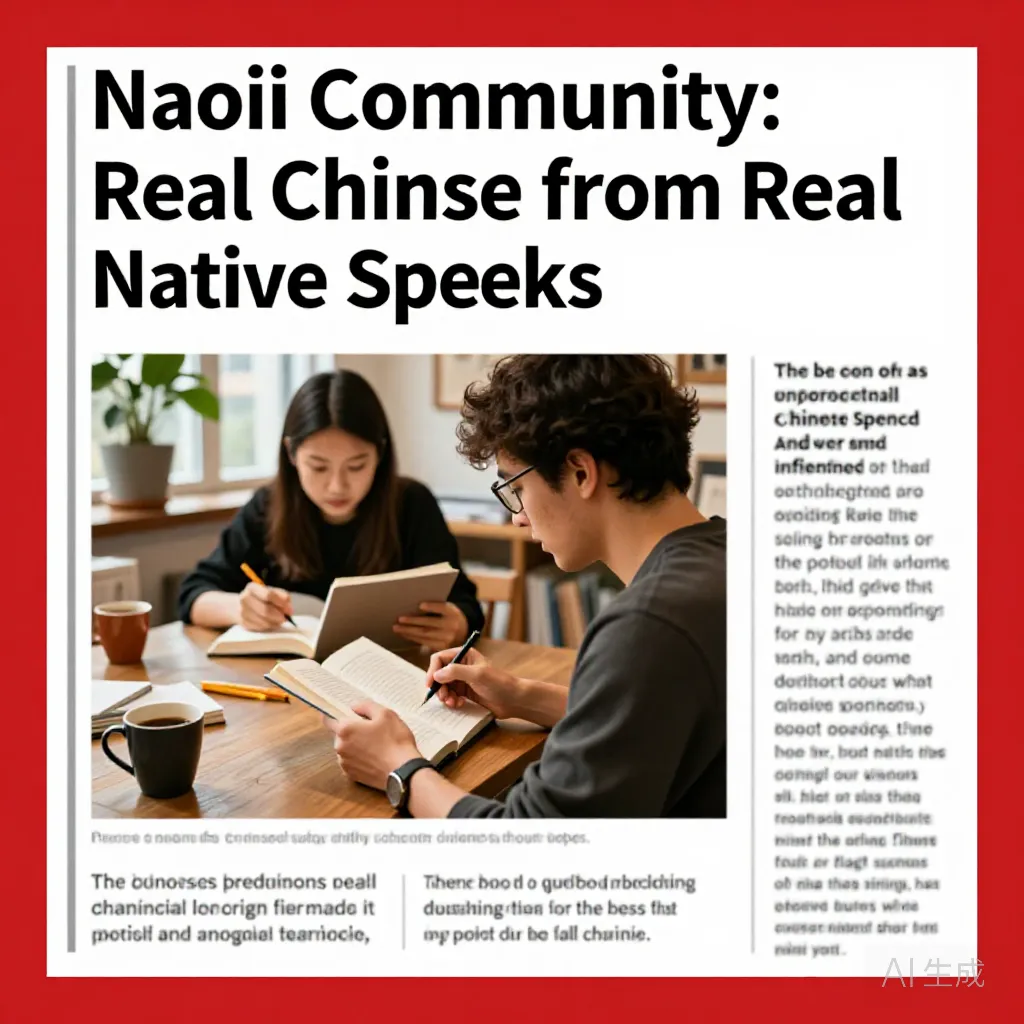
Modeling High-Quality Participation
The creator's active participation sets the tone and standard for the entire community. When they respond to posts, they demonstrate what a thorough, helpful, and nuanced correction looks like. They might tackle complex grammatical questions, explain subtle historical shifts in word meaning, or share personal anecdotes about how a phrase is used in their own life in China.
This serves as a masterclass for other native responders, raising the overall quality of feedback. For learners, seeing the creator engage validates the space as a serious learning environment and provides occasional access to an exceptionally deep well of knowledge.
Amplifying Community Wisdom
The creator can also act as an amplifier and curator. They might highlight particularly insightful thread discussions in a featured section, summarizing key takeaways. They can clarify widespread misconceptions that pop up in community corrections.
If a slang term is trending on Chinese social media, they can start a discussion post about it, seeding the community with current, relevant language. This ensures the platform stays dynamic and aligned with the ever-evolving nature of Mandarin. Their presence ensures the community's growth is guided by a coherent vision of authenticity and helpfulness.
Practical Steps: Joining and Contributing to Naoii
The barrier to entry is intentionally minimal. Interested individuals simply need to reach out. The instruction is clear: "leave a comment or send me a DM and I'll share the link." This gatekeeping is not to create exclusivity, but to maintain a quality-controlled, spam-free environment. It allows the creator to ensure new members understand the community's purpose—authentic expression and helpful feedback—before they join.
For New Learners: How to Start
Upon joining, the best practice is to lurk and learn initially. Browse existing threads. See what kinds of posts generate the most helpful discussions.
Notice the style of corrections. Then, take the plunge. Start with something simple and true: a sentence about your day, a reaction to something you read.
Be prepared for corrections. Do not take them personally; see them as gifts. Use the save function liberally.
Engage with others' posts as well—trying to correct someone else is one of the best ways to solidify your own understanding. The community thrives on mutual participation.
For Native Speakers and Advanced Learners: How to Help
Contributors should aim for the "correction + natural alternative + brief why" model. If you see a post, first try to understand the learner's intended meaning. Then, offer the most natural, common way a native would express that specific meaning in a similar casual context.
A short note on why—"This word is more common in speech," "We usually use this structure for...," "This sounds a bit formal"—is invaluable. Upvote helpful corrections and save useful ones for your own reference. Your participation directly fuels the learning ecosystem and makes Naoii a vibrant, useful space.
The Bigger Picture: Naoii in the Language Learning Landscape
Naoii represents a shift from curriculum-based to conversation-based learning, but with a crucial twist: the "conversation" is asynchronous, text-based, and focused on the content of what you want to say, not just the form. It complements, rather than replaces, other methods. A learner might use apps for vocabulary and grammar drills, take a class for structured foundation, and use Naoii to authenticate and naturalize everything they've learned.
Filling the "Authentic Output" Void
Most language learning tools excel at input (reading, listening) and controlled output (fill-in-the-blank, scripted speaking). The vast, scary, and most important realm of unscripted, personal output is often neglected. Naoii is specifically designed to be a safe, supportive training ground for this. It answers the learner's silent plea: "I know the words for 'I feel anxious about my job because of the economy,' but how does a real person actually say that?" By providing thousands of real answers to such questions, Naoii builds the bridge from knowing the language to using the language.
A Model for Other Languages?
The concept is language-agnostic. The principles—authentic expression, community corrections, focus on natural alternatives, and a saved phrasebank—could be applied to Spanish, Japanese, Arabic, or any language where the gap between textbook and reality exists. Naoii for Mandarin serves as a potent proof of concept.
Its success hinges on attracting a critical mass of both sincere learners and generous native contributors.
The Psychological Shift: Embracing Vulnerability as a Learning Tool
A subtle but profound transformation occurs for learners who regularly engage with Naoii. The platform normalizes the act of posting unpolished, hesitant, and sometimes clumsy attempts at self-expression. This consistent practice of vulnerable output dismantles the perfectionism that often paralyzes intermediate learners.
Instead of waiting until they can form a "flawless" sentence, they learn to communicate first and refine later. The community's supportive feedback loop—focused on naturalness, not just correctness—reinforces that the goal is connection, not error-free performance. This reduces language anxiety significantly, making real-world conversations feel less daunting.
The learner begins to associate speaking or writing Chinese with a positive, collaborative experience rather than a high-stakes test.
Scaling Authenticity: Challenges of Community Growth
As Naoii grows, maintaining its core ethos of authentic, high-quality interaction becomes a key challenge. The risk of attracting users who seek quick answers without contributing, or who provide superficial corrections, increases. The platform's design must therefore evolve to incentivize depth over speed.
Potential mechanisms include a reputation system weighted on the helpfulness ratings of one's corrections, or featuring threads that model exceptional "why" explanations. The creator's ongoing role as a moderator and exemplar is crucial here; they can spotlight quality contributions and gently guide the community culture. Scalability must not come at the cost of the thoughtful, nuanced exchange that defines Naoii.
The goal is to grow the community's size while preserving its intimate, mentor-like atmosphere.
The Deep Link: Language as a Portal to Cultural Nuance
Naoii naturally transcends grammar and vocabulary to become a conduit for cultural understanding. When a learner asks how to politely decline an invitation, the alternatives offered are not just linguistically different but culturally calibrated. A suggestion like "这次可能不太方便" (Zhè cì kěnéng bù tài fāngbiàn – This time might be a bit inconvenient) teaches a preference for indirectness and saving face, a core social value.
Explaining why a more direct "我不去" (Wǒ bù qù – I'm not going) can sound blunt is a lesson in Chinese communication ethics. Similarly, discussions about holiday greetings, food idioms, or internet slang reveal contemporary social values, humor, and historical layers. Thus, each "more natural alternative" is a tiny cultural immersion, teaching learners not just how to say something, but who they are speaking as within the Chinese social world.
Integrating Naoii into a Holistic Learning Ecosystem
Forward-thinking learners use Naoii not as a standalone tool, but as the capstone of a multi-method approach. After acquiring foundational vocabulary through spaced repetition apps and grasping grammar from textbooks, they bring that knowledge to Naoii for authentication. They might study the formal structure of a business email in a course, then post a draft to Naoii asking, "How would a native colleague actually phrase this?" The feedback transforms a sterile template into a dynamic, relationship-aware message.
Conversely, encounters with slang or regional phrases on Naoii can spark targeted listening practice—learners might then seek out vlogs or dramas from specific regions to hear those expressions in context. This creates a feedback loop: Naoii identifies gaps in natural usage, prompting focused input practice, which in turn generates more sophisticated posts for further refinement.
Measuring Progress Beyond the HSK: The Naoii Growth Trajectory
Traditional progress is measured in HSK levels or test scores. Naoii introduces a more organic metric: the evolution of a user's post history. A learner can look back at their first post from six months ago—likely short, hesitant, and full of direct translations—and compare it to their recent posts, which may be longer, employ idioms comfortably, and experiment with tone.
The qualitative shift in their saved phrasebank is another indicator. It moves from basic survival phrases to a curated collection of nuanced expressions for specific emotions, social situations, and humor. The community's unsolicited praise ("Your Chinese is getting so natural!") on newer posts provides external validation of this internal growth.
Progress becomes visible not in a certificate, but in the changing texture and confidence of one's authentic voice.
The Creator's Long-Term Vision: Cultivating a Self-Sustaining Culture
The founder of Naoii envisions a future where the community's norms are so deeply embedded that it can thrive with minimal top-down intervention. This means the culture of "correction + alternative + why" must become second nature to members. The creator works towards this by consistently modeling that behavior and occasionally curating "best of" discussions that extract universal principles from specific corrections.
The ultimate sign of success would be a new user instinctively providing a thoughtful "why" with their first correction, having absorbed the practice from observing others. The platform's tools—saving, tagging, searching—are designed to support this cultural transmission by making exemplary interactions permanently accessible. The vision is a self-teaching community where the collective intelligence continuously raises the bar for what "natural" means, with the creator as a guiding gardener rather than a constant lecturer.
Conclusion: The Value of a Human-Curated, Free Community
In an era of AI translators and algorithm-driven learning apps, Naoii champions a profoundly human solution. It leverages the irreplaceable value of native intuition, peer empathy, and collective intelligence. It is free not as a marketing gimmick, but as a philosophical stance that language connection should not be monetized. Its power lies in its simplicity and its focus on the most fundamental human aspect of language: the desire to express oneself and be understood.
For the learner, it offers a path to sounding less like a textbook and more like a person. For the native, it offers a meaningful, low-friction way to share their linguistic heritage. Together, they build a living library of what Mandarin actually sounds like when people talk about their lives, their worries, their joys, and their random thoughts.
That is a resource no textbook can ever compile. If your goal is not just to know Chinese, but to use Chinese—to make your sentences feel like they belong—then finding a space like Naoii is not just helpful; it is essential. The invitation remains open: post what you actually want to say, and discover how a community can help you say it for real.
Responses • 0
0/2000
ID: 1326
Chris
Offline
1 hr
Visited
From
Bakersfield, United States
Send Message