Li Chengqian's Steppe Identity: The Tang's Forgotten Heart
AI Learn Chinese
3 hr • 0 read
Li Chengqian's Turkic turn reveals the lost Sinosteppe path of the Tang Dynasty in counterfactual history.
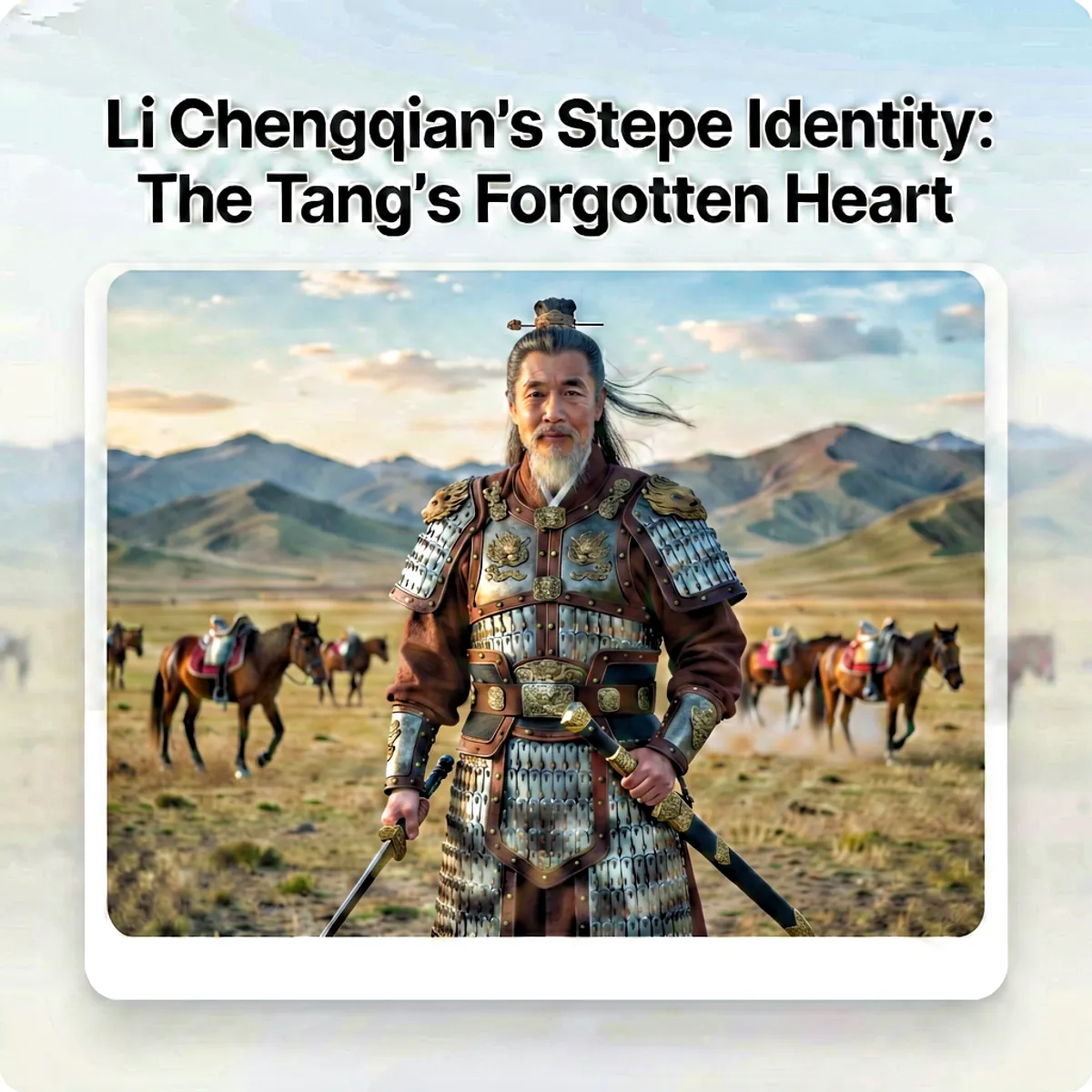
The Tang Dynasty's Steppe Heart: Beyond Cosmopolitanism
The Tang Dynasty (618-907 CE) is celebrated as a pinnacle of Chinese cosmopolitanism, a golden age where Chang'an’s streets echoed with a multitude of languages and its culture radiated across Asia. This narrative, however, often masks a more visceral and foundational truth: the Tang state was forged in the crucible of the Eurasian steppe. Its power rested not solely on Confucian bureaucracy and agrarian wealth, but on a deep, often contradictory, symbiosis with the nomadic empires of the north.
The Li imperial family’s own origins in the northwestern frontier, a zone of perpetual cultural and military fusion, meant that the dynasty’s very DNA was hybrid. To understand Tang China is to understand this sino-steppe dynamic—a reality where cavalry tactics, marriage alliances (heqin), and the ruling clan’s identity were inextricably linked to Turkic and other steppe polities. The court’s public face promoted a sinicized, centralized empire, but its private engine was a pragmatic, often ruthless, negotiation between the sedentary plain and the mobile grassland.
This essay argues that Li Chengqian’s much-maligned embrace of steppe culture was not personal deviancy, but a logical, if politically catastrophic, articulation of the dynasty’s suppressed core identity. His story is the key to a "what if" that probes the very essence of Chinese state formation.
The Li Clan and Frontier Identity
The Tang ruling house, the House of Li, did not spring from the Central Plains, the traditional heartland of Chinese civilization. Their power base was firmly in the northwest—modern Shanxi and Shaanxi—a region that for centuries had been a permeable frontier. This was a cultural melting pot, a landscape where Han Chinese settlers, aristocrats from the preceding Northern Dynasties (many with Xianbei or other steppe connections), and various Turkic and Mongolic tribes lived in dense, often tense, proximity.
Intermarriage was not an anomaly but a strategic norm. Emperor Gaozu, the dynasty’s founder, had a mother of Xianbei descent. This heritage ensured the Tang elite was inherently conversant with steppe customs: the importance of personal loyalty over bureaucratic rank, the prestige of horseback archery, and the clan-based social structure.
They were not external conquerors imposing a foreign order but products of a hybrid world, fluent in both Chinese classical texts and steppe martial culture. This background rendered Emperor Taizong’s later, more public adoption of steppe titles and customs less a revolution and more a formalization of an existing familial and political reality. The dynasty’s identity was a palimpsest, with a Sinitic surface written over a deeply inscribed steppe foundation.
The Turkic Factor in Tang Power
The geopolitical fulcrum of early Tang history was its relationship with the Turkic Khaganates, especially the Eastern Turkic Khaganate. In the dynasty’s precarious infancy, the Turks were the paramount military power in the north, so formidable that Emperor Gaozu contemplated abandoning Chang'an to escape their reach. The dynasty’s survival and rise hinged on navigating this threat.
The masterstroke came from his son, Taizong. Through a combination of devastating military campaigns (notably the 630 CE destruction of the Eastern Turkic Khaganate), strategic marriage alliances, and sophisticated diplomatic manipulation, Taizong did not merely defeat the Turks; he absorbed their elite, integrated their formidable cavalry into the Tang forces, and assumed the title "Heavenly Khan" (Tian Kehan). This was a brilliant political duality: to his Chinese subjects, he was the Son of Heaven, ruling by the Mandate of Heaven through a Confucian bureaucratic framework; to the steppe nomads, he was their khan, a leader whose authority stemmed from personal prestige, military success, and the ability to distribute wealth and honor.
The Tang military machine that expanded into the Tarim Basin and challenged the Western Turks was, in critical respects, a steppe-inspired force, prioritizing mobile horse archers. The dynasty’s greatest territorial zenith was thus achieved by weaponizing the very steppe power it claimed to have eclipsed, creating a state that was simultaneously an empire and a confederation.
The Crown Prince Who Wore Deerskin: Performance and Politics
Into this world of fluid identities and pragmatic power politics stepped Li Chengqian, the eldest son of Taizong and the designated heir. His upbringing was a careful blend: a Confucian education, a Chinese-style palace, and Han Chinese tutors. Yet, from adolescence, he began a public, deliberate, and escalating performance of steppe identity.
Official histories like the Zizhi Tongjian and Jiu Tang Shu record his fascination with detail: his love for deerskin clothing (the garb of nomadic hunters), his fluency in Turkic languages, his hosting of mock nomadic feasts with roasted meats and felt tents, and his circle of companions, many with clear frontier or mixed heritage. These acts are traditionally dismissed as eccentricities or signs of mental instability. Viewed through the lens of the Tang’s foundational sino-steppe reality, however, they read as a profoundly political statement.
In the hyper-observant environment of the Chang'an court, where the heir apparent’s every action was a signal, Li Chengqian was openly championing the very cultural matrix that had birthed the dynasty but was now being systematically downplayed by the Confucian establishment. He wasn't being "weird"; he was performing an alternative vision of the state, one that threatened the court’s preferred narrative of pure Sinitic legitimacy.
Adopting the Steppe Persona: A Political Program in Disguise
Li Chengqian’s actions constitute a coherent, if extreme, political program. His adoption of deerskin was not a fashion choice but a rejection of the silk robes of the scholar-official. It was an embrace of the leather and fur of the steppe warrior, a visual declaration of allegiance to a different set of values: mobility over sedentism, personal valor over literary refinement, clan loyalty over bureaucratic hierarchy.
His use of Turkic languages and music was a direct challenge to the monopoly of Chinese as the language of state. By organizing nomadic-style feasts, he recreated the social bonding rituals of the steppe, where loyalty was forged in communal eating and drinking, distinct from the hierarchical, ritualized banquets of the Chinese court. His coterie was not a gang of delinquents but a proto-faction representing the military-aristocratic frontier interest.
Chancellor Wei Zheng’s famous remonstrances, urging a return to "proper" Chinese decorum, reveal the deep anxiety his behavior provoked. For the Confucian officials, whose entire social and intellectual order was built on a clear civilizational hierarchy with "China" at the center and "barbarians" at the margins, Li Chengqian’s performance was existentially threatening. It suggested the pinnacle of power could be occupied by someone who openly preferred the "uncivilized" other.
For Li Chengqian, this may have been a genuine belief that this hybrid, martial model was more authentic to the Tang’s origins and more effective for governing a vast, multi-ethnic empire. His tragedy was that he expressed this belief with the unvarnished clarity of a crown prince, leaving no room for the necessary ambiguity his father, Taizong, had so masterfully maintained.
The Rebellion and Its Aftermath: Erasing the Alternative
Li Chengqian’s divergence from the expected path culminated in the catastrophic events of 643 CE. Implicated in a plot to assassinate Taizong and seize power, he was deposed, reduced to commoner status, and exiled. His co-conspirators were executed.
The official narrative, meticulously constructed in the subsequent official histories, framed this as the inevitable moral and political collapse of a man corrupted by "barbarian" ways. His interest in Turkic culture was cited as proof of his unfitness, the first step on a road to treason and madness. This narrative served a crucial purpose: it pathologized the steppe identity, making it a symptom of deviance rather than a viable political ideology.
After his fall, Taizong chose his ninth son, Li Zhi (the future Emperor Gaozong), as heir. Li Zhi was known for his gentle, compliant, and conventionally Chinese disposition—a safe choice for a bureaucracy terrified by Li Chengqian’s vision. The brief, shining moment of a crown prince openly identifying with the steppe world was over.
The court’s official history, compiled under the more thoroughly sinicized Gaozong and the formidable Empress Wu Zetian, would cement Li Chengqian’s image as a cautionary fool. Yet, this official version deliberately obscured a more complex and dangerous possibility: that Li Chengqian’s stance was not personal pathology but a coherent political program that threatened the ruling consensus. His removal was a necessary act of narrative control, clearing the way for a succession that reinforced the sinicizing trajectory and buried the dynasty’s hybrid heart under layers of Confucian orthodoxy.
The Hybrid Monarchy That rarely Was: Institutions and Ideology
The haunting counterfactual is not merely about a different man on the throne, but about a fundamentally different state. Had Li Chengqian survived, consolidated power, and ascended the throne in 649 CE, he would have presided over a deliberate, top-down pivot away from the cautious sinicization of Taizong’s later years. He would have sought to be a Heavenly Khan in practice, not just in title, institutionalizing a synthesis where Sinitic imperial ideology and steppe nomadic governance were equal pillars.
This was not a fantasy; the Tang apparatus already contained the necessary mechanisms—the Turkic cavalry units, the frontier aristocratic networks, the precedent of the dual title. The challenge would have been in the conscious, systematic rebalancing of power and culture.
Reimagining the Court and Military
A Li Chengqian monarchy would have initiated a quiet revolution in the composition and values of the state. The northwestern military-aristocracy, with its steppe connections and martial ethos, would have been privileged over the scholar-officials of the Central Plains. His closest advisors would have been generals like the Turkic-general Ashina She'er or nobles from frontier clans like the Liu (of Han-Xiongnu descent) or the Murong (of Xianbei descent), men who understood steppe diplomacy and mobile warfare. The imperial guard units, many already composed of non-Han soldiers (e.g., the "Flying General" cavalry of Turkic origin), would have gained unprecedented prestige and political weight.
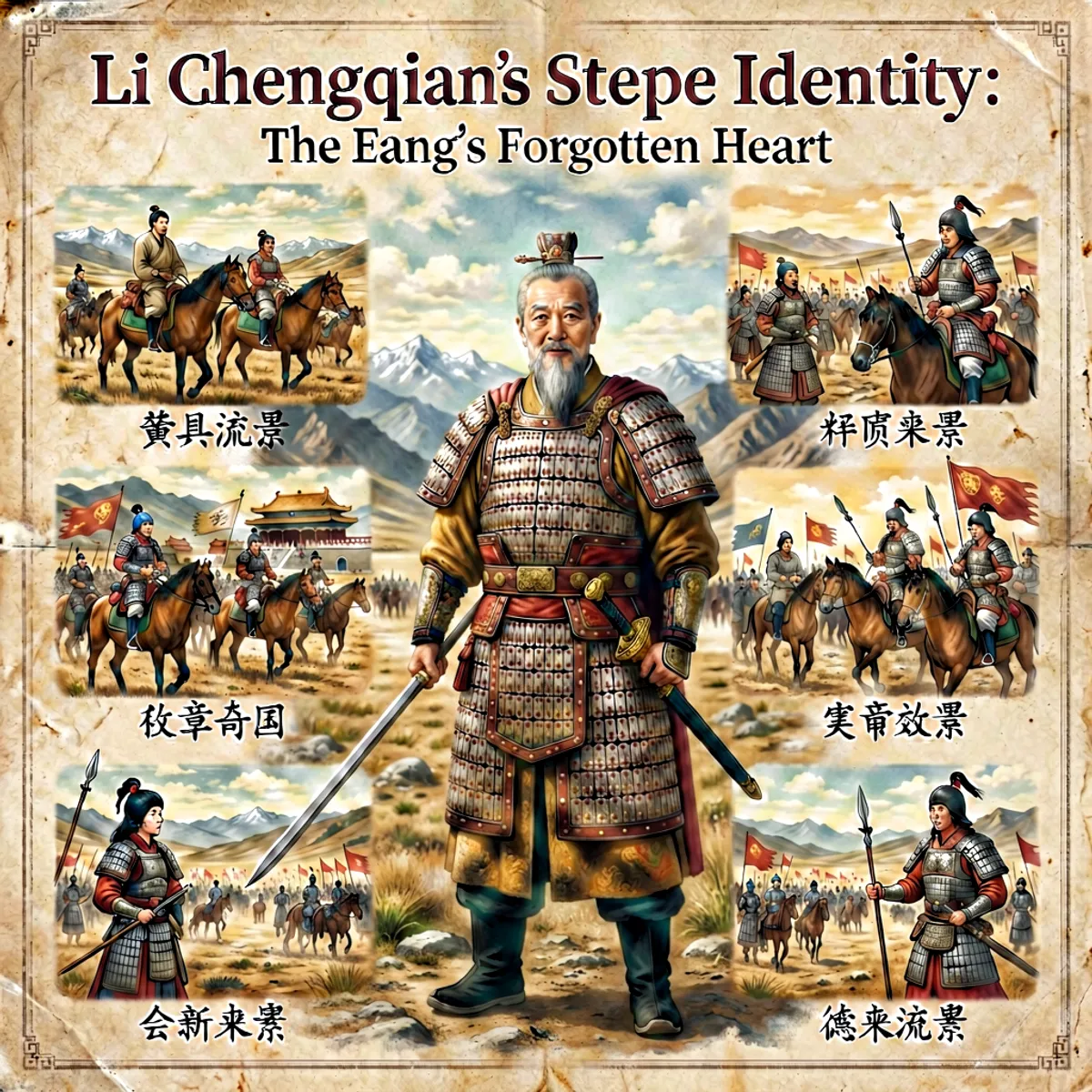
The civil service examination system, which Taizong had cautiously expanded, would have been fundamentally reformed. While not abolished, its content would have been altered to value martial prowess, linguistic skills (especially Turkic and other steppe languages), and knowledge of frontier geography alongside the classical Confucian canon. Poetry and prose would remain important, but essays on cavalry tactics or treaties with the Turks might have become examination topics.
The very aesthetic of the court would have transformed. The serene, lotus-pond-filled palaces of Chang'an, designed for bureaucratic ritual, might have been supplemented or even partially replaced by grand felt tents (gers) for receiving steppe envoys in the traditional kurultai style. State rituals would have incorporated more hunting expeditions—a core steppe test of leadership—and the music and dances of the western regions and the Mongolian grasslands would have dominated court performances, not just been tolerated as exotic entertainment.
The cultural flowering of the Kaiyuan era (713-741) under Xuanzong, often seen as the peak of Tang cosmopolitanism mediated through Sogdian traders, might have had a more visceral, direct steppe flavor, less filtered through Central Asian intermediaries.
Foreign Policy: Khan, Not Just Emperor
In foreign relations, a Li Chengqian emperor would have abandoned his father’s delicate, duplicitous balancing act. Taizong used "Heavenly Khan" as a title of supremacy but governed primarily as a Chinese emperor, projecting power through a sedentary, garrison-based system. Li Chengqian would have fully embraced the steppe model of khanship, where authority was personal, contractual, and based on reciprocal gift-giving, recognition of personal merit, and demonstrated military prowess.
This would have meant deeper, more formal alliances with Turkic tribes, potentially including imperial marriages (heqin) at the highest level to cement bonds as equals, not as a Chinese emperor bestowing a princess on a subordinate. Campaigns against the Western Turks and into Central Asia might have been conceived not as wars of conquest to secure Silk Road trade routes for agrarian tax revenue, but as grand raids (nerge) to demonstrate the khan’s personal power, distribute plunder, and reaffirm the loyalty of allied tribes—a classic steppe khagan’s move that also happened to secure lucrative trade.
The relationship with the Tibetan Empire (Tubo), another hybrid Himalayan-steppe power, would have been particularly fascinating. It might have evolved less as a clash of two territorial empires and more as a rivalry between two khans with different cultural bases (one more Tibetan-Buddhist, one more Turkic-Tang), potentially leading to a partition of influence or a dual-hegemony system in Inner Asia. Such a policy would have carried immense risks: it could have alienated the Confucian scholar class, who saw such "barbarian" customs as demeaning to the throne, and it might have overextended state resources on mobile warfare that was less efficient for controlling settled populations.
But, it might have secured the northern frontier more durably by making the Tang a recognized, respected peer within the steppe political system, rather than an occupying agrarian power resented for its garrisons and taxes. The Uyghur Khaganate, which later succeeded the Turks as the Tang’s crucial steppe ally, might have been integrated even more deeply, perhaps as a semi-autonomous princely domain within the Tang system.
The Long-Term Sinicization Question: Acceleration or Reversal?
The greatest uncertainty concerns the dynasty’s long-term trajectory. Historically, the Tang saw the Li imperial family and the northeastern aristocracy gradually become thoroughly siniticized through intermarriage, bureaucracy, and cultural patronage. Would a Li Chengqian reign have accelerated this process by creating a stable, proud hybrid model, or would it have reversed it by reasserting steppe primacy?
One plausible scenario is that his hybrid model would have created a powerful, enduring Sino-steppe ruling class, akin to a proto-Yuan dynasty but with a Turkic-Chinese synthesis at its core led by a Han-identifying house. The imperial family would have proudly maintained steppe customs (language, dress, marriage patterns), and the state identity would have been explicitly pluralistic, with "Chinese" and "Turkic" as co-equal civilizational streams under the Tang mantle. Alternatively, his experiment might have been too destabilizing.
The Confucian bureaucracy, deeply rooted in local society through the examination system and landholding, might have resisted fiercely, leading to a sharper, more violent internal conflict between "steppe" (military-aristocratic) and "plain" (scholar-bureaucratic) factions. His dynasty could have fractured sooner, with successor states forming along these cultural lines after a succession crisis. Or, his model might have been a dead end—a personal obsession that collapsed with him, causing a severe reaction and making the subsequent Gaozong court retreat even further into Chinese orthodoxy as a defensive measure.
The "what if" is thus not about a better or worse Tang, but about a fundamentally different civilizational trajectory for China itself, one where the steppe contribution was not a suppressed undercurrent but the mainstream current of imperial ideology and identity.
The Truth Beneath the Narrative: Suppression and Its Costs
Li Chengqian’s story is more than a footnote about an eccentric prince; it is a prism that reveals the suppressed tensions at the heart of the Tang Dynasty. The official histories, compiled by the victors of the Confucian establishment, label his behavior "weird" and "barbarian" to discredit it. But his actions were a logical, if extreme, expression of the dynasty’s foundational reality.
The Tang state was a hybrid beast, part Chinese empire, part steppe confederation. Emperor Taizong understood this better than anyone; his "Heavenly Khan" title was a masterstroke of political branding that allowed him to be both. Yet, for the sake of long-term stability and the consolidation of a sedentary, bureaucratic state capable of governing millions, the sino-steppe synthesis had to be downplayed, even hidden.
The heir apparent was supposed to symbolize the future—a future that was increasingly, comfortably Chinese. Li Chengqian, by publicly living the steppe identity with such fervor, forced the court to confront the contradiction. His removal was necessary to maintain the narrative that Tang power was an extension of pure Sinitic civilization, built on the Confucian model, not a product of frontier fusion.
He embodied the truth the dynasty, for political reasons, preferred not to admit.
The Cost of a Single Narrative
By suppressing Li Chengqian’s vision and framing it as deviancy, the Tang court made a decisive choice. It chose the path of deeper sinicization, which brought the glorious cultural achievements of the Kaiyuan and Tianbao eras but also sowed seeds of later weakness. The An Lushan Rebellion (755-763), which nearly toppled the dynasty, was led by a general of Sogdian-Turkic descent who commanded a multi-ethnic army—a stark, violent reminder that the steppe world could not be integrated and then ignored or despised.
A monarchy that had openly embraced its hybrid nature, as Li Chengqian might have led, might have managed these internal tensions differently. Perhaps the jiedushi (military governors) who rose to power in the late Tang would have been seen as legitimate regional khans within a flexible imperial system, akin to steppe appanages, rather than as rebels against a centralized Chinese order. The dynasty’s collapse might have looked less like the failure of a Chinese state and more like the fragmentation of a steppe-inspired empire into successor khanates, a pattern familiar from the earlier Xiongnu or later Mongol empires.
The official history’s dismissal of Li Chengqian thus comes at a profound cost: it blinds us to the viable alternatives that existed within the Tang’s own context, alternatives that might have offered a more resilient model for managing China’s perpetual frontier.
Echoes in Later History: The Hybrid Model Resurgent
The question of a Sino-steppe hybrid monarchy did not die with Li Chengqian in 643 CE. It would echo through Chinese history, most explicitly in the conquest dynasties of the north. The Khitan Liao (907-1125) and the Jurchen Jin (1115-1234) both ruled over northern China while maintaining distinct steppe-based administrative systems for their nomadic populations, creating a dual governance structure.
The Mongol Yuan dynasty (1271-1368) was the ultimate realization of a steppe empire ruling all of China, with Kublai Khan adopting the Chinese title of Emperor but preserving the Mongol core of his regime—a separate legal code for Mongols and a privileged status for steppe peoples. Even the Manchu Qing (1644-1912), while becoming profoundly sinicized in its later centuries, never lost its distinctive Manchurian and steppe-derived banner system, a parallel military and social structure that co-existed with the Confucian bureaucracy. Each of these dynasties grappled with the balance between steppe and plain, between their native identity and the overwhelming cultural gravity of the Central Plains.
Li Chengqian’s hypothetical reign represents an earlier, Chinese-led attempt at this synthesis—a "what if" where the Tang itself became a proto-conquest dynasty centuries before the Khitans or Mongols. His story shows that the model was conceivable within a Han-ruled framework, long before the "barbarian" dynasties made it a reality. The Qing’s ultimate success in forging a durable Manchu-Han synthesis provides the closest historical analogue to Li Chengqian’s imagined reign.
The Qing emperors, from Nurhaci through Qianlong, consciously cultivated a dual identity, mastering Classical Chinese and the Confucian statecraft needed to govern the Han populace while preserving Manchu language, martial traditions, and the banner system for their own people. Their institutional bifurcation allowed them to govern both the agricultural plains and the Mongolian steppe effectively for nearly three centuries. A Li Chengqian Tang would have faced a similar challenge but with a crucial difference: the Tang Li clan’s frontier heritage was older and more deeply intermixed with Turkic culture than the Qing’s relatively recent Jurchen roots.
The Tang synthesis might have appeared less like a foreign conquest dynasty’s pragmatic adaptation and more like an internal, organic evolution of a native Chinese ruling house, potentially making the hybrid model more psychologically acceptable to the Han majority from the start.
The Human Dimension of Identity: Between Performance and Authenticity
Beyond grand historical trajectories, Li Chengqian’s story touches on the deeply personal dimension of cultural identity. He was a man caught between worlds. His father, Taizong, was a supremely pragmatic ruler who could don the robes of a Chinese emperor one day and the leather tunic of a steppe khan the next, but he always maintained a clear, strategic separation.
For Taizong, the duality was a tool. For Li Chengqian, the distinction seems to have blurred. His adoption of deerskin clothing and Turkic songs may have been a genuine expression of self, a feeling of affinity for the martial, free-spirited culture of the steppe that contrasted with the rigid, performative world of the Chang'an court.
Was it a political statement, a personal rebellion, or a psychological break? The official histories, eager to explain his failure, lean toward the latter. But a neutral observer might see a young man attempting to reconcile his frontier heritage with his imperial destiny in the only way he knew how—by fully inhabiting the "other" culture his dynasty’s power relied upon.
His tragedy was that his personal identity became a political liability in a system that demanded a singular, sacralized image of the heir.
Performance and Authenticity in the Court Arena
The line between performance and authenticity in Li Chengqian’s actions is impossible to draw, and in the court, that distinction was irrelevant. Every act was political. His love for Turkic music could be a sincere appreciation, a calculated signal to steppe allies within the empire, or a deliberate provocation to Han officials.
Likely, it was all three simultaneously. What matters is the effect. His behavior destabilized the court’s carefully managed racial and cultural hierarchies.
It suggested that the pinnacle of Chinese power could be occupied by someone who openly preferred "barbarian" ways. This was existentially threatening to the Confucian scholar-officials whose entire worldview, social status, and career path were built on a clear civilized-uncivilized binary with China at the apex. Their victory in promoting Li Zhi as heir was a victory for that binary.
Li Chengqian’s legacy was thus to be erased as a warning. Yet, the very need for such a warning hints at the powerful allure and practicality of the steppe model, even in the heart of the Chinese empire. He represents the ghost in the machine of Tang history, the possibility that the dynasty’s greatest strength—its hybrid origins—could have been its defining, celebrated principle rather than its hidden secret.
His story forces us to ask: what is "Chinese" identity if not a continuous process of negotiation with the steppe?
A Different 2026: Speculative History of a Sino-Steppe Synthesis
To fully grasp the magnitude of the road not taken, we must engage in a disciplined exercise of counterfactual history. Imagine Li Chengqian survives the 643 plot—perhaps through a pre-emptive strike against his rivals, or a sudden, miraculous reconciliation with his father. He ascends the throne in 649 CE upon Taizong’s death.
What does the world look like in 2026, over 1,300 years later, under this alternate Tang trajectory? This is not fantasy but a logical extension of the institutional and ideological premises his reign would have established.
The Enduring Sino-Steppe Synthesis
By 2026, the Tang Empire under the Li Chengqian line would have evolved into a permanent, institutionalized Sino-steppe civilization. The imperial ideology would explicitly recognize two co-equal pillars: the Mandate of Heaven for the agricultural heartland and the Khanate’s legitimacy derived from the steppe confederations. The capital would not be a single city but a ceremonial circuit: Chang'an (or Luoyang) for Confucian court rituals and agrarian administration; a grand tent-city near modern Ulaanbaatar for the annual kurultai (tribal council) where steppe nobles affirmed the khan’s authority; and perhaps a Buddhist monastic center in Dunhuang or a pastoral administrative hub in the Ordos Loop for managing the hybrid frontiers.
The imperial examination would be bifurcated. One track would test mastery of the Thirteen Classics, historical annals, and literary composition for the civil administration. A parallel, equally prestigious track would test fluency in a standardized literary Turkic (written in a modified Uyghur-derived vertical script), knowledge of steppe history and customary law (törö), equestrian skills, and tactics of mobile warfare.
Passing either track could lead to the highest offices, creating a true dual elite. The army would be the core institution: a permanent, professional cavalry force drawn from steppe-descended households and allied tribes, supported by local infantry levies. Command positions would be open to both Han and non-Han nobles based on merit and lineage, with the imperial guards (Fubing system evolved) being the most prestigious, explicitly multi-ethnic unit.
Culturally, literature and art would fuse Tang poetry’s lyrical depth with the epic, heroic narratives of the steppe. Poets might compose in both Chinese and literary Turkic. Painting would depict not only serene landscapes but also grand hunts, tribal gatherings, and cavalry charges, executed in a style blending Chinese brushwork with Sogdian miniature vibrancy and Mongol dynamism.
Buddhism, already a bridge, would see even greater Tantric (Vajrayana) influence from Tibetan and Uyghur patrons at court, while Nestorian Christianity and Manichaeism, tolerated under the historical Tang, could have become semi-official faiths of the frontier garrisons, their scriptures stored alongside the Confucian classics in the imperial library. The state religion would be a syncretic "Heavenly Khanism," blending the Mandate of Heaven, Tengri worship (the sky god of the steppe), and Mahayana Buddhism, with the emperor as both Son of Heaven and Great Khan of Khans, a sacred mediator between the agricultural and nomadic worlds.
The 2026 Civilizational Landscape and Technological Divergence
By 2026, this alternate world’s "China" would be a civilizational term, not a nation-state. The Tang-descended realm, perhaps still called "Great Tang" (Da Tang) or "Central Realm" (Zhongyuan), would be a supranational polity spanning from the Pacific coast to the Aral Sea. Its identity would be inherently plural, with Han, Turkic, Mongolic, Tibetan, and other lineages all claiming equal descent from the Tang synthesis. The concept of "Chinese" would mean "subject of the Tang synthesis," not "Han ethnicity." The Great Wall, if built at all, would be a symbolic boundary of cultural administration, not a barrier of exclusion—a far cry from the Ming’s monument to separatist Han nationalism.
Technologically and economically, this world might have diverged significantly. The state’s dual focus would have spurred infrastructure development along both the Grand Canal (for north-south grain transport) and the steppe corridors of the Mongolian plateau and the Dzungarian Basin (for cavalry movement and pastoral trade). Railways and roads might have first connected the steppe summer pastures to the Chinese winter markets, creating a different geographic logic of integration.
Environmental management would blend Chinese irrigation and terracing with nomadic grassland stewardship, potentially creating a more sustainable northern ecology and preventing the desertification that plagued later Chinese northern frontiers. The equal-field system (juntian) might have been modified to allocate land not just for farming but also for seasonal pasturage, creating a legally recognized class of "steppe-agrarian" households loyal to the throne through dual rights.
The An Lushan Rebellion—a catastrophic civil war triggered by a Sogdian-Turkic general—might never have occurred in its historical form. Instead, the tensions represented by a figure like An Lushan could have been channeled into a constitutional framework. Perhaps the Tang would have developed a formal "Council of Steppe and Plain," where military governors (jiedushi) of mixed heritage held seats, transforming potential rebellion into institutionalized power-sharing.
The dynasty’s eventual fragmentation in the 10th century might not have been a collapse into chaos (the Five Dynasties period) but a peaceful devolution into a family of successor khanates—a Tang Commonwealth—all retaining the hybrid culture, much like the later Mongol khanates. This would have prevented the sharp cultural break and the intense Han-centric revival of the Song Dynasty, which historically turned inward, militarily weak, and obsessed with recovering the "lost north" from "barbarian" rule.
The Qing Precedent and the Tang "What If" Realized
The Qing dynasty’s success in forging a durable Manchu-Han synthesis is the closest historical proof that Li Chengqian’s vision was not inherently unworkable. The Qing emperors, from Nurhaci through Qianlong, consciously walked the tightrope: they mastered Classical Chinese, patronized Confucian scholarship, and governed the Han populace through the traditional bureaucracy, while fiercely preserving Manchu language, martial skills, and the banner system for their own people. They were both Sons of Heaven and Khans of the Manchus and Mongols.
A Li Chengqian Tang would have faced a similar challenge but with a critical advantage: the Tang Li clan’s frontier heritage was older, more deeply intermixed with Turkic culture, and less marked by a recent conquest. The Tang synthesis might have appeared less like a foreign imposition (as the Qing was often seen by literati) and more like a restoration of the dynasty’s authentic, original character. This could have made the hybrid model more psychologically acceptable and stable from the Han perspective from the very beginning, potentially avoiding the deep-seated resentment that simmered beneath the Qing’s surface.
The Qing achievement, therefore, can be seen as the large-scale, successful implementation of a Li Chengqian-style project—a ruling dynasty that never fully chose between its steppe roots and its Chinese imperial mantle, but instead celebrated the duality. The fact that it took nearly a millennium for such a synthesis to be successfully institutionalized on a continental scale suggests Li Chengqian’s vision was not flawed, but simply ahead of its time.
Conclusion: The Significance of a "Weird" Prince
Li Chengqian’s story is a vital, corrective lens on the monolithic image of Chinese civilization. He was not a failed ruler or a mad prince, but a living argument for an alternative path, one that acknowledged the steppe as a co-creator of Tang power, not a peripheral problem to be managed. His "weirdness" was the weirdness of a truth too inconvenient for the state to bear: the greatest Chinese dynasties were often born on and sustained by the frontier.
The Han Dynasty’s founder, Liu Bang, was a minor official from the margins; the Qing founders were Jurchen chieftains. The Tang were no exception. Li Chengqian’s tragedy was that he made this foundational truth explicit, unmediated, and public at a moment when the state was actively constructing a narrative of pure Sinitic continuity to bolster its legitimacy.
The state was not yet institutionally or culturally ready to embrace its hybridity as a positive ideal. The Confucian project of creating a unified, sinicized empire required a clear civilizational hierarchy, and Li Chengqian’s open Turkic sympathies undermined it. His deposition and subsequent vilification cleared the way for the more comfortable, but ultimately less resilient, model of a sinicized dynasty managing a steppe periphery as a potentially rebellious "other." The rebellions, the rise of autonomous military governors, and the eventual collapse of the Tang can be read as the long-term consequences of failing to reconcile that periphery with the core, of insisting on a single, Han-centered identity that could not contain the empire’s multi-ethnic realities.
In this light, Li Chengqian is not a fool but a prophet whose vision was rejected, leaving China to grapple with its steppe connections in more violent and piecemeal ways for the next thousand years. His story reminds us that history is not a single, inevitable line of development, but a field of possibilities, where one man’s eccentric performance might have reshaped a civilization’s trajectory. The ghost of the prince in deerskin haunts the Tang, a constant reminder that the dynasty’s glory was built on a fusion it was ultimately too afraid to celebrate.
Responses • 0
0/2000
ID: 1326
Chris
Online
From
Bakersfield, United States
Send Message