How is the different 非常,特别,挺,不太,最?

Chinese Grammar
 
  Aug 12  •  1069 read 
非常,特别,挺,不太,最的意思有什么区别?
0
0
0
Answer
1. "要...了":
"要...了" 表示某事即将发生,有确定性,通常没有时间紧迫感。这种表达方式不搭配具体的时间词。
例句:
这本书要出版了,很多人都在期待。

2. "快...了":
"快...了" 表示某事即将发生,带有时间紧迫感,但不强调确定性。这种表达方式可以搭配时间词。
例句:
飞机快起飞了,请尽快就座。

3. "就要...了":
"就要...了" 表示某事在不久的将来会发生,可能与上下文中的其他情况相对比,突出即将到来的事件。这种表达方式可以搭配时间词。
例句:
明天就要放假了,我们可以计划一下。

4. "快要...了":
"快要...了" 表示某事即将发生,有一定的时间紧迫感,但不强调确定性。
例句:
考试快要开始了,同学们都在紧张地复习。

注意!
句中又表示具体时间作状语时,不能用“快要...了”。
例句:
不能说: *下个月姐姐快要结婚了。(x)
应该说:下个月姐姐就要结婚了。 (v)
(more)
 0  •  Reply •  Aug 20
The Chinese words 非常 (fēicháng), 特别 (tèbié), 挺 (tǐng), 不太 (bù tài), and 最 (zuì) all have different nuances and usage in expressing degrees, intensities, or comparisons. Here's a breakdown of their differences:

非常 (fēicháng):
非常 is often used to convey a high degree or intensity of something. It can be translated as "very," "extremely," or "extraordinarily." It emphasizes a strong level of the quality being described.

特别 (tèbié):
特别 is used to describe something as "special," "particular," or "unique." It can also indicate that something is "especially" or "particularly" the case, emphasizing distinctiveness.

挺 (tǐng):
挺 is a bit more colloquial and informal. It's used to express a degree of something that is moderately strong, more than expected, or quite noticeable. It can be translated as "quite" or "pretty."

不太 (bù tài):
不太 literally translates to "not very." It's used to express a lower degree or a lack of intensity compared to what might be expected. It's commonly used in negative statements to indicate that something is not quite at a high level.

最 (zuì):
最 translates to "most" or "the most." It's used to indicate superlatives or comparisons of extremes. When used before an adjective, it emphasizes that something has the highest degree of that quality.

Here are some examples to illustrate the differences:

非常: 我非常喜欢这本书。 (Wǒ fēicháng xǐhuān zhè běn shū.) I really like this book a lot.

特别: 这是一个特别的机会。 (Zhè shì yīgè tèbié de jīhuì.) This is a special opportunity.

挺: 这个饭馆的菜挺好吃的。 (Zhège fànguǎn de cài tǐng hǎochī de.) The food at this restaurant is quite delicious.

不太: 这个电影不太有趣。 (Zhège diànyǐng bù tài yǒuqù.) This movie isn't very interesting.

最: 这是我最喜欢的颜色。 (Zhè shì wǒ zuì xǐhuān de yánsè.) This is my favorite color.
(more)
 0  •  Reply •  Aug 19
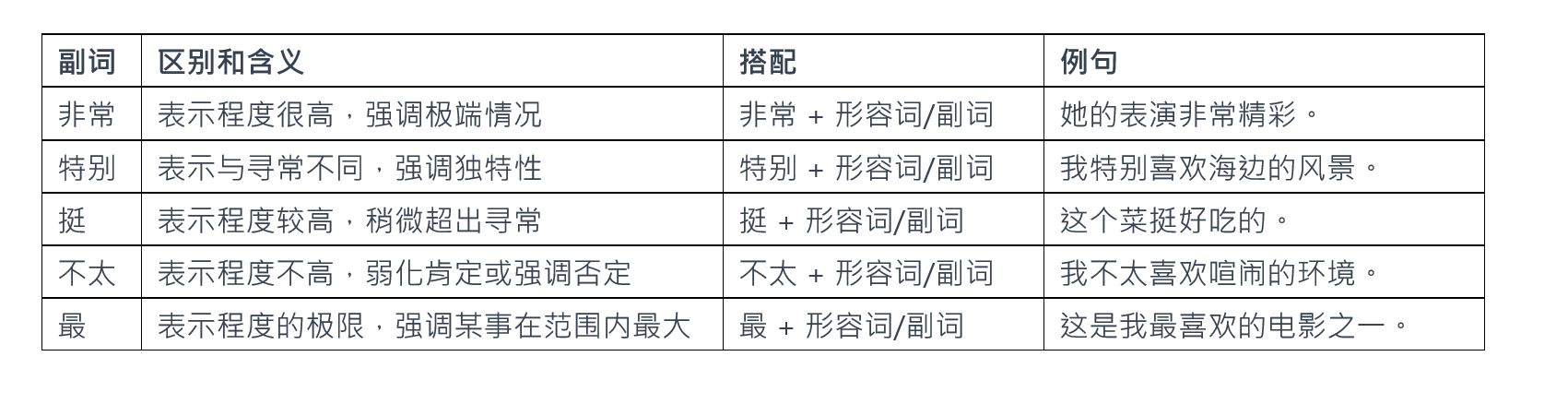
1.非常: 表示程度很高,强调极端情况 非常 + 形容词/副词, 例句:她的表演非常精彩。
2.特别 表示与寻常不同,强调独特性 特别 + 形容词/副词 例句: 我特别喜欢海边的风景。
3.挺 表示程度较高,稍微超出寻常 挺 + 形容词/副词 例句:这个菜挺好吃的。
4.不太 表示程度不高,弱化肯定或强调否定 不太 + 形容词/副词 例句:我不太喜欢喧闹的环境。
5最 表示程度的极限,强调某事在范围内最大 最 + 形容词/副词 例句:这是我最喜欢的电影之一。
 1  •  Reply •  Aug 19
非常感谢!
 0  •  Reply •  Aug 19
答案在表格里
副词-35316-1692425286
 1  •  Reply •  Aug 19
非常感谢!
 0  •  Reply •  Aug 19
最>特别>非常>挺>不太
最 ---the best
特别--specially, particular
非常 --Very /much /great
挺 ----like 很 , but degree less than 很 ; generally used to oral Chinese
不太 --not very ,not so .

eg :最好的 > 特别好 > 非常好 > 挺好 > 不太好
(more)
 2  •  Reply •  Aug 14
Thank you very much for your reply!
 1  •  Reply •  Aug 19
hi there, these five words are all adverbs in different degrees,normally followed with adjectives or adverbs. 最means the most...,非常means extremely..., 特别means especially..., 挺is like quite..., 不太is like not exactly... .The difference of these English words is basically the difference of them in Chinese. and the degreee from 10 to 1 goes with the order I explained them. 最>非常>特别>挺>不太。 and you may want to know that 特别is not only an adv, but adj itself meaning special. let me give you examples, 你特别可爱。 特别+adj. it works as an adv. meaning you are especially cute。 你很特别。here特别works as an adj. meaning you are special。
 1  •  Reply •  Aug 12
非常感谢您!
 1  •  Reply •  Aug 13
More
ID: 21289

myhobby

Offline
Oct 08  Visited
From Rangoon, Myanmar
Send Message