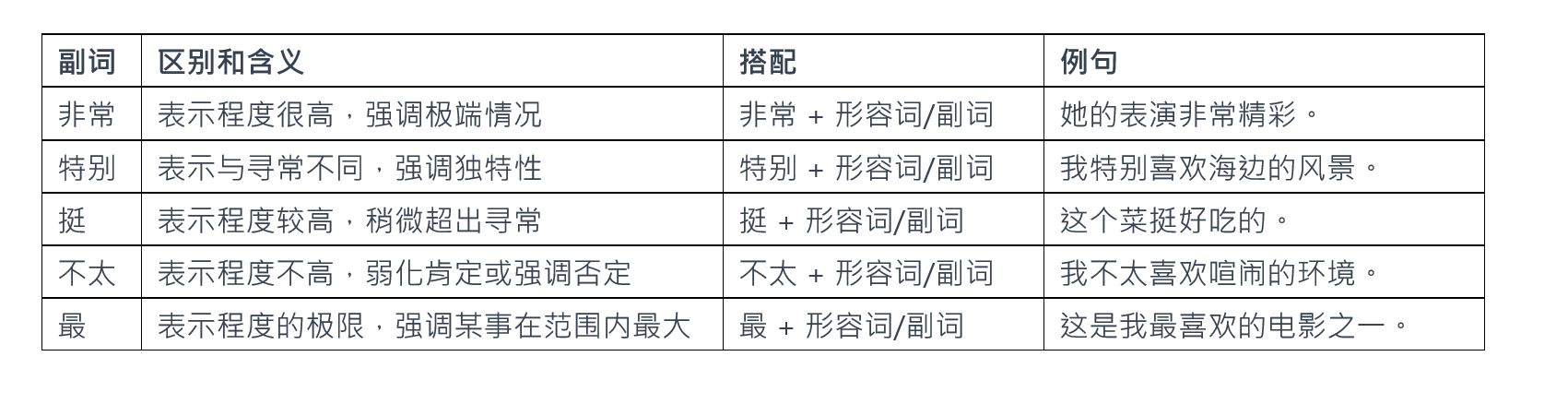
The Chinese words 非常 (fēicháng), 特别 (tèbié), 挺 (tǐng), 不太 (bù tài), and 最 (zuì) all have different nuances and usage in expressing degrees, intensities, or comparisons. Here's a breakdown of their differences:
非常 (fēicháng):
非常 is often used to convey a high degree or intensity of something. It can be translated as "very," "extremely," or "extraordinarily." It emphasizes a strong level of the quality being described.
特别 (tèbié):
特别 is used to describe something as "special," "particular," or "unique." It can also indicate that something is "especially" or "particularly" the case, emphasizing distinctiveness.
挺 (tǐng):
挺 is a bit more colloquial and informal. It's used to express a degree of something that is moderately strong, more than expected, or quite noticeable. It can be translated as "quite" or "pretty."
不太 (bù tài):
不太 literally translates to "not very." It's used to express a lower degree or a lack of intensity compared to what might be expected. It's commonly used in negative statements to indicate that something is not quite at a high level.
最 (zuì):
最 translates to "most" or "the most." It's used to indicate superlatives or comparisons of extremes. When used before an adjective, it emphasizes that something has the highest degree of that quality.
Here are some examples to illustrate the differences:
非常: 我非常喜欢这本书。 (Wǒ fēicháng xǐhuān zhè běn shū.) I really like this book a lot.
特别: 这是一个特别的机会。 (Zhè shì yīgè tèbié de jīhuì.) This is a special opportunity.
挺: 这个饭馆的菜挺好吃的。 (Zhège fànguǎn de cài tǐng hǎochī de.) The food at this restaurant is quite delicious.
不太: 这个电影不太有趣。 (Zhège diànyǐng bù tài yǒuqù.) This movie isn't very interesting.
最: 这是我最喜欢的颜色。 (Zhè shì wǒ zuì xǐhuān de yánsè.) This is my favorite color.
(more)