Guo Degang and China's Shifting Speech Boundaries
AI Learn Chinese
5 hr • 0 read
Guo Degang's lyric alteration case highlights tightening speech boundaries in China, legal risks, and the societal chilling effect on expression.

Introduction: A Performance That Sparked National Debate
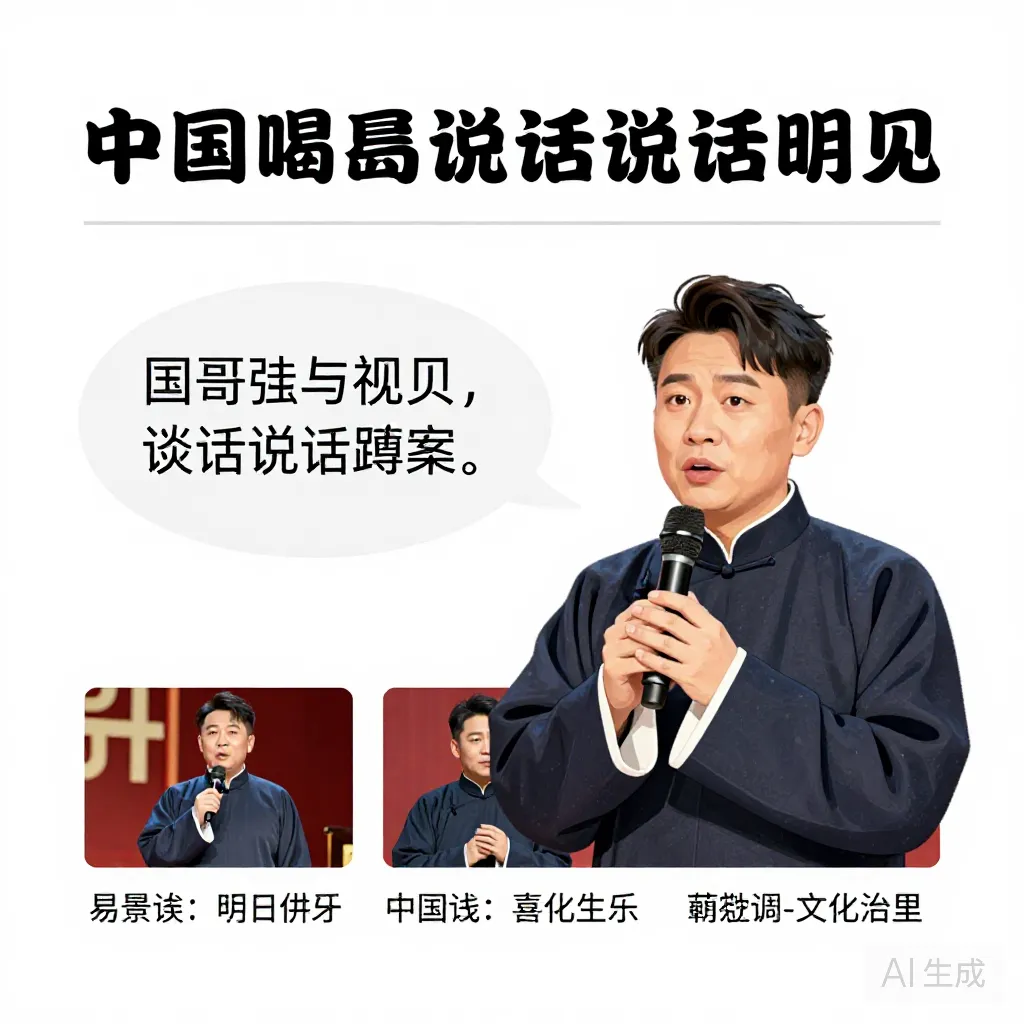
The investigative notice against Guo Degang in early 2024 for altering song lyrics during a xiangsheng performance immediately became more than a celebrity scandal. It transformed into a public referendum on the permissible limits of humor, historical memory, and political commentary in contemporary China. Guo, a towering figure in traditional crosstalk, injected references to the Forbidden City into a beloved revolutionary anthem from the Anti-Japanese War era.
This act, intended as comedic subversion within his art form, was interpreted by some as a disrespectful trivialization of historical sacrifice. The incident crystallized a growing tension: a society with a rich tradition of satirical performance now navigating an increasingly narrow corridor of acceptable speech.
This case is not an isolated tremor but a symptom of a deeper, decade-long shift. The public reaction split decisively. One faction viewed the alteration as a desecration, an insult to the memory of heroes who fought against Japanese invasion, demanding accountability under laws designed to protect their legacy.
The opposing faction saw a dangerous overreach, where artistic license and casual remark are elevated to criminal offenses, creating a pervasive climate of fear. This schism reveals a fundamental question about the relationship between cultural reverence, state authority, and individual expression in modern China. The discussion prompted by Guo’s case extends far beyond a single performer; it probes the very architecture of public discourse.
The Incident: “Playing My Beloved Pipa” and Its Aftermath
During a routine performance, Guo Degang modified the lyrics of “Playing My Beloved Pipa” (《弹起我心爱的土琵琶》). This song is a canonical piece from China’s cultural memory of the Anti-Japanese War, celebrated for its depiction of guerrilla fighters’ resilience. Guo’s version reportedly inserted phrases referencing the Forbidden City, a potent symbol of imperial and later, political power.
He then made a joking commentary linking this symbol to the song’s revolutionary spirit. For an audience segment, this melding of a sacred historical narrative with a symbol of dynastic and party authority was an unacceptable breach. Reports were filed with authorities, formally initiating an investigation into whether his actions constituted “insulting heroes and martyrs.”
The public response was a study in polarization. Online forums and social media buzzed with debate. Critics argued that revolutionary songs are collective cultural property, their integrity non-negotiable.
Altering them for humor, they contended, erodes the solemnity owed to historical sacrifice and could confuse younger generations about the nation’s foundational struggles. Supporters of Guo framed the backlash as a moral panic. They emphasized the context of xiangsheng, an art historically reliant on playful mockery and topical wit.
To them, punishing a joke sets a precedent where any deviation from an orthodox historical narrative becomes a legal peril. The core of the conflict lies in defining the boundary between disrespectful vilification and benign, if irreverent, artistic commentary.
Xiangsheng Crosstalk: A Tradition of Satire and Subversion
To understand the gravity of the accusation, one must appreciate the historical role of xiangsheng. This comedic duet form, with roots stretching back centuries, has long been a vehicle for social satire, linguistic play, and subtle criticism of authority. Its practitioners, or crosstalk performers, often walked a fine line, using humor to comment on bureaucratic inefficiency, social hypocrisy, and even political figures, all under the guise of innocent banter.
The tradition prizes cleverness, improvisation, and a certain cheeky defiance against rigid orthodoxy. Guo Degang himself revitalized the art in the 21st century, in part by embracing this irreverent spirit and drawing massive audiences who appreciated its return to sharp, relatable humor.
The accusation that he tarnished a revolutionary song directly challenges this tradition. It suggests that certain subjects—specifically, the hallowed narratives of national struggle—are now beyond the reach of xiangsheng’s playful touch. This represents a significant constraint.
If the genre cannot engage with iconic historical symbols through its characteristic irony and adaptation, its creative vitality is fundamentally curtailed. The incident forces a question: has the permissible scope for satire in China’s public sphere permanently shrunk? For many artists and cultural observers, Guo’s predicament signals that the long-standing understanding of xiangsheng as a “safety valve” for social commentary is no longer valid.
The art form’s historical function is now in direct conflict with contemporary political sensitivities.
The Legal Framework: From Vague Norms to Specific Crimes
The legal environment governing speech in China has evolved markedly over the past fifteen years, moving from broad administrative guidelines to more specific criminal statutes. For years, criticism of the government or historical narratives was managed through charges like “picking quarrels and provoking trouble” (寻衅滋事) or “inciting subversion of state power” (煽动颠覆国家政权). These were flexible tools, but their application to cultural figures often relied on perceived social impact or political intent. The shift accelerated after 2015, with a series of judicial interpretations and new laws that explicitly criminalized speech deemed insulting to specific, state-defined groups.
The landmark development was the Heroes and Martyrs Protection Law enacted in 2018. This law specifically created the crime of “insulting heroes and martyrs” (侮辱英烈法). It moved beyond general defamation to protect the reputation of individuals the state has officially designated as heroic.
Crucially, the law’s language and subsequent enforcement have been interpreted to include not just direct slurs but also “distortion” or “denigration” of their deeds and spirit. This legal precision is what transforms Guo Degang’s action from a simple artistic misstep into a potential prosecutable offense. The law provides a clear, actionable statute for prosecutors, reducing the ambiguity that previously shielded some forms of commentary.
It signifies the state’s commitment to legally enforcing a particular version of historical reverence.
Precedent Cases: A Decade of Public Figures in the Crosshairs
Guo Degang’s case fits into a discernible pattern of high-profile individuals facing severe consequences for controversial remarks over the last decade. Each case incrementally mapped the contracting boundaries of permissible speech. In 2015, television host Bi Fujian was suspended from China Central Television (CCTV) after a video surfaced showing him using a derogatory reference to Chairman Mao Zedong during a private dinner. The incident, though occurring off-air and in an informal setting, resulted in his professional ostracization, demonstrating that even private speech could trigger catastrophic career consequences if recorded and disseminated.
The year 2020 saw two starkly different but equally consequential cases. Writer Fang Fang published her “Wuhan Diary” online, a chronicle of life in the locked-down city during the early COVID-19 pandemic. While praised internationally for its humanistic detail, the work was attacked domestically as “smearing” China’s pandemic response.
She faced a torrent of organized online abuse and official criticism. Simultaneously, citizen journalist Zhang Zhan was sentenced to four years in prison for reporting on the pandemic in Wuhan. Her crime was “picking quarrels and provoking trouble” for sharing videos and accounts that contradicted the official narrative.
These cases illustrated the spectrum: one involved a published literary work drawing political ire, the other a freelance journalist punished for frontline reporting. Both resulted in severe state and societal pushback.
Other figures have faced similar fates. Activist Yang Shaozheng was detained for online posts critical of the government. Former professor Cai Xia, based in the U.S., had her pension cut and was vilified in state media for her critical essays.
Even celebrities like actress Yao Chen faced brief online silencing for a vague post interpreted as sympathetic to Wuhan residents. Billionaire Wang Sicong also encountered restrictions after a series of outspoken social media posts. The common thread is the application of escalating pressure—from public denunciation and platform bans to legal prosecution and imprisonment—against those whose public utterances deviate from an approved narrative.
Guo Degang’s investigation is the latest, and perhaps most culturally significant, entry in this catalog.
The Chilling Effect: Self-Censorship and a Silent Society
The cumulative impact of these cases is a profound chilling effect on public discourse. The chilling effect describes the phenomenon where individuals, fearing legal repercussions or social ostracization, preemptively censor their own speech. In China, this is no longer a theoretical concept but an observable reality across media, academia, literature, and even casual conversation.
Journalists avoid investigative topics that might touch on sensitive history or current policy. Writers and artists steer clear of narratives that could be misconstrued as distorting national heroes or ridiculing the party’s legacy. Ordinary citizens are increasingly vigilant about what they post on WeChat moments or Weibo, employing euphemisms and oblique references to discuss anything controversial.
This atmosphere of caution fundamentally alters the quality of public debate. It privileges safe, anodyne content over challenging or provocative thought. The space for genuine criticism—not just of specific policies but of underlying historical narratives and symbols—has dramatically narrowed.
The fear is not only of legal punishment but of the “social death” that can accompany a public accusation of being “unpatriotic” or “insulting heroes.” The cost of a careless remark can be career annihilation, as seen with Bi Fujian. Consequently, a generation of creators and thinkers internalizes these limits, shaping their work to comply with unwritten rules. The result is a society where much of the most interesting, critical, and necessary conversation happens in private, or not at all, impoverishing the public sphere.
Cultural Memory vs. Critical Discourse: A National Tightrope
At the heart of the Guo Degang controversy is a clash between two legitimate societal needs: the preservation of a unified, respectful cultural memory and the necessity of critical, evolving discourse. The state’s position, enshrined in laws like the 2018 act, is that certain historical narratives and figures are foundational to national identity and must be shielded from mockery or distortion. This view holds that the sacrifices of heroes and martyrs are a sacred trust, and any dilution of their legacy weakens national cohesion and moral fiber. From this perspective, Guo’s joke, regardless of intent, chips away at that sacred trust and must be corrected through investigation and potential punishment.
The counter-argument, often made by intellectuals and artists, is that a healthy society must be able to question, reinterpret, and even joke about its foundational myths. Rigidity, they argue, turns history into dogma. The Records of the Grand Historian (《史记》), a classic text, is cited by some to show that Chinese historical tradition itself included critical and sometimes irreverent perspectives on emperors and heroes.
If every alteration or satirical glance is treated as an insult, the argument goes, it actually cheapens the gravity of genuine, malicious defamation. In addition, it prevents history from being a living conversation, binding it to a single, state-approved version. The debate is thus about whether cultural memory should be a static monument or a dynamic, sometimes contested, dialogue.
The International Lens: Comparisons and China’s Unique Context
Observers outside China often draw comparisons to debates over free speech and hate speech legislation in Europe or North America. a number of democracies have laws against Holocaust denial or hate speech, balancing free expression with the protection of vulnerable groups from vilification. The Chinese “insulting heroes” law is sometimes framed in this context: a restriction on speech to protect the dignity of a designated group (heroes and martyrs) and the social harmony they represent.
But, key differences are stark. In most democracies, such laws are narrowly tailored, subject to intense judicial scrutiny, and the definition of “insult” is contested in open courts.
In China, the definition of who is a “hero or martyr” is an administrative decision by state bodies. The law’s enforcement is handled by police and prosecutors, not primarily through independent judiciary challenges. The scope for defense or contextual argument is severely limited.
In addition, the symbols protected are not just individuals but the entire revolutionary narrative and, by extension, the legitimacy of the Chinese Communist Party’s historical mission. This links cultural protection directly to political authority in a way that is unique to China’s political system. The international comparison, therefore, often falls short because it overlooks the intrinsic connection between the law and the preservation of single-party rule.
The boundary being guarded is as much political as it is cultural.
The Future in 2026: Projecting the Trajectory of Expression
Looking toward 2026, the trajectory suggests further entrenchment of these speech boundaries, not a relaxation. The legal framework is now in place and has been tested in multiple high-profile cases. Enforcement mechanisms are refined.
The societal lesson, repeatedly broadcast, is clear: certain topics are off-limits for humor, critique, or alternative interpretation. The chilling effect will have matured into a default setting of caution for public intellectuals, media professionals, and artists. We can anticipate that the definition of “insult” may continue to expand through judicial interpretations and official commentaries, potentially encompassing more metaphorical or historically distant references.
Technology will play a decisive role. Enhanced content monitoring on social platforms, driven by both state mandate and corporate self-preservation, will make inadvertent violations easier to detect and punish. The space for nuanced discussion—the “gray area” where Guo Degang’s xiangsheng once operated—will shrink.
By 2026, a young artist may not even attempt a joke on a revolutionary theme, having internalized the boundaries as absolute. The state’s objective is a form of “preventive compliance,” where the law becomes internalized as a cultural norm. The risk, from a governance perspective, is that this suppresses not only harmful speech but also the creative, critical, and satirical energies that have historically fueled Chinese culture.
The Ripple Effect on Language Pedagogy and Cultural Transmission
The evolving speech boundaries illuminated by the Guo Degang case do not exist in a vacuum; they directly reshape how the Chinese language and its embedded cultural narratives are taught, learned, and transmitted both domestically and internationally. For the non-native learner, the Chinese language has always been a portal to a profound and complex civilization. But, this portal now comes with increasingly visible guardrails.
Language textbooks, classroom discussions, and even casual conversation practice are subtly—and sometimes not so subtly—filtered through the lens of permissible discourse. The pedagogical goal shifts from pure linguistic competence to navigating a parallel curriculum of "cultural taboos."
This creates a unique challenge for educators. How does one teach the rich satirical tradition of xiangsheng or the biting social commentary in classic literature like Lu Xun’s stories while simultaneously delineating the contemporary boundaries that would make such works impossible to create today? The tension is palpable.
Instructors may choose to present historical literary works as artifacts of a bygone era, explicitly separating their "then" from the "now," or they may avoid such contentious material altogether in favor of safer, apolitical texts. The latter path, while reducing risk, produces a sanitized understanding of Chinese culture, stripping it of the critical and rebellious spirit that has fueled its artistic evolution for millennia.
Textbook Dilemmas: Curating a "Safe" Cultural Narrative
The production of standardized Chinese language textbooks, especially those for global audiences, has become a exercise in curated diplomacy. Publishers and state-approved content creators must perform a delicate balancing act. They must showcase China’s cultural richness—its poetry, philosophy, and folk traditions—while meticulously excising references that could be construed as challenging official historical narratives. A poem from the Book of Songs (《诗经》) that laments corruption or a Tang dynasty satire on imperial excess might be included, but always with annotations that frame it within the glorious continuum of Chinese civilization, never as a precedent for modern critique.
This curation extends to contemporary vocabulary. Terms related to sensitive historical events, political movements, or current social debates are often absent from learner dictionaries or presented with a single, officially sanctioned definition. The learner is thus equipped with a linguistic toolkit that is functionally incomplete for engaging in certain types of authentic, nuanced discussion.
They may learn how to order food or discuss the weather fluently, but encounter a wall when attempting to parse the subtext in a modern xiangsheng script or a historical film that touches on contested periods. The language taught becomes a language of consensus, not of contestation.
The Classroom as a Microcosm: Navigating Taboo in Real-Time
The language classroom, whether in Beijing or Boston, becomes a critical site where these abstract speech boundaries manifest in concrete interaction. A curious student might ask about the Tiananmen Square protests of 1989, or the cultural revolution, or the political significance of the 1989 Democratic Wall movement. The instructor’s response is a real-time calculation of risk, institutional policy, and personal safety. The answer might be a firm deflection ("That is not a topic for language class"), a vague historical platitude, or, in more liberal environments, a whispered conversation after class.
This performative caution teaches students an unspoken curriculum: that some questions are not just linguistically advanced but politically dangerous. It instills a form of "discursive anxiety" that follows them beyond the classroom. For Chinese students in international programs, the contrast is stark.
They experience a freedom of inquiry abroad that is unimaginable at home, creating a cognitive dissonance that can lead to self-censorship even in foreign settings, fearing that their words might have repercussions for family back home. The global Chinese language classroom thus risks becoming a space of transmitted caution, where the primary lesson is not just grammar, but the boundaries of permissible thought.
The Learner’s Experience: Internalizing the "Red Lines"
For the dedicated learner who delves beyond textbooks into Chinese social media, film, and literature, the experience is one of gradual discovery of "red lines." Platforms like Weibo and Douyin are not just windows into modern Chinese life; they are also highly regulated spaces where algorithms and human censors swiftly remove content that brushes against sensitive topics. The learner observes how netizens use homophones, historical allusions, and coded language (grass mud horse culture being a famous example) to discuss the unspeakable. They learn that even seemingly innocuous phrases like "river crab" (谐音 "和谐" meaning harmony) can be ironic political commentary.
This linguistic landscape is a minefield. The learner must develop a dual competence: not only the ability to produce grammatically correct Chinese but also an intuitive sense of what not to say, and how to say things indirectly if necessary. This is a heavy cognitive and ethical burden.
It transforms language acquisition from an act of connection into an exercise in risk assessment. Does quoting a controversial line from a classic film online risk a ban? Does discussing a historical novel’s themes in a study group attract unwanted attention?
The joy of linguistic mastery is tempered by the anxiety of transgression.
Long-Term Cultural Consequences: A Generation of Cautious Creators
The ultimate impact of this tightening speech ecosystem will be seen in the cultural output of the next generation. If the lesson internalized by young Chinese writers, filmmakers, comedians, and scholars is that the safest path is to avoid difficult historical and political questions altogether, Chinese culture risks a form of creative atrophy. The legacy of a culture that produced the subversive wit of xiangsheng, the social realism of Lu Xun, and the philosophical depth of the Zhuangzi is predicated on a certain freedom to question, mock, and reimagine.
A pedagogical system that prioritizes stability over critical inquiry, and a legal system that criminalizes "distortion," produce creators who are technically skilled but conceptually cautious. They may excel at period dramas that glorify imperial splendor or modern romances that avoid social critique, but they will shy away from the kind of work that defines a mature, self-reflective civilization. The global perception of Chinese culture may become one of spectacular aesthetics paired with intellectual timidity. For learners abroad, this reinforces a stereotype of China as a place of ancient wisdom but contemporary intellectual constraint, a paradox that hampers genuine cultural dialogue.
The language itself, as the vessel of this culture, begins to reflect this shift. Euphemism and bureaucratic language flourish. Direct, passionate, or irreverent expression—the very heart of vibrant satire and poetry—becomes a liability.
The rich tradition of chuanqi (传奇) storytelling, which often featured implicit social commentary, gives way to more predictable, state-aligned narratives. The learner, therefore, is not just learning a language but is being inducted into a specific, constrained worldview where the boundaries of speech are not just social norms but legally enforced doctrines. This is the profound, if often overlooked, intersection of language policy and political control: by shaping what can be said, one ultimately shapes what can be thought, and what can be created.
The classroom, the textbook, and the social media feed all become instruments of this shaping, with implications that will define Chinese cultural expression for decades to come.
Conclusion: The Price of a Narrowed Public Square
The investigation of Guo Degang is a pivotal marker. It demonstrates how a legal tool designed to protect sacred memory has been applied to an artistic practice with a history of subversion. The case encapsulates the central dilemma of China’s contemporary speech environment: the state’s drive to cement a unified, respectful historical narrative collides with deep-seated cultural traditions of satire and the universal human impulse for critical discourse.
The trend over the past decade—from Bi Fujian to Fang Fang to Zhang Zhan and now Guo Degang—shows a consistent, state-led narrowing of the permissible. The “chilling effect” is the tangible outcome, a society where fear shapes expression.
This narrowing carries a significant cost. It risks hollowing out the vitality of Chinese arts and letters, transforming them into vessels for approved sentiment rather than engines of critical thought. It conflates genuine insult with irreverent critique, thereby weakening the force of laws meant to combat true vilification.
What's more, it stifles the kind of robust, messy public debate that is essential for a society to understand its own history and navigate its present. While the state’s goal of safeguarding national dignity is understandable, the method of enforced reverence through legal threat may ultimately produce a public square that is quiet, but not wise; compliant, but not convinced. The legacy of Guo Degang’s case may be less about one performer’s fate and more about confirming that the boundaries of speech in China are now drawn not just by law, but by a pervasive culture of caution.
Responses • 0
0/2000
ID: 1326
Chris
Offline
2 hr
Visited
From
Bakersfield, United States
Send Message