HSK 5
Correct
趋向补语
/ qūxiàng bǔyǔ /
Strokes
/fit-in/684x0/img/202202/趋向补语-Chinese-grammar-Cchatty-a7a791d4-7004-4239-9792-31c379dcf226-1644629324.jpg)
Formula
1
Verb + 来/去
2
Verb + 上/下/进/出/回/过/起
3
Verb + 上/下/进/出/回/过/起 + 来/去
4
Verb + 起来
5
Verb/Adjective + 下去
6
Verb + 出来
7
Verb + 过来
8
Verb + 上去
Definition
Complement of Direction (趋向补语), a complement that indicates the development trend or direction of an action or behavior.
1, Simple complement of direction (简单趋向补语):
Verbs like 来, 去, 上, 下, 进, 出, 回, 过 and 起, when used after some verbs, indicate the direction of an action. Such a component is the simple complement of direction.
2, Compound complement of direction (复合趋向补语):
When verbs such as 上, 下, 进, 出, 回, 过 and 起 is followed by 来 or 去 to indicate the direction of an act, this complement is called a compound complement of direction.
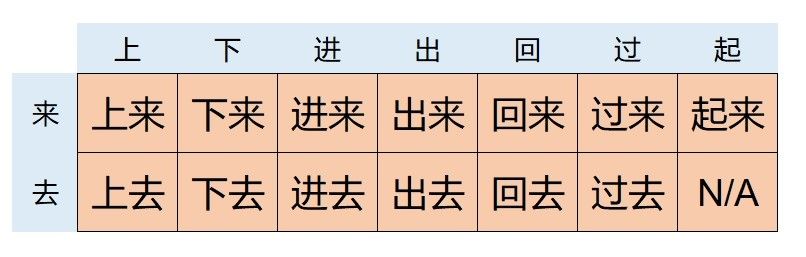
Some common ones are listed below:
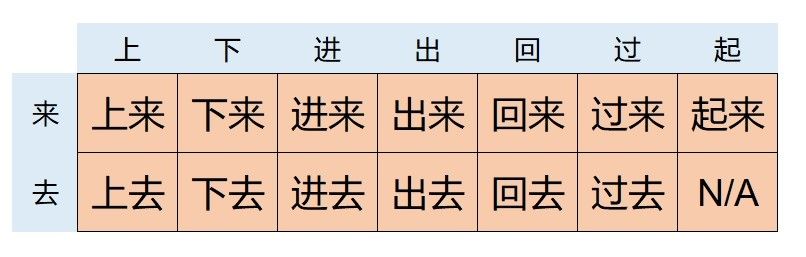
3, Extensions usage of the complement of direction
The complement of direction can be placed after the verb or adjective to indicate direction as well as other meanings. The detailed explanation about the 7 Directional Verbs (趋向动词), there are 起来, 下来, 下去, 出来, 过来, 上来 and 上去.
Example
Simple complement of direction - 来 is used when the act proceeds towards the speaker or the referred thing. 去 is used in the opposite case.
In the below sentence, 信 proceeds toward the speaker 我 so 来 is placed after the verb instead of 去.
Verb + 来/去
1
Wǒ
我
bàba
爸爸
gěi
给
wǒ
我
jì
寄
lái
来
le
了
yī
一
fēng
封
xìn
信
。
My father sent me a letter.
Simple complement of direction - If a verb with a simple complement of direction takes an object that denotes a place, the object is placed after the verb and before the complement.
他回去宿舍了。(NOK)
2
Tā
他
huí
回
sùshè
宿舍
qù
去
le
了
。
He went back to the dormitory.
Simple complement of direction - 了 can not be used after a verb taking a simple complement of direction but should be used at the end of the sentence.
他回了宿舍去。(NOK)
3
Tā
他
huí
回
sùshè
宿舍
qù
去
le
了
。
He went back to the dormitory.
Simple complement of direction - If a verb with a simple complement of direction takes an object that denotes normal things, the object can be placed either between the verb and the complement or after them. 了 can be placed after the verb and the compleme
4
Wǒ
我
gěi
给
nǐ
你
dàilái
带来
le
了
yī
一
běn
本
shū
书
。
I brought you a book.
Simple complement of direction - Verb + 上/下/进/出/回/过/起
Verb + 上/下/进/出/回/过/起
5
Tā
他
ná
拿
qǐ
起
diànhuà
电话
。
He picked up the phone.
Compound complement of direction - If the object is a word or phrase that denotes a place, it is placed before 来 or 去, the pattern is Verb + 上/下/进/出/回/过/起 + Locative object + 来/去
Verb + 上/下/进/出/回/过/起 + 来/去
Verb + 起来
6
Háizi
孩子
pǎo
跑
jìn
进
fángjiān
房间
lǐ
里
qù
去
le
了
。
The child ran into the room.
Compound complement of direction - If a verb takes a locative object, 了 can only be placed at the end of the sentence
老师走进来教室了。(NOK)
7
Lǎoshī
老师
zǒujìn
走进
jiàoshì
教室
lái
来
le
了
。
The teacher walks into the classroom.
Compound complement of direction - 了 can not be placed between the verb and 上/下/进/出/回/过/起
老师走了进教室来。(NOK)
8
Lǎoshī
老师
zǒujìn
走进
jiàoshì
教室
lái
来
le
了
。
The teacher walks into the classroom.
Compound complement of direction - If the object is a common thing, the object can either be placed before 来 or 去 or after them
9
Māma
妈妈
mǎi
买
huílái
回来
hěnduō
很多
shuǐguǒ
水果
。
Mother bought a lot of fruit.
10
Māma
妈妈
mǎi
买
huí
回
hěnduō
很多
shuǐguǒ
水果
lái
来
。
Mother bought a lot of fruit.
Compound complement of direction - If the verb does not take an object, 了 can be placed either after the verb or at the end of the sentence.
公共汽车开了过来。(ALSO OK)
11
Gōnggòng
公共
qìchē
汽车
kāi
开
guòlái
过来
le
了
。
The bus is coming.
起来 - Indicating the beginning and continuation of an action or state.
1) If the predicate verb goes with an object, the object should be placed between 起 and 来. 听到音乐, 她唱起歌来。
2) Adjective + 起来, mostly carries positive connotations.
2) Adjective + 起来, mostly carries positive connotations.
12
Tā
他
xiào
笑
le
了
qǐlai
起来
。
He laughed.
13
Chūntiān
春天
dào
到
liǎo
了
,
tiānqì
天气
nuǎnhuo
暖和
qǐlai
起来
。
Spring is coming and the weather is warm.
起来 - Indicating concentration from scattering.
The common verbs include 收拾, 存, 包, 捆, 扎, 装, etc.
14
Mǎlì
玛丽
bǎ
把
dōngxī
东西
shōushi
收拾
qǐlai
起来
。
Mary packed up her things.
15
Mǎlì
玛丽
bǎ
把
shū
书
dōu
都
kǔn
捆
qǐlai
起来
le
了
。
Mary tied up all the books.
起来 - Indicating the estimation and evaluation of an aspect.
1) The common verbs include 看, 做, 说, 听, 吃, 用, 穿, etc
2) The object should be placed between 起 and 来.
2) The object should be placed between 起 and 来.
16
Tā
她
chàng
唱
de
得
zěnmeyàng
怎么样
?
Tā
她
chàng
唱
qǐ
起
gē
歌
lái
来
,
xiàng
像
xiǎoniǎo
小鸟
yīyàng
一样
hǎotīng
好听
。
How's she singing? She sang, as good as a bird.
17
Nǐ
你
dāng
当
lǎoshī
老师
duō
多
cháng
长
shíjiān
时间
le
了
?
Suàn
算
qǐlai
起来
,
wǒ
我
zuò
做
lǎoshī
老师
yǐjīng
已经
sānshí
三十
nián
年
le
了
。
How long have you been a teacher? Come on, I've been a teacher for thirty years.
起来 - Indicating the result of recalling.
The common verbs include 想, 记, 回忆, 想起, etc
18
Wǒ
我
xiǎngqǐ
想起
liǎo
了
liǎo
了
,
yàoshi
钥匙
zài
在
shūbāo
书包
lǐ
里
。
I remembered, the key is in the bag.
19
Wǒ
我
jì
记
qǐlái
起来
le
了
,
nǐ
你
shì
是
shàngcì
上次
gěi
给
wǒ
我
zhǐ
指
lù
路
de
得
rén
人
。
I remember, you were the last time you showed me the way.
下来 - Indicating stepping down from a high level to a low level.
20
Zuòyè
作业
jīntiān
今天
jiù
就
fà
发
xiàlai
下来
le
了
。
The homework was sent out today.
21
Jiāngjūn
将军
de
得
mìnglìng
命令
chuándá
传达
xiàlai
下来
le
了
。
The general had to pass the order down.
下来 - Indicating that something is fixed or kept in a place.
22
Tóngxué
同学
men
们
bǎ
把
lǎoshī
老师
de
得
huà
话
jì
记
xiàlai
下来
。
The students wrote down the teacher's words.
23
Tài
太
měi
美
le
了
,
wǒ
我
yào
要
bǎ
把
tā
它
huà
画
xiàlai
下来
。
It's so beautiful, I'm going to draw it down.
下来 - Indicating the continuation of action from the past to the present, not easy but completed.
下去 is used to indicate the continuation of action from the present to the future.
The verbs commonly used include 坚持, 话, 保存, 学, 跑, etc.
The verbs commonly used include 坚持, 话, 保存, 学, 跑, etc.
24
Yīwàn
一万
mǐ
米
,
dàwèi
大卫
pǎo
跑
xiàlai
下来
le
了
。
Ten thousand meters, David ran down.
25
Sān
三
nián
年
le
了
,
dàwèi
大卫
zhōngyú
终于
xué
学
xiàlai
下来
le
了
。
Tā
他
hěn
很
xǐhuan
喜欢
hànyǔ
汉语
,
tā
他
háiyào
还要
xué
学
xiàqù
下去
。
Three years on, David has finally learned. He likes Chinese very much, and he has to learn it.
下来 - Indicating an action or state's gradual change of degree from dynamic to static, from light to dark, and from strong to week and also emphasizing the beginning and continuation of the change.
26
Bàn
半
xiǎoshí
小时
hòu
后
,
tā
她
píngjìng
平静
le
了
xiàlai
下来
。
Half an hour later, she calmed down.
27
Jīngguò
经过
nǔlì
努力
,
tā
他
zhōngyú
终于
shòu
瘦
xiàlai
下来
le
了
。
After hard work, he finally lost weight.
下去 - Indicating the continuation of an action or a state that has started.
The verb commonly used include 说, 讲, 学, 读, 传, 坚持, etc.
Verb/Adjective + 下去
28
Dàwèi
大卫
dòu
读
le
了
dìyī
第一
duàn
段
,
mǎlì
玛丽
,
qǐng
请
nǐ
你
dòu
读
xiàqù
下去
。
David read the first paragraph, Mary.
29
Dàwèi
大卫
yǐjīng
已经
pǎo
跑
le
了
wǔqiān
五千
mǐ
米
,
tā
他
háiyào
还要
pǎo
跑
xiàqù
下去
。
David has run five thousand meters, and he has to run on.
下去 - Adjective + 下去 usually carries negative connotations.
30
Rúguǒ
如果
tiān
天
zài
再
hēi
黑
xiàqù
下去
jiù
就
kàn
看
bu
不
jiàn
见
lù
路
le
了
。
If it goes dark again, you can't see the way.
31
Biè
别
zài
再
jiǎnféi
减肥
le
了
,
nǐ
你
rúguǒ
如果
zài
再
shòu
瘦
xiàqù
下去
kě
可
jiù
就
wēixiǎn
危险
le
了
。
Don't lose weight, you'll be in danger if you lose weight again.
出来 - Indicating that action causes something to happen or result from nothing.
想起来 indicates what was experienced but is forgotten; 想出来 indicates new ideas.
The verbs commonly used include 读, 写, 画, 算, etc.
The verbs commonly used include 读, 写, 画, 算, etc.
Verb + 出来
32
Dàwèi
大卫
xiǎng
想
chūlái
出来
hǎojǐ
好几
gè
个
hǎo
好
zhǔyi
主意
。
David came up with several good ideas.
33
Zhè
这
dào
道
shùxuétí
数学题
tā
她
suàn
算
chūlái
出来
le
了
。
She worked out the math problem.
出来 - Indicating to identify or distinguish people or things from concealment to exposure by actions.
Notes: If there is an object, it should be placed between 出 and 来。
eg, 在人群中我认出小王来了。
eg, 在人群中我认出小王来了。
34
Mǎlì
玛丽
tīng
听
chūlái
出来
le
了
,
zhè
这
shì
是
jiékè
杰克
de
的
gē
歌
。
Mary heard it, It's Jack's song.
35
Wǒ
我
kàn
看
chūlái
出来
le
了
,
nǐ
你
shì
是
jiějie
姐姐
,
tā
她
shì
是
mèimei
妹妹
。
I can see, you're a sister, she's a sister.
过来 - Indicating the change of a situation.
Verb + 过来
36
Zhè
这
běn
本
xiǎoshuō
小说
yǐjīng
已经
fānyì
翻译
guòlái
过来
le
了
。
The novel has been translated.
37
Tāmen
他们
de
的
màozi
帽子
huàn
换
guòlái
过来
le
了
。
They changed their hats.
过来 - The form of potential complement is usually used to indicate the disability of doing something.
The verbs commonly used include 吃, 用, 玩, 看, 干, 管, 教, 背, 念, 算, 复习, 照顾, 招待, etc.
38
Háizi
孩子
tài
太
duō
多
le
了
,
māma
妈妈
yī
一
gè
个
rén
人
zhàogu
照顾
bù
不
guòlái
过来
。
There are so many children that my mother can't take care of them by herselves.
39
Zhème
这么
duō
多
cài
菜
,
wǒ
我
chī
吃
bù
不
guòlái
过来
ā
啊
。
With so many dishes, I can't eat them.
过来 - Indicating returning to the original or normal state and mostly carrying positive connotations.
The verbs commonly used include 改, 救, 醒, 恢复, 休息, 明白, etc.
40
Dàwèi
大卫
bǎ
把
zhège
这个
cuòzì
错字
gǎi
改
guòlái
过来
le
了
。
David changed the typo.
41
Jīngguò
经过
yīshēng
医生
de
的
qiǎngjiù
抢救
,
mǎlì
玛丽
zhōngyú
终于
xǐng
醒
guòlái
过来
le
了
。
After the doctor's rescue, Mary finally woke up.
上来 - Indicating approaching something from far to near.
42
Dàwèi
大卫
kàndào
看到
mǎlì
玛丽
mànmàn
慢慢
gēn
跟
shànglái
上来
le
了
。
David saw Mary slowly keep up.
43
Kànjiàn
看见
wǒ
我
,
zhǔrén
主人
yíng
迎
le
了
shànglái
上来
。
Seeing me, the master came up.
上来 - Indicating the ability to do something.
44
Lǎoshī
老师
de
的
wèntí
问题
tā
他
huídá
回答
shànglái
上来
le
了
。
The teacher's question came up to him.
45
Zhè
这
běn
本
shū
书
de
的
nèiróng
内容
,
háizi
孩子
shuō
说
shànglái
上来
le
了
。
The contents of this book, the child said.
上去 - Indicating approaching something from far to near or increasing.
Compared with Verb + 上来, Verb + 上去 can also be used in the example of 看见我, 主人迎上去。In the sentence, the point of view is changed and it is said from 主人 (the host's) point of view.
Verb + 上去
46
Wǒ
我
bǎ
把
zhè
这
liǎng
两
tiáo
条
yìjiàn
意见
jiāshàng
加上
qù
去
。
I'll add these two comments.