HSK 1
Correct
方位词
/ fāng wèi cí /
Strokes
Formula
1
(Noun)+ 方位词(+ 面/边)
2
……(的)方位词
3
…… +(动词)+方位词
4
方位词 + 是 + ……
5
方位词 + 有/Verb + 着 + ……
6
方位词 + 的 + ……
Definition
Noun of Locality (方位词), indicates the direction and location.
The phrase of Locality is a kind of endocentric phrase, the two constituents of which are of fixed order: the noun of locality is preceded or premodified by the first constituent.
The first constituent of a phrase of locality may be a noun, a pronoun, a time noun, a verb, or a phrase while the second is a noun of locality.
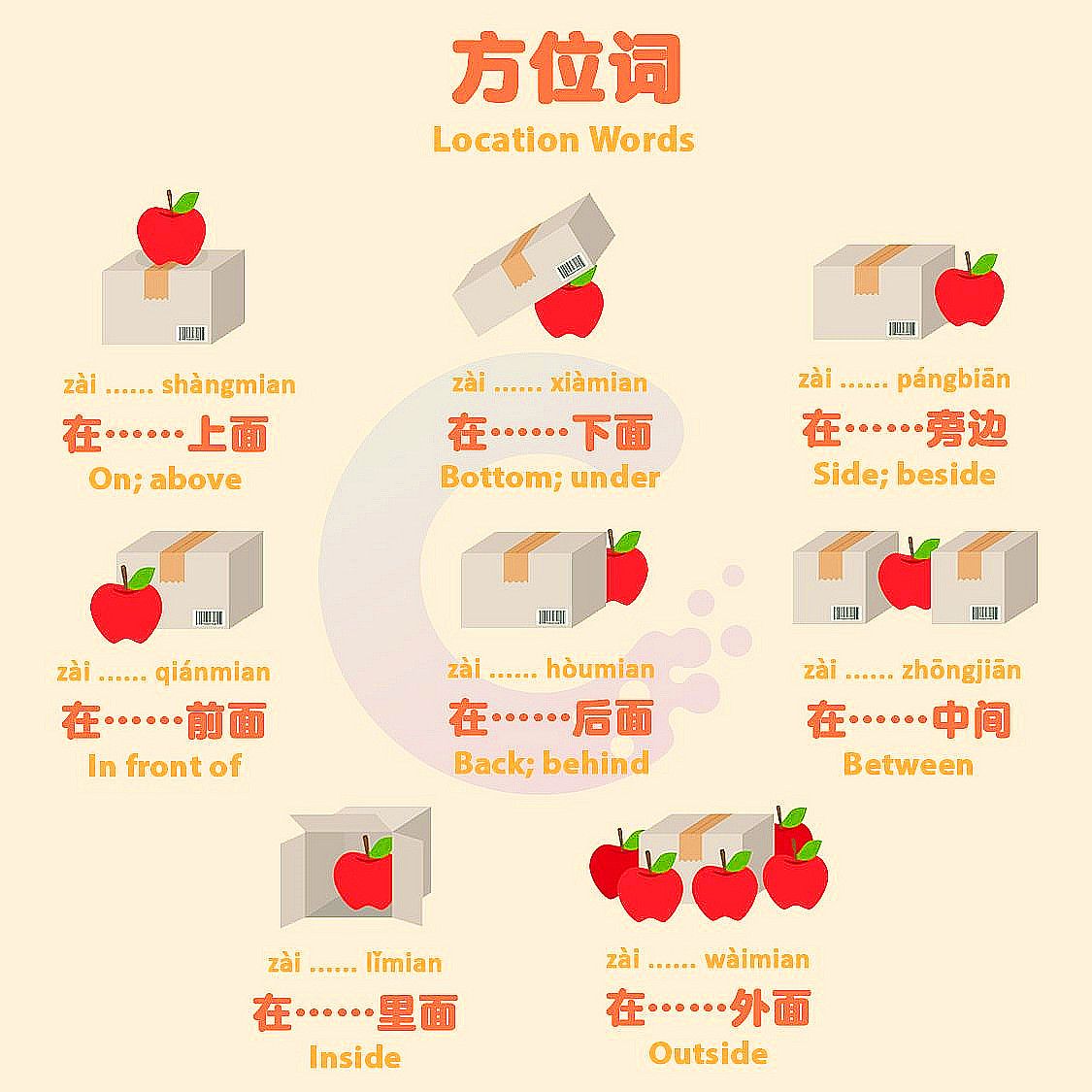

Example
(Noun)+ 方位词(+ 面/边)
When used alone, most nouns of the locality have to add 面 or 边 after them; when the nouns combine with other nouns 面 or 边 is optional.
中 + 间
旁 + 边
中 + 间
旁 + 边
(Noun)+ 方位词(+ 面/边)
1
Dōng
东
(
biān
边
/
miàn
面
)
;
shàng
上
(
biān
边
/
miàn
面
)
;
zuǒ
左
(
biān
边
/
miàn
面
)
;
lǐ
里
(
biān
边
/
miàn
面
)
;
qián
前
(
biān
边
/
miàn
面
)
east, above, left, inside, front, inside the house.
2
Zhōngjiān
中间
;
pángbiān
旁边
in the middle; beside
In a sentence, a noun of locality is placed where a common noun is.
……(的)方位词
…… +(动词)+方位词
方位词 + 是 + ……
方位词 + 有/Verb + 着 + ……
方位词 + 的 + ……
3
Ānnī
安妮
zuò
坐
zài
在
mǎkè
马克
qiánbian
前边
,
mǎkè
马克
hòubian
后边
shì
是
kǎidì
凯蒂
。
Annie sits in front of Mark, behind Mark is Katie.
4
Hēibǎn
黑板
shàng
上
xiě
写
zhāo
着
yīxiē
一些
wèntí
问题
,
dàjiā
大家
zhèngzài
正在
zuò
做
yòubian
右边
de
的
wèntí
问题
。
There are some questions written on the blackboard, everyone is doing questions on the right side.
The order of the two constituents can not be reversed, for the reversion will lead to a change of meaning.
5
Sān
三
tiān
天
qián
前
,
tā
他
gāng
刚
chūchāi
出差
huílai
回来
。
Three days ago, he had just returned from a business trip.
6
Qián
前
sān
三
tiān
天
,
tāmen
他们
jiù
就
gān
干
zhège
这个
le
了
。
The first three days, that is all they did.
7
Māma
妈妈
zhèngzài
正在
wūlǐ
屋里
sǎodì
扫地
。
Mother is sweeping the floor in the room.
8
Māma
妈妈
zhèngzài
正在
dǎsǎo
打扫
lǐ
里
wū
屋
。
Mother is cleaning the back room.
Exercise
Complete the sentences with the noun of locality according to the map:
哈尔滨在( )。
北京在( )。
上海在( )。
香港在( )。
拉萨在( ) 。
乌鲁木齐在( )。
台湾在( )。
Teaching Skill
方位词(1)
表示位置的名词叫方位词。汉语中的方位词组
东南西北+边/ 面
上下左右里外+边/面
东边南边西边北边
上边下边左边右边里边外边
~面
东面南面西面北面
上面下面左面右面里面外面
格式:(1)N + 在……边/面
邮局 在 南边
(2)N1 + 在 + N2 +(的+)……边/面
邮局 在 超市 的 南边
(3)……边/面+ 有 + N
上 面 有 手机
(4)N1 +(的+)……边/面+ 有 +N2
桌子 上面 有 一个手机
(5)……边/面+ 是 + N
下边 是 车库
(6)N1 +(的+)……边/面+是+ N2
公寓楼 下边 是 车库
方位词:
S + 在(zài) +方(fāng)位(wèi)词(cí) + 边(biān)/面(miàn)
韩国 在 中国东 边
日本 在 韩国西 边
手机 在 桌子 上面
钱包 在 书包 里边
老师 在 我 旁(páng)边
同学们 在 教师 里面
书包 在 椅子 下边
后面(HSK1)
教学建议:动作演示加实物道具法
第一步:(教师可板书画图表明“上、下、左、右、前、后、里、外”,也可做动作,示意学生,指着头顶表示“上”
指着地下表示“下”
伸出左手表示“左”
伸出右手表示“右”
指着前面表示“前”
指着后面表示“后”
指着教室里面表示“里”
指着窗户外面表示“外”等)并带领学生认读上、下、左、右、前、后、里、外等词。
师说:“上、下、左、右、前、后、里、外”都是方位词,方位词加“边”或者“面”都可以。
(总结格式:方位词+边/面)
跟我读:
上 边
上 面
下 边
下 面
前 边
前 面
后 边
后 面
左 边
左 面
右 边
右 面
里 边
里 面
外 边
外 面
生说:(学生跟读)
师说:××同学,你读。
生说:(学生独立认读)
师说:“左边”或“右边”也可以说“旁边”,说“旁面”不对
(总结:左边/右边=旁边 旁面(×))
第二步:师生互动,教师随意找一个东西,提问学生“××在哪儿?”
目标句:N1+在(N2)+(的)+……边/面
(PS:充分利用教室或手头儿可用资源)
师说:你的手机在哪儿?
生说:手机在桌子上面。
师说:很好。
(总结格式:N1+在+N2+(的)+……边/面)
老师的钱包在哪儿?
生说:老师的钱包在书包里边。
师说:书包在哪儿?
生说:书包在椅子后面。
师说:很好。
PS:互动操练环节,建议网课教师选用图片法进行练习
(1)选用建筑位置方位图
(2)选用房间内部布置的图片
(3)物品在哪儿