HSK 1
Correct
主谓谓语句
/ zhǔwèi wèiyǔ jù /
Strokes
/fit-in/684x0/img/202005/主谓谓语句-Chinese-grammar-Cchatty-yyyy-1589851908.jpg)
Formula
1
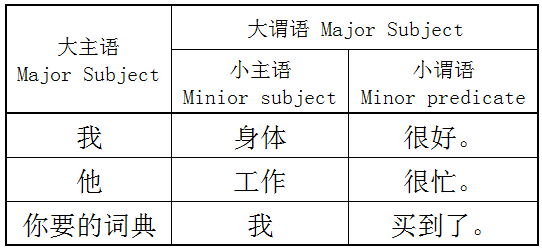
Major subject + Minor subject + Minor predicate
Definition
Subject-predicate Sentence (主谓谓语句), the sentence where a subject-predicate phrase is used to explain or describe the subject.
Example
主谓谓语句 (Subject-predicate sentence)
1) The minor subject is often a part of related to the major subject in a subject-predicate sentence. As the below sentence shows, 身体 is a part of 我 and 工作 belongs to 他.
2) The major subject is often the receiver of action of the minor predicate in a subject-predicate sentence, for example, 你要的词典 is the receiver of action of 买.
2) The major subject is often the receiver of action of the minor predicate in a subject-predicate sentence, for example, 你要的词典 is the receiver of action of 买.
Major subject + Minor subject + Minor predicate
1
Wǒ
我
shēntǐ
身体
hěn
很
hǎo
好
。
I'm in good health.
2
Tā
他
gōngzuò
工作
hěn
很
máng
忙
。
He is very busy for his job.
3
Nǐ
你
yào
要
de
的
cídiǎn
词典
wǒ
我
mǎi
买
dào
到
liǎo
了
。
I bought the dictionary you wanted.
Exercise
Rewrite the sentences into the subject-predicate sentences:
1. 她大大的眼睛。
2. 我的工作很忙。
3. 我有很多事情。
4. 我没有听懂你讲的故事。
5. 我找到了你的钥匙。
6. 我把房间打扫干净了。