HSK 3
Correct
被 Sentence
/ bèi /
Strokes
Formula
1
Subject + 被(叫)(让)+ Object + Verb + Complement
2
被 + …… + 了
3
Noun + 被 + Verb + Complement
4
Noun1 + 被 + Noun2 + Verb + Complement
5
被 + 给 + Verb
6
已经/早就/没有/渐渐地/都/肯定/一定/可能/应该 + 被
Definition
被 Sentence is that the adverbial is made up of the preposition 被 and its objects, which indicates passivity.
The role of 被 is to introduce the doer of actions.
In spoken Chinese, other prepositions, such as 叫 and 让 can substitute 被. All these sentences are 被 sentences.
Example
被 Sentence, the common pattern
Subject + 被(叫)(让)+ Object + Verb + Complement
1
Wǒ
我
de
的
qiánbāo
钱包
bèi
被
xiǎotōu
小偷
tōuzǒu
偷走
le
了
。
My wallet was stolen by a thief.
2
Wǒ
我
de
的
qiánbāo
钱包
jiào
叫
xiǎotōu
小偷
tōuzǒu
偷走
le
了
。
My wallet was stolen by a thief.
被 Sentence, the using conditions
1) The subject of a 被 sentence is usually the receiver of action, and the object is the doer. If the doer is not necessary to identify, the object following 被 can be omitted. However, the object after 叫 or 让 cannot be omitted.
2) Negative adverbs, 不 and 没(没有), and optative verbs should precede 被, but they cannot be placed before the verbs.
我的相机让(叫)借走了。(NOK)
2) Negative adverbs, 不 and 没(没有), and optative verbs should precede 被, but they cannot be placed before the verbs.
我的相机让(叫)借走了。(NOK)
3
Wǒ
我
de
的
xiàngjī
相机
bèi
被
(
jiào
叫
)
(
ràng
让
)
mǎlì
玛丽
jiè
借
zǒu
走
le
了
。
My camera was borrowed by Mary.
4
Wǒ
我
de
的
xiàngjī
相机
bèi
被
jiè
借
zǒu
走
le
了
。
My camera was borrowed.
5
Bēizi
杯子
méi
没
(
méiyǒu
没有
)
bèi
被
tā
他
shuāipò
摔破
。
The cup wasn't broken by him.
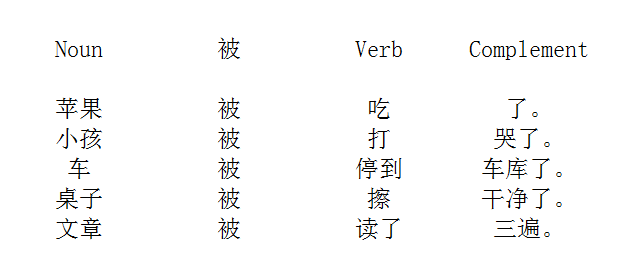
被 is used in a passive sentence to indicate somebody or something has changed under the influence of an action.
The verb in a 被 sentence cannot be used by itself. It must be followed by 了 or a complement.
被 + …… + 了
Noun + 被 + Verb + Complement
6
Fàn
饭
bèi
被
chī
吃
le
了
。
The meal was eaten.
7
Zhè
这
shǒu
首
shī
诗
bèi
被
dòu
读
le
了
sān
三
biàn
遍
le
了
。
This poem was read three times.
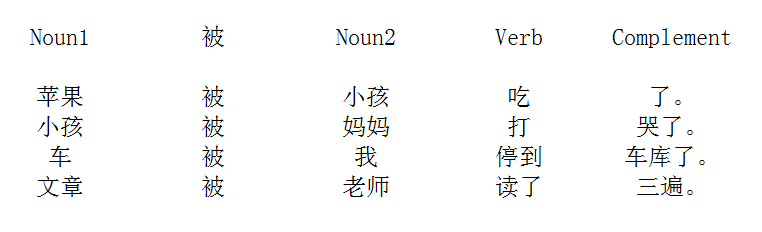
被 is used in a passive sentence to emphasize somebody or something Noun1 is affected by what Noun2 did.
Noun1 + 被 + Noun2 + Verb + Complement
8
Fàn
饭
bèi
被
xiǎomíng
小明
chī
吃
le
了
。
The meal was eaten by Xiaoming.
9
Zhè
这
shǒu
首
shī
诗
bèi
被
wǒmen
我们
dòu
读
le
了
sān
三
biàn
遍
le
了
。
This poem was read three times by us.
The verb is often preceded by 给 in spoken Chinese. The meaning of the sentence is unchanged, but the tone is strengthened after using 给.
If there is a word such as 已经, 早就, 没有, 渐渐地, 都 or 肯定, 一定, 可能, 应该, etc.,it should precede 被.
被 + 给 + Verb
已经/早就/没有/渐渐地/都/肯定/一定/可能/应该 + 被
10
Fàn
饭
bèi
被
gēge
哥哥
gěi
给
chī
吃
le
了
。
The meal was eaten by elder brother.
11
Zhèxiē
这些
píngguǒ
苹果
dōu
都
bèi
被
sòng
送
dào
到
chāoshì
超市
le
了
。
These apples were sent to the supermarket.
12
Zhèxiē
这些
shū
书
kěndìng
肯定
shì
是
bèi
被
xiǎotōu
小偷
tōuzǒu
偷走
le
了
。
These books must have been stolen by thieves.
被-sentence is often used to indicate somebody suffers a misfortune.
13
Wǒ
我
bèi
被
tā
他
gěi
给
piàn
骗
le
了
。
I was deceived by him.
14
Wǒ
我
de
的
shūbāo
书包
bèi
被
tōu
偷
le
了
。
My bag was stolen.
Exercise
1, Form 被 sentences with the given words:
1. 眼镜 摔破 我 了
2. 借走 手机 的 他 小王
3. 窗户 小王 关上
4. 奶奶 到 医院 送
5. 雨伞 拿走 没 小王
6. 会 的 人 这个秘密 发现
2, Complete the following 被 sentences.
1. 自行车被偷( )。
2. 教室的门被关( )。
3. 我今天打扫卫生了,家里的窗户和桌子( )。(擦)
4. 他经常讲这个故事,这个故事已经被( )。(十遍)
5. 小明很喜欢蛋糕,这个蛋糕可能是( )。(吃)
6. 小芳特别爱干净,家里的地一定是( )。(干净)
7. 这本书( )送( )人了 。(姐姐,给)
8. 这台电脑( )修好了。(他,给)
Teaching Skill
被,有标记的被动句。
(1)导入:ppt图片
他的自行车怎么了?
肯定形式:Sb./ Sth +被+Sb./ Sth.+Verb+……
他的自行车被小偷偷走了。
说明:
(1)“被”字句在口语里用的最多的是表示说话人觉得不愉快、不好的、不希望发生的情况。
(2)在这样的句子里,除了动词以外一定要有其他词,不能只是一个动词。
(3)“被”后面的施动者可以是“人”,也可以省略。
(2)练习:改说句子(有施动者——无施动者)
他打破了那个杯子。
他弄坏了我的自行车。
风吹走了他的帽子。
他把手机忘在了出租车上了。
小偷把他的自行车偷走了。(引出否定形式)
师问:他的自行车被小偷偷走了吗?
(3)否定形式Sb./ Sth +没+被+Sb./ Sth.+Verb+……
他的自行车没被小偷偷走。
说明:注意“没”的位置
他的自行车没被人偷走。(OK)
他的自行车没被偷走。(OK)
练习:老师做动作,说疑问形式,请学生说否定形式
我的汉语书被大卫拿走了吗?
老师的水被玛丽喝了吗?
大卫的本子被小民弄坏了吗?
(4)副词的位置
你们觉得刚才那个人的自行车怎么了?——他的自行车肯定被小偷偷走了。
汉语里除了“被”可以表示这样的意思以外,还有几个词也可以。刚才的这个句子我们也可以说:
让——他的自行车让小偷偷走了。
叫——他的自行车叫小偷偷走了。
给——他的自行车给小偷偷走了。
说明:
“被、给”的后面可以有做这件事的人,也可以没有。
“让、叫”的后面必须有。
“给、让、叫”比较口语化。
判断下 面这些句子是对还是错:
他的自行车被偷走了。
他的自行车让偷走了。(X)
他的自行车让小偷偷走了。
他的自行车叫偷走了。(X)
他的自行车叫小偷偷走了。
他的自行车给偷走了。
综合练习:
鱼叫猫吃了。
花瓶让他打破了。
电脑给他弄坏了。
树叶让风吹走了。
面包叫他吃完了。
练习2:来介绍一下儿这个人倒霉 的一天。(《我的自行车被人偷走了》)
早上,他想吃早饭,可是他的早饭被同屋吃掉了。
去学校的路上,书包让他忘在出租车上了。
上午,他要把作业交给老师,可是作业叫他放在宿舍里了。
下午刮大风,他的自行车被风刮倒了。
他下课以后去超市买东西,结果钱包被小偷偷走了。