HSK 3
Correct
地 de
/ de /
Strokes
/fit-in/684x0/img/202005/地de-Chinese-grammar-Cchatty-yyyy-1589851866.jpg)
Formula
1
Disyllabic Adjective + 地
2
Phrase + 地
3
Reduplicated adjective + 地
4
Adverbial ( +地 ) + Verb/Adjective
5
Time + Scope + Place + Degree + Mode + Manner + Headword
Definition
Adverbials (状语) + 地 (结构助词) + Headword (中心语)
地 as Structural Particle (结构助词)
Adverbial ( +地) + Verb/Adjective: adverbial modifiers are used to describe/explain an action. They are often followed by 地:
1, Adverbial + 地 + Verb/Adjective
1.1, Disyllabic Adjective + 地
1.2 Phrase + 地
1.3 Reduplicated Adjective + 地
2. Adverbial + Verb/Adjective: In this case, 地 is usually omitted when a monosyllabic Adjective is used as an adverbial
3, The order of the Adverbial: Time + Scope + Place + Degree + Manner + Mode + Headword
Example
地 is generally used after an adverbial to describe the state/situation of an action.
An adverbial usually precedes a Verb or an Adjective so as to describe/explain the quality/feature of an action or object,
Disyllabic Adjective + 地
Phrase + 地
Reduplicated adjective + 地
Adverbial ( +地 ) + Verb/Adjective
1
Tā
他
gāoxìng
高兴
dì
地
pǎo
跑
huíjiā
回家
le
了
。
He ran back home happily.
2
Tā
他
fēicháng
非常
zǐxì
仔细
dì
地
tīng
听
zhāo
着
。
He is listening carefully.
3
Tā
他
gāogāoxìngxīng
高高兴兴
de
地
pǎo
跑
huíjiā
回家
le
了
。
He ran back home happily.
4
Mànpǎo
慢跑
duì
对
shēntǐ
身体
hěn
很
yǒu
有
hǎochu
好处
。
Jogging does good to our health.
地 is usually omitted after an adverbial - 1
地 can't be used when the adverbial indicates the time or place of action.
5
Xiǎomíng
小明
6
6
diǎn
点
jiù
就
huíjiā
回家
le
了
。
Xiaoming returned home at 6 o'clock.
6
Tā
他
yǐjīng
已经
qù
去
shàngbān
上班
le
了
。
He has gone to work already.
地 is usually omitted after an adverbial - 2
地 can't be used when the adverbial indicates degree, scope or negation.
Note: These adverbials are used to restrict/specify an action or a feature.
Note: These adverbials are used to restrict/specify an action or a feature.
7
Tā
他
fēicháng
非常
xǐhuan
喜欢
zhōngguó
中国
。
He likes China very much.
8
Tā
他
méi
没
kàn
看
qīngchu
清楚
。
He didn't see it clearly.
地 is usually omitted after an adverbial - 3
地 can't be used when the adverbial introduces the object of an action.
9
Tāmen
他们
wéi
为
wǒmen
我们
zuò
做
le
了
hěnduō
很多
shì
事
。
They did a lot for us.
10
Qǐng
请
gěi
给
wǒmen
我们
dǎo
倒
yīxiē
一些
chá
茶
。
Please bring us some tea.
The order of Adverbials, 状语的顺序
The adverbial of time or place is usually placed at the beginning of a sentence.
Time + Scope + Place + Degree + Mode + Manner + Headword
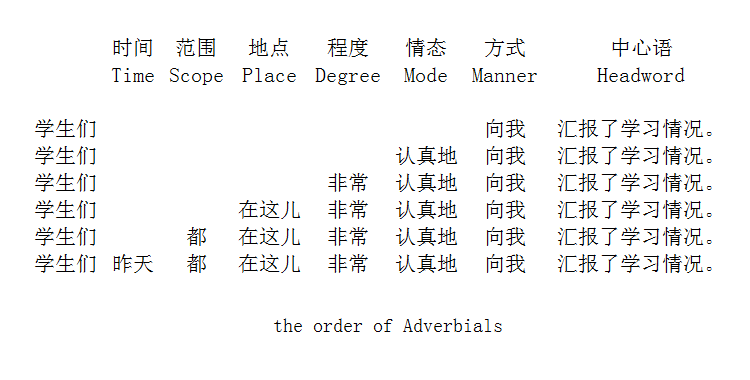
11
Xuésheng
学生
men
们
zuótiān
昨天
dōu
都
zài
在
zhèrfēi
这儿
chángrèn
非常
zhēndì
认真
xiàng
地
wǒ
向
huì
我
bàole
汇报
shí
了
xíqíng
实习
kuàng
情况
。
All students reported practice situation seriously to me yesterday.
12
Zuótiān
昨天
xuésheng
学生
men
们
dōu
都
zài
在
zhèrfēi
这儿
chángrèn
非常
zhēndì
认真
xiàng
地
wǒ
向
huì
我
bàole
汇报
shí
了
xíqíng
实习
kuàng
情况
。
All students reported practice situation seriously to me yesterday.
Exercise
Please fill in the blanks with 地 wherever needed:
1. 他明天( )去参加入学考试。
2. 她开心( )笑了。
3. 小明在中国( )学习了京剧。
4. 他非常( )想知道这首歌歌名是什么。
5. 他们全部( )参加了这次表演。
6. 他很开心( )对我说, 老师表扬他了。
7. 听到这个故事后,他大( )笑起来。
8. 孩子们昨天甜甜( )睡了一觉。
9. 孩子们向我们( )招招手,微笑着跑开了。
10. 今天大家可以痛痛快快( )喝酒了。