HSK 4
Correct
下来 vs 下去
/ xiàlái vs xiàqu /
Strokes
/fit-in/684x0/img/202005/下来vs下去-Chinese-grammar-Cchatty-yyyy-1589851763.jpg)
Definition
下来 and 下去 both are directional complements (趋向补语):
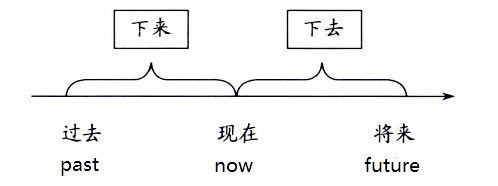
1, "Verb + 下来" means "to move towards to the speaker", means "to move down and away from the speaker".
2, "Verb + 下来" means "an action started in the past and has continued till now, means "an action starts and will continue".
3, "Adjective + 下去" indicates a state has already existed and will continue or develop".
4, "Verb + 下来" means "to separate or divide something", means "to make something unchanged", it also indicates stepping down from a high level to a low level.
Example
Verb + 下来 and Verb + 下去 - 1
Verb + 下来 and Verb + 下去, both can be used to mean to move downward.
"Verb + 下来" means to move downward to the speaker,
"Verb + 下去" means to go away from the speaker.
"Verb + 下来" means to move downward to the speaker,
"Verb + 下去" means to go away from the speaker.
1
Tā
他
pǎo
跑
xiàlai
下来
le
了
。
He ran down.
2
Tā
她
tiào
跳
xiàqù
下去
le
了
。
She jumped off.
Verb + 下来 and Verb + 下去 - 2
Both can be used to refer to time.
"Verb + 下来" means an action started in the past and has continued till now, not easy but completed.
"Verb + 下去" means an action starts and will continue.
The verbs commonly used include 坚持,活,保存,学,跑,etc. Adjective + 下去 usually carries negative connotations.
Verb+下来 can also be used to indicate a harvest of crops. eg, 西瓜/ 苹果下来了。
"Verb + 下来" means an action started in the past and has continued till now, not easy but completed.
"Verb + 下去" means an action starts and will continue.
The verbs commonly used include 坚持,活,保存,学,跑,etc. Adjective + 下去 usually carries negative connotations.
Verb+下来 can also be used to indicate a harvest of crops. eg, 西瓜/ 苹果下来了。
3
Wǒ
我
yǐjīng
已经
zài
在
běijīng
北京
zhù
住
xiàlai
下来
le
了
。
I have already lived in Beijing.
4
Wǒ
我
xiǎng
想
zài
在
běijīng
北京
zhù
住
xiàqù
下去
。
I want to live in Beijing in the future.
5
Sān
三
nián
年
le
了
,
dàwèi
大卫
zhōngyú
终于
xué
学
xiàlai
下来
le
了
。
Tā
他
hěn
很
xǐhuan
喜欢
hànyǔ
汉语
,
háiyào
还要
jìxù
继续
xué
学
xiàqù
下去
。
David has studied Chinese for three years, he likes Chinese a lot, and he will continue learning.
Adjective + 下来 and Adjective + 下去
"Adjective + 下来" indicates the emergence and continuation of a state. It emphasizes the emergence of the state. Indicate an action or state's gradual change of degree from dynamic to static from light to dark, from strong to weak, etc.
In contrast, "Adjective + 下去" indicates a state has already existed and will continue or develop.
In contrast, "Adjective + 下去" indicates a state has already existed and will continue or develop.
6
Tiānsè
天色
jiànjiàn
渐渐
hēi
黑
xiàlai
下来
le
了
。
It's growing dark.
7
Xiànzài
现在
cái
才
7
7
yuè
月
,
tiānqì
天气
hái
还
huì
会
rè
热
xiàqù
下去
。
It's July, it's hot now, hot days will go on.
8
Tā
他
zhōngyú
终于
shòu
瘦
xiàlai
下来
le
了
。
He slim down finally.
Only "Verb + 下来" can be used - 1
The structure "把 + Verb +下来" often indicates to separate or divide something by performing an action.
9
Wūlǐ
屋里
hěn
很
rè
热
,
bǎ
把
wàitào
外套
tuō
脱
xiàlái
下来
bā
吧
。
It's hot in the house, take off your coat.
10
Wǒ
我
xiǎng
想
bǎ
把
zhè
这
zhāng
张
túpiàn
图片
jiǎn
剪
xiàlai
下来
。
I want to cut out this picture.
Only "Verb + 下来" can be used - 2
It means to make something unchanged by performing an action, it also indicates stepping down from a high level to a low level.
11
Kuài
快
tíng
停
xiàlái
下来
,
biè
别
zǒu
走
le
了
。
Stop, don't go .
12
Jìrán
既然
xǐhuan
喜欢
zhè
这
fú
幅
huà
画
,
jiù
就
mǎi
买
xiàlai
下来
bā
吧
。
Now that you like this picture, just buy it.
13
Zuòyè
作业
yǐjīng
已经
fà
发
xiàlai
下来
le
了
。
Homework was given already.
Verb + 得下来/下去 and Verb + 不下来/下去
得 or 不 can be inserted between "Verb" and "下来/下去".
"Verb + 得下来/下去" means to be able to do something, while "不下来 /下去" means not to be able to do something.
"Verb + 得下来/下去" means to be able to do something, while "不下来 /下去" means not to be able to do something.
14
A
A
:
zhè
这
piān
篇
kèwén
课文
zhème
这么
nán
难
,
nǐ
你
kàn
看
de
得
xiàqù
下去
ma
吗
?
B
B
:
kàn
看
bù
不
xiàqù
下去
。
A: This text is so difficult, can you keep on reading? B: No, I can't.
15
A
A
:
nā
那
duǒ
朵
huā
花
nàme
那么
gāo
高
,
nǐ
你
zhāi
摘
de
得
xiàlai
下来
ma
吗
?
B
B
:
zhāi
摘
bù
不
xiàlái
下来
。
A: The flower is so high, can you pick it off? B: No, I can't.
Exercise
Fill in the blanks with 下来 or 下去:
1. 雪从天上飘( )。
2. 参加长跑的人,都坚持( )了。你要加油,坚持( ),很快就到了。
3. 她 一 看见他,眼泪就忍不住流( )了。
4. 最近她觉得自己变老了,她不能让自己再这样老( )。
5. 结婚的日子已经定( )了,就是下个月的今天。
6. 我只要半张纸,你帮我撕( )一半。
7. 这本书没意思,我看不( )。
8. 我已经很胖了,我不能胖( ),我要减肥。