Exploring Rulers of the Five Dynasties and Ten Kingdoms
AI Learn Chinese
4 hr • 0 read
Explore the chaotic yet captivating Five Dynasties and Ten Kingdoms period (907-960 CE). Discover personal favorite rulers from this era of fragmentation, not based on objective greatness but on compelling stories, unique reforms, and intriguing legacies. A deep dive into a pivotal half-century of Chinese history.
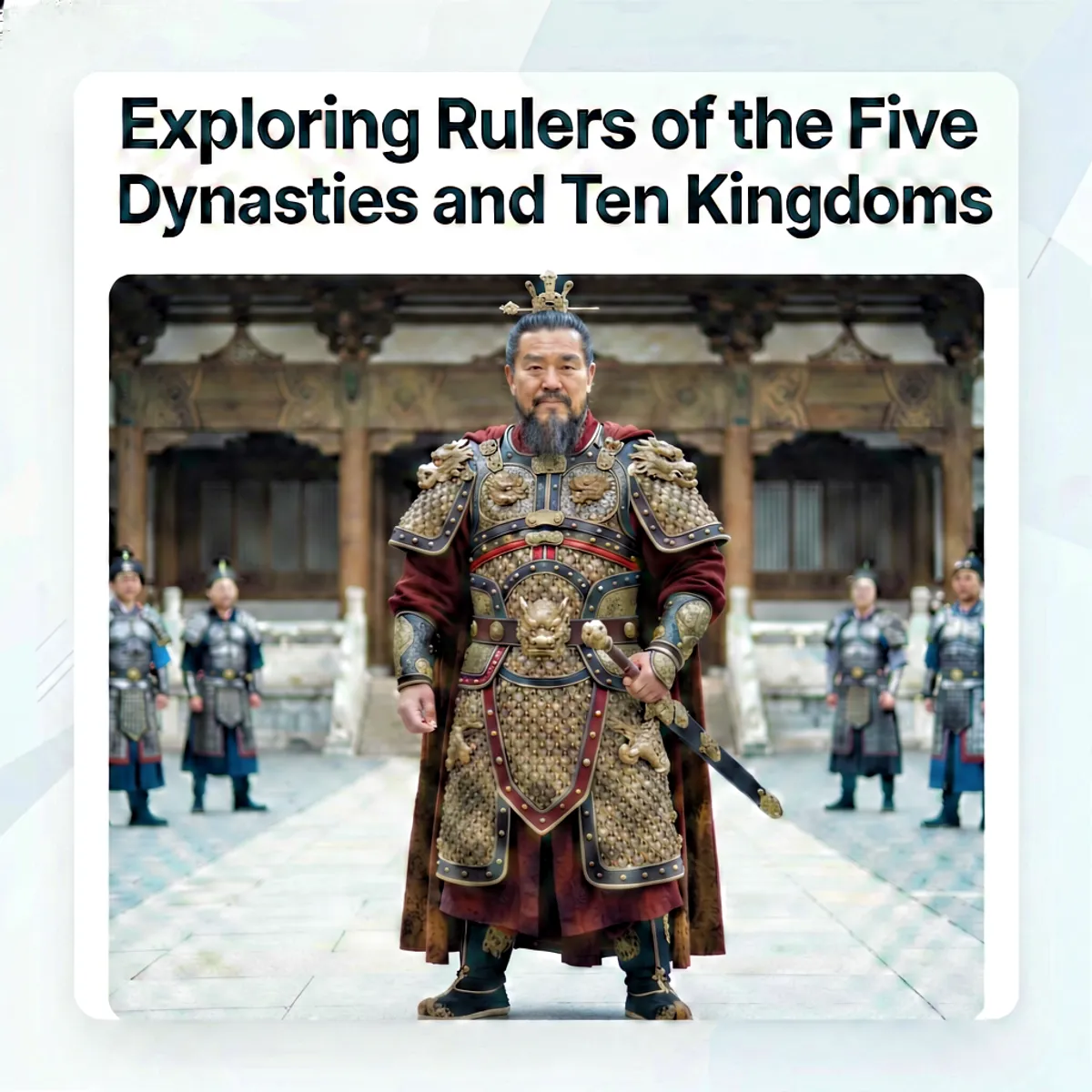
1. Introduction: The Allure of the "Favorite" in a Chaotic Era
History is often written by the victors and distilled into lists of "greatest" and "worst." These rankings, while useful for textbooks, can obscure the deeply personal nature of our engagement with the past. The prompt to choose a favorite ruler—not the best, most successful, or even most interesting, but the one we personally connect with—is a refreshing deviation. It asks us to look beyond metrics of territorial expansion, bureaucratic reform, or military genius. Instead, it invites us to find resonance in character, circumstance, tragedy, or even contradiction.
Nowhere is this exercise more poignant than in China's Five Dynasties and Ten Kingdoms period (907-960 CE). This was not an era of glorious, consolidated empires like the Tang or Song, but a bloody, cacophonous interregnum. It was a half-century of near-constant warfare, rapid dynastic turnover in the north (five successive regimes in quick succession), and the concurrent, relatively more stable, flourishing of ten major kingdoms in the south and west. It was an age of usurpation, assassination, brutal realpolitik, and yet, paradoxically, of remarkable cultural and economic vitality in the southern enclaves. The "favorite" ruler from this period cannot be a paragon of Confucian virtue or a unifier of the realm, for such figures are conspicuously absent. Our favorites must be drawn from a cast of warlords, opportunists, poet-kings, reluctant emperors, and pragmatic administrators who navigated a world where the Mandate of Heaven seemed to have been permanently misplaced.
This article is a follow-up to a series exploring favorite rulers across Chinese eras. For the Five Dynasties and Ten Kingdoms, we define the scope precisely: from the deposition of the last Tang emperor, Ai of Tang, in 907, to the final conquest of the last holdout kingdom (Northern Han) by the Song Dynasty in 979, though the core chaotic period is generally considered to end with the Song's consolidation in 960. The "favorite" is a subjective lens, but it demands explanation. Why does one ruler from this turbulent pool capture our imagination more than another? Is it their backstory, their unfulfilled promise, their cultural patronage, or their sheer audacity in surviving? This exploration will delve into the most compelling figures from both the northern dynastic cycle and the southern kingdoms, arguing for the historical and human interest that makes each a potential personal favorite.
2. Setting the Stage: Understanding the Five Dynasties and Ten Kingdoms Period
To appreciate the individuals, one must first grasp the horrifying complexity of their world. The Tang Dynasty's collapse was not a single event but a systemic failure. After the devastating An Lushan Rebellion (755-763), the central government never fully recovered its authority. Regional military governors (jiedushi), originally appointed to defend frontiers, became de facto independent warlords, inheriting their posts and amassing private armies. By the early 10th century, the Tang court was a puppet, and the real power lay with these military men.
In 907, the Tang finally fell, not to a noble rebel, but to one of its own governors: Zhu Wen, who forced the last Tang emperor to abdicate and founded the Later Liang. This act set the template for the next five decades. In the Central Plains (the traditional heartland around the Yellow River), power was a hotly contested, short-lived prize. Five successive dynasties—Later Liang, Later Tang, Later Jin, Later Han, and Later Zhou—rose and fell, each lasting no more than a few decades, most succumbing to coups, betrayal, and internal violence. The average reign of a founding emperor in this northern cycle was under a decade. It was a masterclass in instability.
Simultaneously, in the more defensible, agriculturally rich south and southwest, a different story unfolded. Former Shu (Sichuan), Later Shu (also Sichuan), Wu, Wuyue, Min, Chu, Southern Han, Jingnan (also known as Nanping), and Southern Tang carved out territories that were largely free from the northern bloodbath. These "Ten Kingdoms" often enjoyed longer reigns, internal peace, and a flowering of trade, arts, and culture. They operated with a degree of legitimacy, often receiving nominal investiture from the northern court (until they felt strong enough to reject it). The period was thus a dual narrative: one of frantic, violent succession in the north, and one of consolidation and prosperity in the south.
The era concluded with the rise of the Later Zhou under Guo Wei and, most decisively, his son-in-law Zhao Kuangyin, who usurped the throne in 960 to found the Song Dynasty. The Song systematically conquered the remaining kingdoms, reunifying most of the traditional Chinese heartland by 979, though it permanently lost the strategic Sixteen Prefectures to the Khitan Liao. The Five Dynasties and Ten Kingdoms period, therefore, is the painful, necessary prelude to the Song's neo-Confucian, commercially vibrant, but militarily cautious empire. Choosing a favorite ruler from this era means selecting a protagonist from a story of fragmentation, where "success" is relative, and survival itself is a monumental achievement.
3. The Northern Spectrum: Rulers of the Successive Dynasties
3.1 Zhu Wen (Emperor Taizu of Later Liang): The Usurper Who Unified (Briefly)
Zhu Wen (852-912) is the man who started it all, the original sin of the era. A former salt smuggler and bandit leader who joined the Huang Chao rebellion before defecting to the Tang, he embodied the ruthless opportunism of the age. As the most powerful jiedushi, he deposed the last Tang emperor in 907 and established the Later Liang, claiming the Mandate for himself. For a time, he was the de facto ruler of most of northern China, his authority extending over the other military governors who nominally submitted.
Why could he be a favorite? Not for his morality—he was notoriously cruel, suspicious, and licentious. His appeal lies in sheer, unadulterated historical force. He is the personification of the era's break from the past. He saw the decaying Tang corpse and, without sentiment, declared it dead and crowned himself. He was a brute, but an effective one who, for a moment, imposed order on chaos. His reign (907-912) is the first, crucial step in the cycle. He represents the raw, unvarnished exercise of power, the moment when the mask of Tang legitimacy was finally and violently torn away. His favorite status would be for the student of realpolitik, the one who admires the cold calculus of a man who built an empire from the ground up, flaws and all. His legacy is the establishment of the north's new, violent political game.
3.2 Li Cunxu (Emperor Zhuangzong of Later Tang): The Warrior-Poet of a Fleeting Restoration
If Zhu Wen was brute force, Li Cunxu (885-926) was something far more romantic. He was the son of Li Keyong, the Shatuo Turkic warlord and Prince of Jin who was the Tang's most formidable (and ultimately unrewarded) defender. Li Cunxu inherited his father's army and his father's bitter rivalry with Zhu Wen. He was a brilliant, charismatic, and notoriously harsh military commander who, against staggering odds, defeated the Later Liang in 923 and founded the Later Tang, claiming to be restoring the Tang (his house used the Tang surname Li).
Li Cunxu is a tragic, dazzling figure. He was a talented musician and poet (he composed the famous "Song of the Victorious Banner"), a fearless warrior who often fought in the front lines, and a ruler who initially enacted some just policies. His conquest of the Later Liang seemed to promise a genuine, if brief, reunification of the north. Yet his paranoia and cruelty grew. He suspiciously executed many of his own generals who had served his father, creating an atmosphere of terror. His reign was a whirlwind of brilliant campaign followed by erratic, despotic rule. He was killed in a mutiny just four years after his triumph.
His favorite status is rooted in this profound tragedy and contrast. He had the potential to be the great unifier, a second Tang Taizong, but his own demons destroyed him. He is the archetype of the gifted, flawed hero whose virtues and vices are inextricably linked. He makes you ponder the "what if": what if he had lived longer, tempered his suspicion, and consolidated his rule? He represents the fleeting glimpse of legitimacy and grandeur in an otherwise grubby era, making his fall all the more poignant.
3.3 Shi Jingtang (Emperor Gaozu of Later Jin): The "Sons of Heaven" Who Bought an Empire
Shi Jingtang (892-942) presents one of the most morally complex and pragmatically fascinating cases. He was the son-in-law of the Later Tang's second emperor and a powerful general. When court intrigue turned against him, he faced a choice: fight a likely losing war, or make a deal with the devil—in this case, the Khitan Liao Empire, a rising steppe power to the north. In 936, he rebelled, and to secure Khitan military aid, he pledged annual tribute and ceded the critical Sixteen Prefectures (a swath of land north of the Great Wall) to the Liao. With Khitan help, he defeated the Later Tang and founded the Later Jin.
This act made him the first Chinese emperor to formally become a vassal to a foreign power for the sake of his own throne. It was an act of profound national humiliation that secured his dynasty. His reign (936-942) was relatively stable internally, but his kingdom was forever crippled by its dependence on and subservience to the Liao. He died of illness, but his successor's attempt to break free led to the Liao invading and ending the Later Jin in 946.
Shi Jingtang is a favorite for the realist and the psychologist. He embodies the terrible, pragmatic choices forced upon rulers in a fractured world. He chose a compromised sovereignty over total annihilation. His story forces us to ask: is it better to rule a diminished, vassal state or die a principled rebel? He was not a hero, but he was a survivor and a pragmatist who understood the limits of his power. His reign marks the permanent shift in the northern power dynamic, placing the Khitan Liao as the ultimate arbiter of Chinese dynastic succession—a fact that would haunt the Song for centuries.
3.4 Liu Zhiyuan (Emperor Gaozu of Later Han): The Reluctant Founder and Last Hope of the North
Liu Zhiyuan (895-948) is the briefest of lights in the northern darkness. A Shatuo Turkic general who served the Later Jin, he was one of the few commanders to retain his army after the Khitan destroyed the Jin in 946. As the Khitan Liao empire, overextended and suffering from disease, plundered the Central Plains and then withdrew, a power vacuum yawned open. Liu Zhiyuan, in a masterstroke of political timing, marched into the deserted capital, Kaifeng, in 947 and was proclaimed emperor of the Later Han.
His reign was short (947-948) and cut down by illness, but it was remarkable. He was reportedly reluctant to take the throne, aware of the chaos and the curse of the era. He was known for his simple, frugal lifestyle and for trying to govern justly amidst the wreckage. He attempted to stabilize the north after the Khitan devastation and the collapse of the Jin. His Later Han was the last of the five northern dynasties to be founded by a military strongman with a personal army. His son and successors were weak, and the dynasty was swiftly usurped by his trusted advisor, Guo Wei, who founded the Later Zhou—the dynasty that would directly precede the Song.
Liu Zhiyuan is a favorite for the "what could have been" historian. He seemed to possess a degree of humility and administrative sense rare among his contemporaries. He was not a usurper in the classic sense but a stabilizer who filled an empty throne. His early death snuffed out a potential alternative path for the north—one less brutal, perhaps more restorative. He represents the last, faint echo of responsible military governance before the cycle turned toward the more bureaucratic and less personally tyrannical Later Zhou and Song.
4. The Southern Tapestry: Kings of the Ten Kingdoms
4.1 Wang Jian (Emperor Gaozu of Former Shu): The Pragmatic Bandit-King of Sichuan
Sichuan, the "Land of Abundance," was a natural fortress. Wang Jian (847-918) was a lowly, illiterate lantern-maker and local tough from Xuchang who rose to become a Tang-era governor of the region. As the Tang collapsed, he consolidated control over Sichuan and parts of surrounding provinces, founding Former Shu in 907. He was a ruthless, suspicious autocrat—executing many of his early supporters—but also a capable administrator who focused on developing his mountainous kingdom. He built roads, promoted Buddhism, and maintained a stable, prosperous court in Chengdu.
Wang Jian is a favorite for the sheer improbability of his story. The ultimate self-made man, he climbed from the absolute bottom of society to an imperial throne through a combination of luck, ruthlessness, and pragmatism. His kingdom was one of the most stable and culturally rich of the southern states. He represents the "king as CEO" model, focused on internal development rather than futile northern conquests. His flaws are glaring, but his journey is a testament to the era's social mobility, however violent. He built a lasting regional power that survived his own dynasty (it was conquered by Later Tang in 925, though a Later Shu briefly revived it later).
4.2 Ma Yin (Prince Wumu of Chu): The Long-Reigning Stabilizer of the South
Ma Yin (852-930) is the embodiment of longevity and consolidation in a chaotic age. He ruled the Chu kingdom (modern Hunan) from its foundation in 907 until his death in 930—23 years of relative peace and prosperity. Originally a local militia leader, he expanded his control over Hunan and parts of Guangdong and Guangxi. His genius was in administration and trade. He standardized taxes, encouraged agriculture, and crucially, promoted the export of local products like tea and horses, making Chu wealthy. He maintained a careful, nominally submissive relationship with the northern dynasties, sending tribute to secure investiture and peace, allowing him to focus inward.
Ma Yin is a favorite for the statesman, not the warrior. He was less interested in imperial glory and more in building a well-ordered, prosperous domain. His long, peaceful reign provided a haven of stability. He was reportedly frugal and hardworking. His story is a lesson in the art of the possible for a regional power: survive by being useful to the stronger neighbor while building your own strength at home. He laid such a solid foundation that Chu remained a significant power for decades after his death. He represents the southern model of kingship at its most successful—not expansionist, but sustainable.
4.3 Qian Liu (King Wusu of Wuyue): The Architect of a Lasting Southern Paradise
Qian Liu (852-932) founded the Wuyue kingdom, covering most of modern Zhejiang and parts of Jiangsu and Fujian. His realm, with its capital at Xifu (Hangzhou), was arguably the most successful and long-lasting of the Ten Kingdoms, surviving until 978, just before the final Song conquest. Qian Liu was a capable military leader who expanded his territory, but his true legacy is in massive public works and cultural patronage. He built extensive seawalls to protect Hangzhou from the sea, dredged canals, promoted Buddhism (famous for constructing the Lingyin Temple's Feilai Feng grottoes), and encouraged literature and the arts. His court attracted scholars and monks.
Qian Liu is a favorite for the builder and the culture-lover. He used his power not for endless war, but for permanent, beneficial infrastructure. He transformed Hangzhou from a regional center into a magnificent city, a legacy that would be inherited and amplified by the Southern Song centuries later. His reign (907-932) set Wuyue on a path of prosperity and relative peace that made it one of the most desirable places to live in 10th-century China. He represents the positive side of fragmentation: the ability of a local ruler to focus intently on the welfare and culture of his specific territory without the drain of constant northern campaigning.
4.4 Liu Yan (Emperor Gaozu of Southern Han): The Ambitious Alchemist-King of the Far South
Liu Yan (889-942), founder of the Southern Han in modern Guangdong and Guangxi, is one of the most colorful and controversial figures. He began as a military governor under the Tang, then declared independence. His reign is a study in contrasts. He was a patron of learning and trade, with his capital at Guangzhou becoming a major international port. Yet he was also famously decadent and cruel in his later years. He developed a fascination with alchemy and immortality, leading to the notorious "Palace of Immortality" where he and his favorite concubine, Lady Zhaoyi, consumed elixirs laced with gold and arsenic, slowly poisoning themselves. He also instituted bizarre and harsh laws, including execution for minor offenses by his own sons.
Liu Yan is a favorite for the student of the grotesque and the paradoxical. He represents the extreme of southern royal excess and the dangers of absolute, unchecked power in an isolated kingdom. His interest in foreign trade and alchemy shows a mind curious beyond pure military administration. His story is a cautionary tale about the corrupting nature of unchecked power and the fatal quest for immortality, but it’s also a vivid portrait of a man who could be both a shrewd ruler and a deluded, tyrannical eccentric. He makes the Southern Han kingdom unforgettable.
4.5 Wang Shenzhi (Prince Zhongyi of Min): The Benevolent Builder of Fujian
Wang Shenzhi (862-925) founded the Min kingdom in Fujian. He is remembered primarily as a humane and effective administrator in a region that was, at the time, still somewhat wild and undeveloped. He encouraged immigration from the north to boost population and agriculture. He was known for his lenient laws and for trying to reduce the burden of corvée labor. He promoted education and Buddhism. Unlike many of his contemporaries, he was not particularly expansionist, focusing on developing Fujian's interior and coastal areas. His capital at Changle (modern Fuzhou) grew into a major port.
Wang Shenzhi is a favorite for the humanitarian. In an era defined by the sword, he stands out for prioritizing the plow. He represents the possibility of benevolent, developmental kingship. His reign was relatively short (909-925), and his kingdom was soon torn apart by succession disputes after his death, but his personal legacy is one of peace and construction. He shows that even in the Five Dynasties and Ten Kingdoms, a ruler could choose to be a father to his people rather than just a conqueror. His story is a reminder that stability and prosperity were achievable even without vast territories.
4.6 Li Bian (Emperor Liezu of Southern Tang): The Scholar-Bandit Who Crafted a Cultural Capital
Li Bian (889-943) has one of the most remarkable origin stories. Born Xu Zhigao, he was a poor orphan from Huang Prefecture who was adopted by the powerful warlord Yang Xingmi of Wu. He served the Yang family with great skill and ambition, eventually becoming the de facto ruler of Wu. In 937, he usurped the Wu throne, changed his name to Li Bian, and founded the Southern Tang, claiming descent from the Tang imperial house (a dubious but politically useful claim).
Li Bian was a voracious reader, a capable calligrapher, and a shrewd politician. He initially ruled with great frugality and concern for the people, reducing taxes and promoting Confucian learning. His Southern Tang, with its capital at Jinling (Nanjing), became the cultural and intellectual heart of the south, attracting poets, scholars, and artists. But, like many, his later years were clouded by paranoia and superstition; he became obsessed with Taoist immortality elixirs and executed officials on flimsy charges.
Li Bian is a favorite for the ultimate self-made scholar-emperor. His journey from destitute orphan to ruler of one of the most powerful southern kingdoms is unparalleled. He represents the fusion of bandit cunning and Confucian aspiration. His early reign showcased a vision of enlightened, cultured autocracy. He built a state that was not just wealthy but cultured, a legacy that would influence the entire Song era. His tragedy is the classic one of power corrupting, but his initial achievement remains stunning.
4.7 Liu Congxiao (Prince of Jinjiang): The Loyalist Regent of a Tiny Kingdom
Liu Congxiao (906-962) rules the tiny, obscure Jingnan (Nanping) kingdom, centered around Jiangling in Hubei. Jingnan was the smallest and weakest of the Ten Kingdoms, surviving only through a policy of careful submission to its larger neighbors—the Later Zhou and then the Song. Liu Congxiao was not a founder but a powerful military governor who, after a coup in 951, became the de facto ruler while keeping a puppet prince on the throne. He ruled with skill, maintaining Jingnan's precarious independence through diplomacy and by paying hefty tribute to the Song.
Liu Congxiao is a favorite for the strategist and the realist. He never proclaimed himself king or emperor, choosing instead to be the power behind the throne. His genius was in understanding his kingdom's absolute limitations and navigating the great power politics of the era with consummate skill. He kept Jingnan independent for decades, a feat in itself. He represents the art of survival at its most sophisticated—not through strength, but through astute, humble diplomacy. His story is a lesson that in international relations, sometimes the shrewdest policy is to acknowledge your own weakness and manage it perfectly.
5. The Borderland Powers: Beyond the Core Ten
5.1 Li Keyong (Prince of Jin): The Uncrowned King and Symbol of Resistance
Li Keyong (856-908) never founded a dynasty that bore his name during his lifetime, but he is perhaps the most iconic figure of the early era. A Shatuo Turkic chieftain, he was the Tang's most powerful and loyal military governor in the north, constantly battling the rebel Huang Chao and later the usurper Zhu Wen. The Tang court made him Prince of Jin. He was a fierce, loyal, and notoriously ugly (he was scarred by smallpox) warrior who embodied the Tang's last stand. He died in 908, just after the Tang fell, but his son, Li Cunxu, would use his army and his legacy to found the Later Tang.
Li Keyong is a favorite for the loyalist and the tragic hero. He represented the dying flame of Tang loyalty in a world of betrayal. He was too powerful for the Tang court to control but too loyal to abandon them until the very end. His story is one of magnificent, futile resistance. He shows the personal cost of the era's transition—a man of formidable ability and genuine (if complicated) loyalty, who saw the world he served crumble around him. He is the uncrowned king, the man who held the line but never got to wear the crown.
5.2 Yang Xingmi (Prince Wuzhong of Wu): The Founder Who Laid the Groundwork
Yang Xingmi (852-905) was the founder of the Wu kingdom, which would later be usurped by Li Bian (founder of Southern Tang). He was a Tang military governor who built a powerful base in the lower Yangtze region (modern Jiangsu and Anhui). He was a capable, ruthless commander who expanded his territory through both warfare and strategic marriages. He died before the official start of the Five Dynasties and Ten Kingdoms period in 907, but his kingdom was one of the foundational southern powers.
Yang Xingmi is a favorite for the foundational architect. He was the hard-nosed, pragmatic founder who established the power base that others would later inherit and transform. His Wu was the seed from which the culturally brilliant Southern Tang grew. He represents the first generation of southern warlords who, seeing the Tang's collapse, secured their own turf. His story is less about personal charisma and more about effective, foundational state-building in a peripheral region.
6. Comparative Analysis: What Makes a "Favorite" in an Age of Failure?
Reviewing these figures, patterns emerge for why a particular ruler might become a personal favorite from this era:
The Romantic Tragic Hero (Li Cunxu): The brilliant, flawed figure whose potential was cut short by his own virtues/vices. We are drawn to their grandeur and pathos. The Pragmatic Survivor (Shi Jingtang, Liu Congxiao): The ruler who made the cold, realistic choice to preserve their state, even at the cost of principle or sovereignty. Their appeal is in their clear-eyed understanding of power dynamics. The Cultural Builder (Qian Liu, Li Bian [early reign]): The ruler who used peace to foster art, infrastructure, and learning. They offer a vision of what the era could have been without constant war. The Unlikely Climber (Wang Jian, Li Bian): The self-made man who rose from obscurity to a throne. Their story is a narrative of sheer, improbable will. The Benevolent Administrator (Ma Yin, Wang Shenzhi): The ruler who prioritized internal peace, prosperity, and lenient rule over military glory. They represent the quiet, sustainable success. The Symbolic Loyalist (Li Keyong): The figure who stands for a dying ideal (Tang loyalty) with unwavering, if doomed, commitment. Their appeal is in their principled stand against the tide. * The Reluctant Stabilizer (Liu Zhiyuan): The ruler who seemed to understand the burden of power and sought to restore order, not just seize it.
What is striking is how few of these "favorites" could be called unambiguous successes by the traditional metrics of Chinese historiography (long reign, territorial expansion, strong heirs, benevolent reputation). Their appeal is often in their complexity, their context, their unfulfilled promise, or their very specificity. Choosing a favorite from the Five Dynasties and Ten Kingdoms is, in many ways, an act of historical empathy. It requires us to appreciate leadership and character in circumstances where "greatness" was nearly impossible. It values survival, cultural patronage, pragmatic choice, and personal narrative over simple victory.
7. Conclusion: The Enduring Power of Personal Connection in History
The Five Dynasties and Ten Kingdoms period is often dismissed as a mere, bloody interlude between the glories of the Tang and the Song. It is seen as an era of "disunity," a national tragedy of fragmentation and foreign subservience (especially after Shi Jingtang's cession). To view it only this way is to miss its profound vitality and the fascinating human stories that thrived within its chaos.
This period was a laboratory of political experimentation. It saw the final, dramatic breakdown of the Tang jiedushi system, the rise of Shatuo Turkic-led dynasties in the north, and the flowering of economically dynamic, culturally sophisticated kingdoms in the south. It was an age where the traditional Confucian disdain for merchants and soldiers was challenged by the realities of trade-based wealth and military autocracy. The southern kings, in particular, created societies that were more commercially open and culturally diverse than the centralized empires that preceded and followed them.
Choosing a favorite ruler from this half-century is not about endorsing the era's violence or its many tyrants. It is about finding a point of human connection amidst the historical turbulence. It could be the melancholic poetry of Li Cunxu, the architectural legacy of Qian Liu, the sheer self-invention of Wang Jian or Li Bian, the weary pragmatism of Liu Congxiao, or the doomed loyalty of Li Keyong. Each choice reveals something about the selector—an admiration for literary talent, for infrastructural vision, for social mobility, for diplomatic cunning, or for principled resistance.
In the end, the enduring power of studying these "favorite" rulers lies in moving beyond grand narratives of rise and fall, unity and disunity. It compels us to look at the individual on the throne, in all their flawed, ambitious, cultured, or brutal humanity, operating within the severe constraints of their time. The chaotic, captivating half-century of the Five Dynasties and Ten Kingdoms provides a perfectly fragmented mirror for this exercise. There is no single "best" ruler, no unifying hero to celebrate. Instead, there is a rich gallery of men (and they are all men) who, in their own ways, tried to rule, to build, to survive, or simply to be remembered in a world where the throne changed hands with terrifying speed. That is the enduring, personal power of this chaotic, captivating half-century. Their stories remind us that history is not just a record of what was achieved on the largest scale, but also of what was felt, attempted, and created in the shadow of inevitable collapse. The favorite ruler is the one whose particular struggle, triumph, or tragedy resonates most deeply with our own understanding of leadership, legacy, and the human condition within the relentless flow of time.
Responses • 0
0/2000
ID: 1326
Chris
Online
From
Bakersfield, United States
Send Message