Decoding Sifu's Flood Poster
AI Learn Chinese
2 hr • 0 read
Unravel the mysterious Chinese text on Sifu's Flood poster. Explore why standard tools fail, the cultural meanings of rare characters, and insights for accurate recreation.
Introduction: A Pixelated Puzzle
A poster from a video game becomes a tangible object of study. This is the journey of a fan attempting to print the fictional "FLOOD" exhibition poster from the game Sifu. The project begins as a simple act of recreation but quickly deepens into an investigative quest.
The central obstacle is the Chinese text adorning the poster. Standard research avenues—search engines, AI translators, specialized symbol databases—yield no clear, satisfying identification. The characters feel unusual, resisting easy explanation.
This article traces that journey, examining the specific linguistic hurdles, the cultural context that might explain them, and what this small artifact reveals about the meticulous worldbuilding of Sifu. It is a case study in the friction between digital authenticity and real-world interpretation.
The Allure of In-Game Cultural Artifacts
Video games are increasingly recognized as complex cultural texts. They do not merely entertain; they construct worlds with their own histories, aesthetics, and semantics. Objects within these worlds, especially those presented as "real" artifacts like posters, books, or signs, carry a unique weight.
They are diegetic elements meant to be read and understood by the player-character, and often by the player themselves. When a game like Sifu, steeped in Chinese martial arts and folklore, presents a piece of in-world media, it implicitly promises a layer of authentic detail. The player's desire to recreate this object "IRL" is a direct response to that promise.
It is an attempt to bridge the gap between the game's fictional reality and our own, to hold a piece of that constructed world in one's hands. This act of recreation is itself a form of deep engagement and appreciation.
Why Sifu's Poster Captivates
Sifu stands out for its commitment to a specific, grounded aesthetic. The game's visual style is a blend of stark, minimalist design and rich, textured storytelling. The "FLOOD" poster fits this perfectly.
It is not a generic splash of text; it is presented as an exhibition piece, likely commemorating a significant, traumatic event in the game's lore—the literal and metaphorical flood that reshaped the world. Its design suggests age, weathering, and importance. For a player, this isn't just background decoration; it's a narrative device.
The Chinese text is the core of this device. It is the "voice" of this in-game event, a primary source document from the world of Sifu. The desire to understand it is therefore a desire to understand the game's foundational story more completely.
The poster becomes a key, and the text is the lock it must fit.
The Flood Event in Game Lore
In Sifu, the Flood is a cataclysmic event from a century prior. It was triggered by the actions of a corrupt martial arts master, whose hubris led to a magical deluge that destroyed his school and much of the surrounding area. This event is the catalyst for the game's entire plot, as the player's master was a victim, and the protagonist's journey is one of revenge and restoration.
The Flood is mythologized within the game's world. It is history, legend, and trauma all at once. An exhibition poster about this event would logically contain text that references this history—perhaps names, dates, philosophical maxims, or warnings.
The text is not random; it is curated lore. Understanding its potential content is the first step in decoding its actual form.
Deciphering the Chinese Text: A Step-by-Step Journey
The researcher's first instinct is to apply standard tools. Copy the text from a screenshot. Paste it into a search engine.
Use an optical character recognition (OCR) app or a translation AI. Consult a comprehensive dictionary or a site dedicated to Chinese character etymology like QHanzi. The failure is immediate and total.
The tools return nothing. No matches. No translations.
The characters are either misread by the software or are so obscure that they do not exist in standard digital fonts or databases. This points to a deliberate creative choice by the game's artists. They did not simply type standard Chinese into a text box.
They either designed unique glyphs or used extremely rare, archaic, or variant forms that exist outside common computational knowledge.
Initial Research Attempts and Dead Ends
The process of elimination begins. Is it a different language? Could it be Japanese kanji or Korean hanja?
The character structures are fundamentally Chinese. Is it a cipher or code? The arrangement looks like natural prose or poetic lines, not a random sequence.
The frustration mounts because the tools that work for 99% of Chinese text are utterly useless here. This suggests the text operates on a different set of rules. Perhaps it is written in a specific historical script style, like seal script (篆书) or clerical script (隶书), which are visually distinct from the standard regular script (楷书) used in modern printing.
Alternatively, the characters might be "invented" or heavily modified by the artists to evoke a sense of ancient mystery, sacrificing linguistic accuracy for atmospheric effect. The dead ends confirm the text is an intentional puzzle.
Limitations of Common Tools
Standard OCR and translation AI are trained on vast datasets of modern, printed Chinese text. Their knowledge is statistical and contemporary. They excel with common characters in common fonts.
They fail with calligraphic variations, artistic distortions, and historical scripts. A character with an extra stroke, a missing component, or a radical altered for design purposes becomes an unknown glyph. AI translators, lacking the contextual understanding of a human scholar, will either guess incorrectly or refuse to translate.
This technological limitation highlights a crucial point: the poster's text is designed for a human player's aesthetic and intuitive experience, not for machine readability. Its meaning is meant to be felt as ancient and obscure, not parsed efficiently. The recreation project must therefore adopt a human-centric, investigative methodology.
Recognizing Uncommon Characters
Without digital tools, the researcher must become a detective. This involves carefully examining each glyph, breaking it down into its constituent parts: radicals (semantic components) and phonetic components. For example, a character that looks like it contains the "water" radical (氵) might relate to fluidity, rivers, or floods.
A character with the "heart" radical (心) might imply emotion, intention, or spirit. This manual analysis is slow but revealing. It can identify which parts of a character are standard and which are aberrant.
Perhaps a familiar radical is attached to an unknown stem, or a standard character has an extra stroke that changes its meaning entirely. This process shifts the goal from "what does this say?" to "what is this character trying to be?" It is an exercise in reverse-engineering artistic intent.
Examples of Rare Glyphs
Let's hypothesize about potential characters. The word "FLOOD" itself in the poster's title might not be the standard 洪水. Perhaps it uses a variant like 洪氾 or an archaic term.
Other characters might include terms like 劫 (jié, catastrophe), 孽 (niè, retribution), 缘 (yuán, fate/connection), or 道 (dào, the Way). But their forms could be altered. A character for "master" or "teacher" (师) might be written in an ancient form that looks like 師.
A character for "school" or "faction" (门) might be stylized. The key is that these are not random scribbles. They are likely based on real, albeit obscure, characters from historical texts, stone inscriptions, or martial arts manuals.
Their obscurity is the point. They signal a deep, forgotten history.
The Cultural and Linguistic Context Behind the Symbols
To guess at the text's meaning, one must immerse in the cultural logic of Sifu's world. The game draws heavily from Chinese martial arts folklore, Wuxia (martial heroes) narratives, and traditional concepts of balance, retribution, and cultivation. The Flood is a moral and cosmic event.
Any text commemorating it would reflect these themes. It might read like an epitaph, a warning, a philosophical treatise, or a ritual incantation. The language would be formal, perhaps poetic, using classical Chinese (文言文) structures rather than modern vernacular.
Classical Chinese is terse, allusive, and often omits subjects and conjunctions, making it challenging even for modern Chinese readers. The poster's text is likely a fragment of such classical language, chosen for its evocative power and sense of antiquity.
Martial Arts Philosophy in Written Form
Martial arts styles are often accompanied by their own philosophical texts or mottos. Think of the "Sinew Metamorphosis Classic" or the "Yijin Jing." The Flood poster could be referencing a lost manual or a foundational principle that was drowned in the cataclysm. The text might discuss concepts like 气 (qì, vital energy), 形 (xíng, form), 意 (yì, intention), or 劲 (jìn, power).
It could be a line from a famous poem or a saying attributed to a legendary master. For instance, a phrase like "水能载舟,亦能覆舟" (water can carry a boat, but also overturn it) is a classic metaphor for the people's power, but here it would be literalized by the Flood. The artist would select characters that visually convey these ideas with minimal strokes, maximizing density of meaning.
Terms from Traditional Chinese Medicine and Alchemy
Sifu's world also incorporates elements of traditional Chinese medicine and Daoist alchemy. The pursuit of longevity, the balance of yin and yang, and the circulation of qì are central. The Flood, as a supernatural event, might be framed in these terms.
Was it a failure of internal alchemy? A disruption of the body's (or the world's) energetic channels? Characters related to 经脉 (jīngmài, meridians), 阴阳 (yīn-yáng), 五行 (wǔxíng, five phases), or 丹 (dān, elixir) might appear.
A phrase could allude to a "broken circuit" or "reversed flow" that caused the deluge. This contextual layer adds depth. The text isn't just about a historical disaster; it's about a metaphysical one.
The uncommon character forms might be drawn from obscure medical or alchemical texts, further distancing the poster from everyday literacy and aligning it with esoteric knowledge.
Challenges in Recreation and Printing
The researcher's ultimate goal is a physical print. This introduces a new set of problems beyond linguistic decipherment. How does one render these unique glyphs?
Standard Chinese fonts on a computer will not have them. The options are limited and creatively demanding. One must essentially become a typographer or a forger, replicating the specific strokes, weights, and weathered effects of the in-game design.
This requires high-resolution reference images from multiple angles to capture the texture of the poster as it appears in the game's environment. Is it a printed poster? A painted sign?
A carved woodblock? The medium affects the recreation method. The "weathered" look is part of its diegetic authenticity, suggesting it has survived the Flood or its aftermath.
Sourcing Accurate Fonts
The first technical hurdle is the font. Since the characters are not in standard sets, one cannot simply type them. The path forward involves either:
1.
Vector Tracing: Manually drawing each character in a vector graphics program (like Adobe Illustrator) based on the game's screenshot. This is painstaking but offers total control. 2.
Font Modification: Finding a historically appropriate font (e.g., a seal script or clerical script font) and modifying its characters to match the poster's unique forms. This requires a deep understanding of both the font's structure and the target glyphs. 3.
Custom Font Creation: For the most dedicated, building an entire custom font from scratch. This is a massive undertaking but yields the most authentic and reusable result. Each path demands a blend of artistic skill and scholarly patience.
The researcher is no longer just a fan; they are an archivist and a craftsman.
Digital vs. Hand-carved Aesthetics
The game's art direction makes a crucial distinction. The poster is not a perfect, modern print. It has imperfections: ink bleeds, paper texture, perhaps uneven carving if it's a woodcut.
These imperfections are data. They inform the recreation. A flawless digital vector might look "clean" but wrong.
The goal is to simulate age and handmade production. This might involve adding noise textures, distressing the edges, or using a brush-style font that mimics hand-brushed characters. The researcher must decide: is the goal a museum-grade replica or a "lived-in" prop?
The answer shapes every technical choice, from paper stock selection to printing method (inkjet vs. letterpress). The text's meaning is tied to its materiality.
What the Poster Reveals About Sifu's Worldbuilding
This deep dive into a single poster is ultimately an analysis of Sifu's narrative craftsmanship. The developers did not simply write lore documents. They embedded lore into the environment in a way that is visually compelling and intellectually tantalizing.
The poster is "diegetic UI"—user interface that exists within the game world. Its text is deliberately opaque to the player, mirroring the protagonist's own potential ignorance of the full history. This creates a shared experience of discovery.
The fact that the text resists easy translation is not a bug; it's a feature. It tells us that the world of Sifu has depths that are not readily accessible, that history there is fragmented and encoded. It rewards the obsessive fan who goes beyond the game's explicit narrative.
Layered Storytelling Through Background Details
Sifu's environment tells stories. A discarded weapon hints at a fight. A broken statue suggests a fallen idol.
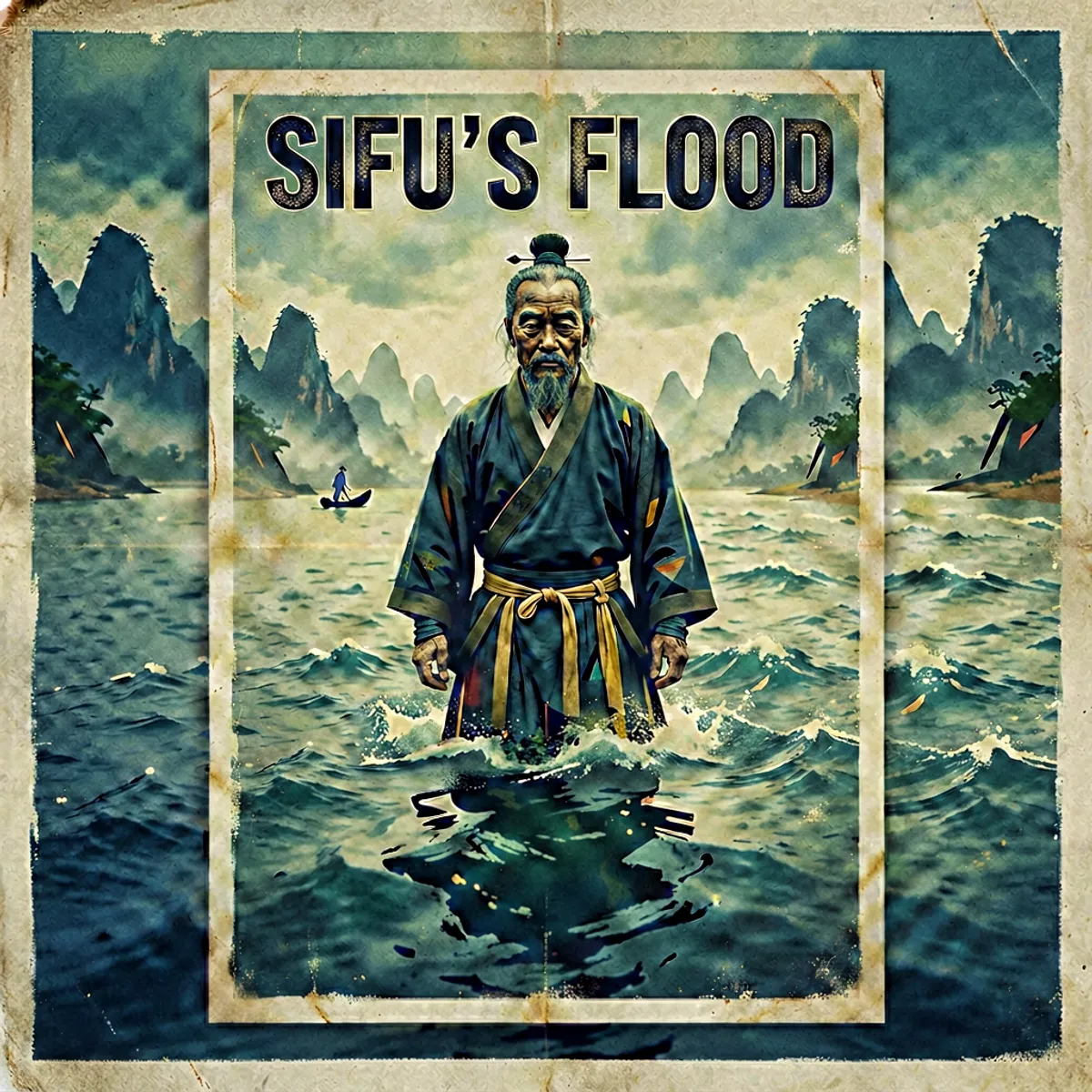
The Flood poster is a major piece of this environmental storytelling. It is a primary source from the event itself. Its mysterious text elevates it from a set dressing to a mystery box.
The player is meant to look at it, wonder, and perhaps piece together clues from other locations—a journal entry here, a master's dialogue there. The text's indecipherability forces the player to engage with the world's other narrative channels. It creates a holistic puzzle.
The developers trust the player to feel the weight of history without spelling it out. The recreation project, therefore, is an external validation of that trust.
The Reconstruction Process: From Pixel to Paper
Having navigated the linguistic labyrinth, the recreator faces the tangible challenge of bringing the poster into physical existence. This phase transforms scholarly inquiry into artisanal craft. The goal is no longer just to understand the glyphs but to faithfully reproduce their material essence—the texture of age, the weight of history, the subtle imperfections that scream authenticity over sterility. The chosen medium becomes a narrative statement.
Selecting the Right Material: Paper as Narrative
The substrate is as important as the ink. A pristine, bright white sheet would betray the poster's in-game provenance. It should feel like it has weathered the same century as the Flood itself. Options narrow to specialized art supplies.
Rice Paper vs. Xuan Paper
Two traditional papers dominate consideration. Rice paper (often misnamed, typically made from mulberry bark) offers a fibrous, absorbent surface that takes ink beautifully, with natural variations in thickness and color. It feels hand-made and ancient.
Xuan paper, from Anhui province, is smoother, more resilient, and prized for calligraphy. Its slight sheen and durability might suit a poster meant for public display. The choice hinges on the poster's implied original function: was it a temporary broadside or a more permanent commemorative print?
The game's weathered texture suggests a paper that ages visibly, leaning toward the more porous, organic rice paper. The recreator might experiment with tea-staining or iron-gall ink模拟 to accelerate the patina of time.
Typographic Fidelity: Capturing the Hand of the Past
The digital font, if used, must be transformed. A clean, vector-perfect seal script font will look digital and dead. The strokes must breathe.
Simulating Hand-Carved Imperfections
If the poster is inferred to be a woodblock print (a logical assumption for an exhibition poster in a pre-industrial or post-collapse setting), the recreator must mimic the artifacts of that process. This involves: - Ink Bleed: Using a dry brush technique or a textured brush tip in software to create slight feathering at stroke ends. - Pressure Variation: Manually adjusting stroke width to simulate the inconsistent pressure of a hand-carved block, where corners might be sharper and curves slightly thinner. - Registration Errors: For multi-color prints (if any are visible), introducing a minute, deliberate misalignment between layers to evoke the imprecision of hand-pulling.
If the poster is a hand-brushed sign, the approach shifts to emulate a brush's drag, pooling, and dry-brush effects. This might require scanning actual brush strokes or using a high-quality calligraphy brush in a graphics tablet. The key is that the "flaws" are data points, not mistakes. They communicate the human, pre-digestic origin of the text within Sifu's world.
The Philosophy of Inaccessibility: Why Obscurity Works
This entire endeavor circles back to a core game design principle: diegetic depth through controlled opacity. Sifu does not hand the player a lore codex with neat translations. It scatters fragments—a poster, a half-remembered proverb, a rusted plaque—that resist immediate synthesis.
The Flood poster's indecipherable text is the ultimate expression of this. It is not a puzzle to be solved in the conventional sense; it is a texture to be felt. Its meaning is atmospheric, not literal. The player's frustration with translation tools mirrors the protagonist's own struggle to piece together a past deliberately shrouded by trauma and time.
Obscured Lore as a Gameplay Mechanic
This design choice turns environmental storytelling into an active, investigative process. The poster ceases to be mere set dressing and becomes a player-driven mystery. The community's collective effort to decode it—spreading screenshots, debating character forms, proposing historical parallels—becomes part of the game's extended narrative.
The developers are not just telling a story; they are providing raw materials for the audience to co-create the mythology. The poster's success lies in its failure to be easily consumed. It demands participation, rewarding those who approach it with the rigor of a historian and the passion of a devotee.
Contrast with Explicit Exposition
a number of games would present the Flood's story through a straightforward cutscene or journal entry. Sifu shows the aftermath—the ruined school, the changed landscape—and hints at the cause through objects like this poster. The text's resistance to easy reading forces the player to engage with the world's other cues: the architecture, the clothing, the martial arts styles.
It creates a holistic puzzle where every element is a potential clue. The poster teaches the player to read the world, not just the words. This is a sophisticated form of environmental storytelling that prioritizes implication over exposition.
Fan Labor as Cultural Preservation
The recreator's project transcends fandom. It is an act of digital archaeology and tangible preservation. Game worlds are fragile; servers shut down, assets are compressed and degraded, cultural context can be lost as communities dwindle. By physically printing the poster, the fan creates an artifact immune to digital obsolescence.
This labor—the research, the typographic trial-and-error, the material sourcing—mirrors the real-world work of cultural preservation done by historians and museum curators. The fan is applying the methods of artifact conservation to a fictional, digital-origin object. They are treating the game's world with the seriousness of a real historical period.
The Tangible Turn in Digital Fandom
There is a growing movement among gamers to move beyond screenshots and wikis. People build physical replicas of in-game weapons, sew costumes with historically accurate patterns, and cook meals from game recipes. This is a rejection of purely virtual engagement.
It is a desire to inhabit the game's world with one's physical body and senses. Holding the Flood poster, feeling its paper, seeing the ink sit on its surface—this completes a sensory circuit that the screen alone cannot provide. It transforms the game from an observed fiction into a lived, material culture.
The recreation is a bridge not just between game and reality, but between the player's mind and their hands.
Conclusion: The Value of the Puzzle
The journey to print Sifu's Flood poster ends not with a definitive translation, but with a richer understanding. The struggle with the text is the point. It connects the recreator to the fictional world's sense of depth, age, and obscured knowledge.
The unusual characters, whether they are real rare forms or artistic inventions, serve a narrative function: they symbolize a past that is difficult to access, a truth that requires effort to uncover. This mirrors the player's journey through the game itself—a path of hardship, learning, and revelation. The final printed poster, even if its exact wording remains uncertain, becomes a trophy of that investigative journey.
It is a physical testament to the player's commitment to engaging with a game world on its own meticulously crafted terms. The mystery is not a failure of design, but the core of its allure. In trying to bring a piece of Sifu's world into ours, we participate in the very act of historical reconstruction that the game's story is all about.
Responses • 0
0/2000
ID: 1326
Chris
Offline
2 hr
Visited
From
Bakersfield, United States
Send Message