Confucius in South Korea: The Revered Stranger
AI Learn Chinese
2 hr • 0 read
Why young South Koreans are baffled by Chinas longstanding reverence for Confucius, and how historical legacies and modern divides create this disconnect.
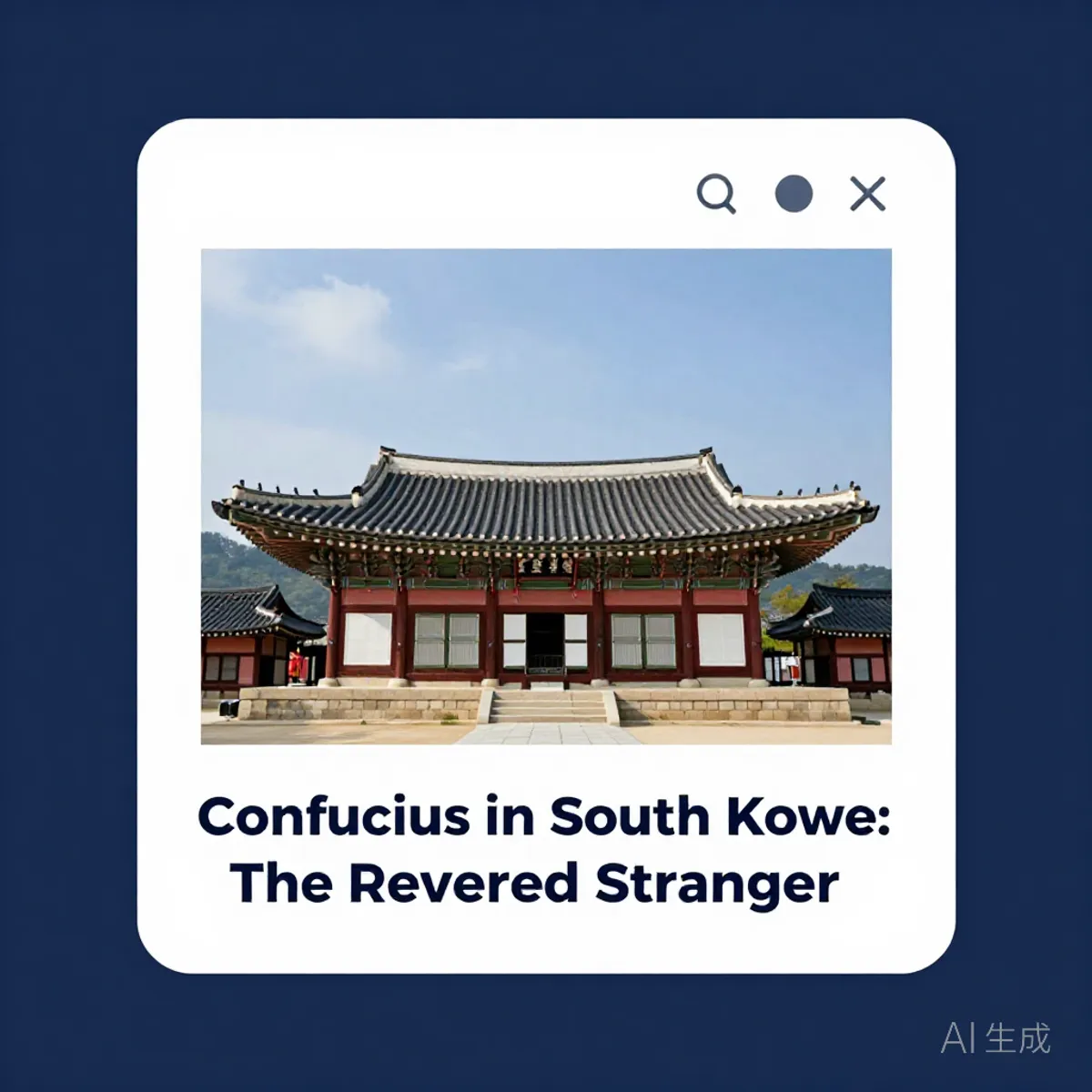
The Surprise Chinese Visitors Feel
When Chinese students or tourists first encounter the popular narrative that "Koreans view Confucius as their ancestor," their reaction is often one of polite acknowledgment. a number of accept this as a point of shared cultural heritage, a testament to the profound historical influence of Chinese civilization on the Korean peninsula.
This view aligns with a common understanding of East Asian history, where ideas and philosophies flowed from China outward. The Confucian classics, after all, formed the bedrock of the Joseon Dynasty’s state ideology for centuries.
But this narrative takes a sharp turn when these same Chinese individuals engage more deeply with younger Koreans. The bewilderment quickly morphs into utter dumbfoundedness. The response they receive is not one of proud affirmation but of confused dismissal, often laced with amusement or ridicule.
The gap between the external perception and the internal reality is vast and jarring. It reveals a fundamental misreading of how Confucianism is experienced in modern South Korea.
The core of the disconnect lies in a simple truth: the vast majority of Koreans, particularly those under 40, have no emotional or intellectual connection to Confucius as a revered sage. They are largely unaware that their social customs might have roots in Confucian thought. To them, Confucianism is not a living philosophy but an archaic set of rules, a historical burden frequently blamed for societal pressures.
The idea that they would claim Confucius as an ancestor is not just wrong; it is conceptually alien.
This article explores this fascinating cognitive dissonance. It traces the historical implantation of Confucianism in Korea, its rigidification during the Joseon period, and its subsequent fragmentation under modernity, Christianity, and rapid economic development. We will examine why Confucian values are often decried while their structural echoes remain, and why for a generation raised on K-pop and digital innovation, Confucius is more a punchline than a patriarch.
The Historical Implantation: The Confucian Joseon Dynasty
To understand the modern Korean mindset, one must first journey back to the Confucian Joseon Dynasty (1392-1910). This was not a passive adoption but an aggressive, state-driven project. When the Joseon founders overthrew the preceding Goryeo Dynasty, they deliberately rejected Buddhism as the state orthodoxy, which they associated with Goryeo’s corruption and monastic power.
In its place, they elevated Neo-Confucianism as the supreme governing ideology. This was a comprehensive social engineering program. The state established a nationwide network of hyanggyo and the paramount seowon. Their curriculum centered on the Four Books and Five Classics, with an intense focus on memorization, annotation, and the civil service examination (gwageo).
The path to power, prestige, and social mobility was inextricably linked to mastery of Confucian texts. Confucius himself, along with his Korean interpreter Mencius, became the ultimate authorities.
The social structure was meticulously Confucianized. A strict samgang (three bonds) and oryun (five relationships) defined every interaction: ruler and subject, father and son, husband and wife, elder and younger brother, friend and friend. Filial piety (hyo) was not merely a virtue but the foundational pillar of all social order.
Ancestor worship rituals were formalized and regulated. Women were subordinated within a patrilineal, patriarchal household system (ga). This created a deeply hierarchical, status-conscious society where age and birth order dictated deference.
The Joseon state also used Confucianism to solidify a distinct Korean identity in contrast to its neighbors. While borrowing the Chinese philosophical framework, Joseon scholars stressed Korea’s role as the most devoted custodian of true Confucian values after the Ming Dynasty fell. They developed a strong sense of cultural superiority, sometimes called "Sojunghwa" (small China), positioning Korea as the authentic heir to Confucian civilization.
This historical narrative is the root of the external perception that Koreans inherently revere Confucius. But, this system also bred immense social pressure and rigidity. The examination culture was brutally competitive, favoring the yangban aristocratic class. The emphasis on outward ritual and propriety (ye) often created a gap between social performance and private reality.
Dissent was stifled in the name of social harmony. These tensions would eventually explode in the modern era.
The Shattering: Modernity, Christianity, and War
The Confucian edifice of Joseon began to crack in the late 19th century under internal decay and external pressure. The failed Gabo Reform of 1894 attempted to dismantle the gwageo system and yangban privileges, signaling the first official attack on the Confucian social order.
This was followed by the brutal Japanese colonization (1910-1945), which actively suppressed Korean cultural and intellectual autonomy, including traditional Confucian institutions, while promoting Japanese State Shinto.
Simultaneously, a powerful new force entered Korea: Protestant Christianity. Arriving in the late 19th century, it gained massive traction in the 20th century. For many Koreans, Christianity offered a direct, personal relationship with God, a stark contrast to the ritualistic, ancestor-focused, and hierarchical nature of Confucianism.
It provided a modern, universalizing worldview and a powerful communal network. During the Japanese era, churches became centers of nationalist resistance. Post-1945, Christianity became associated with modernity, education, and anti-communism, especially in the South.
For a generation seeking to break from the Joseon past, Christian ethics provided a compelling alternative moral framework that often explicitly rejected Confucian familialism as idolatrous.
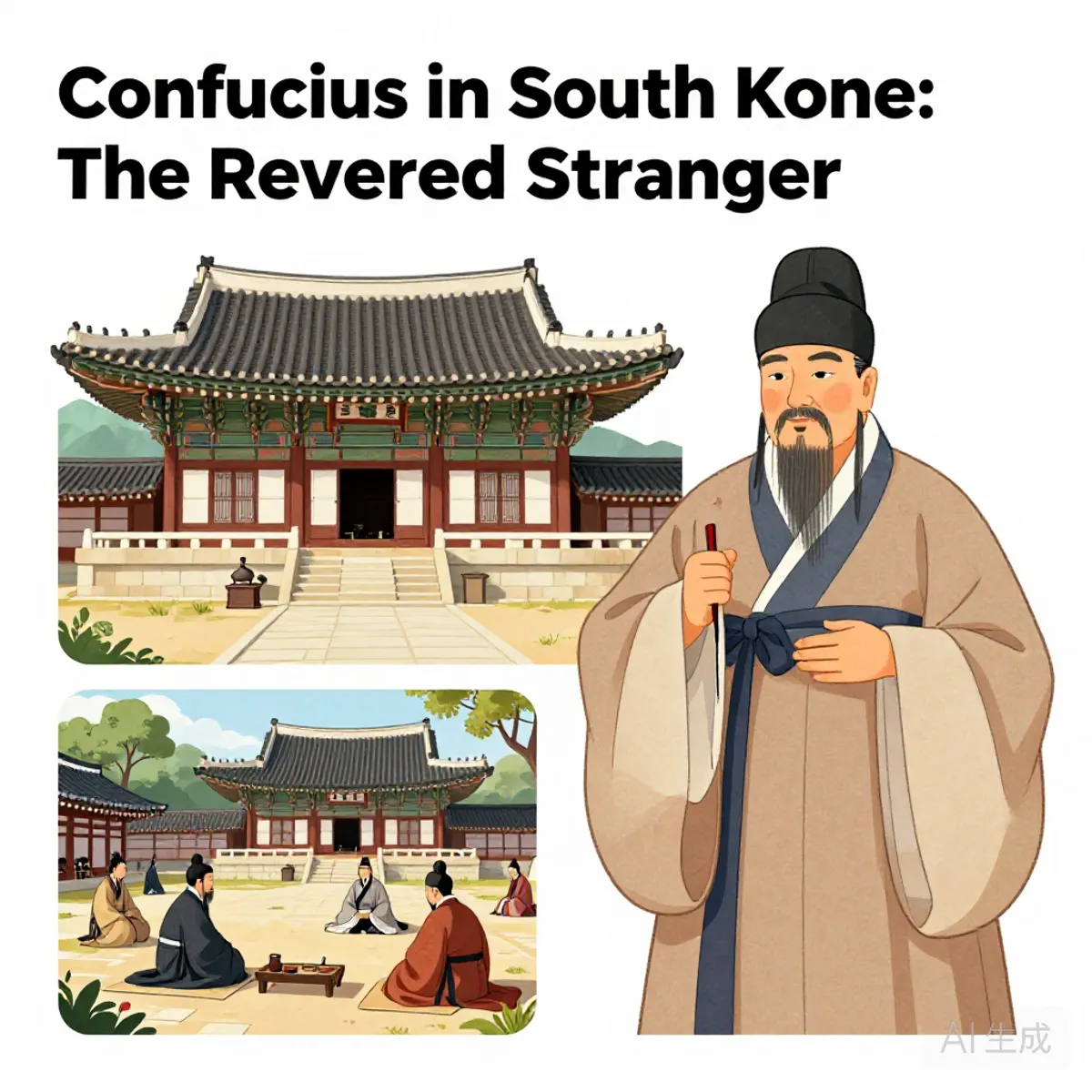
The Korean War (1950-1953) was the final, cataclysmic blow. The peninsula was utterly devastated. Survival, not philosophical continuity, became the primary goal.
The old agrarian society based on extended family clans was shattered. Millions were displaced, families separated. In the desperate rebuilding that followed under Park Chung-hee’s authoritarian rule (1961-1979), the priority was rapid industrialization and economic growth.
The state promoted a new, disciplined workforce, but its model was less Confucian scholar-official and more Japanese-style corporate soldier. Confucian values of loyalty were redirected from family and king to the company and the nation-state.
The Park regime also actively suppressed traditional culture and thought deemed backward or feudal. While it utilized Confucian-like rhetoric of social harmony and sacrifice for national development, it did so in a secular, nationalist context. The Confucian intellectual elite (yangban) was replaced by a technocratic and military elite.
The profound social changes—urbanization, nuclear families, increased female education and workforce participation—began to erode the concrete social structures that had sustained Confucian practice for centuries.
The Generational Divide: Who Remembers Confucianism?
The result of this historical whiplash is a profound generational amnesia and divergence in attitude toward Confucianism. For Koreans in their 50s and older, Confucian values may still resonate as a lived, if complicated, memory. They grew up in a society where bowing to elders, strict filial duties, and prioritizing family reputation were non-negotiable social codes.
The hyo of the Classic of Filial Piety was not a text but a daily expectation. They may look back on this system with a mix of nostalgia for its perceived stability and resentment for its oppressive weight.
But for Koreans in their 40s and younger, Confucianism is a foreign country. They did not experience the full force of the Joseon social structure. Their world is defined by digital technology, global pop culture, hyper-competitive private education (hagwon), and a struggling democracy.
The social pressures they feel—academic competition, job market anxiety, housing costs—are framed in economic and systemic terms, not as Confucian duties. When they hear the term Confucianism, it is often through a critical lens presented in media, academia, or political discourse.
This is where the ridicule begins. In this demographic, Confucius and Confucianism have become convenient shorthand for everything perceived as backward, patriarchal, collectivist, and suppressive of individual expression. It is blamed for Korea’s infamous academic pressure (pali-pali culture), hierarchical corporate abuse, political corruption, and the marginalization of women and LGBTQ+ individuals.
The phrase "Confucian Taliban" has emerged in some critical discourse, a potent piece of rhetoric that paints Confucianism as a rigid, fundamentalist force stifling modern, liberal values.
This sentiment is vividly visible in online spaces. Browsing Korean internet forums, news comment sections, or Reddit communities like r/korea, one encounters frequent, casual mockery of Confucianism. Memes depict Confucius as a boring, authoritarian old man. Discussions about social problems will invariably include comments attributing the issue to "our Confucian culture."
There is a strong current of what scholars call "Confucian bashing," where the philosophy is singled out as the primary root cause of societal ills, often with little nuance about its historical evolution or internal diversity.
This phenomenon is not merely an internet curiosity; it permeates mainstream media and political discourse. Television dramas, a cornerstone of Korean cultural export, frequently depict Confucian family structures as sites of conflict, oppression, and generational trauma. The stern, patriarchal father figure—often a business executive or a professor—enforces rigid hierarchies and sacrifices personal happiness for familial duty, a trope that reinforces the association of Confucianism with emotional repression.
Webtoons and satirical cartoons routinely exaggerate these traits, presenting Confucius as a humorless bureaucrat or a ghost haunting modern life. This popular cultural framing reduces a complex philosophical tradition to a set of negative social symptoms, making it an easy target for collective frustration.
Political rhetoric further cements this simplistic linkage. Across the spectrum, politicians and pundits invoke "Confucian culture" as a catch-all explanation for persistent problems. Conservatives might subtly appeal to its values of social harmony and respect for authority to argue against rapid social change or criticize youthful disrespect.
But, it is progressive and liberal voices that wield the term most aggressively as a weapon. They blame "Confucian patriarchal thinking" for the gender pay gap, the lack of women in leadership, the stigma against single mothers, and the hierarchical, seniority-based corporate culture that fuels hoesa (company) abuse. The phrase becomes a rhetorical shortcut, allowing complex socio-economic issues to be personified in an ancient philosophy, thereby deflecting from more nuanced analyses of capitalism, legal frameworks, or corporate governance.
This political instrumentalization creates a paradoxical landscape. While the state under President Park Geun-hye (2013-2017) occasionally referenced "Confucian values" in promoting social cohesion, her administration was also heavily criticized by younger feminists who explicitly identified Confucianism as a root cause of gender inequality. The very act of state co-option often backfires, reinforcing the public perception that Confucianism is a tool of conservative power.
The debate is rarely about the texts of Mencius or the Analects; it is a proxy war over Korea's modern identity—whether it should embrace a more individualistic, Western-style liberalism or seek a distinct, perhaps reformed, Asian value system. In this war, Confucius is the symbolic battlefield, and most young combatants on the progressive side see his banner as one to be torn down.
University campuses, theoretically spaces for nuanced historical engagement, often mirror this public polemic. While departments of Korean philosophy or East Asian studies offer courses on Neo-Confucianism, these are typically electives with limited enrollment. For the vast majority of students in business, engineering, or social sciences, their encounter with Confucian thought is filtered through critical theory, gender studies, or sociological critiques that frame it as a hegemonic ideology.
A common undergraduate essay topic might be "Confucianism and the Crisis of Modern Korean Society." The academic discourse, while more sophisticated than internet memes, still largely operates within a paradigm of critique rather than reconstruction or appreciative engagement. There is little mainstream movement to reinterpret Confucian concepts like ren (benevolence) or yi (righteousness) as potential resources for addressing contemporary ethical dilemmas. The project remains overwhelmingly deconstructive.
The generational chasm is perhaps most visible in the stark contrast between how elders and youth interpret the same social ritual. An older Korean may perform a deep bow to a senior colleague or a professor with a sense of ingrained, respectful duty (ye). A younger person might perform the same bow out of palpable social anxiety or perceived coercion, resenting it as a "Confucian leftover" that forces performative submission.
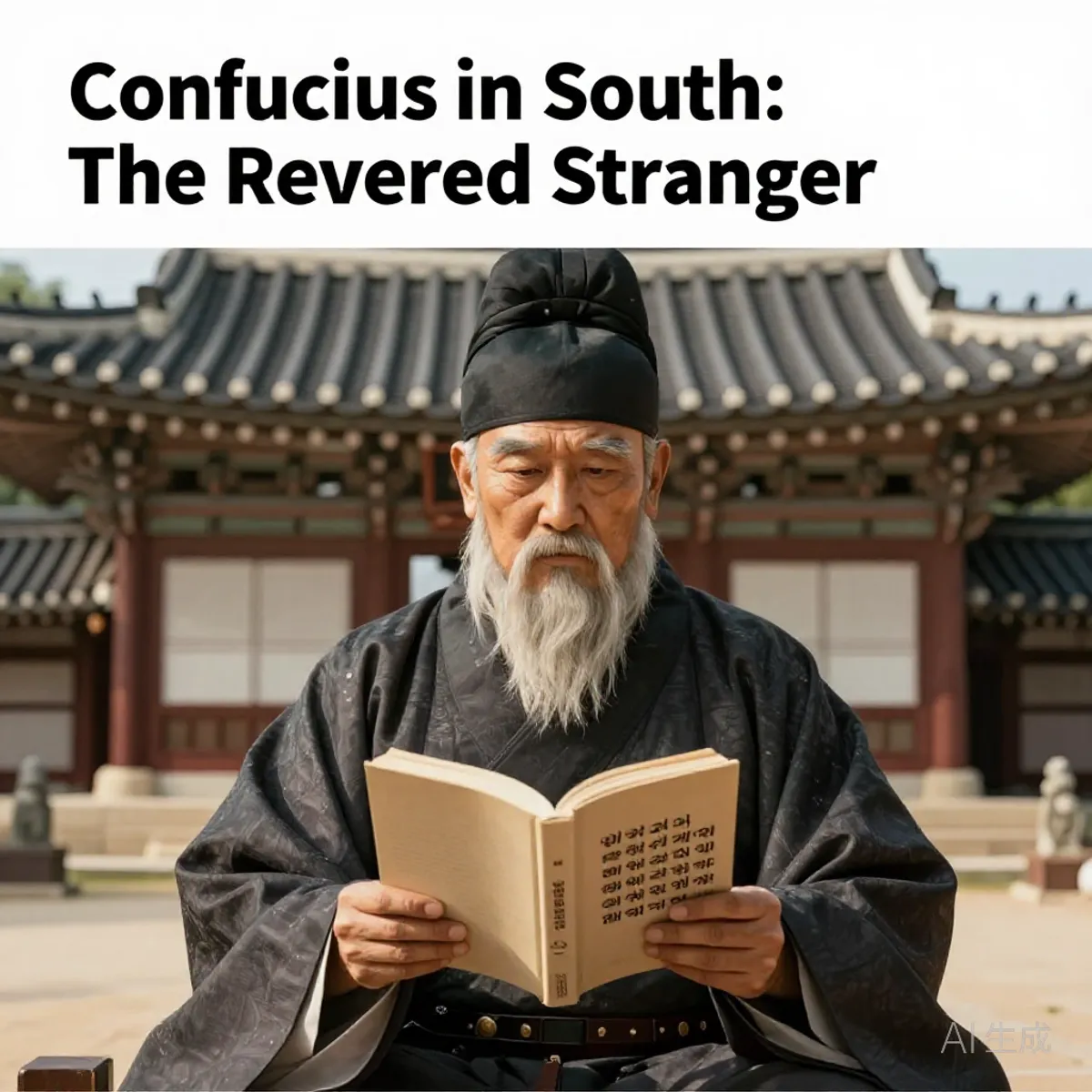
The action is identical, but its internal meaning and emotional valence are worlds apart. The elder sees continuity with a valued, if strict, past; the youth sees an arbitrary, burdensome relic. This disconnect means that even practices with deep Confucian roots are being stripped of their original philosophical context and re-framed as mere social oppression.
This re-framing is powerfully evident in the realm of gender and family. The intense societal pressure on women to marry and bear children, the stigma against divorce, and the disproportionate burden of childcare and eldercare on daughters-in-law are routinely attributed to "Confucian family ideology." The feminist movement in South Korea, one of the most vibrant and radical in Asia, has consistently targeted the patriarchal family system as its primary adversary, and this system is inextricably linked in the popular imagination to Confucian prescriptions. The term "Confucian patriarchy" is a staple of activist discourse.
Consequently, any attempt to invoke Confucian values in public policy or education is often met with immediate suspicion from young women and gender-equality advocates, who view it as an attempt to roll back hard-won rights. The philosophical concept of harmonious family relations is thus heard not as an ideal but as a threat to female autonomy.
Yet, for all the vocal rejection, the structural echoes of the Joseon social order are remarkably resilient. The hyper-competitive, exam-obsessed education system, while driven by modern economic anxieties and the hagwon (private academy) industry, operates on principles that would be familiar to a Joseon scholar. The relentless focus on ranking, the prestige attached to attending a SKY university (an acronym for Seoul National, Korea, and Yonsei Universities), and the belief that academic success dictates one's entire life trajectory mirror the gwageo examination culture in its social function, if not its specific content.
The hierarchy of schools and majors creates a new yangban class of credential holders. The stress is not framed as fulfilling a Confucian scholarly ideal but as a brutal, capitalist game—yet the underlying social logic of meritocratic competition for status remains profoundly Confucian in its spirit.
Similarly, the corporate world, despite its globalized jargon and扁平化 (flat organization) aspirations, remains intensely hierarchical and age-sensitive. The use of honorifics (jondaesmal) is strictly observed, and junior employees routinely perform tasks for seniors that extend far beyond their job description. The expectation of after-work drinking sessions (hoesik), where bonding is enforced and dissent is silenced, can be seen as a modern ritual of ye (propriety) that binds the corporate in-group.
While critics blame this on "Japanese-style management" or general Asian culture, its roots are deeply embedded in the Confucian emphasis on hierarchical loyalty and group harmony. The key difference is that the object of loyalty has shifted from the king and the clan to the chaebol founder's family and the corporation itself.
The economic miracle of the 1960s-80s, often called the "Miracle on the Han River," is frequently analyzed through a lens that separates its Confucian and non-Confucian elements. Scholars like the late sociologist Gil-sung Kim argued that the Park Chung-hee state selectively mobilized Confucian values—like diligence, frugality, and loyalty to the collective—to discipline the workforce for export-oriented industrialization. But, it simultaneously dismantled the Confucian agrarian social structure and the political power of the yangban scholar-officials, replacing them with a technocratic elite loyal to the regime.
This created a hybrid: a capitalist economy powered by a workforce socialized with Confucian discipline but operating within a framework that actively undermined the traditional Confucian social order and its intellectual class. The result was a society where Confucian habitus (to borrow Bourdieu's term) persisted in behavior and expectation, but the explicit ideology and its supporting institutions had been hollowed out.
This historical layering explains the current cognitive dissonance. The external observer, often Chinese, sees the surface continuity of rituals, the respect for elders, the emphasis on education, and the family-centric ethos, and correctly identifies their historical origin in Confucianism. They then assume these are consciously cherished traditions.
The internal reality, especially for the young, is that these are experienced as unexamined, often resented, social facts—the "air one breathes"—while the explicit philosophy is rejected as a toxic ideology. It is the difference between recognizing a cultural inheritance and actively venerating its source. A young Korean might automatically stand for an elder on the subway (a Confucian-inspired act of deference) while simultaneously posting a meme mocking Confucius as a dictator.
The practice and the belief have been severed.
The rise of digital media and global pop culture has accelerated this severance. K-pop and K-drama stars project images of modern, often Westernized, individuality and romantic love that directly conflict with Confucian familial duty and arranged marriage norms. The global success of Korean culture is predicated on a cool, innovative, and relatively liberal image that has little room for the stern moralism of Zhu Xi's Neo-Confucianism.
For Korean youth consuming this content, their cultural pride is tied to a modern, global identity that consciously distances itself from the "feudal" past associated with Confucianism. Rejecting Confucius becomes part of claiming a place in the cosmopolitan, digital world.
Christianity, particularly the dominant Protestantism, provided the first major ideological framework for this rejection. As noted earlier, its emphasis on a personal God and a universal community of believers offered a direct alternative to the Confucian focus on this-worldly, familial, and hierarchical relationships. For decades, being modern in Korea often meant being Christian.
While church attendance has declined among the young, the cultural residue of this Protestant-CONFUCIAN binary remains powerful. Confucianism is still implicitly coded as the "traditional" or "pagan" option against which a modern, rational, and individualistic identity was forged. This historical alliance between modernization and Christian (and later, secular liberal) values created a deep-seated cultural bias against Confucianism as inherently pre-modern.
What, then, of the future? Will this rejection solidify into permanent cultural amnesia? There are counter-currents, though they remain marginal.
A small but growing number of scholars, cultural entrepreneurs, and spiritual seekers are attempting to "reclaim" or "reinterpret" Confucianism for a modern, democratic Korea. They point to its humanistic aspects, its potential for ethical business practices, and its rich tradition of self-cultivation (xiu shen). Some explore "Confucian feminism," arguing that the tradition contains resources for critiquing power and promoting relational ethics that differ from Western liberal feminism.
These efforts are often dismissed by the mainstream as academic exercises or, worse, as apologetics for patriarchy. They lack the cultural momentum and emotional resonance of the dominant narrative of rejection.
The paradox is thus complete: Korea is one of the most Confucian-in-practice societies in the world, yet it is also one of the most Confucian-in-name hostile. The philosophy is blamed for problems its institutional collapse actually exacerbated—like the intense educational competition that arose after the gwageo system was abolished and the old yangban class was dismantled, creating a vacuum filled by new, often more ruthless, forms of status competition. It is held responsible for gender inequality, yet the most rapid changes in women's rights occurred alongside the decline of the Confucian family system, not because of it. The bashing is, in many ways, a misdirected anger at the lingering effects of a system whose ideological authority has been shattered.
For the Chinese visitor, this is the profound disconnect. They are taught that Confucianism is the glue of East Asian civilization, a shared heritage to be proud of. They encounter a Korea where that glue is acknowledged to have once bound the society together but is now widely seen as the very adhesive that must be scraped off to move forward.
The Korean experience suggests that a philosophy can be historically foundational yet existentially rejected; that its social after-effects can be inescapable while its explicit tenets are vilified. Confucius is not revered in Korea today; he is a specter—a revered stranger whose house is occupied by tenants who deny his ownership while living by the rules he once wrote. The bewilderment of the Chinese guest stems from a failure to grasp that heritage and reverence are not synonymous.
One can be utterly shaped by a legacy while utterly despising its source. This is the strange, modern Korean condition: a civilization built on Confucian stone, now inhabited by people who curse the architect while living in the rooms he designed. The dissonance is not a sign of hypocrisy but of a historical rupture so complete that the past has become a foreign country, visited only by scholars and tourists, while its architecture silently structures the daily life of those who have forgotten its name.
In the end, the question is not whether Koreans are Confucian—they are, in countless behavioral ways—but whether they can ever bring themselves to say so with anything but a sneer. The legacy is in the bones; the judgment is in the mind. And for now, the mind is winning.
Responses • 0
0/2000
ID: 1326
Chris
Offline
3 hr
Visited
From
Bakersfield, United States
Send Message