Chongqing Kindness, Martian Chat
AI Learn Chinese
4 hr • 0 read
A Korean visitor's funny translation fails in Chongqing, grateful for a stranger's help, and dreams of Chengdu and Yunnan.

Introduction: A Comic Strip from a Departure
Standing on the platform of Chongqing North Railway Station, the humid air clinging to my skin, I felt the familiar pang of a trip ending. My phone battery, a stubborn 5%, glowed a warning red. This was my third time in China, and the city's dramatic, layered geography—a symphony of rivers, mountains, and neon-lit cliffs—had once again left its mark.
As a Korean traveler, the language barrier was a constant, quiet companion. To process the experience, I did what I often do: I drew a short comic. It depicted a final, frantic conversation with a local shopkeeper as I scrambled to catch my train.
The dialogue, a direct, word-for-word translation from my fragmented Mandarin into Korean and back again, was clumsy. I posted it online, translated the captions for my Chinese-speaking friends, and expected a few polite smiles. What I got instead was a torrent of laughter.
They declared my dialogue sounded like "Martian language." The incident, however, was only the surface. Beneath it lay a story of a simple, profound kindness that kept my phone, and my connection home, alive that day. This article is about that laughter, that help, and the enduring hope that pulls me back toward China's southwest, toward Chengdu and the legendary landscapes of Yunnan.
The Comic That Sparked Laughter
Drawing the Departure
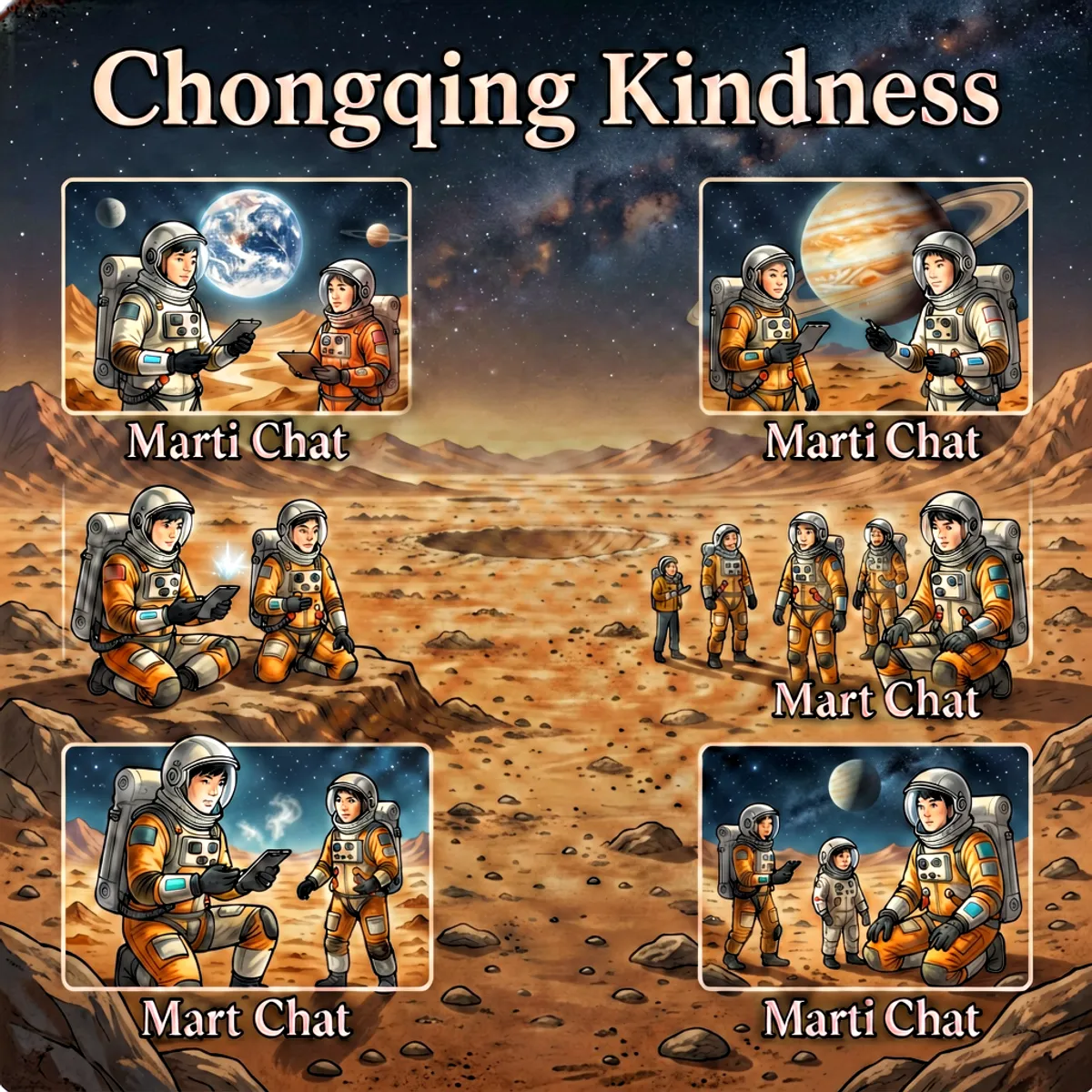
The comic was four panels, stark and simple. Panel one showed me, backpack huge, pointing at my phone's dying screen inside a small convenience store. The shopkeeper, an older man with a weathered but kind face, looked concerned.
Panel two: my hand gestures, miming a "train" and "urgent." Panel three: his solution, holding up a portable power bank. Panel four: my grateful bow as he waved it off, refusing payment. The text bubbles were the key.
I had tried to capture the essence of our broken exchange. My character says something like, "My electricity in the machine is very little, I must go to the big iron bird place, can you lend me your electricity container?" His reply, as I imagined it, was a patient, "This is for you, no need to give money, quickly go." It was a literal, grammatical mess. To me, it was a honest record of cross-cultural communication.
To my friends, it was pure comedy.
The Final Scene's Dialogue
The specific lines that became "Martian" were a masterpiece of mistranslation. In Korean, I had written my plea as, ""기계에 살이 거의 없어요. 큰 철새 장소로 가야 해요.
당신의 전기 그릇을 빌려 주실 수 있나요?"" (Gigae-e sari geoui eobsseoyo. Keun cheolsae jangso-ro gya haeyo. Dangsin-ui jeongi geuriseul billye jusil su issnayo?).
This translates directly to "There is almost no flesh in the machine. I must go to the big iron bird place. Can you borrow me your electricity bowl?" My friend's response in the comic was, ""이건 너를 위한 거예요.
돈 필요 없어요. 빨리 가세요."" (Igeon neoreul wihan groyeyo. Don piryo eobsseoyo.
Ppalli gaseyo.)—"This is for you. No need for money. Go quickly." The humor came from the surreal imagery: "flesh in the machine" for battery life, "iron bird place" for train station, and "electricity bowl" for power bank.
My Chinese friends, reading the translated text, were in stitches. They said it sounded like a naive alien trying to decipher human technology and transport. The gap between the intended meaning and the literal words created a charming, absurdist vignette.
The "Martian Language" Effect
Why It Sounded Alien
The laughter, I quickly learned, wasn't mockery but delighted recognition. My friends explained that the "Martian" quality stemmed from applying Korean grammatical logic and vocabulary directly to Mandarin concepts. Korean often uses native words for everyday objects (like ""전기"" for electricity) and Sino-Korean terms for formal concepts.
My attempt to describe a "power bank" as an "electricity container" or "bowl" (""전기 그릇"") was technically descriptive but utterly unnatural. In Mandarin, you'd simply say ""充电宝"" (chōngdiàn bǎo), literally "charge treasure," or ""移动电源"" (yídòng diànyuán), "mobile power source." Similarly, "train station" as "iron bird place" (""철새 장소"") confused the metaphor. ""철새"" means " migratory bird," but I was trying to evoke the metallic, flying nature of a train.
The humor arose from this hyper-literal, cross-linguistic calque. It was as if I had constructed a language from first principles, ignoring the organic idioms and slang that make a language feel lived-in. My friends saw the earnest effort behind the absurdity, which made it funnier.
The Humor in Honest Mistakes
This kind of linguistic mishap is a universal traveler's rite of passage. What made mine resonate was its specific cultural context. The Chinese internet has a long history of celebrating " Chinglish" signs and translations that are grammatically correct but contextually bizarre.
My "Martian" dialogue fit perfectly into that meme-friendly category. It highlighted the gulf between textbook learning and street-level reality. I wasn't using the polite, formal phrases from my textbooks; I was desperately constructing meaning from a handful of vocabulary words and gestures.
The laughter was, in part, an acknowledgment of their own similar experiences, either as language learners or as hosts to bewildered foreigners. It was a gentle, shared joke about the beautiful chaos of communication. They weren't laughing at my inability; they were laughing with the situation, the universal struggle to be understood when the words fail you.
The phrase "Martian language" became a affectionate label for any communication that is technically decipherable but stylistically otherworldly.
A Phone's Lifeline
The Dying Battery
The comic was fiction only in its condensed form. The real event unfolded in a blur of pre-departure stress. My train to Chengdu (a trip I would take later, on a different journey) was departing in 45 minutes.
I was in a nondescript alleyway shop near the station, having just finished a bowl of fiery Chongqing noodles. I pulled out my phone to check my ticket and confirm my Didi ride. The screen flickered and died.
The battery icon was a stark, empty outline. Panic, cold and sharp, set in. Without my digital ticket, map, or translation app, I was stranded.
I had no paper copies. The shopkeeper, Mr. Li, saw my distress. Our conversation was the real-life version of the comic's dialogue, but with more frantic pointing at my phone and more emphatic shrugging from him.
He understood the problem instantly: a dead phone for a foreigner in transit was a minor crisis.
A Stranger's Intervention
What followed was a masterclass in silent, efficient kindness. Mr. Li didn't try to puzzle through my terrible Mandarin. He simply rummaged under his counter and produced a portable power bank.
He plugged it into my phone, held up a finger for "one moment," and went back to serving other customers. Ten minutes later, my phone blinked to life at 15%. He waved away my fumbled attempts at payment, making a clear ""不用"" (bùyòng, "no need") gesture.
His communication was all action and minimal words, a universal language of help. He pointed at my ticket on the screen, gave a thumbs-up, then shooed me toward the station entrance. I ran, heart pounding, making my train with seconds to spare.
That power bank, a simple object, had been a lifeline. It kept my digital existence alive. The kindness was not verbose; it was practical, immediate, and profound.
It was the quiet counterpoint to the noisy, confusing linguistic failure of minutes before. I never got his name, only a fleeting glimpse of his face and the indelible memory of his gesture. The comic, therefore, has a bittersweet edge—it captures the funny confusion, but the reason it mattered was because of the silent help that followed.
Three Journeys: Evolving Perspectives
First Visit: Overwhelmed Senses
My relationship with China began three trips ago. The first was a whirlwind of iconic sights: the Great Wall, the Forbidden City, the Terracotta Army. I was a typical tourist, awestruck and perpetually lost.
The language barrier was a wall. I relied on phrasebooks and pointing. My memories are of sheer scale, ancient history pressing against modern skyscrapers.
I liked the efficiency of high-speed rail and the bewildering variety of street food. But I felt like an observer, separated by a glass screen. Chongqing wasn't on that first itinerary; it was a name that meant "mountain city" and spicy hot pot.
I left with a postcard view, beautiful but shallow.
Second Visit: Seeking Connection
The second trip was different. I targeted smaller cities, including Chongqing. I wanted to live, not just visit.
I stayed in a hostel in the Yuzhong district, walked until my legs ached through the maze-like streets, and took the monorail that seemed to pierce apartment buildings. The language was still a barrier, but now I had a few more tools. I learned to say ""多少钱?"" (duōshǎo qián?, "how much?") and ""谢谢"" (xièxie, "thank you") with proper tones.
The interactions were still basic—ordering food, buying tickets—but they felt like real exchanges. I liked the directness of some vendors, the curiosity of locals who'd smile and say ""你好"" (nǐ hǎo). This trip, I drew more comics, capturing small moments: the old man doing tai chi by the river at dawn, the chaos of the Ciqikou ancient town.
I left Chongqing feeling I had touched the city, not just seen it. The seed for the "Martian language" comic was planted here, from the accumulated frustration and humor of those broken conversations.
Third Visit: The Nuanced Traveler
This most recent trip, the one that produced the comic in question, was about depth. I returned to Chongqing with friends who spoke some Chinese. Their presence changed the dynamic.
I could ask more complex questions about the history of the wartime capital, the meaning of the Liberation Monument. I could understand more of the rapid-fire conversations around me. The "Martian" feeling persisted, but it was now tinged with comprehension.
I could catch snippets, recognize patterns. The kindness of Mr. Li wasn't a surprise; it was an affirmation of the warmth I'd experienced before. I left with a more nuanced palette of memories: the taste of xiaomian (small noodles) at 2 AM, the view from Nanshan Mountain at sunset, the feeling of being utterly engulfed by the city's vertical energy.
My like for China shifted from a tourist's admiration to a traveler's affection. I no longer just visited; I tried to live in the moments, even briefly. The three trips chart a clear progression: seeing, touching, understanding.
Each journey built on the last, making the language mishaps funnier and the human connections more meaningful.
Counting Down to 2026: Chengdu and Yunnan
Chengdu: A Friend's Home
The comic's backstory mentions a friend who lives in Chengdu. That's my anchor for the next trip, planned for 2026. Chengdu represents a different facet of Southwest China—laid-back, tea-house culture, the home of the panda.
My friend has promised a tour that avoids the most tourist-crowded spots: a morning at the Research Base of Giant Panda Breeding before the crowds, an afternoon in a hidden hutia (alley) for mapo tofu, an evening of bianlian (face-changing) opera at a smaller theater. I hope to experience Chengdu not as a visitor but as a guest. This means using my improving Mandarin to navigate the metro, to order ""一杯茶"" (yì bēi chá, "a cup of tea") at a riverside teahouse, to ask locals about their favorite mahjong spots.
The goal is to practice the language in a low-stress, friendly environment. Chengdu's slower pace contrasts with Chongqing's frantic energy, and I'm eager to compare them. My friend's presence turns the trip from sightseeing into a personal pilgrimage, a chance to share a part of my friend's life.
Yunnan: Tower Karst Dreams
The other magnet is Yunnan. The input specifically mentions its "breathtaking tower karst landscapes." This is the Shilin (Stone Forest) and the rice terraces of Yuanyang, but it also includes the dramatic peaks around Lijiang and the deep gorges of the Tiger Leaping Gorge. My fascination is geological and aesthetic.
I want to visit places where limestone towers rise from the earth like stone skyscrapers, where mist clings to terraced fields like green staircases to the sky. This is a trip for photography and hiking. The language challenge here might be different; in ethnic minority areas like the villages around the Stone Forest, local dialects or languages like Yi might be more common than Mandarin.
The "Martian language" experience could repeat itself on a whole new level. Planning for 2026 means researching the best seasons (spring or autumn to avoid summer rains and winter cold), transportation from Chengdu (a long bus or train ride), and basic phrases for rural areas. Yunnan represents the raw, natural beauty of China, a stark and stunning contrast to the urban landscapes of Chongqing and Chengdu.
It's the landscape that has fueled Chinese art and poetry for millennia, and I want to witness it.
The Universal Language of Kindness
Beyond Words
The central irony of my story is that the most significant moment—Mr. Li's help—required almost no words. The "Martian language" episode was all about the failure and comedy of words. The lifeline was about action.
This duality captures a fundamental truth about travel and human connection. We place immense pressure on language to convey everything: need, gratitude, friendship. But often, the core messages—I am in trouble, let me help you, you are safe now—transcend grammar.
Mr. Li's gesture was a universal symbol. He saw a problem (dead phone, stressed traveler), had a tool (power bank), and applied it. The transaction was complete before any sentence could be formed.
My gratitude, expressed later through a bow and a broken ""谢谢"", was secondary to his immediate act. This kind of non-verbal kindness is a traveler's most cherished discovery. It builds trust faster than any conversation.
It makes you feel alive to the goodness that exists outside your linguistic comfort zone.
Carrying the Laugh and the Lesson
I carry both the laughter and the lesson forward. The "Martian" dialogue is now a cherished inside joke with my friends. It reminds me to laugh at my own mistakes.
That humility is crucial for a traveler. It disarms potential frustration and opens you to the humor in situations. The lesson from Mr. Li is one of proactive compassion.
It informs how I hope to behave when I'm the local and see a struggling visitor. In 2026, as I navigate Chengdu's tea houses or Yunnan's mountain paths, I will undoubtedly produce more "Martian" phrases. I will probably get lost, mispronounce something critical, and create new funny stories.
But I will also remember to look for the person who might silently offer a solution, a direction, a cup of water. The experience in Chongqing taught me that a successful trip isn't measured by flawless communication. It's measured by the sum of moments: the ones that make you laugh until you cry, and the ones that make you cry with gratitude.
Both are equally valuable. Both make you want to live more fully, to say yes to the next journey, to leave your comfort zone again and again. The kindness of a stranger in Chongqing is the reason I will visit again.
The laughter of my friends is the reason I will share the stories.
Bridging the Martian Gap: My 2026 Study Plan
My upcoming 2026 journeys to Chengdu and Yunnan are not just about new landscapes; they are a direct challenge to my "Martian language" legacy. The comic, while a source of joy, is also a roadmap of my linguistic gaps. I am determined that in 2026, my pleas for a power bank will sound less like an alien probe and more like a local’s request. My study plan is therefore intensely practical and scenario-based, built around the very situations that previously failed me.
I am moving beyond textbook dialogues. My focus is on colloquial, functional phrases for travel hiccups. I drill sentences like, "我的手机没电了,请问有充电宝吗?" (Wǒ de shǒujī méi diàn le, qǐngwèn yǒu chōngdiàn bǎo ma?), which translates to "My phone is out of power, do you have a portable charger?" This replaces my previous "electricity bowl" construction.
I practice the tone patterns until they feel automatic, using language exchange apps to get feedback on pronunciation. The goal is not fluency, but clarity in crisis. I want to be understood the first time when I’m stressed and rushing.
A key part of this is learning the native terms for common objects. Instead of descriptive calques, I memorize the common, short words. A power bank is 充电宝 (chōngdiàn bǎo).
A train station is 火车站 (huǒchē zhàn). A ticket is 票 (piào). I create flashcards with images, not English translations, to build direct associations.
This drills out the Korean-language logic that previously led me astray. It’s about installing the correct Mandarin "shortcut" in my brain for high-pressure moments.
Immersion Through Media and Memory
To internalize natural speech patterns, I am consuming massive amounts of contemporary Chinese media. I watch travel vloggers from Chongqing, Chengdu, and Yunnan on Chinese video platforms, paying close attention to how they ask for directions, order food, and handle minor emergencies. I listen to Sichuanese podcasts, even if I only catch 10%, to accustom my ear to the regional accent and speed. This passive immersion is crucial for moving beyond the slow, deliberate speech I use with phrasebooks.
I also revisit my old comics not just to laugh, but to analyze and correct. For each "Martian" phrase, I write the natural Mandarin equivalent next to it. This creates a personal contrastive dictionary.
My "flesh in the machine" becomes "电池电量很低" (dianchi dianliang hen di, "the battery level is very low"). This exercise turns past embarrassment into a structured learning tool. It highlights the precise point where my linguistic frameworks clashed.
The Kindness Compass: How Chongqing Shapes Future Travel
The lesson from Mr. Li transcends language; it gives me a behavioral compass for my future travels. His help was silent, proactive, and solution-oriented. I now understand that my role as a traveler is not just to receive kindness, but to be prepared to recognize and reciprocate its forms.
In 2026, I will carry a physical map and paper copies of essential tickets as a backup, mirroring the lifeline he provided. This reduces my potential need for frantic help, but more importantly, it frees me to be the calm, helpful presence for another traveler if the situation arises.
I plan to carry a small, high-quality power bank myself, not just for my phone, but to offer to someone in need, just as Mr. Li did. This act becomes a tangible tribute to his kindness—a way to pay forward the silent gift. It transforms me from a passive recipient of goodwill into an active node in the network of traveler solidarity.
The "Martian" moments will still happen; I will still mispronounce words and gesture wildly. But I hope to balance those moments with moments of quiet, practical assistance for others.
This shift in perspective is profound. The goal is no longer merely to avoid "Martian" misunderstandings, but to cultivate the local’s ease that Mr. Li displayed. His confidence came from competence and generosity.
My aim is to develop enough competence to navigate basics smoothly, thereby freeing up mental and emotional space to extend that same generosity. It’s about evolving from a confused guest to a considerate participant in the local ecosystem.
Conclusion: The Journey’s True Destination
Looking toward 2026, my anticipation for Chengdu’s tea houses and Yunnan’s stone forests is intertwined with a quieter hope: to communicate with a little less comedy and a little more grace. The "Martian language" comic will always be a cherished artifact, a reminder of the humility and humor required when crossing linguistic borders. It symbolizes the beautiful, messy gap between intention and understanding.
Yet, the true north of my travel compass remains fixed on the kindness of Mr. Li in a Chongqing alley. It proved that the most critical connections are forged not in perfect grammar, but in shared humanity. The power bank was a tool, but his gesture was the message—one that needed no translation.
So, I will study my phrases, practice my tones, and pack my spare power bank. But I will also carry the lesson that a smile, a nod, and a willingness to help are the most universal vocabulary of all. The next time I find myself fumbling for words, I will remember that the goal is not just to be understood, but to understand, and to be worthy of the kindness that so often follows a traveler’s honest struggle.
The journey outward is always, ultimately, a journey inward, toward becoming a better, more connected human. That is the destination I am counting down to in 2026.
Responses • 0
0/2000
ID: 1326
Chris
Offline
4 hr
Visited
From
Bakersfield, United States
Send Message