Chinese Nicknames: Do They Signal a Special Bond?
AI Learn Chinese
4 hr • 0 read
When a Chinese friend gives you a unique nickname, does it signal a special bond? Uncover the cultural nuances of personal nicknames in China.
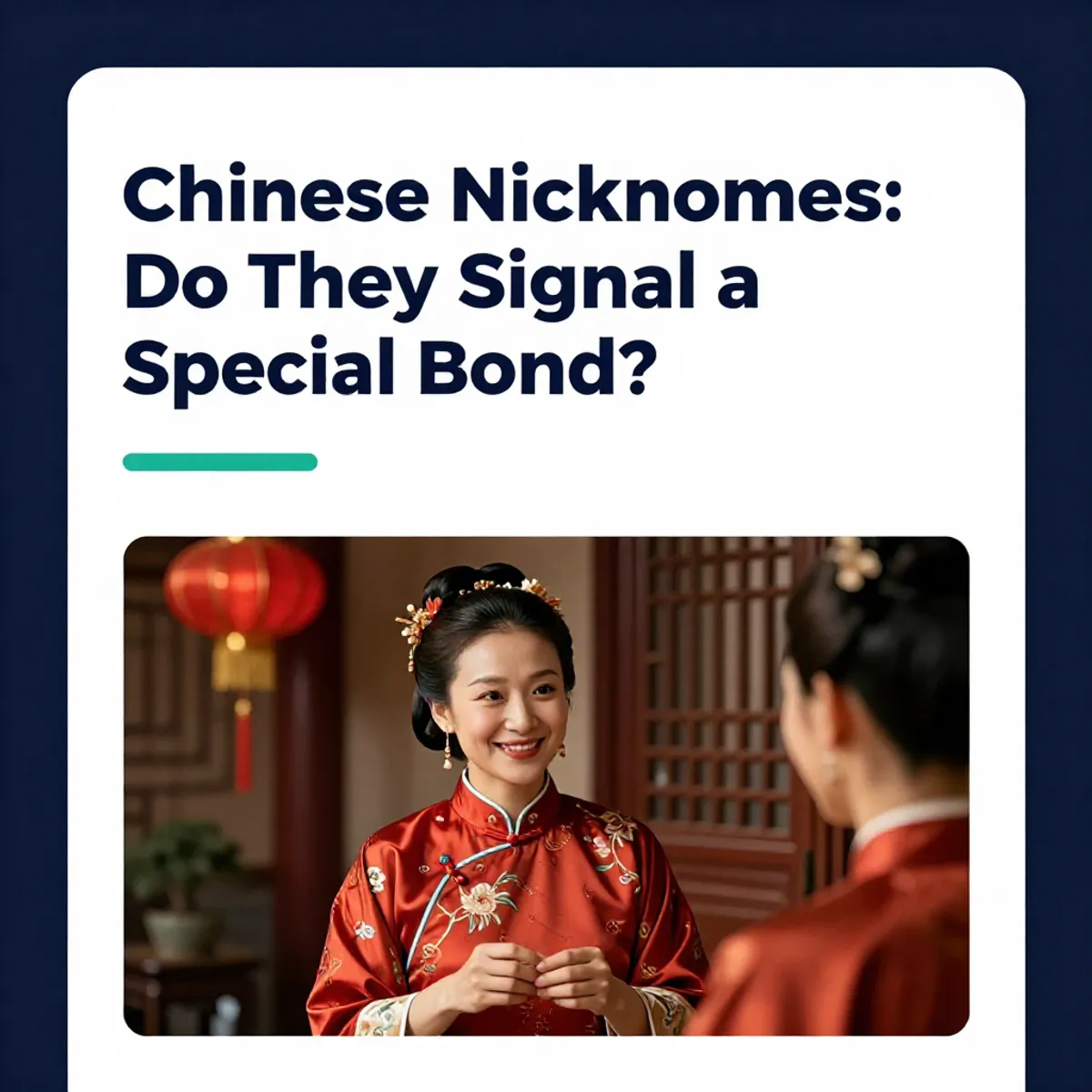
The Intimacy of a Given Name
In the intricate dance of human connection, few gestures are as personally revealing as the names we choose to call one another. A nickname, distinct from a formal or given name, carries a unique weight. It often encapsulates an inside joke, a shared memory, or a perceived characteristic, creating a private linguistic world between two people.
For someone navigating a cross-cultural friendship, receiving such a name from a Chinese friend can spark a profound question: what does this truly mean? Is it a casual habit, or a significant marker of relationship depth? Understanding this requires moving beyond the surface of the nickname itself and into the core values that shape interpersonal dynamics in Chinese culture.
The scenario is familiar: two people, in this case both in their mid-20s, build a friendship over time. Despite busy careers and daily responsibilities, they maintain regular contact, sharing the minutiae of their lives. This consistent investment of time and emotional energy forms the bedrock of their closeness.
Within this context, the act of bestowing a unique nickname emerges not as an isolated incident, but as a potential symptom of a relationship that has transcended casual acquaintance. The central query hinges on the cultural specificity of this act. In many Western contexts, a nickname can be spontaneous and fleeting.
In Chinese social frameworks, however, the choice and use of names are often more deliberate, loaded with unspoken social cues and historical precedent.
The Architecture of Chinese Names
To decipher the significance of a personal nickname, one must first appreciate the structured landscape of naming in Chinese society. The formal system is multi-layered and deeply relational. A person typically has their xing (姓, surname), followed by their ming (名, given name).
This given name is bestowed by parents and carries aspirations and meanings. This formal combination is used in official, respectful, or distant contexts. The intimacy of a relationship is frequently signaled by what one does not use: the full formal name.
In its place, a spectrum of alternative address forms exists, each occupying a specific rung on the social ladder. The most common is the use of the full given name without title, which already indicates a degree of familiarity among peers. For elders or to show respect, one might use xiao (小, little) or lao (老, old) prefixed to the surname, as in Xiao Wang (小王, Little Wang) or Lao Li (老李, Old Li).
These are not necessarily about age but about relational positioning and a sense of enduring familiarity. Then there is the mingzi (名字), a general term for one's full name, and the hao (号), a more literary, self-chosen pseudonym or courtesy name with historical roots in scholarly circles. The nickname, or bie ming (别名), or often simply a playful, modified version of the given name, exists within this ecosystem but operates on a different, more personal plane.
The Weight of a Given Name
The given name, or ming, holds a particular cultural gravity. It is not merely a label but a fragment of one's identity handed down from the family. Using someone's given name directly, especially by a non-family member, can sometimes feel too direct, too bare.
It removes the protective layers of surname or title. So, the avoidance of the formal ming is often the first step toward building rapport. When a Chinese person consistently uses a modified, shortened, or entirely new name for a foreign friend, they are consciously choosing to operate outside the standard formal and semi-formal structures.
They are creating a new category of address for that specific individual.
This act of naming is an assertion of a unique relational category. It says, "You exist outside the standard hierarchy of colleague Xiao Zhang or classmate Wang Wei. You are in a space where we have our own rules." The nickname itself becomes a shared token.
Its origin might be obscure—a mispronunciation, a reference to a specific event, a comment on a personality trait, or even a random, funny sound. Its power derives not from its literal meaning but from its exclusivity. Only the two friends understand its full backstory and emotional resonance.
This exclusivity is a direct function of guanxi (关系), the complex network of social relationships and obligations that underpins Chinese society. A unique nickname is a tiny, potent thread woven into the fabric of a personal guanxi.
Mianzi, Renqing, and Private Language
Two other crucial concepts frame this behavior: mianzi (面子, face) and renqing (人情, human feeling). Mianzi is about social standing, reputation, and the respect one is due. In public or formal settings, using the correct title and name is a primary way of granting mianzi.
A nickname, being informal and private, is the antithesis of public mianzi management. It is a mianzi-free zone. By using a special nickname, a Chinese friend is implicitly stating that in their private interactions, the strictures of social face are suspended.
This is a significant gift, as it offers a space of unguarded authenticity.
Renqing refers to the reciprocal exchange of favors, kindness, and emotional bonds that lubricate social machinery. It is the currency of obligation and goodwill. A unique nickname is not a transactional renqing debit or credit, but it is an investment in the renqing account of the friendship.
It represents a non-material, emotional contribution that strengthens the bond. It is a small, daily affirmation of "I see you as more than a social role." The consistent use of this nickname over time—through "about five months" or years—accumulates into a substantial renqing deposit. It signals a willingness to maintain this private, informal channel, which requires a certain emotional commitment and memory for the shared context it represents.
Cross-Cultural Perception Gaps
For the foreign friend, the nickname’s significance might be filtered through a different cultural lens. In many Western cultures, nicknames are plentiful and can be given quite freely, sometimes even as a form of teasing or mild depreciation among acquaintances. The bar for what constitutes a "special" nickname can be lower.
So, the foreigner might downplay its importance, seeing it as a simple, friendly habit. This creates a potential perception gap. The Chinese friend, operating within a framework where address forms are highly stratified, may intend the nickname as a clear, deliberate signal of stepping into a closer, more informal tier.
This gap is a classic pitfall in cross-cultural communication. One party sends a signal calibrated for their cultural receiver, while the other receives it through their own cultural decoder. The foreigner might not realize that in the Chinese friend's world, they are likely not using such a nickname for all their other friends.
Its uniqueness is the point. The question, "Is this something usually reserved for people they feel especially close to?" gets to the heart of this decoding. The answer is most often yes, but with nuance.
It is reserved for a category of relationship defined by private, sustained, and mutually understood intimacy, which may not have a direct one-to-one equivalent in the foreigner's home culture.
The Friend's Perspective: A Gesture of Inclusion
From the Chinese friend's viewpoint, bestowing a unique nickname is a powerful act of inclusion. It is an invitation into a more authentic social space. It communicates several layered messages.
First: "I have taken the time to observe you and have formulated a special name for you." This requires cognitive and emotional engagement. Second: "I am willing to lower the usual formal barriers between us." This is a risk, as it makes the interaction less scripted and more vulnerable. Third: "This name is our secret.
It binds us." It creates an in-group identity against the out-group of everyone else who uses the standard forms of address.
This gesture aligns with broader patterns of friendship formation in China. While friendships can form quickly, the deepening often involves the sharing of personal stories, the offering and acceptance of help (a renqing act), and the establishment of private rituals and language. The nickname is a linguistic ritual.
Its use in regular, daily check-ins—sharing updates about the day, staying involved in each other's lives—reinforces its meaning. It becomes a verbal hug, a shorthand for the entire history and warmth of the connection. It is less about the specific sound of the nickname and more about its consistent, chosen deployment as the primary mode of address in private communication.
Historical Echoes: Courtesy Names and Literary Pseudonyms
The practice has deep historical roots that inform its modern, informal usage. In imperial China, educated men often received a zi (字, courtesy name) upon reaching adulthood, used by friends and acquaintances in place of the given ming. This zi was often thematically linked to the ming and reflected aspirations or virtues.
Its use was a marker of respect and a signal that the relationship had matured beyond the familial use of the childhood name. Later, scholars and artists would adopt hao (号, pseudonyms), which were even more personal and expressive of their philosophical leanings or love for a particular place.
While the modern playful nickname is far removed from these formal, classical conventions, the underlying principle persists: a name other than the birth name signifies a specific, recognized social identity. The historical practice sanctified the idea that a person could be known by different names in different spheres of life. The modern Chinese friend, perhaps unconsciously, is participating in this long-standing cultural logic.
They are assigning their foreign friend a "courtesy name" for their private, equal-footed relationship. It is a mini-ritual that taps into a millennia-old understanding of how names demarcate relational boundaries.
Generational and Regional Variations
It is crucial to note that this is not a monolith. Generational shifts, especially among urban, internationally exposed Chinese in their 20s and 30s, have accelerated and Westernized some naming practices. The strict adherence to hierarchical address may be loosening in peer groups.
A foreigner might receive a nickname from a younger Chinese person that feels very similar to how nicknames are given among their own global, millennial peers. The key differentiator often remains the consistency and exclusivity. Even if the form of the nickname (e.g., a simple shortening like "Mike" from "Michael") seems generic, its application—used by only this one person in this specific context—can still carry the weight of a special token.
Regional differences also play a role. The directness and frequency of such personal naming might vary between, for example, the more reserved northeastern regions and the commercially vibrant, socially fluid south. But, the core mechanism—using a unique name to cordon off a space of special intimacy—remains widely recognizable across China. The friend in question, being in their mid-20s and likely part of a connected, modern generation, is operating within a contemporary version of this tradition, where the barriers to cross-cultural friendship are lower but the deep codes of relational signaling remain potent.
The Test of Time and Circumstance
The longevity and resilience of the nickname through various circumstances is its ultimate test. Does it persist during arguments? Is it used in moments of genuine support or celebration?
Is it dropped in formal settings where other Chinese friends are present, reverting to a more standard form of address? The answers reveal its true function. A true "special relationship" nickname often survives conflict because it is tied to the positive foundation of the friendship, not just its surface harmony.
It might be consciously withheld during a frown but return effortlessly with a smile.
The fact that both individuals "make time to talk and call each other regularly" despite busy schedules is the essential precondition. The nickname is the verbal artifact of that invested time. It is the condensed essence of "about five months" (or more) of shared updates, check-ins, and life involvement.
It transforms routine communication into something marked. Each time the Chinese friend uses the nickname, they are re-enacting the moment of its creation and reaffirming the bond. It becomes a self-perpetuating symbol of closeness, reinforced with every utterance.
Potential Misunderstandings and Pitfalls
While a unique nickname is overwhelmingly positive, a foreigner should be aware of potential pitfalls. If the nickname is based on a physical characteristic or a perceived flaw, it could, in rare cases, edge toward mockery, though this is highly unlikely from a genuine friend. The context of the relationship is everything.
The foreigner must also be cautious not to over-interpret. Not every slightly modified name is a sacred token. The overall pattern of behavior—the frequency of contact, the depth of sharing, the effort to maintain the connection—is the primary evidence of friendship strength.
The nickname is a corroborating detail, not the sole proof.
In addition, the foreigner should observe how the Chinese friend addresses other close friends. Do they also have unique nicknames? If so, it confirms this is their standard mode for deep friendships.
If the foreigner's nickname seems uniquely elaborate or consistently used compared to others, its special status is further amplified. The key is to avoid creating a narrative in isolation. The nickname must be interpreted as one thread in the larger tapestry of the friendship's demonstrated behavior.
A Gesture of Affection and Belonging
Ultimately, the act is best understood as a multi-faceted gesture of affection and a desire to create a zone of belonging. For the Chinese friend, it is a way of saying, "In my social world, which is often governed by complex rules of hierarchy and face, I have carved out a space just for us where those rules don't apply. You have a personal key to that space, and this name is the key." It is an offering of insider status. It elevates the foreign friend from the generic category of "waiguoren" (外国人, foreigner) or even "pengyou" (朋友, friend) to a specific, named entity within the friend's private universe.
This aligns with the human universal of creating couple-specific language—pet names, inside jokes, shared references. What is culturally specific is the explicit foregrounding of the naming act as a relational milestone within a system where names are otherwise so functionally precise. The foreigner receiving this nickname is being granted a degree of relational intimacy that is, in the Chinese context, significant.
The Linguistic Playground: Wordplay and Cultural Codes in Nicknames
The intimacy conveyed by a Chinese nickname is frequently amplified by the linguistic creativity it embodies. The Chinese language, with its logographic system and rich homophonic landscape, provides a fertile ground for playful modification of names. A nickname is rarely a random collection of sounds; it is often a carefully crafted pun, a visual joke using characters, or an allusion that only makes sense within the shared cultural and personal context of the friendship. This transforms the nickname from a simple label into a miniature piece of cultural art, a private joke that hinges on linguistic dexterity.
Homophones and Puns: The Sonic Layer
The most common form of wordplay exploits homophones—different characters sharing the same pronunciation. A friend’s name might be altered to a character with a completely different but contextually funny meaning. For instance, someone named Ming (明, meaning 'bright') might become Ming (名, meaning 'famous') in a nickname if they have a story about suddenly gaining recognition.
The humor and affection lie in the clever substitution, which requires the recipient to recognize both the original name and the punning alternative. This sonic layer adds a cognitive dimension to the bond; understanding the joke confirms one’s cultural literacy and shared history with the namer.
Visual Gags and Character Substitution
Beyond sound, the visual form of Chinese characters allows for another type of play. A single component of a character might be swapped for another, creating a new word with a humorous or pointed meaning. If a friend’s name contains the character xiao (小, meaning 'little'), a nickname might replace it with shao (少, meaning 'few' or 'young') to tease them about being the youngest sibling.
This requires a basic understanding of character composition, making the nickname an even more exclusive club. The foreign friend who deciphers this visual pun has moved beyond phonetic recognition to engaging with the logographic heart of the language, a significant step in cross-cultural intimacy.
Historical and Literary Allusions
Some nicknames draw from classical literature, history, or popular idioms. A friend who exhibits relentless optimism might be nicknamed Xiao A'bao (小阿宝), borrowing from a beloved, resilient character in a classic novel or modern TV drama. The reference is a compressed cultural compliment.
Understanding it demands not just language proficiency but a shared repertoire of cultural touchstones. When a Chinese friend uses such an allusion, they are implicitly assuming the foreign friend has either learned enough to get the reference or is eager to be initiated into it. The nickname thus becomes a vehicle for cultural transmission within the friendship, a small lesson wrapped in affection.
The Foreigner's Decoding Challenge
For the foreign friend, this linguistic complexity presents a dual challenge. First, they must hear the nickname correctly—distinguishing tones and sounds that may not exist in their native language. Second, they must unpack its referent, which could be a homophone, a character swap, or a historical quote.
The initial confusion is common. The moment of realization—"Ah, they're calling me that because my name sounds like the word for 'tiger' and I was loud at the karaoke bar"—is a pivotal bonding event. It transforms the nickname from an opaque sound into a celebrated inside story.
This decoding process itself is a form of renqing investment, where the Chinese friend patiently explains (or simply enjoys the friend's eventual discovery), deepening the mutual investment.
When the Joke is on the Language
Sometimes, the nickname playfully highlights the foreigner's own language struggles. A common pattern is adapting a foreign name into Chinese phonetics and then playing with those characters. "Michael" might become Mikailu (迈克尔, a standard transliteration), which a friend might jokingly shorten to Kai (开, meaning 'open' or 'start') if the person is always initiating plans.
This is a subtle act of inclusion: the friend is not just using a foreign name but actively re-Chinesifying it, making it their own. It signals that the foreigner's identity is being integrated into the Chinese linguistic sphere, not merely tolerated as an outsider's label. This can be a profoundly affirming gesture, turning potential linguistic insecurity into a source of shared laughter.
The Nickname as a Relational Thermometer
The evolution of the nickname itself can serve as a thermometer for the friendship's progression. It might start as a simple, obvious pun based on a foreign name's sound. Over months of shared experiences, as more private jokes and references accumulate, the nickname might be modified to incorporate a new layer of meaning.
The original "Kai" might evolve into "Kai the Opener of Our Adventures" (开 adventure 之旅) in a private chat, blending the Chinese character with an English word only they use. This metamorphosis mirrors the friendship's growth, with the nickname acting as a living document of the relationship's history. Its continued use and subtle adaptation are quiet testimonials to the friendship's vitality and the friends' commitment to maintaining their private linguistic world against the backdrop of standard social discourse.
Conclusion: The Name as a Relational Map
So, is a personal nickname from a Chinese person usually seen as a sign of a special relationship? The evidence strongly points to yes. It is a common, culturally coherent practice for signaling that a friendship has moved beyond standard, polite forms of address into a realm of private, sustained intimacy.
It is not merely a "personal habit" in a trivial sense; it is a habit loaded with cultural meaning about how relationships are categorized and nurtured. It is a small, daily ritual that reinforces guanxi, honors renqing, and creates a mianzi-free zone.
The foreigner in this scenario can feel confident that the nickname is a positive, meaningful token. Its value is derived from the consistent, caring communication that surrounds it—the daily updates, the regular check-ins, the mutual effort to stay involved in each other's lives. The nickname is the fragrant blossom on a tree that has been carefully watered over time.
It is a linguistic landmark that says, "Here, in this private space between us, we are not just two people going about our business. We are X and Y, and we have our own world." That is the essence of a special friendship, articulated in the universal language of a chosen name.
Responses • 0
0/2000
ID: 1326
Chris
Offline
26 min
Visited
From
Bakersfield, United States
Send Message