China's Hypersonic Destroyer Shift
AI Learn Chinese
3 hr • 0 read
China arms its Type 052D destroyers with the new YJ20 hypersonic missile, expanding longrange antiship firepower across a larger fleet.

The New Threat Emerges
A Landmark Public Display
Recent footage released by the People's Liberation Army (PLA) has captured a significant milestone: a Type 052D destroyer launching the YJ-20 hypersonic anti-ship ballistic missile. This marks the first time this weapon system has been shown publicly in operation from this class of warship. The event provides concrete visual evidence of a major advancement in China's naval anti-access/area-denial (A2/AD) capabilities. For years, analysts have tracked the development of the YJ-20, but its integration onto the more numerous Type 052D platform changes the strategic calculus significantly.
The launch itself was conducted from one of the destroyer's 64 universal vertical-launch system (VLS) cells. The missile employed a cold-launch method, where it is ejected from the cell by a gas charge before its solid-fuel rocket motor ignites at a safe altitude. This technique is standard for modern missiles to reduce stress on the launch system and ship. The successful demonstration confirms the technical compatibility between the YJ-20 and the Type 052D's combat system, a critical step for fleet-wide deployment.
Decoding the YJ-20
The YJ-20 represents the latest generation of Chinese anti-ship ballistic missiles (ASBMs). It is a boost-glide weapon, meaning it is launched by a rocket booster to a high altitude and speed before releasing a hypersonic glide vehicle (HGV). This HGV then maneuvers unpredictably towards its target at speeds exceeding Mach 5.
Its estimated operational range is vast, with open-source intelligence suggesting it can reach targets up to 1,500 kilometers away. This range allows a Chinese destroyer to strike at high-value assets like aircraft carriers from well outside the typical defensive perimeter of carrier air wings.
The missile's terminal phase is its most dangerous feature. Hypersonic glide vehicles travel at such extreme speeds that they compress the decision-making timeline for defenders. Their ability to perform maneuvers mid-flight makes their trajectory difficult to predict, challenging existing missile defense interceptors.
Unlike a traditional ballistic missile following a predictable arc, the YJ-20's HGV can change direction, potentially approaching from unexpected angles. This forces defensive systems to contend with a combination of high velocity and low observability.
The Platform: Type 052D Destroyer
The Workhorse of the Modern Fleet
The Type 052D, often called the "Luyang III" class by NATO, is the backbone of China's modern destroyer force. More than 35 of these ships are already in active service, with several more under construction at Chinese shipyards. They are a significant evolution from earlier Type 052C vessels, featuring a stealthier, integrated mast and a larger, more capable AESA radar system. Each ship carries 64 VLS cells, a mix of cells for medium-range air defense missiles like the HHQ-9 and anti-ship cruise missiles like the YJ-18, as well as the new YJ-20.
This class is designed for blue-water operations, providing area air defense, anti-submarine warfare, and long-range strike capabilities for carrier strike groups or independent surface action groups. Their deployment across the Eastern, Southern, and Northern Theater Commands ensures a constant presence in key areas like the South China Sea, the Western Pacific, and the Taiwan Strait. The Type 052D's versatility and relative abundance make it an ideal candidate for fielding a new strategic weapon like the YJ-20.
Universal VLS: A Key Enabler
The Type 052D's "universal" VLS is a crucial technical factor. Unlike older systems that are often "cold" or "hot" launch specific, this system can accommodate a wider variety of missile diameters and propulsion types using a common gas generator. This flexibility means the same launcher that fires an HHQ-9 surface-to-air missile can also fire an YJ-18 anti-ship cruise missile or, now, an YJ-20 hypersonic ballistic missile. This simplifies logistics and allows for a highly adaptable weapons loadout tailored to a specific mission.
A mixed loadout is now a practical reality. A single Type 052D could carry a combination of YJ-20s for long-range, high-speed hypersonic attacks and YJ-18s for shorter-range, sea-skimming cruise missile strikes. This creates a complex defensive problem for an adversary.
They must prepare for threats coming at vastly different speeds, from different altitudes, and along different flight paths simultaneously. It overloads combat systems and decision cycles, increasing the probability of a successful penetration.
Strategic Implications and Regional Impact
Multiplying the Launch Platforms
Previously, the primary platform for the YJ-20 (or its predecessor, the DF-21D ASBM) was understood to be the larger, more expensive Type 055 guided-missile destroyer, with over 055 ships now in service. The Type 055 boasts 112 VLS cells and is a larger, more capable ship, but it exists in smaller numbers. By fielding the YJ-20 on the Type 052D, China dramatically increases the number of launch platforms. Over 35 Type 052Ds versus a smaller number of Type 055s means the total number of ready launchers capable of firing this hypersonic weapon has multiplied.
This creates a greater number of potential attack axes. An adversary's fleet, such as a U.S. Navy carrier strike group centered on a *Gerald R.
Ford*-class carrier, must now monitor a much wider area for launch signatures. The threat envelope is no longer concentrated around a few high-value ships but is distributed across a larger formation of destroyers. This forces a dispersion of defensive assets and complicates command and control, as every Chinese destroyer in the operational area becomes a potential hypersonic missile battery.
The Carrier's Dilemma
For a carrier strike group, the core of U.S. naval power projection, this development is a direct challenge. Carrier defenses are built around layered protection: long-range aircraft, surface-to-air missiles like the SM-6, and close-in systems like the Phalanx CIWS.
The YJ-20 attacks from a different part of this layered defense. Its extreme range means it can be launched before the carrier's air wing can get within effective strike range of the launching destroyer. Its hypersonic speed greatly reduces the time available for detection, tracking, and engagement.
The missile's maneuvering glide further complicates the solution. Standard mid-course and terminal phase intercept calculations are less reliable against a maneuvering target. The U.S.
Navy and its partners are actively developing counters to hypersonic threats, including space-based sensors and new interceptor missiles, but these are not yet deployed in a fully operational, integrated manner. In the interim, the YJ-20 on a Type 052D represents a potent, asymmetric threat that must be planned for in any high-end conflict scenario in the Western Pacific, particularly concerning Taiwan or in the South China Sea.
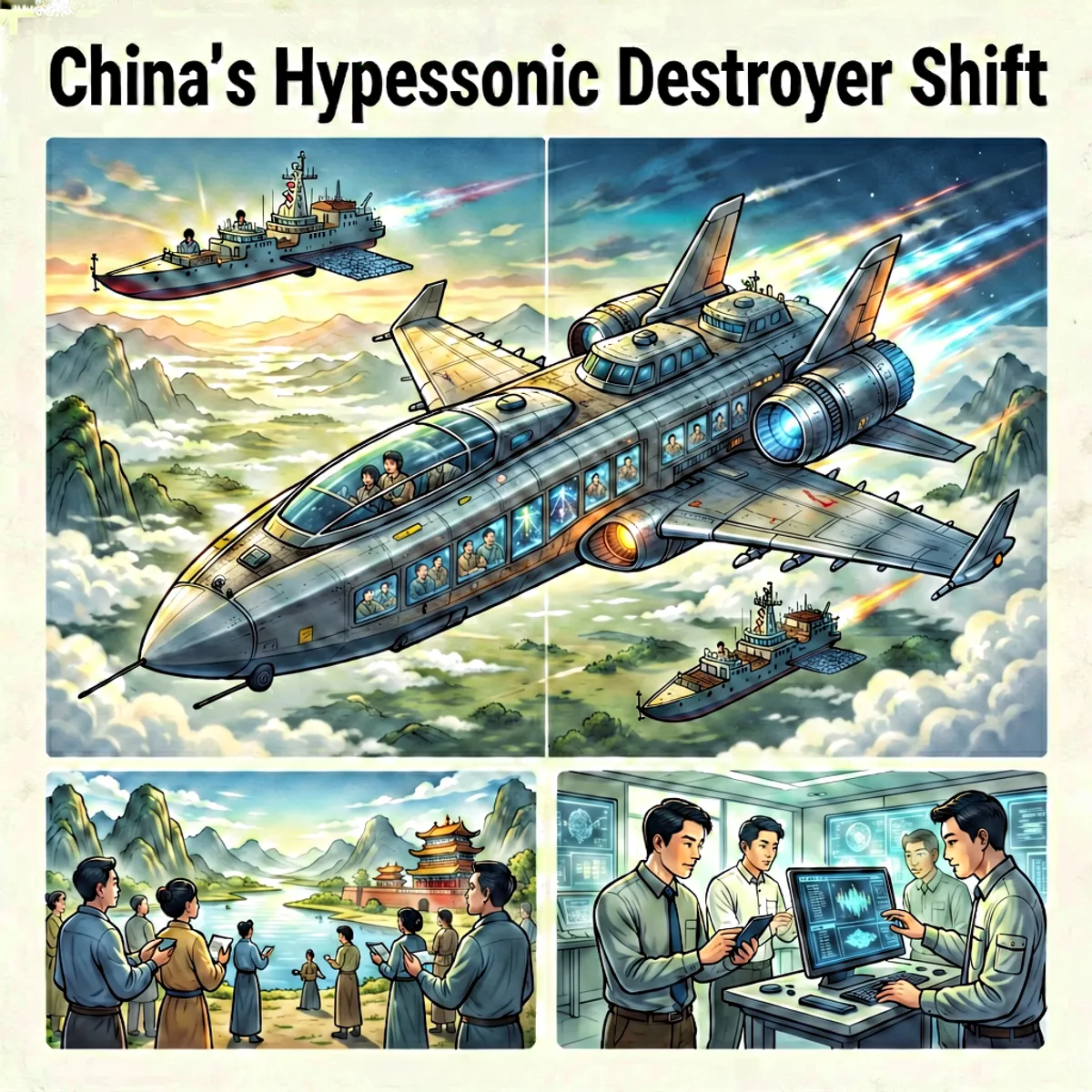
The Broader Naval Arms Race
A Response in Motion
This deployment does not occur in a vacuum. It is the latest step in a long-term, systematic effort by the PLA Navy (PLAN) to counter the technological and numerical advantage of the U.S. Navy.
The strategy has centered on developing "assassin's mace" weapons—systems that can inflict disproportionate damage on more advanced adversaries at long range. The DF-21D was the first such ASBM. The YJ-20, being smaller and ship-launched, offers greater operational flexibility and surprise.
The U.S. and its allies are responding. The Pentagon's 2026 budget and future force design documents consistently highlight the "pacing challenge" posed by China.
Programs like the development of the Conventional Prompt Global Strike (CPGS) capability and investments in directed-energy weapons for ship defense are direct responses to the hypersonic threat. Allies like Japan and Australia are also accelerating their own missile development and procurement, including acquiring long-range strike missiles for their destroyers and future frigates. The region is witnessing a silent but rapid buildup of long-range precision strike capabilities.
Beyond the First Island Chain
The operational reach of the YJ-20 extends far beyond the so-called "First Island Chain." Its 1,500 km range means a Type 052D operating from the Chinese coast could theoretically target naval forces throughout the South China Sea and deep into the Western Pacific, potentially covering areas around Taiwan and the Philippines. If deployed from forward bases in the Paracel or Spratly Islands, the threat bubble expands even further south and east. This fundamentally alters the geographic scope of any potential conflict, forcing U.S. and allied forces to operate from greater distances and with more caution.
It also strengthens China's ability to deny access to specific maritime zones. A fleet attempting to reinforce Taiwan, for instance, would need to navigate through a gauntlet of dispersed Chinese destroyers, each capable of launching a hypersonic missile. The risk calculus for a naval commander becomes significantly more perilous. This is the essence of A2/AD: not necessarily to win a head-on fleet battle, but to make the cost of entry and operation within a contested zone prohibitively high for an adversary.
Technical Nuances and Future Outlook
The Glide Phase Advantage
The boost-glide flight profile of the YJ-20 offers advantages over a purely ballistic trajectory. After the rocket booster burns out, the HGV glides at high altitude and speed. Its non-ballistic path makes it harder to distinguish from other objects in space during its mid-course phase, complicating early warning satellite tracking. In addition, the ability to maneuver means it can execute terminal "bunt" maneuvers—sudden changes in direction—to break the lock of a defending interceptor's radar or seeker.
Analysts will be watching for details on the HGV's control surfaces or thrust-vectoring capabilities. Can it perform sustained maneuvers, or only short corrections? What is its exact terminal speed and altitude profile?
Answers to these questions determine the required kinetic energy and guidance accuracy of an interceptor. The publicly available footage, while limited, shows a stable, controlled glide, indicating a sophisticated flight control system.
Integration and Saturation Attacks
The next logical step after initial deployment is full integration into the PLAN's networked combat system. The YJ-20's effectiveness depends on receiving accurate, real-time targeting data. This relies on a vast sensor network—over-the-horizon radars, maritime patrol aircraft, drones, and potentially satellites—to locate a moving carrier group at extreme range. The robustness and resilience of this "kill chain" under electronic warfare and attack will be a critical factor in the weapon's actual combat utility.
In addition, the proliferation of launchers enables the possibility of saturation attacks. A coordinated strike involving multiple Type 052Ds, each firing one or more YJ-20s, could overwhelm the defensive magazines of a carrier group. Even if some missiles are intercepted, a sufficient number might penetrate to achieve mission kill.
But, saturation attacks depend on more than just a numerical advantage in launchers. They require a coordinated, real-time targeting solution that can survive the opening phases of a conflict. The entire "kill chain"—from initial detection to final guidance—must function under intense electronic warfare and physical attack.
China's investment in a multi-domain sensor network, including land-based over-the-horizon radars, oceanic surveillance satellites, and long-endurance unmanned aerial vehicles, is explicitly designed to provide that persistent targeting picture. The resilience of this network, particularly its ability to operate in a degraded, contested electromagnetic environment, will ultimately determine whether a salvo of YJ-20s can be launched on accurate coordinates or if they are fired into a sensor-blank void.
The Defender's Dilemma: Counter-Hypersonic Efforts
The emergence of the YJ-20 on a widely deployed platform has accelerated allied research into hypersonic defense. The core challenge remains the same: detecting, tracking, and engaging an object moving at Mach 5+ with a maneuvering flight path. Current naval missile defense systems, like the RIM-161 Standard Missile 6 (SM-6), are optimized for traditional ballistic or cruise missile profiles. Their kinematic performance against a hypersonic glide vehicle is questionable, especially during the terminal phase where the target's energy and agility are highest.
The U.S. Navy's response is multi-pronged. The first layer is enhanced sensing.
Programs like the Hypersonic and Ballistic Tracking Space Sensor (HBTSS) aim to create a constellation of low-Earth orbit satellites capable of continuously tracking dim, high-speed objects. This space-based "tracking net" is intended to provide the early warning and mid-course guidance updates that terrestrial radars cannot, due to the Earth's curvature. The data would be fed to both shooters like AEGIS-equipped destroyers and potentially to interceptors in flight, allowing for course corrections.
A second layer involves entirely new interceptor designs. The Conventional Prompt Global Strike (CPGS) mission, while primarily a strike capability, has driven research into very-high-velocity projectiles. More directly, the U.S.
Army and Navy are co-developing the Glide Phase Interceptor (GPI), a missile specifically designed to engage HGVs during their unpowered glide phase. The GPI will require new seekers capable of locking onto a maneuvering target against a complex background and propulsion to achieve the necessary closing speed. Its deployment timeline is critical; until it and its integrated command and control are operationally ready, the gap in defense against weapons like the YJ-20 persists.
Allied nations are not idle. Japan has fast-tracked its own Hyper Velocity Gliding Projectile (HVGP) program for island defense and is exploring co-development of interceptors. Australia's investment in long-range strike missiles, such as the Naval Strike Missile for its Hobart-class destroyers and future general-purpose frigates, reflects a strategy of holding adversary assets at risk from stand-off ranges, a reciprocal form of A2/AD. The regional dynamic is shifting from a U.S.-centric security umbrella to a more distributed network of long-range precision strike capabilities, all responding in part to the proliferation of Chinese hypersonic systems.
The Human and Doctrinal Dimension
Integrating a weapon as strategically significant as the YJ-20 is not merely a technical exercise in mating a missile to a VLS. It demands profound changes in training, doctrine, and command philosophy for the PLAN. The missile's operational concept requires a different decision-making cycle.
Its extreme range means a Type 052D commander may have to launch based on intelligence or sensor data from a third party—a maritime patrol aircraft, a satellite, or a distant land-based radar—without having the target in their own ship's radar picture. This "remote engagement" capability places a premium on secure, high-bandwidth data links and trust in external targeting information.
In addition, the rules of engagement for a weapon that cannot be recalled once launched and travels for many minutes become critically important. A false positive or a shifting tactical situation could lead to a catastrophic escalation. The PLAN is undoubtedly conducting extensive simulation and live-fire exercises to work through these command and control (C2) challenges.
We can expect to see more publicized drills involving coordinated attacks from multiple Type 052Ds against a simulated carrier group, testing the synchronization of the kill chain from detection to impact. The 2026 annual defense white paper from any major power will likely have a dedicated section on the integration protocols for such strategic weapons.
The crew training pipeline must also adapt. While the vertical launch operation itself is similar to firing other missiles, the pre-launch planning—calculating the ballistic/glide trajectory, inputting target coordinates that may be hours old, and understanding the weapon's specific failure modes—is more complex. This knowledge is not just for the combat information center; it permeates the entire watchstanding team.
The psychological dimension of wielding a weapon that promises such a powerful, hard-to-defend strike also cannot be overlooked. It may embolden commanders or create an unrealistic expectation of invulnerability, a classic pitfall in military history when new technology is introduced.
Cost, Sustainability, and the Industrial Base
Deploying the YJ-20 across the Type 052D fleet has significant logistical and industrial implications. Each missile is an expensive, sophisticated piece of technology. While unit costs are not publicly known, they are certainly far higher than an anti-ship cruise missile like the YJ-18. Sustaining a high-readiness posture where dozens of destroyers are each carrying several of these missiles requires a robust and resilient production line and a secure, expensive stockpile.
This contrasts with the defensive dilemma it creates. For an adversary, building enough high-performance interceptors and space sensors to counter every potential YJ-20 launch tube is a colossal economic undertaking. The attacker needs only a finite number of launchers and missiles to pose a threat; the defender must protect against all possible axes of attack simultaneously.
This is the classic "offense-defense cost-exchange ratio" that favors the hypersonic attacker. China's state-owned defense industry, operating under a different economic model than Western private defense contractors, may be able to produce these missiles at a scale that further exacerbates this imbalance.
But, the PLAN's own sustainability is not infinite. The Type 052D, while numerous, is a complex, crew-intensive warship. Maintaining over 35 of them at high operational tempo, all configured for potential hypersonic strikes, strains personnel and maintenance cycles.
The newer Type 055, with its larger VLS capacity and more advanced sensors, will likely remain the primary bastion for the most sensitive strategic deterrence patrols, while the Type 052D provides the more numerous, distributed threat. This creates a tiered deployment strategy that optimizes the use of both ship classes.
The Evolving Battlespace: Beyond the Naval Duel
The YJ-20's impact reverberates beyond the immediate carrier-versus-destroyer scenario. It forces a re-evaluation of all high-value, mobile assets within its reach. This includes not just warships, but also major amphibious assault vessels carrying Marine Expeditionary Units, and potentially even large, slow-moving logistics ships supporting forward operations.
The traditional sanctuary of a well-defended logistics tail is eroded. Every major surface combatant and support vessel within the weapon's footprint must now factor the hypersonic threat into its routing, formation, and defensive posture.
This also affects air operations. Carrier air wings rely on the carrier group as a floating airbase. If the group itself is under constant, severe threat from hypersonic missiles, the operational radius and sortie generation rate of the air wing may be intentionally constrained to keep the carrier at a safer distance.
This indirectly reduces the air wing's effectiveness in supporting other fleet elements or conducting strikes inland. The YJ-20, therefore, is not just an anti-ship weapon; it is a tool for shaping the entire operational environment, pushing adversary forces back and creating temporal and spatial windows for other PLA actions, whether they be air, missile, or cyber.
The land-based component is equally crucial. The PLA Rocket Force's own hypersonic systems, like the DF-17, create a layered threat. A U.S.
or allied commander must now contend with a seamless threat gradient from the coast (DF-17), through the near seas (YJ-20 from Type 052D/055), and out into the blue water (potential future air-launched or submarine-launched hypersonics). This integrated system-of-systems approach is the maturation of China's A2/AD strategy, turning the Western Pacific into a heavily contested domain where freedom of navigation is not free, but paid for in constant risk mitigation and diluted combat power.
Looking Ahead to 2026 and Beyond
By 2026, the initial integration of the YJ-20 on the Type 052D will likely be complete for several ships, with full fleet rollout progressing. We will see more official PLA media showcasing these destroyers in "combat-ready" configurations, with missile canister covers open on VLS cells during at-sea replenishments or port visits—a clear signal of capability. The next observable milestone will be a live-fire test against a realistic, moving maritime target, possibly a decommissioned ship towed into a remote area. Such a test would be the ultimate proof of operational capability and would have profound geopolitical implications.
The technical race will also intensify. China is almost certainly researching successors to the YJ-20: perhaps a missile with even longer range, a more sophisticated HGV with greater maneuverability, or a two-stage boost-sustain-glide profile. They are also exploring hypersonic cruise missiles (HCMs), which use scramjet engines for sustained hypersonic flight within the atmosphere, presenting a different set of challenges.
The West's countermeasure programs—space sensors, GPI, directed energy—must not only counter the current threat but also anticipate these next generations. The stability of the region may increasingly depend on the relative pace of these parallel development and deployment cycles.
Ultimately, the YJ-20 on the Type 052D is more than a new weapon; it is a symbol of a new normal. It signifies the point where a long-theorized, strategically decisive anti-ship ballistic missile capability has matured from a bespoke system on a handful of elite platforms to a fleet-wide, operational asset. This normalization of hypersonic strike at sea compresses decision times, raises the stakes of any crisis, and makes the calculus of deterrence and escalation in the Western Pacific more precarious than at any point in recent history. The battlespace has expanded vertically into the hypersonic regime and horizontally across a vast maritime expanse, and all major naval powers are now scrambling to adapt.
Conclusion: A New Normal in Naval Warfare
The public confirmation of the YJ-20's deployment on the Type 052D destroyer is more than a technical footnote. It signifies the maturation of a key component of China's A2/AD strategy and its dissemination to a major, numerous warship class. The strategic effect is a dramatic expansion of the long-range hypersonic anti-ship threat across the PLA Navy's most active surface combatants.
For regional navies, particularly the U.S. Seventh Fleet, it necessitates a reevaluation of operational tactics, defensive postures, and force design. The era where hypersonic sea-skimming threats were confined to a few specialized platforms is ending.
A new normal is emerging, where a large fleet of modern destroyers can launch a coordinated hypersonic assault from multiple directions, challenging the foundations of carrier-centric naval power projection in the Western Pacific. The response will shape naval developments for the remainder of this decade and beyond.
Responses • 0
0/2000
ID: 1326
Chris
Offline
39 min
Visited
From
Bakersfield, United States
Send Message