China's Comfort vs Europe's Grind: A Family's DecadeLong Test
AI Learn Chinese
4 hr • 0 read
A familys decade of comfort in China meets the harsh grind of European life. Is their education investment worth the endless struggle? A candid personal reassessment.
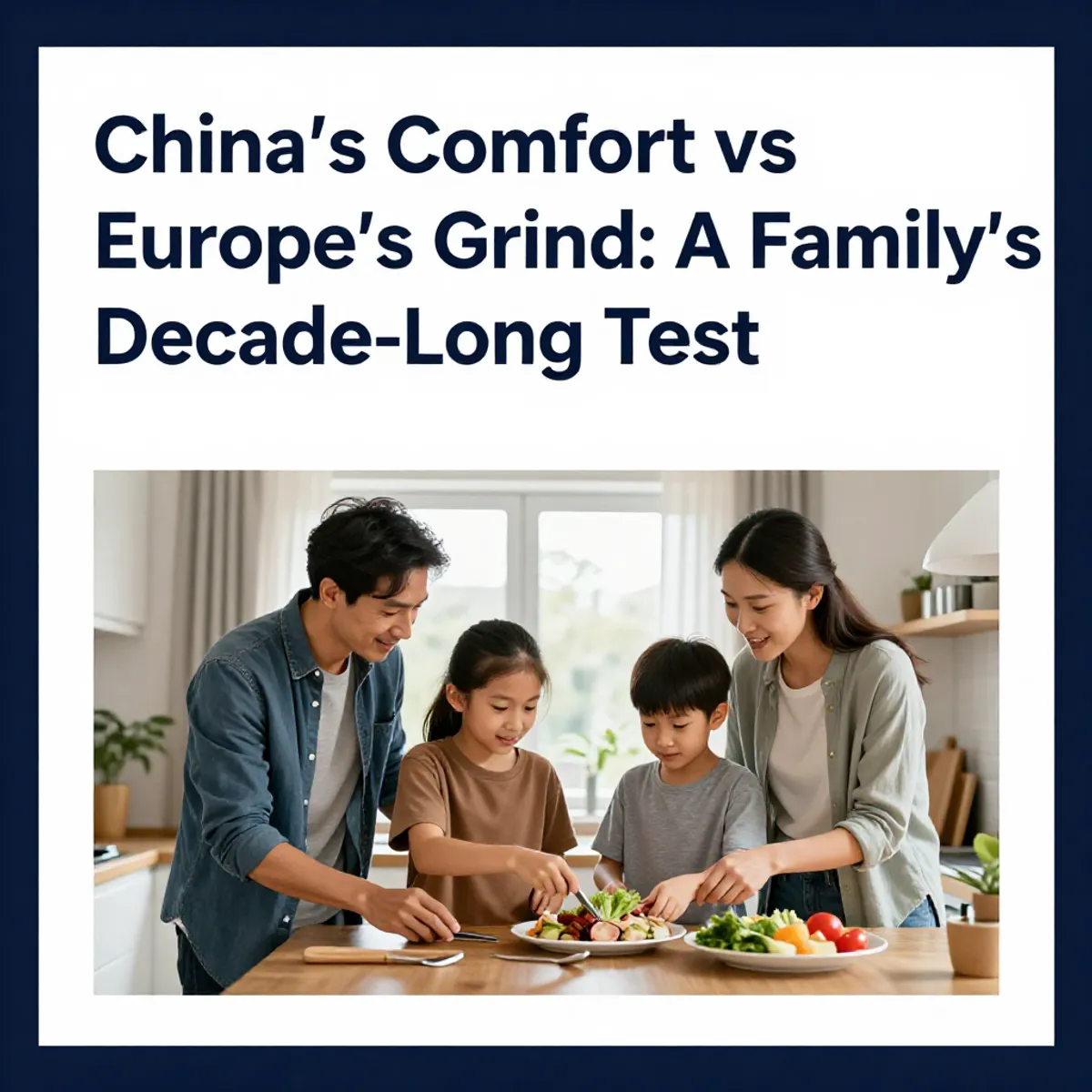
Introduction: A Crossroads of Memory and Reality
The decision to leave China a decade ago felt like a step toward a promised future. We were returning to Europe, the continent of our roots, for one primary reason: to provide our children with the education system we believed was superior. Our son was two years old when we boarded the plane, his childhood in China a fleeting, formative memory.
Now, ten years later in 2026, we have two children. The promised land feels more like a burden. A recent summer trip back to China served as a startling, visceral reminder of a life that felt easier, richer, and moreSupported.
The ghost of that past is now haunting our present, forcing a brutal reevaluation of what "better" truly means for our family.
This is not a simple tale of East versus West. It is a granular account of daily logistics, financial pressures, and social infrastructure. It is about the weight of a grocery bill, the availability of a pediatrician, and the feel of a public park.
Our experience challenges the assumption that a European passport automatically grants a higher quality of life. The narrative begins with the idyllic, pragmatic reality of urban Chinese life, contrasts it with the unforeseen hardships of our European return, and culminates in the agonizing question sparked by a summer's journey: should we go back?
The Allure of the Chinese Metropolis: A Decade of Ease
Life in the System: Efficiency as a Cornerstone
Living in a major Chinese city from 2011 to 2021 was an immersion in a society engineered for density and convenience. The infrastructure was not just modern; it was aggressively functional. High-speed rail connected us to the entire country in hours.
Subway systems were clean, frequent, and affordable. Supermarkets and wet markets were abundant, offering fresh produce at prices that felt like a gift. The sheer volume of services—from 24-hour pharmacies to ubiquitous food delivery apps—created a baseline of convenience that became invisible, like oxygen.
We never owned a car; we never needed one. The city moved for us, and we moved with it.
This efficiency extended to the social realm. Hukou, the household registration system, while complex, provided a clear, if sometimes rigid, framework for accessing local services. For us as registered residents, this meant straightforward enrollment in public schools and access to community healthcare clinics.
The cost of living, relative to our European hometown, was remarkably low. Rent for a spacious apartment in a good district was a fraction of what we now pay for a modest house. Domestic help, like an ayi for cleaning or childcare, was not a luxury but a common, affordable reality for dual-income families.
Life was not just busy; it was supported.
The Social Fabric: Community and Child-Rearing
The social environment was uniquely tailored to family life with young children. Public parks were not afterthoughts; they were major investments, filled with intricate, safe playgrounds, shaded walking paths, and spaces for tai chi or dancing. Grandparents were a visible, integral part of the childcare ecosystem, often living nearby or even in the same building.
This multi-generational proximity was a silent support network. The collective attitude toward children meant they were welcomed everywhere—restaurants, shops, public transport. There was a palpable sense that raising the next generation was a communal, not purely private, endeavor.
Our son grew up bilingual, his Chinese native and his English maintained through an international preschool. The cultural duality was seamless. He celebrated Mid-Autumn Festival with mooncakes and Halloween with candy.
This was not a curated expat experience; it was our ordinary life. The financial freedom afforded by the lower living costs meant we could save, travel domestically every school break, and still have a robust social life involving dinners out and weekend excursions. The stress we felt was the normal stress of careers and parenting, not the gnawing anxiety of making ends meet.
We were, by all measurable metrics, living well.
The Great Return: Confronting a Changed Europe
The Cost of Living Abyss
Our return to Europe in 2021 was framed as a homecoming, but it felt like arriving in a different, more expensive country. The first shock was housing. The concept of paying over 40% of our combined income for a mortgage on a home smaller than our Chinese apartment was staggering.
Property taxes, maintenance fees, and utility costs were an endless drain. In China, our housing costs consumed about 20% of our income. The difference was not a margin; it was a chasm that defined every other financial decision.
Everyday expenses compounded the shock. Groceries, particularly fresh meat, dairy, and organic produce, carried a premium that made meal planning a strategic exercise rather than a pleasure. Fuel and car ownership are non-negotiable in our sprawling European town, adding a fixed, heavy monthly burden.
The "convenience tax" is everywhere. Wanting a simple repair, a quick delivery, or even a taxi that arrives promptly often meant paying a premium for services that felt sluggish and scarce compared to China's hyper-competitive market. Our disposable income vanished, replaced by a spreadsheet of mandatory outgoings.
The financial ease we had taken for granted was gone, replaced by a constant, low-grade calculation of affordability.
Infrastructure and Public Service Erosion
The infrastructure we returned to was, in many critical areas, a relic. The public transport network is infrequent, with buses often hourly and trains subject to frequent strikes and delays. The roads are riddled with potholes and perpetually under repair.
Our local pediatric clinic has a waiting list of several weeks for non-emergency appointments. To see a specialist, the wait can be months. This is not an anomaly; it is the standard operating procedure.
The NHS-style system we idealized is groaning under the weight of underfunding and demand, a stark contrast to the walk-in clinics of China where, for a small fee, you could see a doctor the same day.
The facilities for children are another point of painful contrast. The local playground is a single, aging structure in a patch of cracked asphalt. It is a world away from the sensory-rich, innovative designs we remembered in China.
After-school activities are prohibitively expensive. A weekly music lesson or sports club can cost as much as our monthly grocery budget. The communal, public investment in spaces and services for families feels minimal, as if child-rearing is entirely a private cost to be borne by parents.
The societal message is clear: you are on your own.
The Summer Catalyst: Visiting the Life We Left
The Sensory Overload of "Easy"
Returning to China for a summer holiday was not a tourist visit; it was a plunge back into a living, breathing system that worked. The moment we stepped into the airport, the efficiency was palpable. From seamless mobile payment systems (we used our foreign phones with some hiccups, but locals moved at light speed) to the sheer volume of people moving with purpose, the energy was one of capability, not constraint.
The cost of living hit us first: a lavish meal for four at a fantastic restaurant cost what we would spend on two mediocre pizzas at home. A taxi ride across the city was less than the price of a single tank of fuel.
But it was the mundane ease that undid us. Ordering anything, from furniture to groceries to a plumber, was a matter of minutes on an app. The delivery would arrive, often within the hour, with a smile and a call.
We watched our ten-year-old, who barely remembers China, navigate purchase transactions on her own using QR codes. Her autonomy was a given. The public spaces were spectacular, clean, and buzzing with activity.
We took our children to museums, aquariums, and parks, all impeccably maintained and either free or costing pennies. The constant, low-grade friction of life in Europe—the planning, the waiting, the premium pricing—was simply absent. We weren't on vacation; we were experiencing a baseline of existence that felt, frankly, wealthier in quality of life despite not having a European salary.
The Bitter Pill of Comparison
The most difficult part of the trip was the silent conversation between my spouse and me. We would look at our children laughing on a free, brilliant playground and then think of the argument we'd had that morning about whether we could afford the local swimming pool membership. We'd eat a delicious, affordable dinner and remember scraping together coins to buy our son an ice cream the week before.
The trip highlighted what economists call "non-monetary income"—the time saved, the stress avoided, the access granted. In China, we had time. We had access.
We had a social infrastructure that absorbed the shocks of daily life.
Our children, while enjoying the holiday, also voiced small observations. "Dad, why is everything here so cheap?" "Mom, why are there so many fun things to do that don't cost money?" They were noticing the disparity in real-time. They were experiencing a version of childhood where their desires and activities were not constantly mediated by a price tag.
The trip didn't just remind us of a past; it showed us a present that was, for our specific family constellation, demonstrably easier. The ghost we had left behind was, in many tangible ways, a better host.
The Education Equation: Reassessing the Core Premise
The European Promise: Critical Thinking and Autonomy
We must defend the premise that brought us here. The European education system, particularly at the secondary level, is renowned for fostering critical thinking, creativity, and personal autonomy. The pedagogy encourages debate, independent research, and project-based learning.
There is less rote memorization and more emphasis on developing a reasoned argument. For our children, this approach aims to build resilient, innovative thinkers. The university system, while now costly in the UK, still holds global prestige for its depth and research orientation.
This was, and remains, a powerful argument for enduring the present difficulties.
In addition, the language itself is a monumental asset. Our children are native English speakers. This linguistic capital is a permanent, invaluable tool for global mobility in academia and business.
It is a door-opener that we, as their parents, wanted to guarantee for them. The cultural capital of a European upbringing—the exposure to classical music, art history, and a certain canon of literature—is also part of the intangible package. We believed, and still partly believe, that this combination of critical thought and linguistic fluency was worth the financial and logistical sacrifice.
The Chinese Reality: Academic Rigor and High-Stakes Pressure
What we left behind was the legendary academic rigor of the Chinese system, particularly from primary school onward. The focus on discipline, mastery of core subjects (mathematics, science, Chinese language), and sheer volume of practice produces students with formidable foundational knowledge. The gaokao, the national university entrance exam, is a brutal, meritocratic filter that, for all its pressure, can be a ladder for social mobility. The culture of respect for teachers and the value placed on education as a family project is intense and all-consuming.
But, we also left the extreme pressure. The "involution" (neijuan) of the education system, where competition starts in preschool and burnout is common, was a significant factor in our decision to leave. We saw friends' children burdened with hours of homework and weekend tutoring, their childhoods structured around exam preparation.
The creativity and play we valued were often secondary. The system excels at producing top-tier exam-takers but can stifle the very divergent thinking prized in the West. Our choice was a trade-off: we accepted a potentially less academically pressurized early environment for the promised, more holistic European outcome.
The Recalculation: Is the Trade-Off Still Valid?
Our recent trip forces a recalculation. We are now incurring the severe financial and logistical costs of European life while our children are in the local system. We are not receiving the "European education premium" in a vacuum; we are paying a massive deficit to access it.
The question becomes: is the quality of the education we are receiving so superior that it justifies the diminished quality of our overall family life? Our children are happy, well-adjusted, and learning. But are they learning in an environment that is so transcendentally better that it outweighs the stress we carry, the limited family time due to long work hours needed to pay bills, and the reduced access to enriching activities?
We must also consider the global landscape of 2026. The value of an English-language degree from a European university remains high, but is it a golden ticket? The world is multipolar.
China's top universities are climbing global rankings. The economic and technological influence of China is undeniable. Our children's future may be served as much by Mandarin fluency and a nuanced understanding of Chinese culture as by perfect English and European history.
By prioritizing the European system, are we inadvertently closing doors? The education question is no longer just about pedagogy; it is about strategic positioning in a changing world, and our current location feels strategically disadvantaged on multiple fronts.
The Infrastructure of Daily Life: A Point-by-Point Contrast
Healthcare: Access vs. Affordability
In China, we had a public health insurance card that covered a significant portion of costs at local clinics. For a serious issue, we could opt for a high-quality private hospital for a reasonable out-of-pocket fee. The system was transactional and fast.
In Europe, we have comprehensive insurance, but the gatekeeping is severe. Access to a general practitioner is the first bottleneck, followed by specialist referrals and then waiting lists for diagnostics and procedures. The system is designed for equity but suffers from extreme rationing by time.
The "free" at the point of use comes at the cost of time and, often, the need to pay for private care to circumvent queues. For a family with two children prone to ear infections and the occasional fracture, this is not an academic debate; it is a weekly source of anxiety about where and when we can get treatment.
Childcare and Family Support: The Invisible Network
The Chinese model relied heavily on the extended family and affordable domestic help. Grandparents provided daily care, reducing the need for expensive formal daycare. When we did use it, the cost was a fraction of European prices.
Now, formal childcare is a major household expense, often consuming the income of one parent. There is no meaningful state support to offset this. The societal expectation is that parents, particularly mothers, will either drastically scale back careers or incur crippling costs.
The "village" it takes to raise a child feels privatized and monetized. The lack of a grandparent network in Europe, combined with the high cost of its substitutes, is a relentless pressure on our finances and our careers.
Urban Planning: Density vs. Sprawl
Chinese cities are built for people, not cars. Mixed-use developments mean shops, cafes, services, and parks are within a 10-15 minute walk. This walkability fosters community, reduces transport costs, and promotes incidental exercise.
Our European town is a classic sprawl. Separated residential zones from commercial ones make every errand a car trip. The lack of density means public transport is inefficient and infrequent.
The design actively discourages the spontaneous, community-oriented life we enjoyed. Children cannot walk to school or friends' houses safely; it requires parental chauffering. This spatial separation fragments social life and adds immense hidden costs in time and fuel.
The Human Cost: Measuring Strain on the Family Unit
The Financial Anxiety Threshold
We have crossed a financial anxiety threshold. In China, our financial decisions were about optimization: saving for a bigger apartment, a nicer holiday. In Europe, our decisions are about survival and avoidance of debt.
The mental bandwidth consumed by budgeting, comparing prices, and worrying about unexpected expenses (a broken boiler, a dental bill) is constant. This is not the productive stress of a challenging job; it is the draining stress of scarcity. It affects our mood, our patience with the children, and our long-term planning.
We have no meaningful emergency fund. Our retirement savings are stagnant. The promise of a secure future feels like a distant mirage.
This financial strain directly impacts family time. Both parents must work longer hours or take on secondary jobs to maintain our standard of living. The evenings and weekends are filled with chores, meal prep from scratch (to save money), and exhausted recovery.
The spontaneous family outings, the leisurely dinners with friends, the ability to say "yes" to a child's request for a activity or a treat—these have been systematically edited out of our life script. We are present in body but often absent in spirit, preoccupied with the ledger. The trade-off we made for education feels like we are trading our present happiness and family cohesion for a hypothetical, uncertain future benefit.
The Children's Experience: Richness vs. Restriction
Our children are not suffering. They are safe, loved, and have access to a good, free school. But their experience is narrower.
Their world is smaller, bounded by our car's range and our budget. The vast array of extracurriculars—calligraphy, martial arts, robotics clubs, swimming lessons—that were affordable and abundant are now rare treats. The social world is also different.
The dense, walkable neighborhoods of China meant constant, unsupervised play with neighborhood kids. Here, playdates are scheduled events between parents, another logistical task. The freedom we thought we were giving them through a "better" education feels, in practice, like a more restricted childhood.
We are not sure the trade-off is fair to them.
The Pull of the Familiar: Why China Still Beckons
The Tangible Metrics of a "Well" Life
When we analyze it coldly, the metrics point east. Well is a word that encapsulates it. In China, we lived well.
Our income went further. Our time was our own. Our children had space, stimulation, and support.
The infrastructure served us. The social fabric, while different, was woven tightly around family life. The "con" list from our Chinese years mostly revolves around air pollution (a serious issue), the gaokao pressure looming in the future, and the political environment we chose to distance ourselves from.
The "pro" list is a daily, tangible reality of convenience, affordability, and community.
The political and environmental concerns are real but abstract in daily life for a family focused on the immediate. The pollution, while bad in winter, was manageable with air purifiers and was seasonal. The lack of political freedoms did not impinge on our daily routines as expatriates living in a bubble of international life.
The gaokao pressure was a future problem, not a present one for primary school children. Conversely, the European "pros"—rule of law, political stability, clean air—are abstract benefits that we enjoy in theory while feeling their negative consequences (austerity-driven public service decline) in practice every single day.
The Reconnection with a Global Hub
China in 2026 is not the country we left. It is more technologically advanced, more confident, and more globally connected than ever. The cities are cleaner, greener, and offer a cultural dynamism that is palpable.
The opportunity to be part of that growth, to have our children be truly bilingual and bicultural in the world's next superpower, is a compelling narrative. It is not a retreat; it is a strategic positioning. The professional networks, the business opportunities, the sheer momentum of the place is something we feel viscerally when we visit.
We are not considering moving back to the China of 2010; we are considering moving to the China of 2026, a different and, in many ways, more formidable and attractive proposition.
The Deciding Factors: Weighing the Unweighable
The Education Verdict in Practice
The central pillar of our move—education—must be stress-tested against the new context. If we return to China, we would likely opt for an international school to maintain English-language instruction and a Western pedagogical style, avoiding the gaokao gauntlet. This is a significant expense, but within the Chinese cost structure, it is feasible without sacrificing overall family lifestyle.
We could have the "international school" benefit (which many European families also seek) plus the Chinese cost-of-living and infrastructure benefits. We could, in essence, have the best of both worlds we originally sought: a global education within a highly supportive, affordable daily life.
Staying in Europe means accepting the high cost for a local education that, while good, may not offer a unique global advantage over an international school in Shanghai or Shenzhen. We are paying a European premium for a product that, in our specific value equation (balancing holistic development, future opportunities, and immediate family well-being), may not offer a commensurate return. The calculus has fundamentally shifted. The education system is no longer a standalone benefit; it is a factor in a complex equation where the other factors (cost of living, infrastructure, family stress) have become overwhelmingly negative.
The Quality of Life Synthesis
The synthesis is this: in China, we had a high quality of life on a middle-income budget. In Europe, we have a middle-quality of life on a high-income budget (and we are not even high-income by local standards). The margin for error, for enjoyment, for saving, is gone.
The "European dream" we returned to feels like a austerity model for the middle class. The social contract has been broken, with public services degraded and the burden shifted to the individual. Our children's childhood is being shaped by our financial anxiety and logistical struggles more than by the pedagogical philosophy of their school.
The foundational premise that a European life is inherently "better" for a family has collapsed under the weight of our lived experience.
Conclusion: The Uncomfortable Reckoning
The summer trip did not provide an answer; it clarified the question. We are not comparing two abstract systems. We are comparing two versions of our own family's life: one characterized by ease, abundance, and supported daily functioning, and another characterized by strain, scarcity, and relentless logistical friction.
The original justification—superior education—now feels like a single, expensive variable in a much larger equation of overall well-being. That variable may not be valuable enough to justify the massive deficits in every other category.
The thought of moving back to China is no longer a nostalgic daydream. It is a serious, pragmatic consideration for 2026 and beyond. It involves navigating visa complexities, job searches, and reintegration.
But the alternative is a continued erosion of our family's financial health, our mental peace, and our ability to enjoy our children's childhoods. We left a comfortable, supported life for an ideal. We found the ideal to be a mirage, shimmering over a landscape of unexpected hardship.
The path back may be complicated, but the destination—a life that simply works for us—now seems not just desirable, but essential. The ghost of our past in China has become a blueprint for our possible future.
Responses • 0
0/2000
ID: 1326
Chris
Offline
26 min
Visited
From
Bakersfield, United States
Send Message